


The Counterintuitive Fact at the Centre of It
For the first half of the twentieth century, cars were built to resist damage. A heavy chassis, thick steel, rigid construction. After a collision such a car could sometimes be straightened and driven away, which looked like the obvious definition of a safe vehicle.
It was close to the opposite. A rigid car that hits a wall and does not deform has to get rid of all its motion in the distance over which the wall gives way, which is almost none. The car stops in a few centimetres. The occupants, who are not attached to the structure in any meaningful way in an older vehicle, continue at the original speed until they meet something, and when they do, they stop in an even shorter distance against a hard dashboard, a rigid steering column or the road outside.
The insight that reorganised the whole field is that the dangerous quantity is not the force of the impact, the speed, or the damage to the vehicle. It is the rate at which a human body’s velocity changes. A body can tolerate a surprisingly violent change in speed if that change is spread over enough time, and it cannot tolerate even a modest one delivered instantly.
Everything that followed is a consequence of that single reframing. The car’s job stopped being to survive and became to take as long as possible to stop.
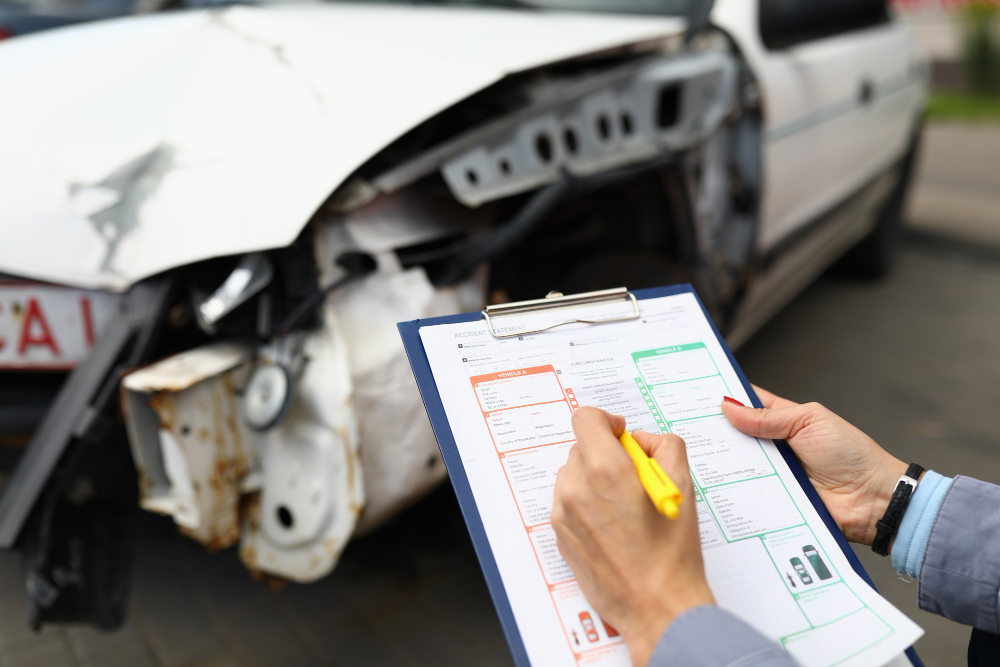
Which means the car has to be destroyed, deliberately, in a controlled sequence, and the amount of visible damage after a serious collision is not a measure of failure. It is a measure of how much work the structure did.
Like our content? Follow us for more.
Why Time Is the Only Thing That Helps

Consider what has to happen. A vehicle moving at speed has a certain amount of energy by virtue of its motion, and after the collision it has none. That energy has to go somewhere, and the only places available are deformation of metal, heat, sound and the movement of whatever it hit.
The total amount is fixed by the speed and the mass, and nothing in the design can reduce it. What the design can change is how long the process takes.
If a car stops in five centimetres, the deceleration is brutal. If the same car stops in seventy centimetres, the average deceleration is roughly a fourteenth of what it was, because the energy is being absorbed over fourteen times the distance. The occupant experiences a correspondingly gentler change in speed.
Seventy centimetres does not sound like much, and the time involved is a fraction of a tenth of a second either way. But the difference between those two numbers is routinely the difference between walking away and not, because human tolerance has a threshold and the design is trying to stay underneath it.
So the front of a car is, functionally, a distance budget. Every centimetre of it that can be made to collapse in a controlled way, rather than transmitting the load straight through, buys time. That is the entire purpose of the space between the front bumper and the base of the windscreen.
What a Crumple Zone Actually Is
It is not soft material and it is not padding. Padding would be useless; it has no capacity to absorb the quantities of energy involved.
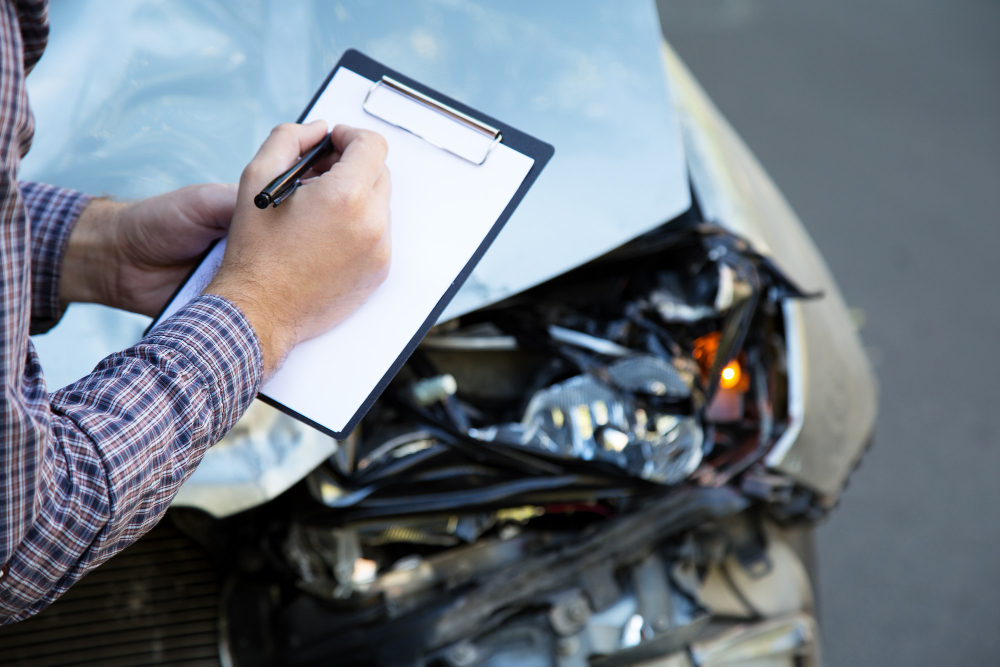
A crumple zone is a steel structure designed to fold up in a predetermined pattern. The metal is deliberately weakened at specific points, with grooves, holes, changes in thickness and changes in section, so that when it is loaded along its length it buckles where the designer intended rather than wherever it happens to be weakest.
The result is something closer to a concertina than to a collapse. Each fold absorbs energy by bending steel permanently, and bending steel takes a great deal of energy. The structure is engineered so that the folds occur in sequence, front to back, at a roughly constant resistance. A constant resistance is what produces a constant deceleration, and a constant deceleration is the gentlest possible way to stop something in a given distance.
Different materials are used in different places for the same reason. Some sections are high-strength steel that resists until a threshold and then folds; others are softer steel that begins deforming immediately; some components are designed to shear or tear rather than buckle. Aluminium and composite elements behave differently again. The structure is a composition of materials chosen for how they fail, not for how strong they are.
That is the phrase worth holding on to. In this part of a car, the engineering specification is a failure specification.
And the Cabin Is the Exact Opposite

The two halves of the design are in direct opposition, and that opposition is the whole architecture.
The occupant compartment must not deform. If it collapses, the space the occupants need in order to decelerate over any distance at all disappears, and no amount of crumpling at the front will help. So the cabin is built as a rigid cage of very high-strength steels, with reinforced pillars, a reinforced roof, heavy sills, a stiff floor structure and beams inside the doors.
The transition between the two is the part that requires the most care. The crushable structure has to collapse completely and then hand off the remaining load to a cage that does not, and the join between them has to transfer enormous forces without tearing. The loads are routed deliberately into multiple paths, so that a collision at the corner of the car is fed into several members rather than concentrated into one.
This also explains a feature that looks like negligence and is not: the engine. In a serious frontal impact the engine and gearbox, which are extremely rigid and heavy and cannot usefully be crushed, are deliberately directed downwards and under the floor rather than backwards into the cabin. The mountings and the subframe are designed to let it go that way. A component that cannot be absorbed is instead aimed somewhere harmless.
The steering column is treated the same way. It is built to collapse or to move away rather than to be driven through the cabin, which was one of the single largest causes of serious injury in older vehicles.
Why Modern Cars Look So Badly Damaged

A common complaint is that cars are made of tinfoil now, because a low-speed knock produces a bill that would once have bought the car. There is something real behind the complaint and it is not what people think.
The front structure is tuned to begin absorbing at a particular load. Below that threshold it should not deform at all, which is why there are separate crushable elements behind the bumper intended to take minor impacts and be replaced. Above it, the main structure starts folding, and once it has folded it has done its job and cannot do it again. It is a single-use device, like a fuse.
So a collision serious enough to deform the main structure writes off components that cannot be straightened, because straightening steel that has been deliberately weakened and then folded does not restore its designed collapse behaviour. The repair is a replacement, and the replacement is structural.
Meanwhile the same collision in a rigid older car might have bent a wing and a bumper and left a repairable vehicle, while delivering a deceleration to the occupants that the modern car would not have.
The trade is explicit and it was made on purpose: the car is the consumable item. A structure that absorbs energy by being destroyed cannot also be a structure that survives, and the choice between protecting the vehicle and protecting the people in it was settled a long time ago.
The Belt and the Bag Are Doing the Same Arithmetic

Slowing the car down over a greater distance is only half the problem. The occupant is a separate object travelling at the same speed, and if they are not connected to the structure they will not benefit from any of it.
A belt’s job is to couple the body to the decelerating car so that the body decelerates with it rather than continuing until it meets the interior. It spreads the load across the strongest available parts of the skeleton rather than the soft parts, which is why the geometry of where it crosses the body matters so much.
But a belt that simply held the body rigidly would transmit the car’s deceleration directly. So belts include a device that pays out a controlled length of webbing under high load, letting the body move forward slightly further and therefore decelerate over a longer distance. That is the same trick again, applied to the body instead of the car: buy distance, gain time.
An airbag is also a distance device rather than a cushion. It inflates in order to be already in position, and then it deflates through vents as the body presses into it, so that the body is decelerated progressively over the depth of the bag rather than stopped by it. A bag that stayed inflated would be a hard object. The venting is the function.
This is why the two are designed as one system and why the bag is calibrated on the assumption that the belt is in use. They are two stages of a single sequence intended to stretch one tenth of a second into something a body can survive.
The Things Designed to Break

Once you know the principle, a car becomes legible as a collection of components intended to fail in specified ways.
The bonnet is designed to buckle upward in the middle rather than fold back towards the windscreen, and on many vehicles it is designed with clearance beneath it so that a pedestrian striking it meets a deformable panel rather than a solid engine. Some have mechanisms to lift the rear of the bonnet on impact in order to create that gap.
The pedals are designed to detach or move away from the driver’s feet. The seats and their mountings are designed to resist specific loads and then yield. Glass is laminated so that it holds together as a sheet instead of leaving the aperture, or toughened so that it breaks into fragments without long edges.
And outside the vehicle, the same logic appears everywhere once you look for it. Lighting columns are designed to shear off at the base rather than stop a car dead. Barriers are designed to deform and to redirect rather than to stand firm. Sign posts, bollards and gantry supports are all, in their various ways, choosing between being strong and being survivable.
Everything along a modern road has been quietly rebuilt around the realisation that nothing should bring a moving object to a sudden halt if it can be made to bring it to a gradual one instead.
Why Two Cars Are Never Equal
One consequence of the physics is uncomfortable and is worth stating plainly, because it is frequently misunderstood.
In a collision between two vehicles of very different mass, the heavier one experiences a smaller change in velocity and the lighter one a larger change, regardless of how well either is designed. Both vehicles may have excellent structures, and the occupants of the lighter one will still experience a more severe deceleration. The structural design determines how well each vehicle manages its own share; it does not change how that share is divided.
There is a second asymmetry about height and structural geometry. Energy-absorbing structures only work if they meet each other. Two vehicles whose main members are at different heights can pass each other’s crushable structure entirely, with one loading the other somewhere it was never designed to be loaded, and the available absorbing distance is simply not used.
This is why a great deal of engineering attention goes into where the main members sit rather than only how well they crush, and why comparisons between vehicles of different classes are not straightforward.
None of which changes the underlying point, which remains the single most counterintuitive idea in the field. A car that absorbs a serious collision and is destroyed in the process has worked exactly as intended. The wreck is the evidence that the energy went into the steel instead of into the people, and a car that came out of the same collision looking fine would have put it somewhere else.
Like our content? Follow us for more.
