


The ear is usually described as a funnel with a nerve at the end of it, which makes hearing sound like a straightforward matter of collecting sound and passing it on. It is nothing of the sort. Four distinct physical problems have to be solved in sequence, each with its own piece of hardware, and the reason hearing loss is generally permanent is buried in the last one.
The Outer Ear Is Not Just a Funnel
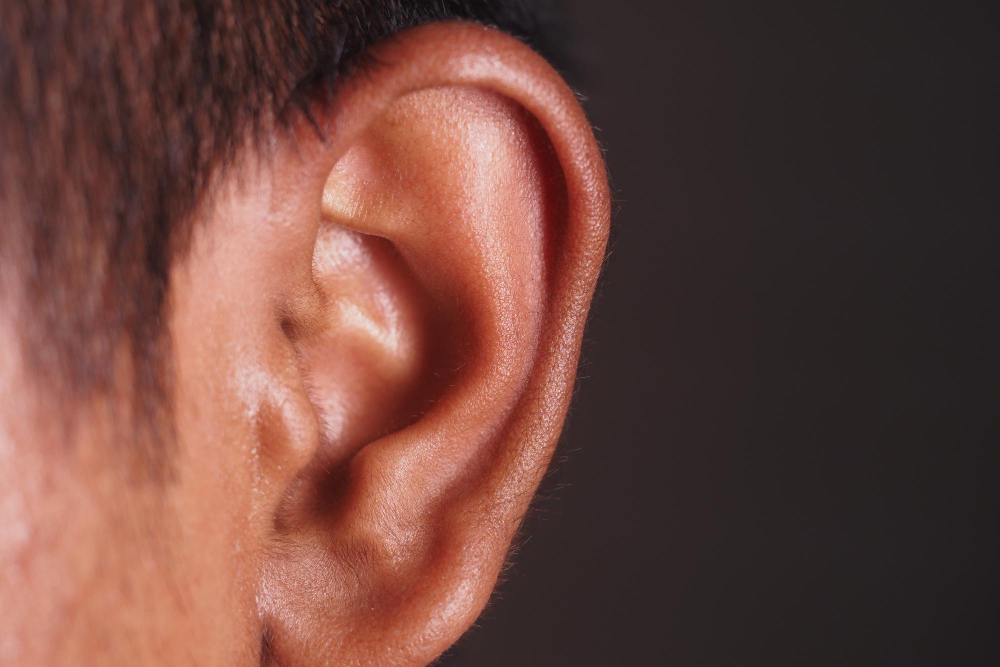
The visible part of the ear, the folded cartilage flap, does more than gather sound. Its ridges and hollows are not decorative: they reflect and delay incoming sound in ways that depend on the direction it came from, subtly colouring the sound before it reaches the canal.
Your brain uses that colouring. Working out whether a sound came from above, below, in front or behind cannot be done by comparing the two ears, because a sound directly above you arrives at both simultaneously and at equal volume. The only information available is the filtering imposed by the shape of the ear itself, and the brain learns each individual’s particular filtering during development.
This is why recordings played through headphones tend to sound as though they are inside your head. The sound bypassed the shape that would have told you where it came from.
The canal itself is doing something less obvious. It is not straight: it curves, which means nothing can travel down it in a straight line to reach the membrane at the end, and its walls migrate outward continuously, carrying debris toward the opening. The most delicate part of the whole system is at the end of a bent, self-clearing tunnel, and that placement is the reason it survives a lifetime of exposure to a world full of dust and insects.
Like our content? Follow us for more.
The Eardrum Solves an Impedance Problem
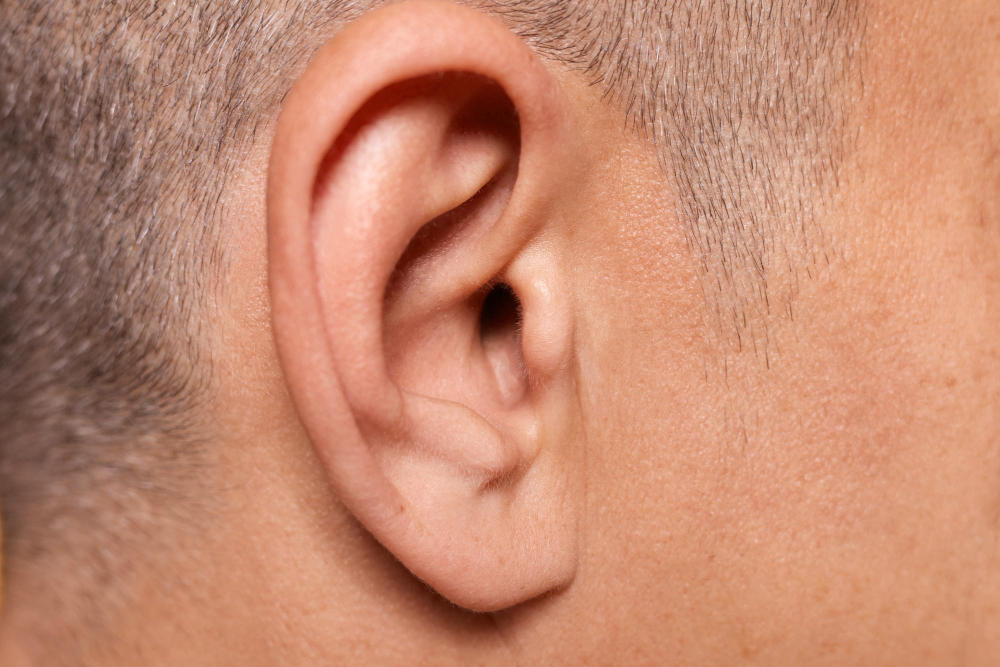
At the end of the canal is a thin membrane, and its job is the first hard one.
Sound in air is a low-pressure, high-movement phenomenon. Sound in liquid is the reverse: high pressure, very little movement. Air and water are badly matched, which is why you hear almost nothing of the outside world when your head is underwater – the sound is reflected off the surface rather than entering.
The inner ear is full of fluid. So sound arriving in air has to be converted into sound in liquid, and doing that naively would lose almost all of it. The middle ear exists entirely to prevent that loss.
It works two ways. The eardrum has a surface area roughly twenty times larger than the small window it eventually pushes against, and concentrating the same force onto a smaller area multiplies the pressure. Then the three bones between them are arranged as a lever, which multiplies it again by a smaller factor.
Together these recover most of what would otherwise be lost at the boundary. It is a mechanical transformer, and without it you would be severely deaf in air while hearing perfectly well underwater.
Three Bones, Two of Which Have Muscles

The ossicles – hammer, anvil and stirrup, to use the old names – are the smallest bones in the body, and the stirrup is smaller than a grain of rice.
They are not simply a rigid linkage. Two tiny muscles attach to them, and they contract in response to loud sound, stiffening the chain and reducing how much energy it transmits. This is the acoustic reflex, and it provides a measure of protection.
It has two important limitations. It takes tens of milliseconds to engage, so it cannot protect against a sudden impulse such as a gunshot or an explosion, which is over before the muscles have moved. And it fatigues, so it does not protect against sustained loud noise either. It is best at moderating continuous moderate sound, including, usefully, the sound of your own voice, which the reflex engages for just before you speak.
The middle ear cavity also has to be at the same pressure as the outside, or the eardrum is pushed out of its working position and hearing dulls. That is what the tube to the back of the throat is for, and why swallowing on an aircraft restores normal hearing.
The Cochlea Sorts Frequencies by Position
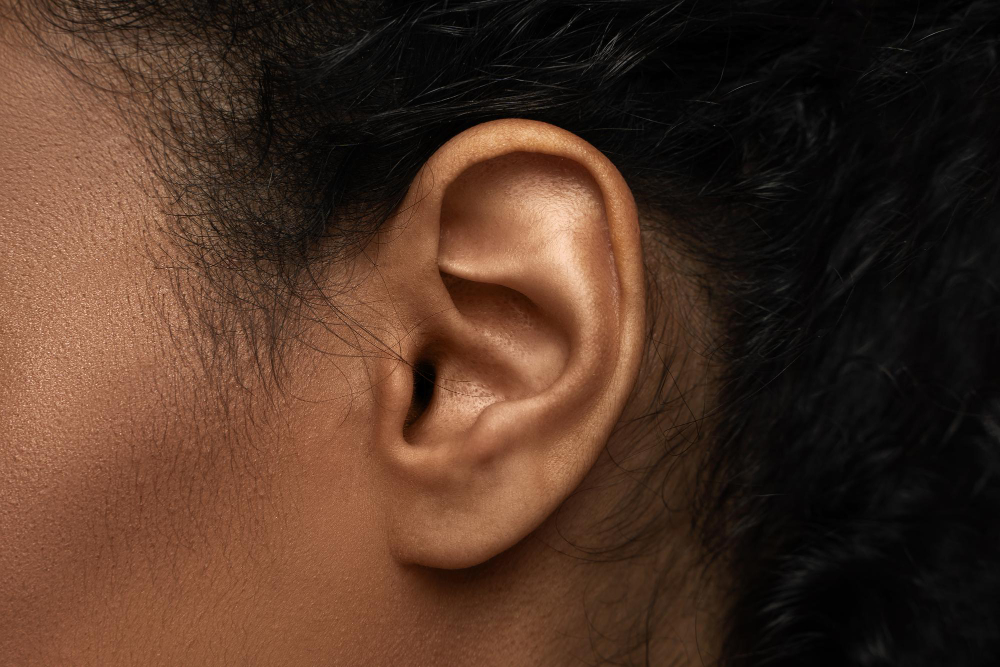
The inner ear contains a fluid-filled spiral about the size of a pea, and inside it is the piece of engineering that makes hearing possible.
Running along the spiral is a flexible membrane that is not uniform. At the base, near the entrance, it is narrow and stiff. As it winds toward the centre it becomes progressively wider and floppier. That gradient does something remarkable: a wave travelling along it peaks at a different place depending on its frequency. High frequencies produce maximum movement near the stiff base; low frequencies travel further in and peak near the floppy end.
The cochlea is therefore a mechanical frequency analyser. It does not measure pitch by timing anything. It sorts pitch by position, spreading the frequency range out along a physical line, and every point along that line has its own nerve supply reporting back.
That arrangement is preserved all the way up to the brain, so neighbouring frequencies are handled by neighbouring nerve fibres and by neighbouring regions of the auditory cortex. There is, in a real sense, a map of pitch laid out in your head, and it was laid out by the varying stiffness of a strip of membrane.
Cells With Hairs That Turn Bending Into Voltage
Sitting on that membrane are the hair cells, and they are where the physical world stops and the electrical one starts.
Each carries a bundle of fine projections on its upper surface. When the membrane moves, the bundle bends. The projections are linked to one another by fine filaments, and bending puts those filaments under tension, which physically pulls open channels in the cell. Ions flood in, and the cell’s voltage changes.
This is a direct mechanical linkage – a pull opening a gate – and it is why hearing is so fast. There is no chemical cascade to work through, as there is in vision. The response follows the sound almost instantaneously, which is what allows the auditory system to resolve timing differences between the two ears of a few tens of millionths of a second, the basis of locating sound horizontally.
There are two populations doing different jobs. One, about 3,500 cells, sends the actual signal to the brain. The other, roughly three times as numerous, barely reports anything and instead changes length in response to sound, actively pushing on the membrane and amplifying the motion. The ear is not a passive receiver. It contains an amplifier, and that amplifier is what gives hearing its enormous range and sharp frequency discrimination.
One consequence of that is odd: because the amplifier is active, ears can emit sound. Faint tones generated inside the cochlea can be measured leaking back out of the ear canal, and this is used routinely to test hearing in newborns, who cannot report anything.
The Part That Does Not Grow Back
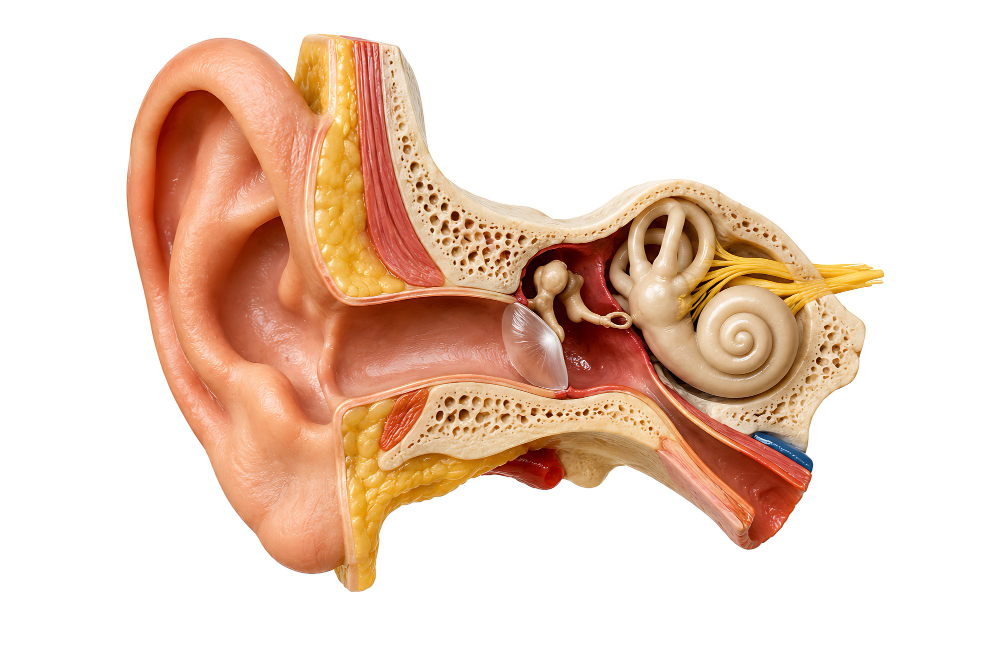
Here is where the whole chain has its vulnerability.
You are born with a fixed complement of hair cells. In mammals they are not replaced. Damage them with loud noise, certain drugs, infection or simply time, and the loss is permanent, because there is no mechanism for producing new ones.
This is not true of all animals. Birds and fish regenerate hair cells routinely, and a bird deafened by noise recovers. Mammals lost that capability somewhere in their history, and a substantial research effort is directed at understanding why and whether it can be restored.
The pattern of loss follows from the cochlea’s layout. The base, which handles high frequencies, sits nearest the incoming energy and takes the most punishment, so high-frequency hearing degrades first. Age-related loss follows the same pattern.
And this explains a complaint that sounds contradictory. People with early hearing loss often say that volume is not the problem, but that they cannot follow conversation in a noisy room. High frequencies carry the consonants that distinguish similar words, while vowels are lower and louder. Lose the top end and speech remains audible while becoming markedly harder to decode, particularly against background noise.
This is a general description of the anatomy and not medical advice; anybody concerned about their hearing should see a professional rather than an article.
Four Conversions and No Spare Parts
Run the chain again and the elegance of it is clearer.
Sound in air arrives, shaped by the folds of the outer ear so that its direction is encoded in its tone. The canal resonates, boosting the frequencies that carry speech. The eardrum converts pressure in air into mechanical movement, and a lever of three miniature bones multiplies that force enough to drive a fluid. The fluid wave travels along a membrane tuned by stiffness so that each frequency peaks at its own address. And at each address, cells with bundles of fine hairs are pulled open by the movement and convert it into electrical signals, while a second population of cells actively amplifies the motion to make faint sounds audible at all.
Four conversions, in a space smaller than a walnut, running continuously, with no downtime and no off switch.
The last stage is the one worth respecting. Everything before it can be assisted, bypassed or rebuilt, but 3,500 cells doing the final conversion cannot be replaced once they are gone, and they have to last a lifetime.
Like our content? Follow us for more.
