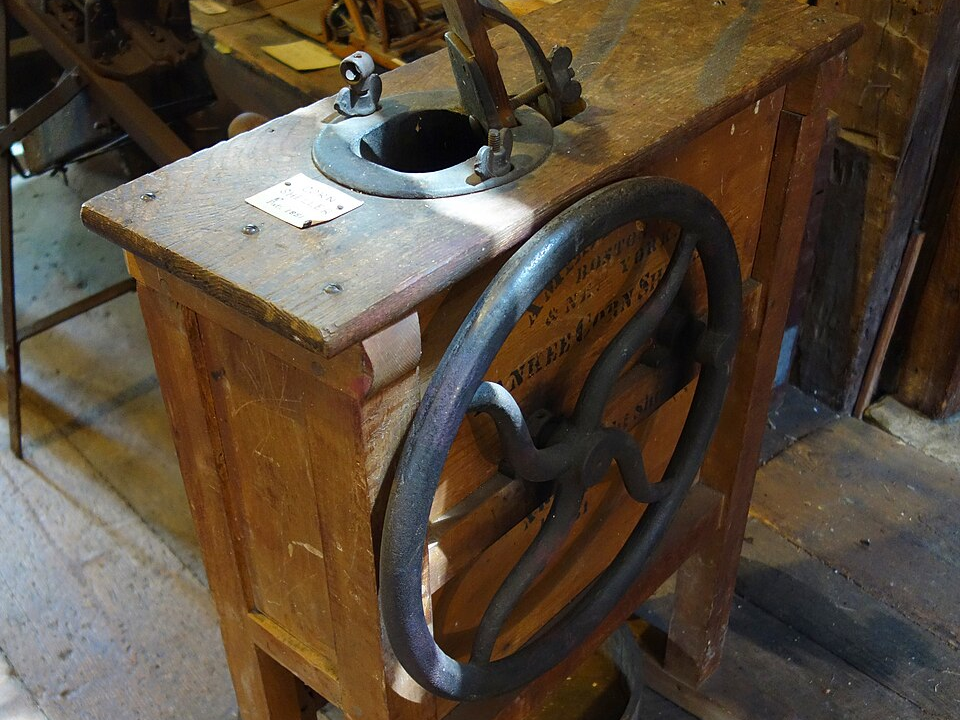
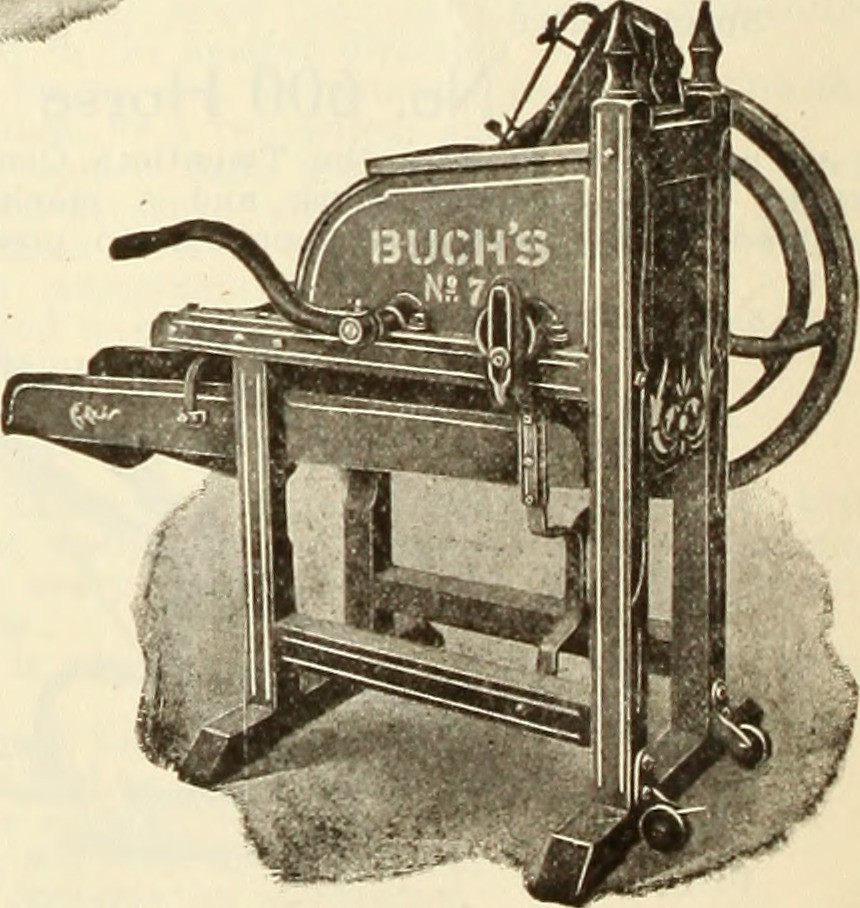
It is bolted to a bench in a shed somewhere, or sitting in a flea market with a price tag on the hopper: a cast iron frame with a crank on the side, a funnel on top, and a spout at the bottom. Nobody at the market can tell you what it does. Somebody guesses apple press.
It shells corn. You drop an ear in the top, turn the handle, and kernels come out one chute while the stripped cob falls out another.
And the reason it existed – the reason hundreds of thousands of them were sold across the American Midwest – is that the job it replaced was the single most hated task on a farm, and the only one where being good at it did not help.
Why Corn Has to Be Shelled at All
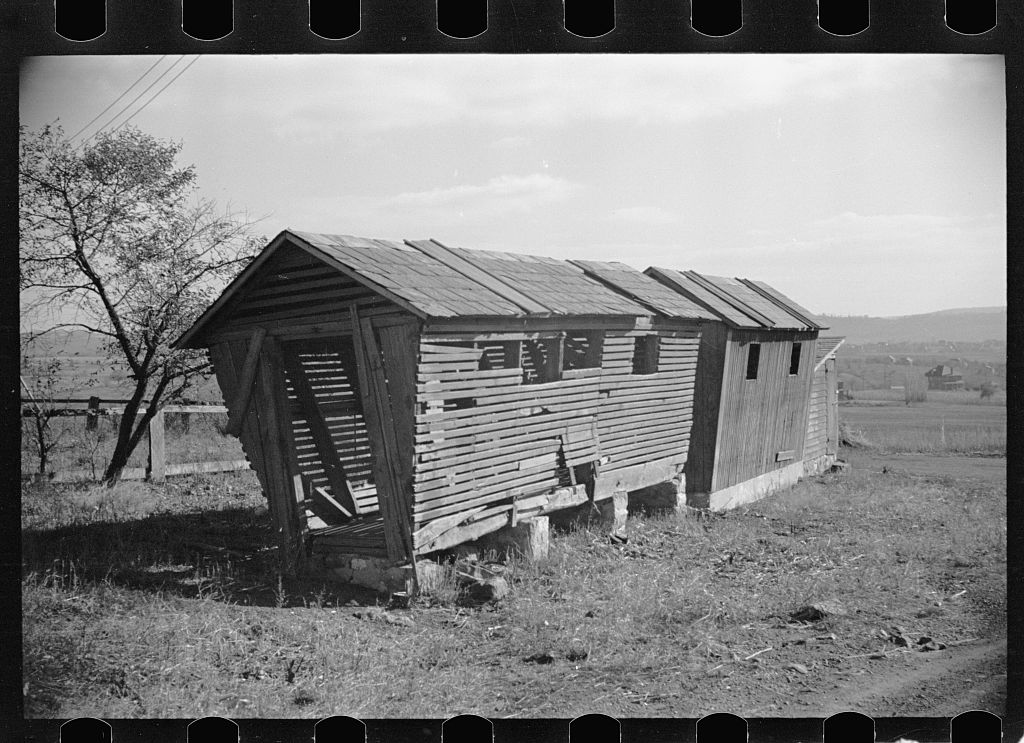
Field corn was not harvested as loose grain. For most of the period that matters here, it came off the stalk as a whole ear, husk removed, and went into a corn crib as ears – which is a slatted building designed to let air through so the ears keep drying.
Storing it on the cob is deliberate and sensible. An ear is a natural package: the kernels are protected, air circulates between them, and a crib full of ears dries steadily rather than heating and spoiling the way a solid mass of loose grain will if it goes in wet.
But almost nothing uses corn on the cob. Grinding it into meal needs loose kernels. Selling it by the bushel to a mill or an elevator needs loose kernels. Feeding small stock and poultry needs loose kernels. Seed corn needs loose kernels.
So the corn went into storage as ears and had to come out as grain, which means somewhere between the crib and the use, every single kernel had to be separated from its cob. On a farm growing field corn, that is not a chore. It is a quantity of work measured in weeks.
Like our content? Follow us for more.
Doing It With Your Hands Is Genuinely Awful
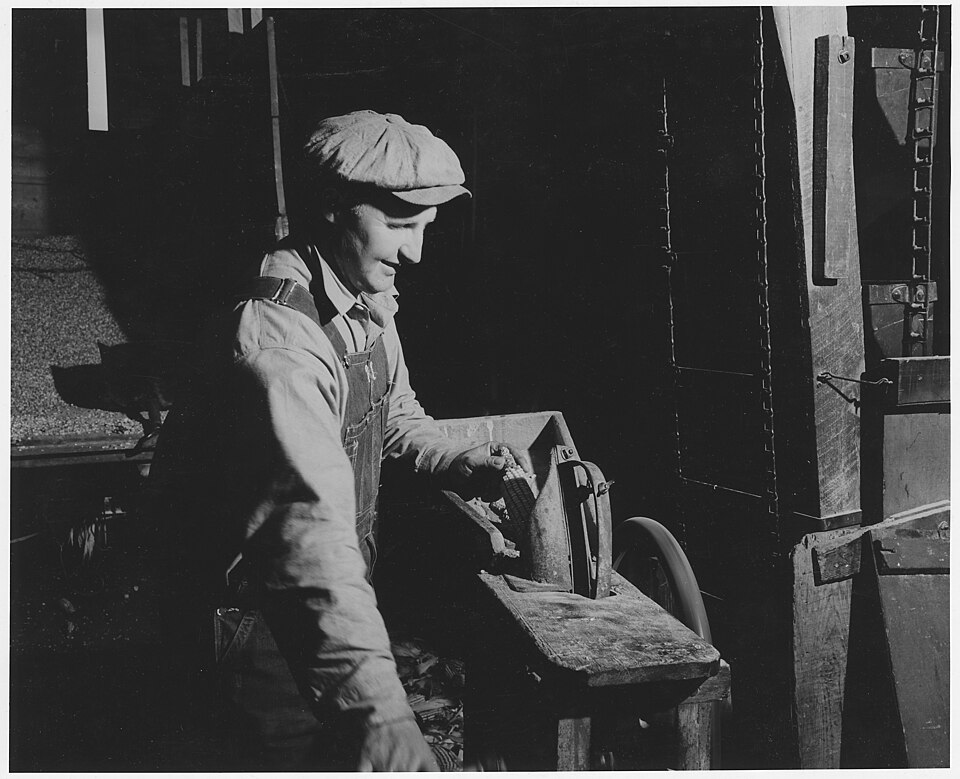
This is the part that gets romanticised and should not be.
Shelling by hand means holding an ear and pushing the kernels off with your thumbs, usually working against another cob or a hard edge to get some purchase. Each ear has hundreds of kernels. They are set tight, they are hard, and the butt end of an ear is harder than the rest.
The result is blisters, then split skin at the base of the thumb, then calluses, and a particular ache in the hands that people who did it described decades later. It was done sitting down, in a crib or a shed, in winter – because winter is when the farm had the time – which means doing it cold, for hours, in a building with the wind coming through the slats.
And here is what makes it worse than other hard farm work: there is no skill in it. A good hand with a scythe outcuts a poor one by a wide margin. A good teamster gets more out of a day than a bad one. Shelling corn has no technique worth learning. Everybody goes at approximately the same rate, the rate is slow, and the only variable is how long you are willing to keep doing it.
Tools were tried. There were shelling pegs – a wooden or bone point strapped to the palm, used to start a row of kernels so the thumbs had somewhere to begin. They helped, which tells you how bad the unaided version was.
The Machine Is Simpler Than It Looks
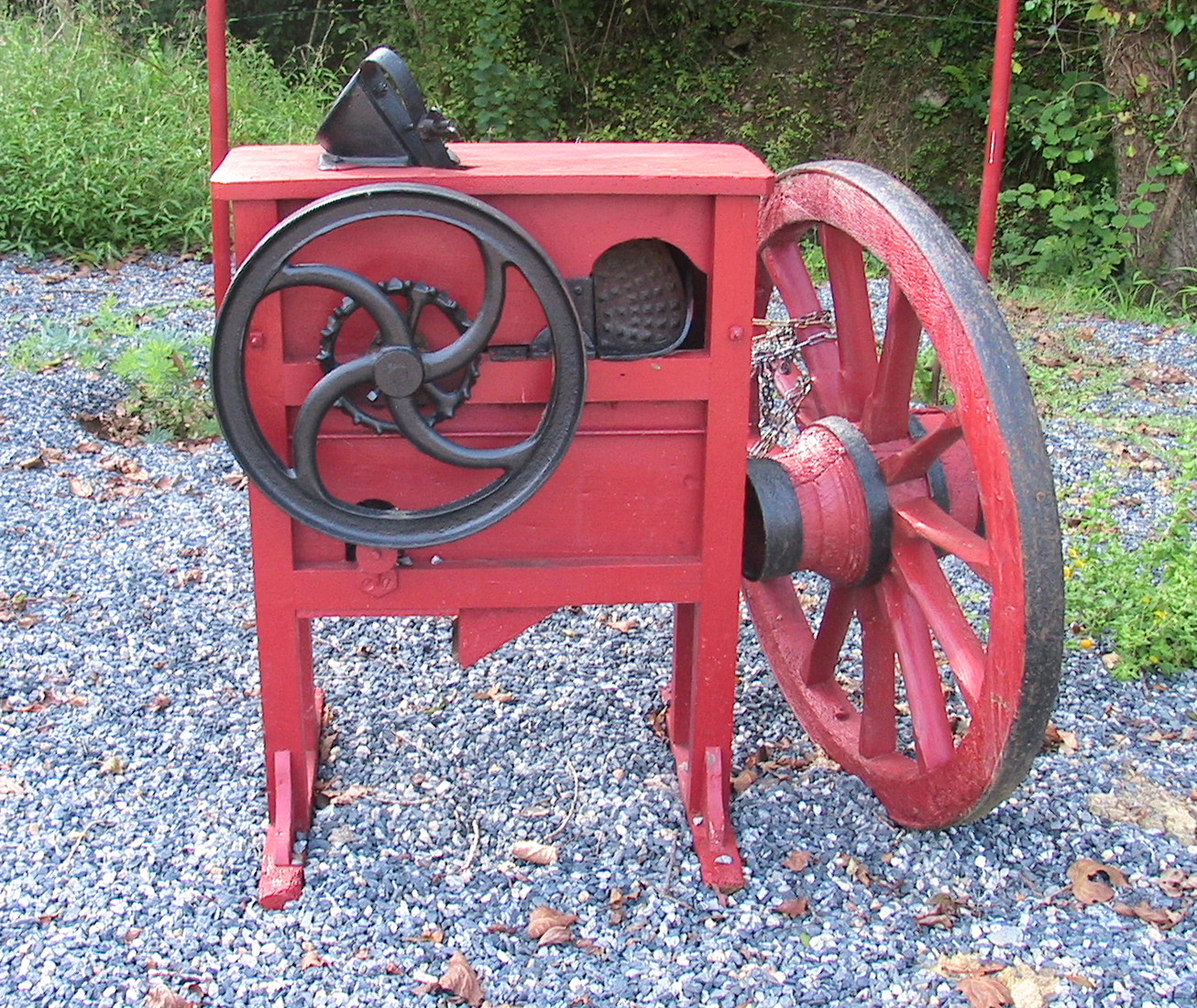
The mechanism is one good idea executed in iron.
Inside is a rotating disc or drum studded with blunt projections, turning against a fixed concave plate. The gap between them is slightly narrower than the ear. An ear fed into the hopper is gripped, dragged through, and the projections knock the kernels off as it passes – stripping it progressively from one end to the other.
The kernels, being small, drop through a grate below. The cob, being too large, is carried on and ejected out of a separate opening. So the machine sorts as it works, with no screening step and no second handling, which is the part that makes it genuinely good rather than merely faster.
A spring-loaded plate on better models let the gap adjust to the ear, since ears are not uniform, and the geared crank meant one turn of the handle produced several turns of the drum. That gearing is why a child could work one: the force required at the handle is modest and the speed at the business end is high.
One person cranking and one person feeding could do in an afternoon what the same two people would have spent a fortnight on with their hands.
It Was Cheap Enough to Be Universal
The commercial story matters as much as the mechanical one.
These were made by a great many American foundries in enormous numbers, in a range of sizes from a small one-ear hand model clamped to a bench up to large geared machines driven by a horse on a sweep or later by a belt. The small ones were cheap – cheap enough that a household with very little money could still have one, and cheap enough to be sold through general stores and mail order catalogues to anywhere a freight depot reached.
That is the difference between this and most farm mechanisation. A reaper or a thresher was a major capital item, bought by the prosperous or shared between neighbours. A hand sheller was within reach of nearly everybody, which means the relief it provided was not confined to good farms.
And because it was small, it lived where the work was. Bolted to a bench in the crib doorway, or to a plank laid across a barrel, with a bushel basket under the kernel chute and the cobs piling up on the floor.
The Cobs Did Not Go to Waste
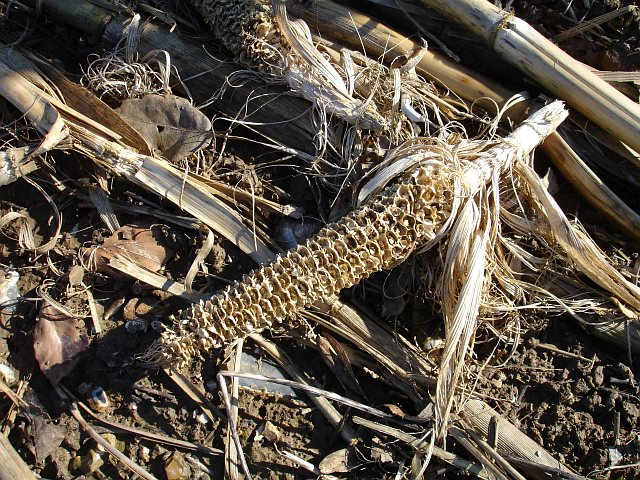
Worth a note, because the output of this machine was two products rather than one.
Dry cobs burn. They burn fast and hot with very little ash, and in the corn country of the Midwest a basket of cobs beside the kitchen range was ordinary – used for starting a fire or for a quick hot burn when something needed to boil rather than simmer. In a region short of timber that is a real fuel, free, and arriving as a by-product of a job that had to be done anyway.
They had other uses too, as bedding, as rough scrubbing material, and for purposes that every farm household knew about and nobody wrote down.
So the sheller sat at the junction of two supply chains. Grain out of one chute toward the mill, the stock and the market; fuel out of the other toward the house.
What Replaced It, and Why It Vanished So Completely

Two changes, and the second one is the interesting one.
The first is scale. Powered shellers – belt driven from a stationary engine or a tractor – did the same job far faster, and custom operators travelled with large machines to shell a farm’s whole crib at once. That turned a winter’s chore into a day’s hired service, and it made the hand machine redundant on any farm producing a serious quantity.
The second change removed the job altogether. The mechanical corn picker, and then the combine with a corn head, shelled the corn in the field, at the moment of harvest. The grain goes into a wagon as loose kernels and the cob is dropped in the field with the rest of the residue. There is no ear storage, no crib, no later separation and no cobs anywhere near the house.
That is why the sheller disappeared so thoroughly rather than lingering. It was not outcompeted at its task. The task stopped existing as a separate operation. Once corn arrived at the farmstead already shelled, there was nothing for a machine that shells corn to do – and the corn crib, which was the whole reason ears needed shelling, went with it.
The One at the Flea Market
Pick one up and the first surprise is the weight. They are solid cast iron because the forces involved are real – something has to hold an ear against a studded drum without flexing.
The second surprise, if the drum still turns, is how smooth it is. The gearing is well cut, the bearing surfaces are generous, and a hundred-year-old one frequently works perfectly, because there is almost nothing in it to go wrong and nothing in it that wears out in ordinary use.
It is one of the small machines that genuinely improved people’s lives in a way they could feel in their hands on the first day. Not a labour-saving convenience. The end of a specific, stupid, painful job that somebody in every farm household had been doing all winter for as long as anybody could remember.
Which is probably why the ones that survive are usually in good condition. Nobody abused a thing like that.
Like our content? Follow us for more.