

Nagoro, in Japan’s Iya Valley, has fewer than 30 human residents and more than 350 handmade scarecrow dolls — each one made by a single woman, Tsukimi Ayano, to replace neighbors who died or moved away.
Driving along Route 439 in the mountainous Iya Valley on Japan’s Shikoku island, you eventually arrive at a village that, from a distance, looks normal. There are people working in the gardens. Figures sitting at bus stops. A group of utility workers hunched over what appears to be a cable repair. Children waiting near the school. Couples chatting on benches. A wedding party assembled in the gymnasium.
Almost none of them are real.
This is Nagoro — known internationally as Japan’s “Scarecrow Village” or “Doll Village” (Kakashi no Sato in Japanese). According to the village’s most recent counts, fewer than 30 human residents live here permanently. More than 350 life-sized handmade dolls inhabit the village alongside them. Almost every one of those dolls was made by a single woman, Tsukimi Ayano, in what has become one of Japan’s most discussed responses to the country’s rural depopulation crisis.
How the village became dolls

The story began in 2002. Tsukimi Ayano had spent her entire adult life in Osaka, Japan’s third-largest city. She returned to Nagoro — the village where she had been born and raised — to care for her elderly father, who was ailing.
Ayano attempted to plant a vegetable garden at her father’s home. Birds kept digging up the seeds. To solve the problem, she made a scarecrow. But instead of the traditional Japanese kakashi (a simple cross with old clothes and a hat), she crafted a full life-sized figure in her father’s likeness — same weathered cap, same padded jacket, same gentle facial features.
The resemblance was uncanny. Neighbors walking past the field would see the figure and call out greetings, mistaking it for her father. “They would sometimes say, ‘Good morning, you’re up working very early,'” Ayano told NPR in a 2016 interview. “It just started up a conversation between the scarecrow and the neighbors.”
Amused by the reactions, Ayano made more dolls. Then more. Most of them were modeled on specific people — neighbors who had died, friends who had moved away to the cities, residents she remembered from her childhood. Over more than two decades of work, she has handmade over 400 dolls, with about 350 currently displayed throughout the village.
What it actually looks like

Nagoro’s dolls are not arranged in any single museum-style display. They are scattered throughout the working village, embedded in the daily landscape:
- The closed elementary school, which shut down in 2012 when there were no longer enough children to support it, is now filled with doll students. In one classroom, two of the dolls are self-portraits made by the last two real children to attend the school — they dressed the dolls in their own clothes before leaving.
- A group of three figures sit eternally at the base of a telephone pole on the village outskirts, posed as if mid-conversation.
- A man fishes in the river that runs through Nagoro, his line cast indefinitely into the water.
- Utility workers crouch over what appears to be roadwork, frozen in mid-task.
- A bus shelter holds figures waiting for buses that come less frequently every year.
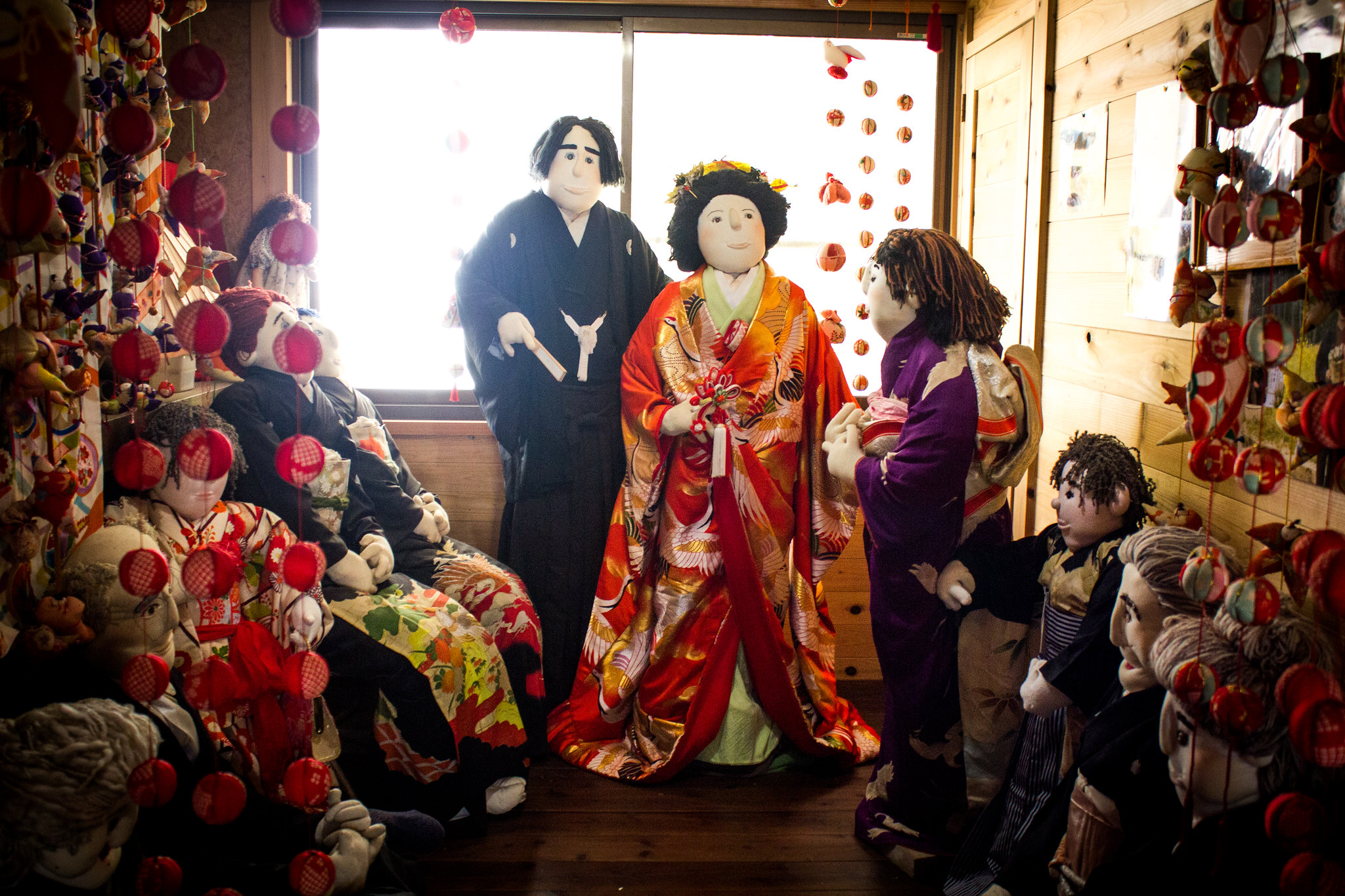
- In the village gymnasium, an entire wedding party stands assembled — bride and groom in formal attire, surrounded by guests in both Western suits and traditional Japanese kimonos, flanked by six small boys in potato sacks.
Every year in early October, Ayano organizes an undokai — a traditional Japanese school sports day. Child-sized dolls line up for races, perch on swings, and pull on ropes in mock competitions. Real villagers and visitors join in. Food stalls serve yakisoba and takoyaki. The air fills with cheering. For a few hours, the village sounds bustling — not just with dolls, but with the echoes of community life that the dolls represent.
The bigger story behind the dolls
Nagoro’s situation is not unique to Nagoro. According to data from Japanese government sources, the country’s total population began declining in 2011. Birth rates have continued falling — 2025 saw approximately 670,000 babies born, the lowest figure since records began in the late 1800s and roughly one-third of the two million births recorded annually in the 1970s.
The decline has been particularly severe in mountain hamlets like Nagoro, which lose population in two ways simultaneously: residents die, and younger generations move to Tokyo, Osaka, and other cities for university and work. Forty years ago, Nagoro had about 300 residents. By January 2015, the population had dropped to 35. By August 2016, it was 30. By September 2019, just 27. The current figure is fewer than 30.
The village school closed in 2012 because there were no children left to attend. Buses run less frequently. The last café and guesthouse remain open partly because of tourism that Ayano’s dolls have generated.
Ayano has been forthright about what the dolls actually represent. In multiple interviews, she has described her creations as a way to honor people who are gone. “When I make dolls of dead people I think about them when they were alive and healthy,” she told German filmmaker Fritz Schumann in his 2014 documentary Valley of Dolls. “The dolls are like my children.” To The New York Times in 2019, she said simply: “I wish there were more children because it would be more cheerful. So I made the children.”
She keeps a doll of her grandmother in the passenger seat of her car. On the hour-and-a-half drive to the nearest grocery store, she says, she never feels alone.
Visiting Nagoro
For travelers interested in seeing Nagoro, it remains one of the more difficult destinations in Japan to reach. The route involves taking the JR train to Oboke Station, then a Shikoku Kotsu bus toward the Iya Valley to the Kazurabashi stop, then a 15-minute walk along Route 439 to the village center. The drive from Tokushima City takes hours over hairpin mountain roads. Route 439 itself is nicknamed “Yona-San-Kyu” — a play on the road number that translates roughly to “You’ll Never Arrive.”
There is no entrance fee to the village. Nagoro is a working community, not a gated attraction. Visitors can wander the lanes, the abandoned schoolhouse, and the riverside for free. A donation box outside Tsukimi Ayano’s workshop accepts contributions toward doll upkeep. The 350+ figures remain outdoors year-round, though some are moved indoors temporarily during typhoon warnings.
For visitors interested in making their own scarecrow, Ayano offers a workshop on the fourth Wednesday of each month from April through November. Participants are encouraged to bring their own sewing kits and clothing for the figures. Each doll begins with wooden slabs for the base, cotton for the head, elastic fabric for the skin, and buttons for the eyes. Roughly 80 tightly rolled sheets of newspaper form the skeleton at the core of every figure.
Visitors are asked to treat the village with the respect appropriate to a living community. The remaining residents are private people who happen to live in a global tourist curiosity. Walking onto private porches or touching the dolls without permission is not appropriate. The Scarecrow Festival in October is the one time the village explicitly invites the outside world in for celebrations.
What Nagoro represents
Tsukimi Ayano is now in her late 70s. She has begun training volunteers in her doll-making techniques, hoping the oral histories sewn into each figure will outlive her ability to create new ones. Tokushima Prefecture has installed fiber-optic lines in the Iya Valley and launched tax incentives for digital nomads willing to settle in the region. A handful of remote workers have tested “workations” in the area. None of these efforts have meaningfully reversed the underlying population decline.
What Nagoro has demonstrated, more than anything, is that a single person’s creative response to depopulation can preserve a community’s memory in a form that resists the slow erasure of forgotten places. The dolls don’t replace the people who left or died. But they make the absence visible in a way that’s impossible to look away from. A village with 30 people quietly fades. A village with 30 people and 350 dolls becomes, paradoxically, internationally famous — and the few remaining residents have a livelihood from the visitors who come.
The deeper question Nagoro raises — and that filmmakers, journalists, and sociologists have been asking for over a decade — is how many other Japanese villages, and rural villages in similar countries facing demographic decline, will follow the same path. The Iya Valley alone has dozens of similar hamlets. Most of them will simply disappear. Some, like Nagoro, may find their own version of Ayano’s needle and thread.
For travelers, Nagoro offers something genuinely rare: a place where the absence of people is so present that you can feel it. The dolls are uncanny. They are also, in a way that Ayano clearly intends, an act of love.
