

Some archaeological claims are interesting because they are true. Others are interesting because of what happens to a suggestion once it escapes into general circulation.
The object usually called the Baghdad battery belongs firmly in the second category, and the story of how a tentative proposal became an established fact in the popular imagination is more instructive than the object itself.
This is not a debunking in the dismissive sense. The artefacts are real, they were truly puzzling, and the person who proposed the electrical interpretation was doing something reasonable with limited information. What has happened since is the interesting part.
What the Object Actually Is
The physical description is not in dispute.
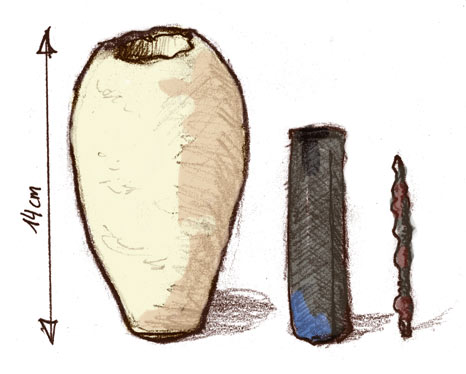
It is a ceramic vessel, roughly the size of a fist, with a narrow neck. Inside is a cylinder of copper sheet, rolled and with a soldered seam and a base. Suspended within that cylinder, held by a stopper of bitumen at the top, is a rod of iron.
The iron rod shows corrosion. The copper shows some corrosion of its own. The bitumen stopper isolates the rod from the copper cylinder, so the two metals are not in contact with each other.
Similar assemblages have been reported from the region, and dating estimates place them somewhere in a range spanning the Parthian and Sasanian periods — figures around two thousand years old are commonly cited, though the dating is itself uncertain.
That configuration — two dissimilar metals, separated, in a container that could hold a liquid — is what prompted the electrical suggestion, and it is a reasonable thing to notice.
Like our content? Follow us for more.
Why the Battery Idea Was Proposed
The suggestion came from a museum director in Baghdad in 1938, who observed the arrangement and proposed that it might have functioned as a galvanic cell.
The underlying physics is sound and worth stating, because it is the strongest part of the case. Place two different metals in an acidic or otherwise conductive liquid and a voltage develops between them. This is elementary electrochemistry and it does not require anybody to understand it in order to work — a copper strip and an iron strip in vinegar will produce a small voltage whether or not anyone knows why.
Replica experiments have been performed repeatedly, and they succeed. Filled with an acidic liquid such as vinegar or grape juice, a reconstruction of the vessel produces a voltage — generally reported in the region of half a volt to around a volt, which is small but measurable.
So the object can function as a cell. That is established and is not the disputed part.
What Is Missing
The difficulty is that demonstrating something could work is a substantially weaker claim than demonstrating it was used that way, and almost everything required for the stronger claim is absent.
No electrolyte was recovered. The vessels contained no residue of acidic liquid, and while such residues might not survive two thousand years, their absence means the central component is inferred rather than found.
No conductors were found. A battery producing electricity is useless without something to carry the current somewhere, and no wires, no connectors and no apparatus consistent with an electrical circuit have been recovered in association.
No application has been identified. The most frequently proposed use is electroplating — using the current to deposit a thin layer of gold or silver onto another metal — but no plated objects have been convincingly linked to the technique, and the gilding methods actually documented in the region work by entirely different means requiring no electricity at all.
Most significantly, the context points elsewhere. The vessels were reportedly found alongside rolled documents, and jars of very similar type from the region are known to have been used to store papyrus and parchment scrolls. On that reading the copper cylinder is a container, the bitumen a seal, and the iron rod part of the closure or a fitting.
Corrosion on the iron rod is frequently cited as evidence that something acidic was inside. Iron also corrodes for a great many other reasons over two thousand years in the ground.
There is one further consideration that weighs against the electrical reading and is rarely raised. A galvanic cell of this size produces a fraction of a volt. Doing anything useful with that requires connecting several in series, which requires conductors, connectors and an understanding that stacking them multiplies the output.
That understanding is not obvious and was not arrived at in Europe until the very end of the eighteenth century, by someone deliberately investigating the phenomenon. Assuming it two thousand years earlier, with no supporting evidence, is a substantial claim.
Where the Object Went
There is a practical difficulty that makes further investigation extremely awkward.
The artefact was held in the National Museum of Iraq and was among the material lost during the looting of the museum in 2003. It has not been recovered.
That means the primary object is unavailable for modern analysis — for residue testing, for materials analysis, for anything that might resolve the question directly. Investigation now depends on the original descriptions, on comparable objects, and on replicas.
It is a good illustration of why context and custody matter so much in archaeology. An object that might have settled its own argument with a residue analysis is simply gone.
Why the Story Travelled Anyway
The gap between the tentative original proposal and the confident popular version is the part worth examining.
The proposal was a suggestion. What circulated was a fact: the ancients had electricity, batteries were invented two thousand years earlier than anyone thought, and this had somehow been overlooked.
Several things drove that. The claim is short, vivid and easily repeated. A working replica makes a compelling demonstration, and the demonstration proves the mechanism rather than the history, which is a distinction that does not survive being filmed. And the idea slots neatly into a pre-existing appetite for lost ancient knowledge.
There is also a structural asymmetry. Explaining why an interpretation is unsupported requires several paragraphs about absent evidence and alternative readings. Asserting it requires one sentence. The two do not compete on equal terms.
The consensus among specialists working on the material is that the storage-vessel reading is better supported than the electrical one, and that in the absence of the object and of any associated apparatus, the battery interpretation remains unsubstantiated.
What Ancient Electrical Knowledge Would Look Like
A useful test for any claim of this kind is to ask what evidence would exist if it were true, and then check whether any of it does.
Suppose a society had a working electrical technology two thousand years ago. Electricity is enormously useful and extremely difficult to discover, so a group that had it would not have used it once and stopped.
There would be multiples. Cells are simple to reproduce once the principle is known, so you would expect large numbers of them, of varying quality, across a range of sites and periods, including failures and prototypes.
There would be a supporting industry. Conductors have to be drawn, connections made, containers standardised, electrolytes prepared and stored. That is a supply chain, and supply chains leave debris.
There would be products. Whatever the electricity was for — plating, medicine, display — the outputs would exist in quantity and would be distinguishable from products made by other methods.
And there would very likely be text. This was a literate region with substantial surviving documentation covering crafts, medicine, administration and religion, and a technique this remarkable would be difficult to keep out of the written record entirely.
None of that is present. What exists is a small number of similar objects, no apparatus, no products, no texts, and a plausible alternative explanation involving scroll storage.
That is not proof of absence, and it is the kind of silence that a real technology does not usually produce.
What the Case Is Actually Good For
The value of this story is not in settling what the jars were for.
It is a clean example of the difference between three claims that are routinely conflated: that something could work, that something did work, and that somebody understood why it worked.
A replica demonstrates the first. The second requires evidence of use — residues, apparatus, products, context. The third requires evidence of understanding, which is a much higher bar again, and which nobody has claimed here.
Ancient technology contains real examples of all three. There are devices whose function is documented, techniques whose products survive in quantity, and processes that were used empirically for centuries by people who could not have explained them.
The jars from Baghdad are not among them, on current evidence. They are two pieces of metal and a pot, which would generate a voltage if somebody filled them with vinegar, and which are substantially more likely to have held a scroll.
That is a less exciting answer than the popular one, and it has the advantage of matching what was actually found.
Like our content? Follow us for more.
