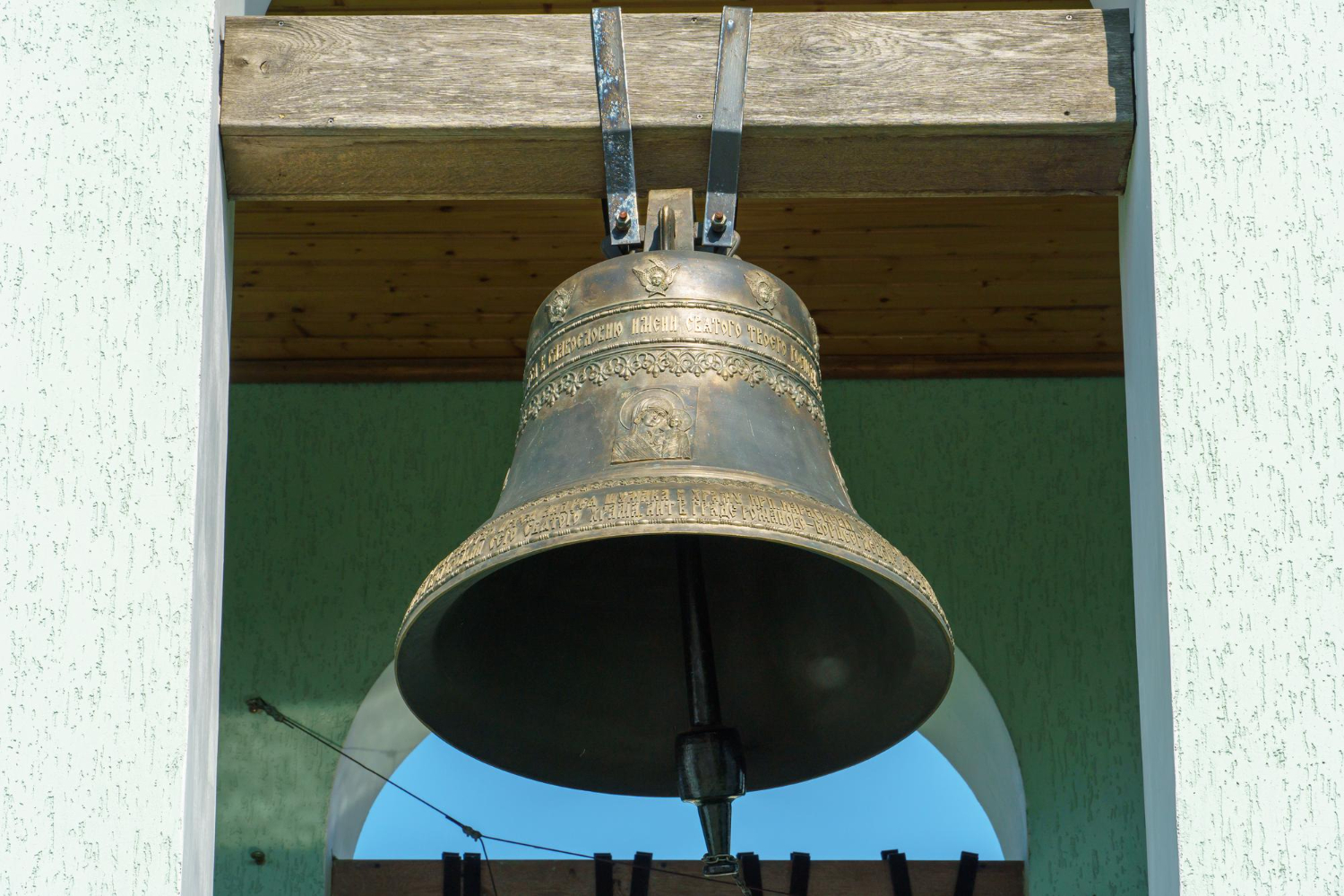
There is a category of object that has to be got right first time, and a large bell is among the more demanding examples.
It is cast in one piece from molten metal, at a scale where a fault means starting again. It cannot be adjusted by tightening anything. Its sound depends on its exact geometry, and the only way to change that geometry is to remove material.
And what it produces is not a note in the ordinary sense but a collection of frequencies whose relationships determine whether it sounds correct or unpleasant — relationships that were arrived at empirically over centuries before anyone could measure them.
Here is what is happening inside a bell.
The Alloy Is Not Arbitrary

Start with the material, because the specification is unusually tight.
Bell metal is a bronze — copper alloyed with tin — and the proportion of tin is substantially higher than in most bronzes, typically around a fifth of the total.
That ratio is a compromise between two competing requirements. Increasing tin makes the alloy harder and more resonant, producing a longer and clearer sound. It also makes it more brittle, and a brittle bell struck repeatedly for a century is a bell that will eventually crack.
Move too far in either direction and the object fails. Too little tin gives a dull sound that dies quickly; too much gives a beautiful tone in something that cannot survive being used.
The ratio settled at roughly four parts copper to one of tin, and it has remained essentially unchanged for a very long period — which is what happens when an empirical process finds an optimum and there is no reason to move.
Other metals have been tried. Iron and steel bells exist and are cheaper, and they generally sound less good, with a shorter decay and a harsher character. The bronze specification survives on acoustic merit rather than tradition.
Like our content? Follow us for more.
Why the Shape Is That Shape

The profile of a bell — thin at the top, thickening toward the rim, flaring outward — is not a stylistic choice, and it is not obvious.
Different regions of a bell vibrate at different frequencies, and the thickness at each point determines what those frequencies are. The heavy rim, the thinner waist and the flare are all doing acoustic work.
This means the shape is effectively a solved equation. Founders developed it over centuries by making bells, listening to them and adjusting, and the profile they converged on is a set of proportions that produce the desired relationships between the partials.
The knowledge was held as workshop practice rather than as theory — scale drawings, proportional rules and templates passed down within businesses, some of which operated for centuries. Nobody could have explained why it worked in physical terms until modern acoustics arrived.
Which is a familiar pattern: the object was optimised long before it was understood, by people who could hear the result and iterate.
The Note You Hear Is Not There

This is the part that surprises people.
A struck bell produces several strong partials simultaneously. Traditional names exist for them — the hum, the fundamental, the tierce, the quint and the nominal, among others — and each corresponds to a different vibrational mode of the metal.
The pitch a listener identifies as the note of the bell is generally the strike note, and the strike note is frequently not a frequency the bell is actually producing. It is inferred by the ear from the relationships between the partials that are present, in the same way the brain reconstructs a missing fundamental from a harmonic series.
That has a real consequence: you cannot tune a bell by measuring one frequency. You have to bring several into the correct relationship with one another, and the perceived note emerges from that arrangement.
It also explains why bells differ so much in character. Two bells nominally at the same pitch can sound entirely unlike each other depending on how their partials are arranged and how strong each is.
Tuning by Removing Metal

The tuning process is where the permanence bites.
A bell comes out of the mould close to its intended proportions and not exact. Bringing the partials into their correct relationships requires removing metal from the inner surface, at specific heights, in specific quantities.
Where you cut determines which partial moves, because each partial has regions where the metal vibrates most and regions where it barely moves at all. Removing material from a location that matters for one partial shifts that one and leaves the others largely alone.
Historically this was done by hand with chisels, which is a demanding operation on a large casting. Modern practice uses a vertical boring machine, with the bell mounted and rotated while a cutting tool takes material from the inside.
The constraint is absolute in one direction. Metal can be removed and cannot be replaced. Overshoot a partial and the bell cannot be brought back — the options are to retune the whole set of partials around the new position, which may not be possible, or to melt the bell and cast it again.
That asymmetry governs the entire practice. Cuts are small, measurements are taken constantly, and the process converges on the target from one side.
Why a Cracked Bell Cannot Be Mended

The failure mode is worth understanding because it explains why so many famous bells have simply been left cracked.
A crack in a bell is catastrophic for the sound rather than for the structure. The vibrating body is no longer continuous, the partials are disrupted, and the characteristic sustain disappears — a cracked bell produces a dull thud rather than a note.
Welding is possible in principle and extremely difficult in practice. The alloy is not easy to weld, the heat involved risks introducing further stress, and even a successful repair changes the local thickness and stiffness, which changes the acoustic behaviour.
So the usual outcome is that a cracked bell is either recast — melted down and poured again, which preserves the metal and loses the object — or retired and kept as it is.
Cracks generally originate where the clapper strikes, from fatigue over an enormous number of impacts, and the risk is increased by a clapper that is too heavy or by striking a stationary bell in a way it was not designed for.
The Bells That Were Never Tuned

An important qualification belongs here, because the tuning described above is not universal.
Precise tuning of the individual partials is a comparatively recent refinement in the long history of bell founding. For most of that history, founders worked to proportional rules that produced a good sound, and what came out of the mould was largely what was hung.
Bells made that way are not badly made. They were cast by people with centuries of accumulated proportion behind them, and a great many sound excellent. What they are not is tuned in the modern sense, which means their partials sit in relationships that vary from bell to bell.
That has a real consequence for anything played as a set. A group of individually pleasing bells whose partials are not aligned to a common scheme will produce something that sounds acceptable struck singly and unsatisfactory struck together.
Which is why the development of systematic tuning mattered so much. It was not about improving any single bell; it was about making bells that work as an ensemble.
There is a preservation argument on the other side that founders take seriously. Retuning an old bell means machining metal from a historic object permanently, and a bell that is acoustically imperfect may be worth keeping exactly as it was cast.
So the modern practice involves a judgement that has nothing to do with acoustics: whether this particular bell is a piece of equipment to be improved or an artefact to be left alone.
An Object That Has to Be Right
What makes bell founding worth understanding is that it sits at an unusual intersection.
It is a casting problem, requiring a large volume of molten metal poured into a mould in one operation. It is a metallurgical problem, requiring an alloy balanced between resonance and durability. It is an acoustic problem involving several interacting frequencies and a perceived pitch that is not physically present. And it is a machining problem in which every operation is irreversible.
All four had to be solved simultaneously, by people working without any theory of any of them, using accumulated proportional rules and their own ears.
The result is that a bell cast centuries ago can still be in daily use, still holding its pitch, still producing a sound that a modern founder would recognise as correctly tuned — because the geometry that produces it has not changed and cannot drift.
Which is a reasonable definition of a well-made object: it does exactly what it did the day it was hung, and nobody has been able to improve the specification since.
Like our content? Follow us for more.