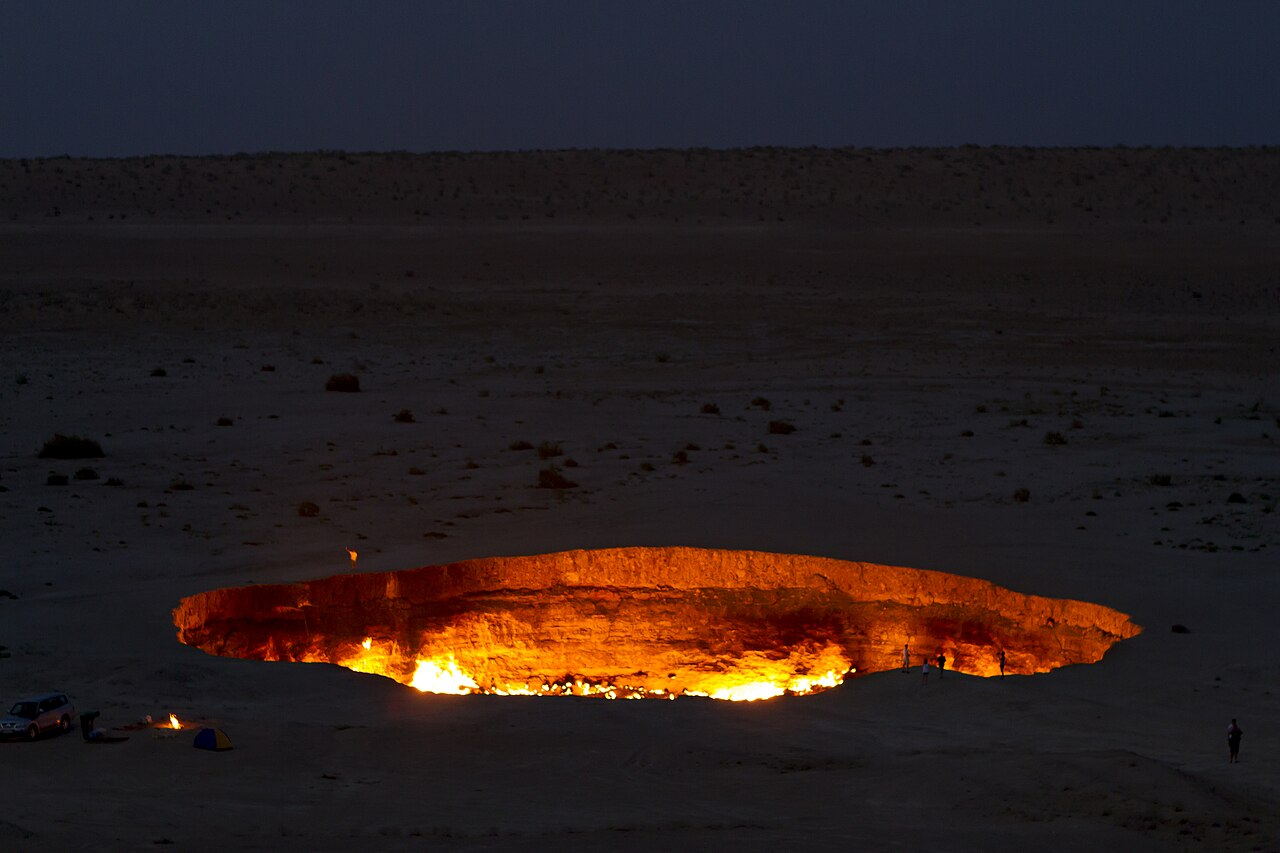
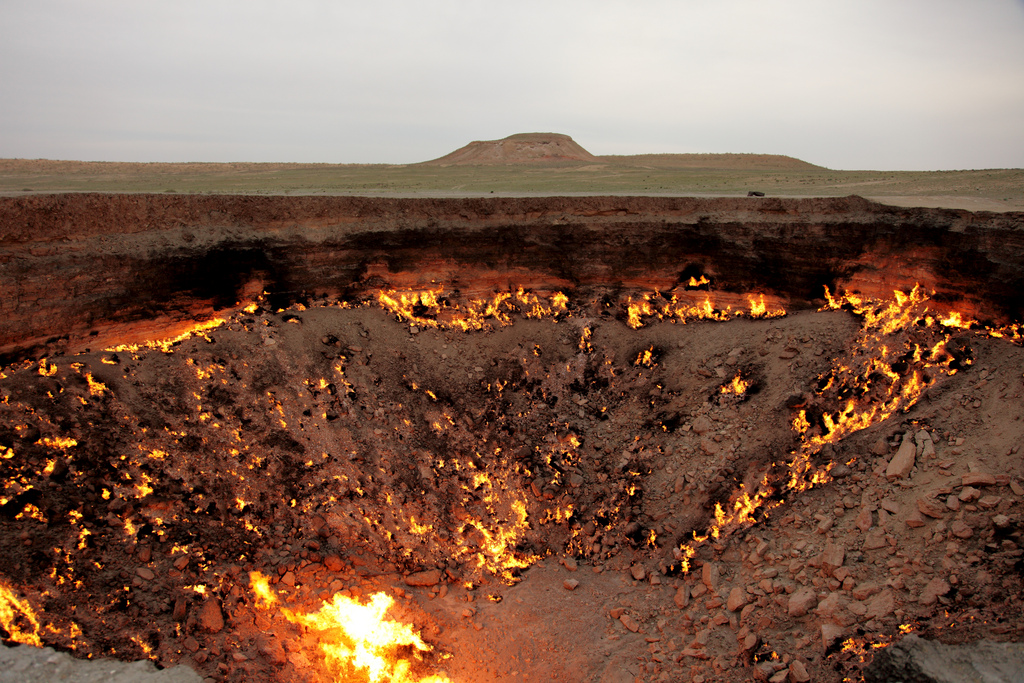
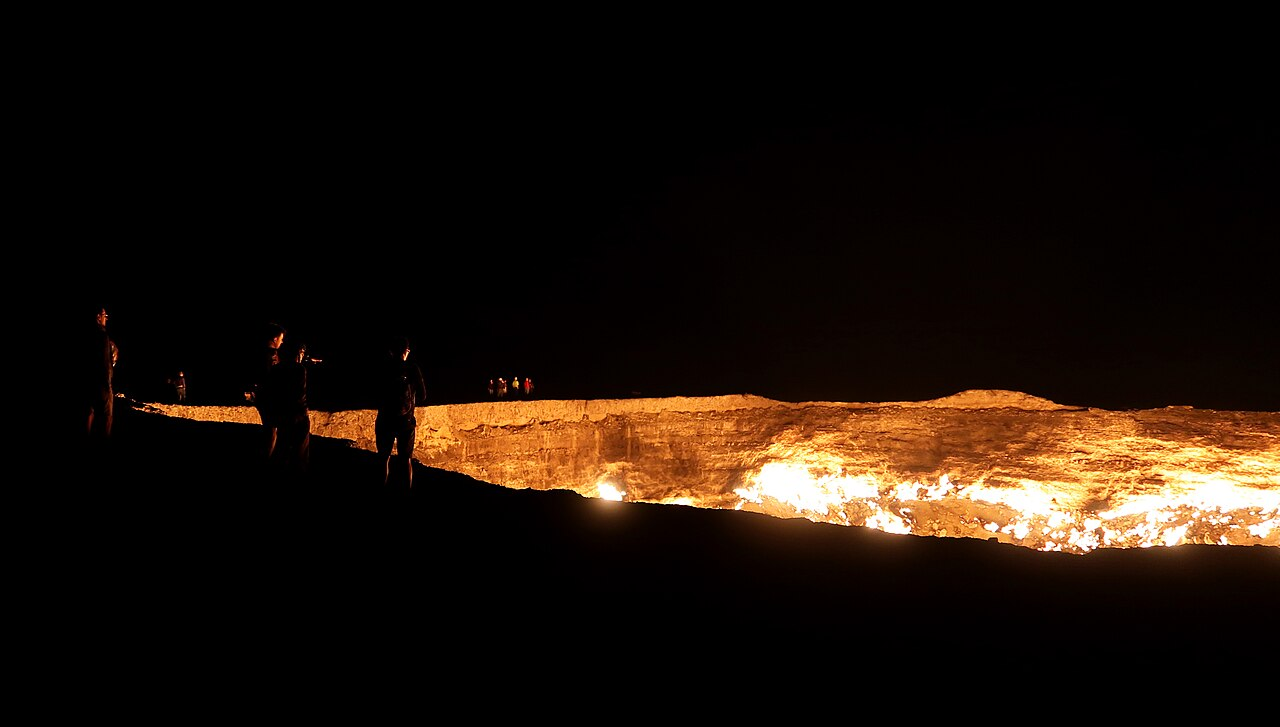
Somewhere in the Karakum Desert of Turkmenistan, hundreds of miles from anything, there is a hole in the ground that is on fire and has been for longer than most people reading this have been alive. It is a roughly circular pit, something like 230 feet wide and 65 feet deep, and its floor and walls are studded with hundreds of flames fed by natural gas seeping out of the earth. At night, when the surrounding desert is absolute blackness in every direction, the crater throws an orange glow visible from miles away, and up close the heat is too intense to stand near at some points along the rim. People who have seen it reach for the same word, and it’s the one that stuck: the Door to Hell.
The Darvaza gas crater is one of the strangest sights on the planet and one of the few truly otherworldly things a person can go and stand next to. It is also, despite the infernal appearance, entirely man-made — the result, by the standard telling, of an industrial accident and a hasty decision that turned out to be spectacularly permanent. The full story is a little murkier than the popular version, which only makes it better.
The Standard Story
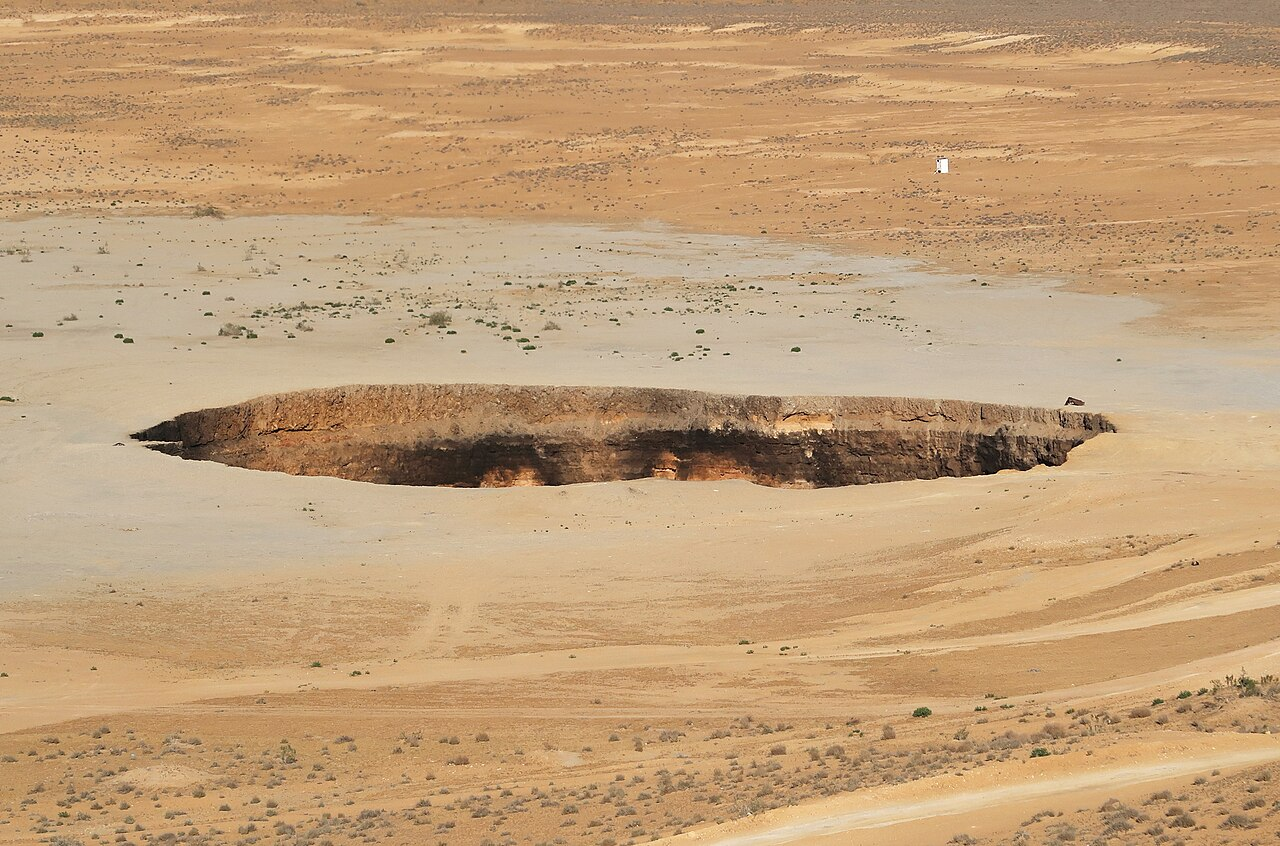
The version repeated in guidebooks and documentaries goes like this. In 1971, a team of Soviet geologists was drilling for natural gas in the Karakum, the vast desert that covers most of Turkmenistan and sits atop some of the largest gas reserves in the world. As they drilled, the ground beneath the rig gave way, collapsing into an underground cavern and taking the equipment down with it, leaving a large crater. Fortunately, by the accounts, nobody was hurt.
The collapse left the crater venting methane and other gases into the air. Methane is hazardous — poisonous in quantity, suffocating as it displaces oxygen, and explosive — and the geologists, worried about the gas spreading toward the nearby settlement of Darvaza and about the danger it posed generally, made a decision that seemed sensible at the time. They would set the escaping gas on fire and burn it off, the standard way of dealing with an uncontrolled gas leak. The expectation was that the pocket would exhaust itself and the flames would gutter out within a few weeks.
The estimate was off by roughly half a century. The gas field feeding the crater turned out to be far larger than anyone anticipated, and the fire has burned continuously ever since, drawing on a supply that has not run out in more than fifty years. What was meant to be a brief, tidy solution to a leak became one of the longest-burning fires on Earth.
Like our content? Follow us for more.
The Complication
That’s the story everyone tells, and it may well be broadly true. But it’s worth knowing that the details are really uncertain, because Turkmenistan is one of the most closed and secretive countries in the world, and there is no clear official record of the incident.
Some Turkmen geologists have offered a different account. In their version, the crater formed from a drilling collapse substantially earlier — in the 1960s rather than 1971 — and then sat as an open, gas-leaking pit for years or even decades before anyone set it alight, possibly not until the 1980s. In this telling, the neat narrative of geologists igniting it immediately to protect a village is a later tidying-up of a messier and less certain sequence of events. The exact year of the collapse, the exact date of the ignition, and the reasoning behind lighting it are all, on close inspection, hard to pin down. What isn’t in dispute is the result: a large crater in the desert that has been on fire for a very long time.
This uncertainty is fitting for a place in a country where, for much of its modern history, industrial accidents were state secrets and failures were steadily scrubbed from the record. The Door to Hell has a documented reality — you can stand at its edge — wrapped in an origin story that no one can fully verify. It is, in a sense, a mystery with a completely solid physical presence.
Why It Keeps Burning
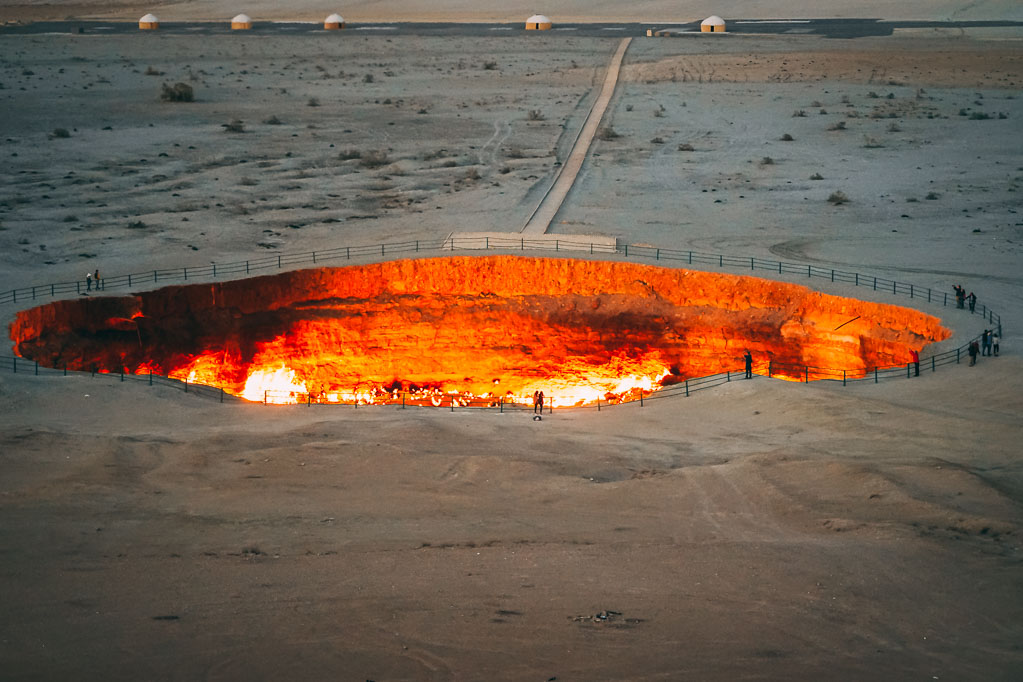
However it started, the reason the crater is still alight comes down to the geology beneath it. The Karakum sits above one of the great natural gas provinces of Central Asia, and the crater appears to be connected to a substantial reservoir. As gas seeps up through the walls, the floor, and the rubble within the pit, it meets the oxygen in the air and ignites, and as long as the supply continues, the fire continues. Each visible flame marks a spot where gas is emerging.
A fire that burns for decades is only possible with an enormous and sustained fuel source, and that’s precisely what makes the crater both a spectacle and a problem. Every day it burns, it is releasing the gas — a valuable resource in a country whose economy depends heavily on natural gas exports — straight into the sky, unsold and uncaptured, along with the emissions that come from burning it. The crater is, in economic terms, a hole in the ground that has been setting money on fire continuously since before most of the country’s population was born.
The Effort to Put It Out
That economic and environmental cost has prompted repeated official interest in extinguishing the crater. Turkmen leadership has, at various points, ordered the government to find a way to put the fire out, citing the wasted gas, the environmental damage, and the health of nearby communities. Various technical approaches have been floated over the years — drilling relief wells to draw off and capture the gas before it reaches the crater, or other engineering interventions to cut off or redirect the supply.
None has yet succeeded in extinguishing it. Putting out a fire fed by a large, poorly mapped underground reservoir in a remote desert is a honestly difficult engineering problem, and for all the announced intentions, the crater has kept burning. There have, however, been recent reports from Turkmen officials suggesting the fire has diminished over time — that the intensity of the flames has dropped compared to years past, possibly because the accessible gas is finally beginning to deplete or because of measures to reduce the seepage. Whether that means the Door to Hell is slowly closing on its own, after more than fifty years, remains to be seen, and travelers hoping to see it at full ferocity may want to bear the uncertainty in mind.
Standing at the Edge
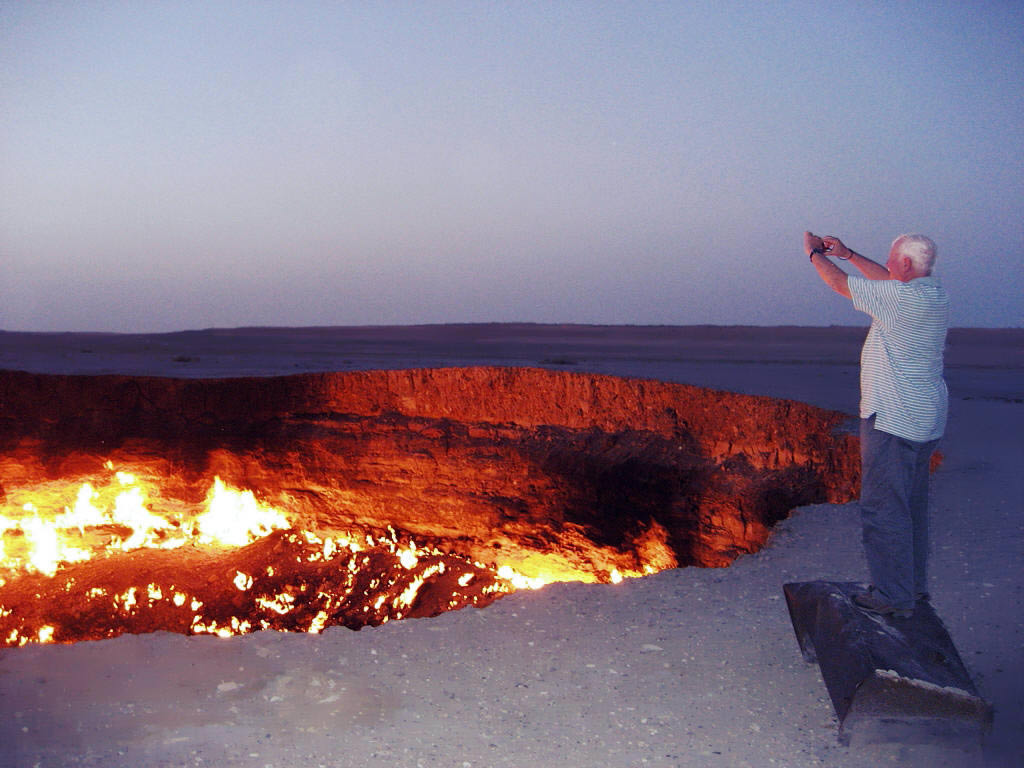
For the small number of travelers who make it there, the crater is an extraordinary experience, precisely because it is so remote and so unlike anything else. Turkmenistan is one of the least-visited countries in the world, with tight controls on tourism, and reaching Darvaza involves a long drive across the desert from the capital, Ashgabat, some 160 miles or so to the south, usually as part of an organized trip with a guide and often with an overnight camp near the rim so the crater can be seen after dark, when it is at its most dramatic.
There is a real hazard worth stating plainly. The crater is not fenced, the ground near the edge is unstable, and the combination of a crumbling rim, intense heat, and toxic fumes makes approaching too closely plainly dangerous. The spectacle is best appreciated with a healthy respect for the fact that it is, functionally, a very large, very hot, very deep pit of burning gas with no barriers around it. Visitors who treat it with caution are rewarded with one of the most surreal sights on Earth: a field of fire in the middle of an empty desert, roaring and glowing under the stars.
The Accident That Wouldn’t End
The Darvaza crater endures in the imagination because it collapses the distance between the mundane and the mythic. Its cause is about as unromantic as it gets — a Soviet drilling operation, a collapsed rig, a decision to burn off a leak — and its result looks like a literal gateway to the underworld, blazing away in one of the emptiest places on the planet. It is a monument to a small human miscalculation that has outlived the Soviet Union that produced it.
Whether it was lit in 1971 or years later, whether it lasts another decade or is truly beginning to fade, the crater has already earned its place as one of the great accidental wonders of the world. Somebody expected a fire to burn out in a week. Fifty-plus years later, it is still throwing orange light across the dunes every single night — a reminder that human beings are entirely capable of starting things they have no idea how to stop.
Like our content? Follow us for more.