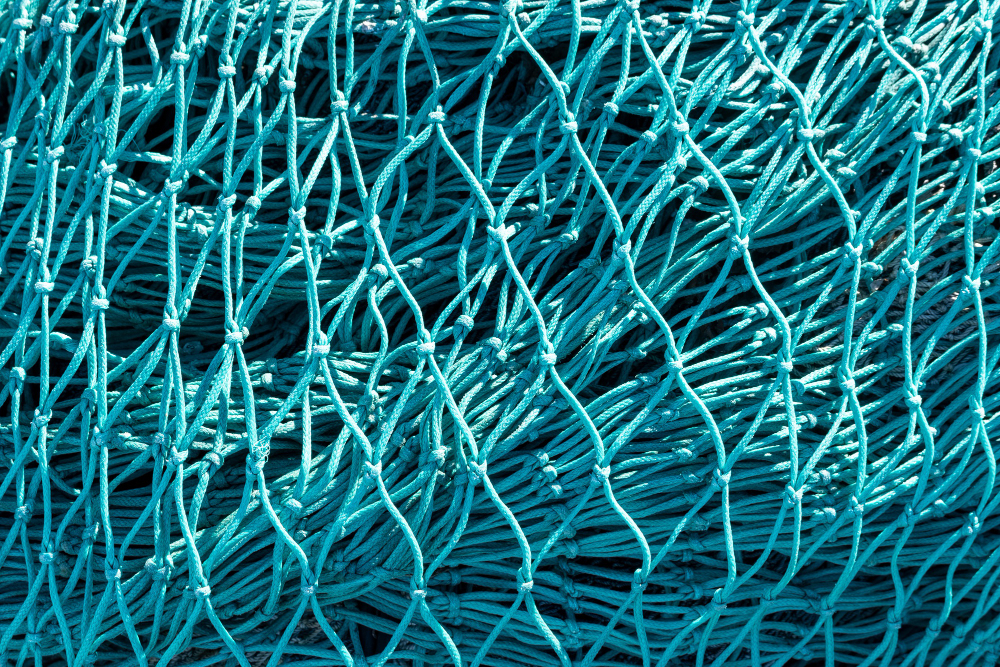
There is a category of object where the useful part is the absence rather than the substance, and netting is the clearest example.
A net is mostly nothing. The material forms a grid and the openings are what does the work, which makes it an unusual thing to design — the specification is about the holes, and the material is whatever is needed to keep them the right size and in the right place.
That inversion has consequences throughout. It determines how a net is made, why the knot matters so much, how the shape behaves in water, and why the single most regulated property of a net anywhere in the world is the size of the gap.
Why the Knot Is the Component

The junction is where the engineering sits, which is counterintuitive.
A net is a grid of openings, and each opening is defined by four junctions. If those junctions slide, the openings change size and shape under load, and the net stops doing what it was made to do.
So the knot has to hold position under tension from several directions, repeatedly, while wet, without tightening so far that it cannot be untied for repair and without loosening as it is worked.
That is a demanding specification for a knot, and the ones used for netting are specific arrangements chosen for exactly those properties rather than general-purpose knots.
Knotless netting exists, produced by weaving or moulding the junction rather than tying it, which removes the bulk at each junction and reduces drag and weight.
The trade is repairability. A knotted net can be cut and retied by anybody with a needle and material; a knotless one generally cannot be mended the same way, which matters enormously for something that is damaged constantly.
Like our content? Follow us for more.
The Mesh Size Question
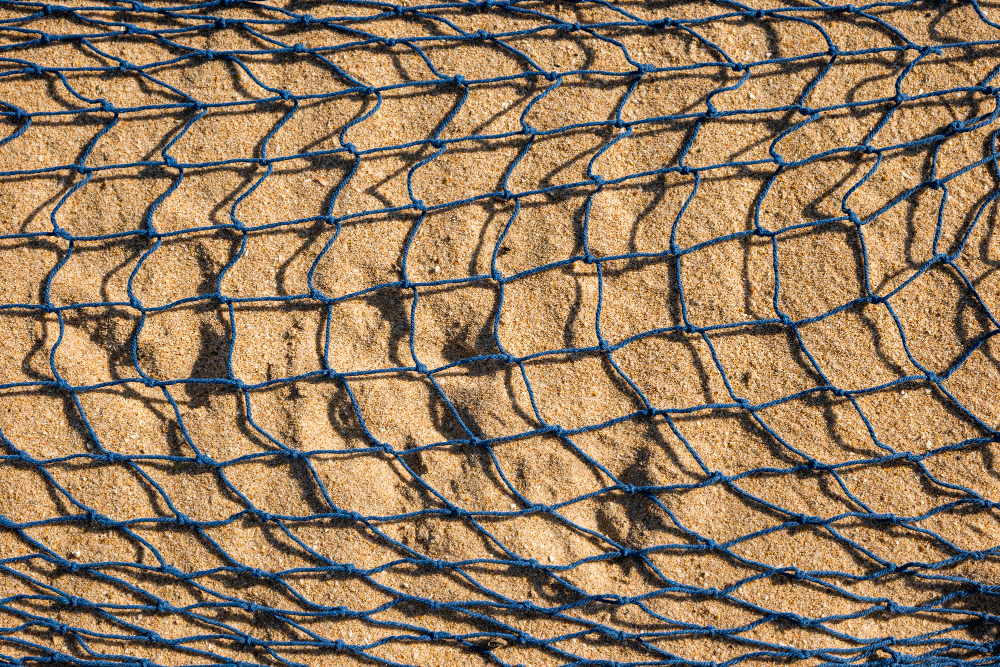
The single dimension is the whole subject and its consequences run in every direction.
A smaller opening catches smaller things, retains more of what enters, and also drags far more water, weighs more for the same area and requires more material.
A larger opening lets more pass, drags less, is lighter and cheaper, and catches only larger items.
Because the relationship is between the size of the opening and the size of what is being caught, the same net is highly selective at one size and indiscriminate at another — and the selectivity is the property that everything else follows from.
That is why mesh size is regulated. It is the most effective single control available over what a net does, it is easy to measure, and it has a direct and predictable relationship to what is retained.
The measurement itself is defined carefully, since a diamond-shaped opening measures differently depending on which way it is stretched, and the specification has to state how it is assessed.
Shape, Weight and Float

A net has to hold a form in water, and achieving that is a separate problem from the netting itself.
A sheet of netting in water has essentially no shape of its own. It follows the current, collapses, folds and drifts.
So nets carry weights along one edge and floats along another, which holds the sheet extended vertically and keeps it oriented.
The balance between those determines how the net sits and how it responds to current, and adjusting it is a substantial part of how a net is set up for particular conditions.
Larger structures require more: frames, spreading devices, lines under tension and arrangements that use the water flow itself to hold the mouth open.
That last principle is elegant. A shape designed so that water passing through it generates outward force keeps itself open while moving, which means the structure requires no rigid frame at all.
What Holds the Shape Under Load
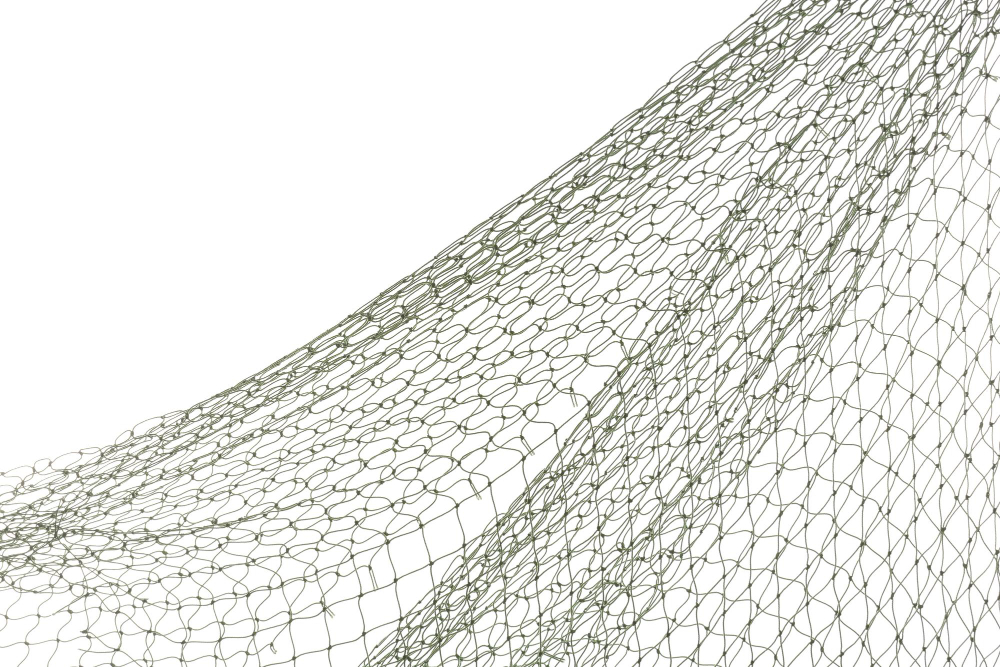
A structural point belongs here because it determines how a net behaves when working.
Netting has almost no resistance to being pulled out of shape. A square mesh under diagonal tension becomes a diamond, the openings narrow in one direction and widen in the other, and the effective size changes completely.
That deformation is not a fault; it is inherent to a structure of flexible members meeting at points, and it is why the orientation of the mesh relative to the load matters enormously.
Some arrangements exploit it, since a mesh that narrows under load holds more securely. Others must prevent it, which requires bracing the structure in the direction it would otherwise distort, generally with lines running through it under tension.
That is why larger nets carry ropes woven through the mesh at intervals. Those lines take the load, hold the geometry and transmit force to the frame, and the netting between them does the work it was made for without being asked to carry the structure as well.
The division is a good piece of engineering. One component holds the shape and takes the tension, and another provides the openings — each doing the job it is suited to rather than both being asked to do both.
Why Nets Are Always Being Mended

Damage is constant and repair is a permanent activity rather than an occasional one.
Nets snag on obstructions, tear under load, abrade against surfaces, degrade in sunlight and are damaged by whatever they catch.
Because the structure is a grid, damage is local — a hole in a net is a hole, and the rest continues working, which means repair rather than replacement is almost always the answer.
That produced a skilled trade and a body of technique concerned entirely with putting material back into a grid so that the openings return to their original size, which requires counting and matching rather than simply filling the gap.
A badly mended net has openings of the wrong size in the repaired area, which changes what it does there, so the standard of repair matters functionally rather than aesthetically.
And the materials have changed the calculation. Natural fibre netting rotted, required drying, was treated with preservatives and had a limited life; synthetic netting does not rot, lasts far longer and has created a substantial problem when it is lost or discarded, because it continues to exist and to function without anybody operating it.
That last point is a real and well-documented consequence of a material improvement, and it is one of the clearer examples of a durability gain producing a disposal problem.
Making One
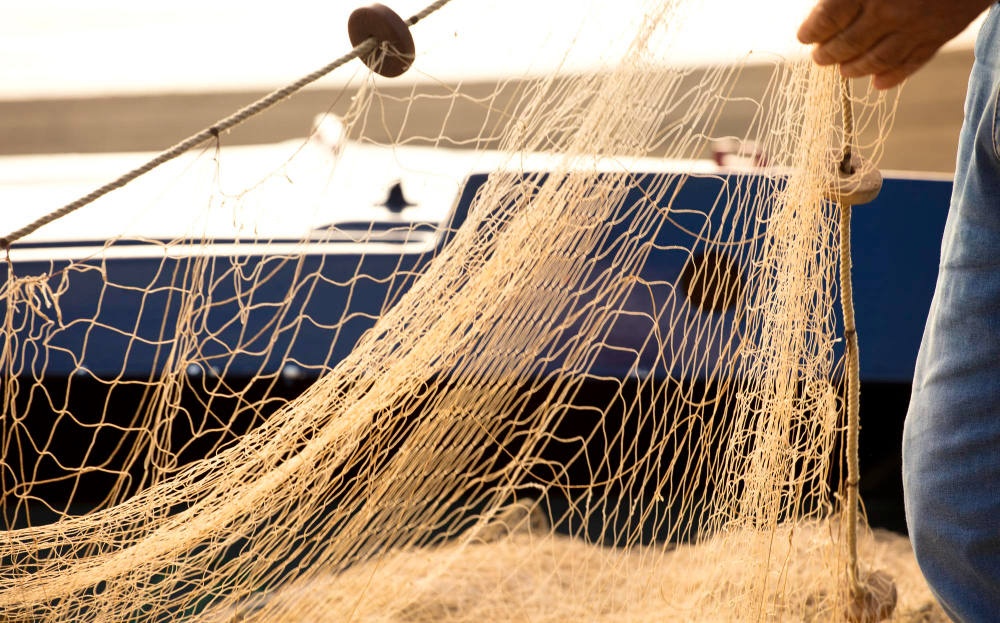
The manufacture is worth describing because it explains why netting was so labour-intensive.
A net is built row by row, with each new opening formed by tying material to the row above, which means the whole structure is produced sequentially and cannot be assembled in parallel.
The maker works with a shuttle holding a length of material and a gauge — a flat piece sized to the required opening — which the material is wrapped around before each knot, so that every opening comes out identical.
That gauge is the specification made physical. Change it and the entire net changes, and using a worn or wrong one produces a net that is subtly the wrong size throughout.
Shaping is achieved by adding or omitting openings in a row, which widens or narrows the sheet — the same technique as shaping any knitted or looped structure, and it allows flat netting to be built into three-dimensional forms.
That is truly skilled work and it was enormously slow, which is why netting was expensive before machinery and why a net was a substantial asset rather than a consumable.
Machine netting removed the labour and removed the flexibility with it, since a machine produces uniform sheet and the shaping is done afterwards by cutting and joining — which is why hand-made and machine-made nets differ in construction rather than only in cost.
The Other Things Nets Do
The principle extends well beyond the obvious application, which is worth noting.
Nets are used to contain rather than to catch — in cargo handling, in safety barriers, in agriculture to protect crops from birds, and in construction.
They are used to separate, allowing air or water through while holding something back, which is what a sieve does at small scale and a screen does at large scale.
They are used structurally, since a net in tension is an extremely efficient way to span a space with very little material, and tensioned mesh structures exploit exactly that.
And they are used to slow things, since the drag of a fine mesh in air or water is substantial relative to its weight, which is the principle behind several kinds of brake and barrier.
Every one of those uses the same trade: a specified opening size, held in position by the minimum material, chosen so that what passes through and what does not are the right things.
Which is what makes netting worth thinking about as a designed object rather than as a piece of equipment. It is one of the few things where the specification is written entirely about the parts that are not there.
And it is an unusually pure piece of design for that reason. Every decision is about a dimension of nothing, held in place by the least material that will hold it — which is about as close to designing an absence as anybody gets.
Like our content? Follow us for more.