

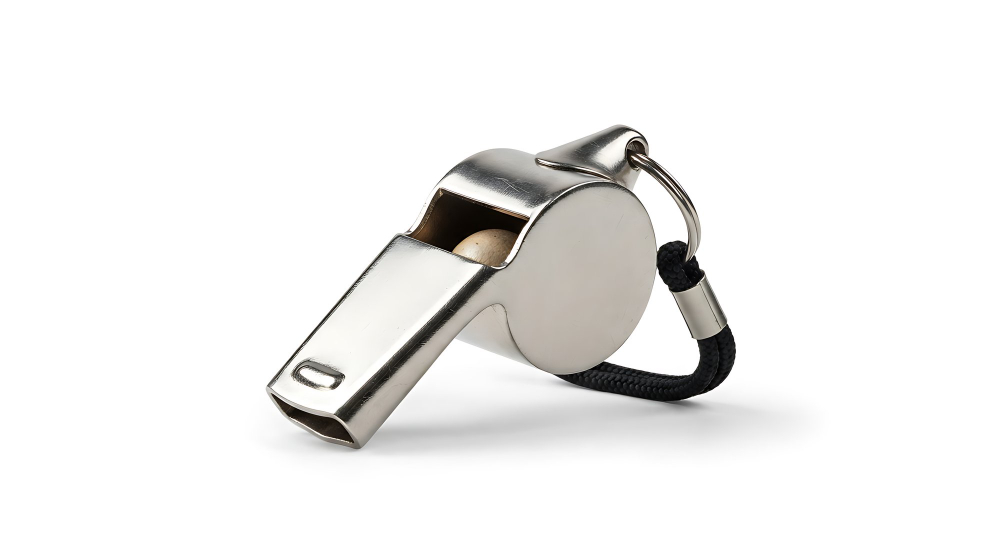
There is a useful principle about signals that applies well beyond sound, and whistles are the clearest everyday demonstration of it.
The principle is that being heard is a matter of standing out from what else is present rather than of being loud in absolute terms.
A shout is loud and contains energy spread across a wide range of frequencies, most of which is in the same region as wind, traffic, machinery, water and voices — so a substantial proportion of the effort produces sound that is competing with whatever else is there.
A whistle concentrates almost all of its energy into a very narrow band, chosen so that little else is present in it, and that concentration is worth far more than raw output.
Understanding why explains the design of the object, why certain frequencies were chosen, and why the same principle appears in a great many warning devices that have nothing to do with whistles.
How the Sound Is Made
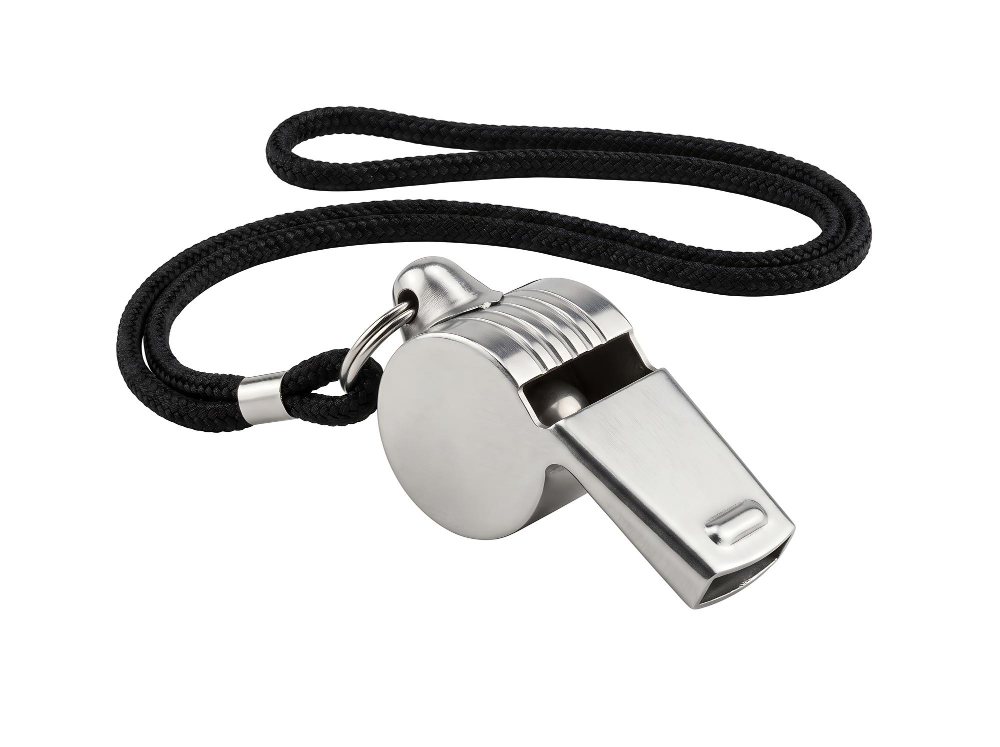
The mechanism is not obvious and is frequently described wrongly.
Air blown through a narrow slot forms a thin fast-moving sheet, which is directed at a sharp edge.
That sheet is unstable. Small disturbances cause it to deflect to one side of the edge, then the other, and the deflection oscillates — the jet flips back and forth across the edge at a rate determined by the geometry and the airspeed.
Each flip pushes air into or out of the chamber behind, which generates a pressure wave, and the oscillation is what produces the tone.
The chamber then does the important part. It has a natural frequency, determined by its volume and the size of its opening, and it responds strongly at that frequency and weakly at others.
That response feeds back to the jet, locking the oscillation to the chamber’s preferred rate — so the pitch is set by the chamber rather than by how hard anybody blows, which is why a whistle produces essentially the same note across a wide range of effort.
Like our content? Follow us for more.
Why That Frequency
The choice of pitch is deliberate and it exploits a property of hearing.
Human hearing is not equally sensitive across its range. It is substantially more sensitive in a band roughly corresponding to the upper part of speech, and less sensitive above and below it.
That means a sound in the sensitive band is perceived as substantially louder than a sound of identical physical intensity outside it.
Whistles are tuned into that band, which means the perceived loudness is far greater than the energy involved would suggest.
The band is also relatively quiet in most environments. Wind, traffic, machinery and water produce a great deal of low-frequency energy and comparatively little in the sensitive band, so a whistle is competing with less.
And the combination compounds. A frequency where the ear is most sensitive and the background is least present produces a signal that stands out by a considerable margin, using very little power.
The Two-Tone Trick
A refinement found in many whistles is worth explaining because it is deliberate.
A single pure tone is easy to confuse with other single tones, can be masked by a background component at the same frequency, and can be difficult to locate directionally.
Two tones sounded together that are close but not identical produce a beating effect — a regular pulsing as the two waves reinforce and cancel — which is highly distinctive and does not occur naturally.
That pulsing is also easier to detect in noise, because the pattern is recognisable even when the individual tones are partially masked.
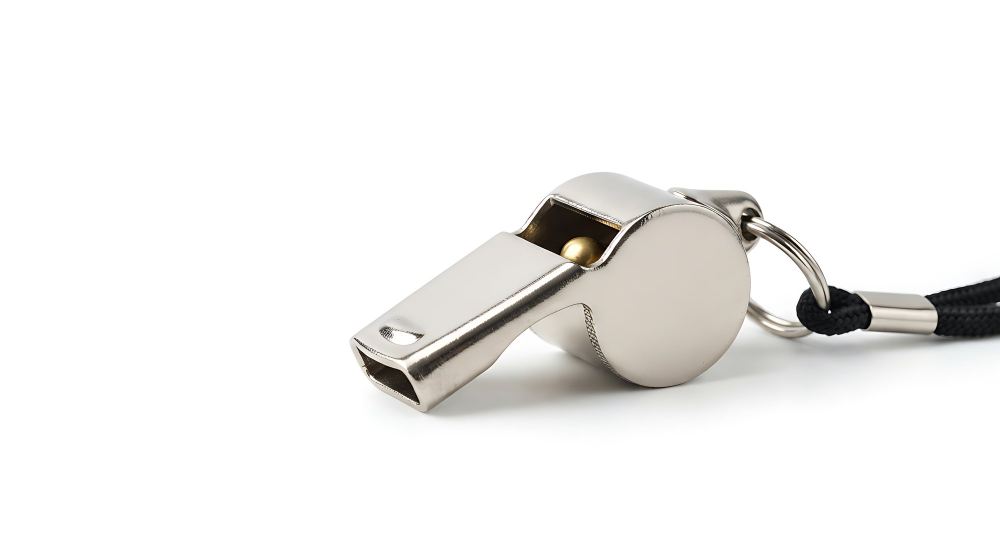
Some whistles achieve it with two chambers of slightly different size; others use a loose object inside a single chamber, which interrupts the airflow irregularly and produces a warbling rather than a steady tone.
That loose object is the pea, and its function is to make the sound irregular rather than to make it louder — which is why a whistle without one sounds thin and is harder to pick out.
The Chamber Sets the Note
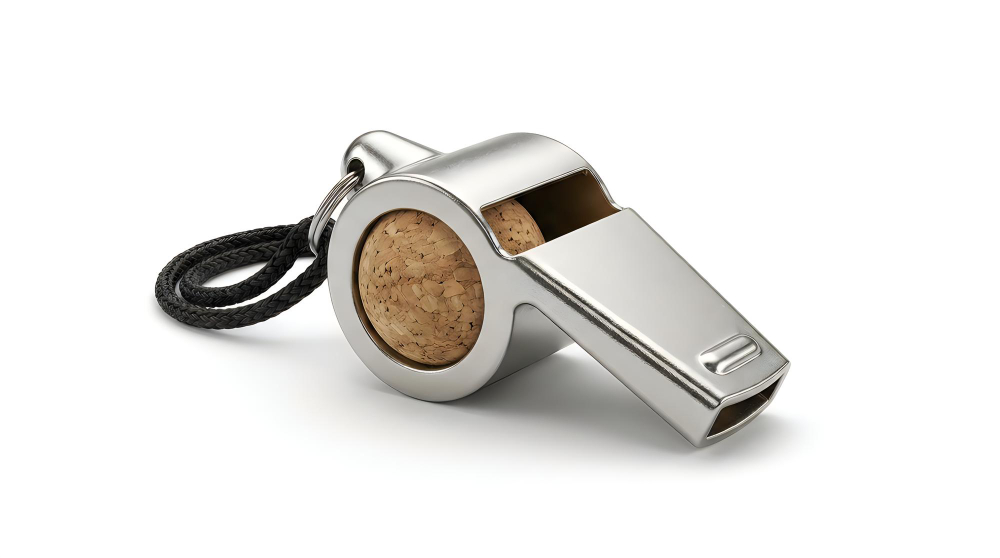
One aspect of the design deserves separating out, because it explains the shape of the object.
The resonant frequency of an enclosed volume with an opening depends on the size of the volume and the dimensions of the opening, in a relationship that means a smaller chamber produces a higher note.
That is why small whistles are shrill and larger ones are lower, and why the pitch cannot be changed by blowing harder — the chamber responds at its own frequency and ignores attempts to drive it at another.
It also means the external shape is largely irrelevant. What matters is the internal volume and the opening, so two whistles that look entirely different can sound identical, and two that look similar can differ.
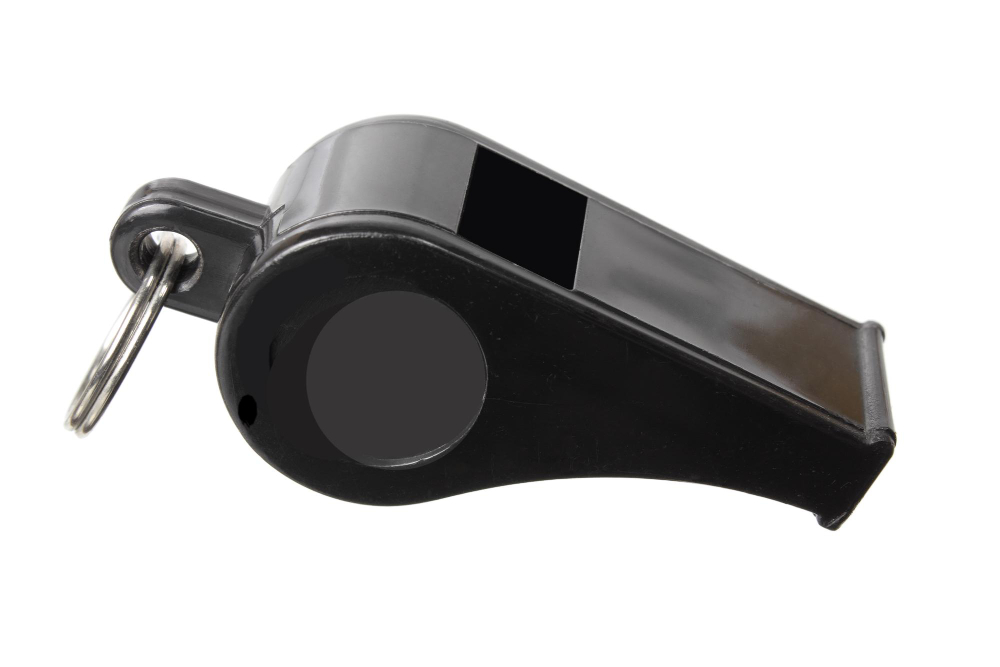
The material matters less than people assume, for the same reason. A chamber of the right dimensions produces the same note in metal or plastic, since the air is doing the resonating rather than the walls.
What the material does affect is durability, cost, how it behaves when cold and wet, and how much the walls absorb — which changes the loudness slightly rather than the pitch.
That is why the object has the proportions it does. Every dimension is set by the acoustics, and the visible design is constrained to whatever leaves the internal geometry correct.
Directionality and Its Absence
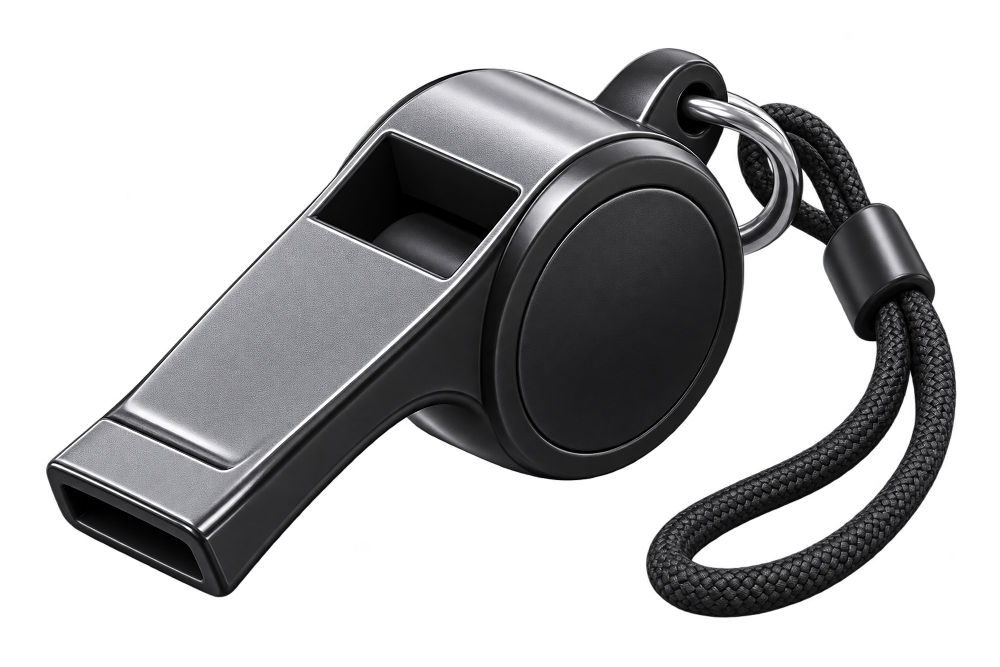
A limitation worth stating balances the picture.
Higher frequencies are easier for hearing to locate, because the head casts an acoustic shadow at those wavelengths and the difference between the ears carries directional information.
Whistle frequencies are high enough to be reasonably locatable, which is useful.
They are also directional in emission, meaning the sound is projected more strongly in some directions than others, so which way a whistle is pointing matters more than people assume.
And they are readily blocked. High frequencies do not travel around obstacles well, which means a whistle behind a wall, a hill or dense vegetation is attenuated far more than a low-frequency sound would be.
That is the trade underlying the whole design. The frequencies that carry furthest in open conditions and cut through noise are the same frequencies that are stopped by obstacles — which is why low-frequency signals are used where obstruction is the problem and high-frequency ones where distance and noise are.
Why Fingers Work Too
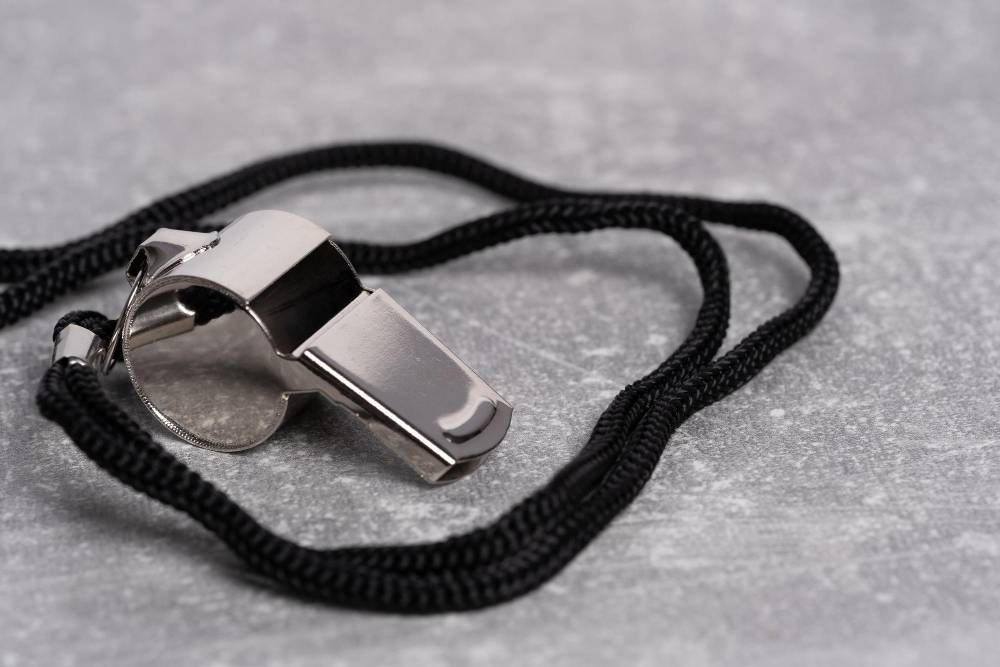
The version made without any object is worth explaining, because it works on the same principle with a different chamber.
Placing fingers in the mouth and blowing produces the same jet-and-edge arrangement, with the fingers or teeth forming the edge and the mouth cavity serving as the resonating chamber.
That chamber is adjustable, which is why the pitch can be varied by changing the shape of the mouth and the position of the tongue — and why the technique is difficult, since the geometry must be held precisely for the oscillation to lock.
The output is frequently louder than a manufactured whistle, because the chamber is larger and the airflow available is greater.
Whistling without fingers uses the lips as the slot and the mouth as the chamber, and produces a much purer and quieter tone, because the arrangement is more stable and the energy involved is lower.
That is why one is used for music and the other for signalling. The same physics, adjusted for a different requirement, produces either a controllable pure tone or a loud harsh one, and nobody can do both at once.
And the difficulty of learning either is a geometry problem rather than a breathing one, which is why instruction rarely helps and why people either find the position or do not.
The Same Logic Elsewhere
The principle appears in a range of devices designed to be noticed.
Alarm and alert tones are selected in the sensitive band for the same reason, and frequently use rising or pulsing patterns rather than steady ones, because a changing sound is harder to ignore than a constant one.
Emergency vehicle signals combine several tones and vary them continuously, which aids both detection and location.
Devices intended to be heard by animals use entirely different frequencies, because the sensitivity curve of the intended listener is different — and a signal inaudible to one species can be conspicuous to another.
And devices intended to be located rather than merely heard — beacons, locators, personal alarms — use patterns specifically because a varying signal is far easier to home in on than a steady one.
That family resemblance is the useful observation. Every one of those devices is solving the same problem: producing a signal that a particular listener will notice, against a particular background, with limited power available.
Which is what a whistle does with a slot, an edge, a small chamber and something loose rattling around inside it — arriving at an answer that is difficult to improve on and that costs almost nothing to make.
And that is the part worth appreciating. The whole thing is an argument about what a particular listener will notice against a particular background, settled in favour of a very small object producing a very narrow band of sound – which is a more considered piece of design than anything about it suggests.
Like our content? Follow us for more.

