
The round cover is a famous interview question with a famous answer, and the famous answer is correct but incomplete. Roundness solves one problem extremely well. The lid is solving five or six others at the same time, and several of them explain features people look at daily without registering that they are features at all.
The Geometry, Properly Stated

A square lid has a diagonal longer than its side. Stand it on edge, turn it forty-five degrees to the opening, and it passes straight through. The same is true of a rectangle, a triangle and a hexagon: every straight-sided shape has a longest dimension greater than its shortest, and that difference is the gap it can fall through.
A circle has the same width in every direction. There is no orientation in which it is narrower than its own hole, so it cannot be dropped in, however it is handled.
That matters because these covers are heavy, they are moved by hand, and there is often somebody working directly underneath. A lid that can fall down the shaft is a lid that will eventually fall down a shaft onto a person.
The geometric property is not unique to circles. Any shape of constant width will do it, and there are others – a Reuleaux triangle, the curved shape on a British fifty-pence piece, has the same property and would also be undroppable. Circles win on other grounds: they can be rolled to where they are needed, they seat correctly however they are turned so nobody has to line them up, and a circular casting distributes stress evenly with no corners to crack from.
The corner point is worth dwelling on. A sharp internal corner concentrates stress, and a repeatedly loaded square plate will crack from its corners. A disc has nowhere for a crack to start preferentially.
Like our content? Follow us for more.
The Weight Is a Security System

A cast iron cover of ordinary size weighs something in the region of fifty to a hundred kilograms, and that is not simply a consequence of being strong enough.
It has to resist being lifted by traffic. A heavy vehicle passing over creates suction behind it, and a light cover would be picked up and dropped, or displaced entirely. Weight holds it down.
It also has to be inconvenient to remove. There is no lock on most covers, and the security is that a single person cannot casually lift one and walk away with it, particularly without the purpose-made key that engages the slots.
This is also why cast iron persists in an age of better materials. Composite covers exist, are lighter, do not conduct electricity, are not worth stealing and are used in some places. They have not displaced iron everywhere, partly because being light is a disadvantage as well as an advantage, and partly because iron’s failure behaviour is well understood by everyone who works with it.
The theft problem is real and follows directly from the material. When scrap metal prices rise, covers disappear from streets in large numbers, leaving open shafts in roadways. Some authorities now use covers that are hinged or bolted to the frame for exactly this reason.
The Pattern Is Not Decoration
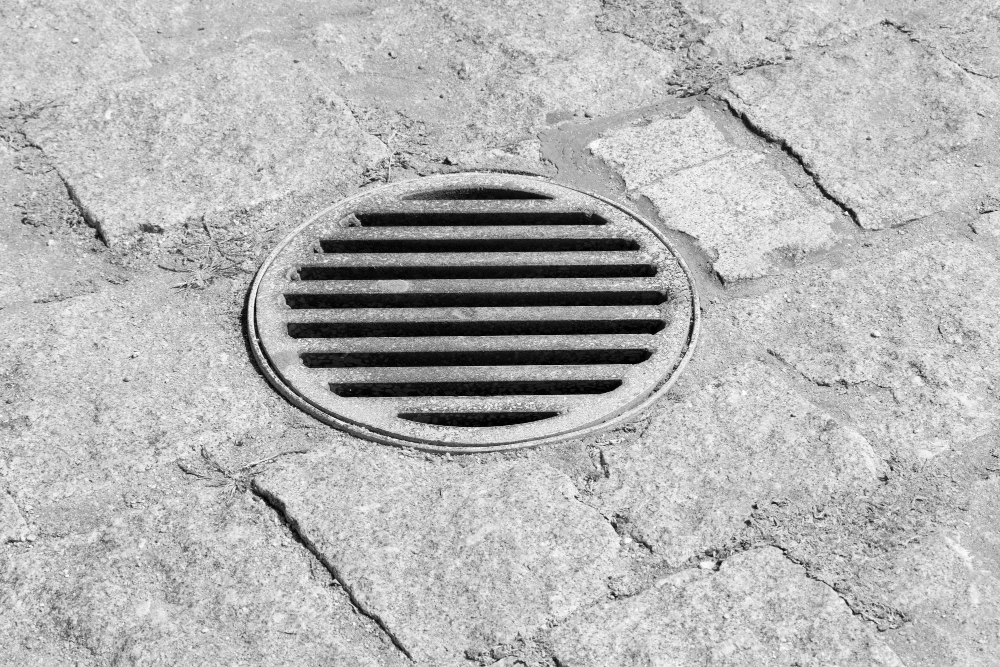
The raised geometry on the top – diamonds, squares, hexagons, concentric rings – is a working surface.
Its primary job is grip. A flat iron plate, wet, is treacherous, and a cover sits in a road or a footway where vehicles brake and people walk. The raised pattern gives tyres and shoes something to bite on, and the gaps between raised elements let water drain away so a film cannot form across the surface.
The pattern also stiffens the casting. A plate with raised ribs on it resists bending far better than a smooth plate of the same weight, which is the same principle that makes corrugated material stiff. Some of what looks decorative is structural depth.
And it wears. A cover in a busy road is polished smooth over years by traffic, which is why old covers in heavily used streets are noticeably slipperier than new ones and why replacement is driven by surface wear rather than by structural failure.
Covers also carry cast lettering identifying the utility, and sometimes a date and a foundry. This is functional: a person standing in the street needs to know whether the shaft beneath contains water, gas, electricity or telecommunications before opening anything, and the lid is the label. It has also made them collectable, and in some cities the designs are distinctive enough that enthusiasts photograph and catalogue them.
The Frame Is the Part That Fails
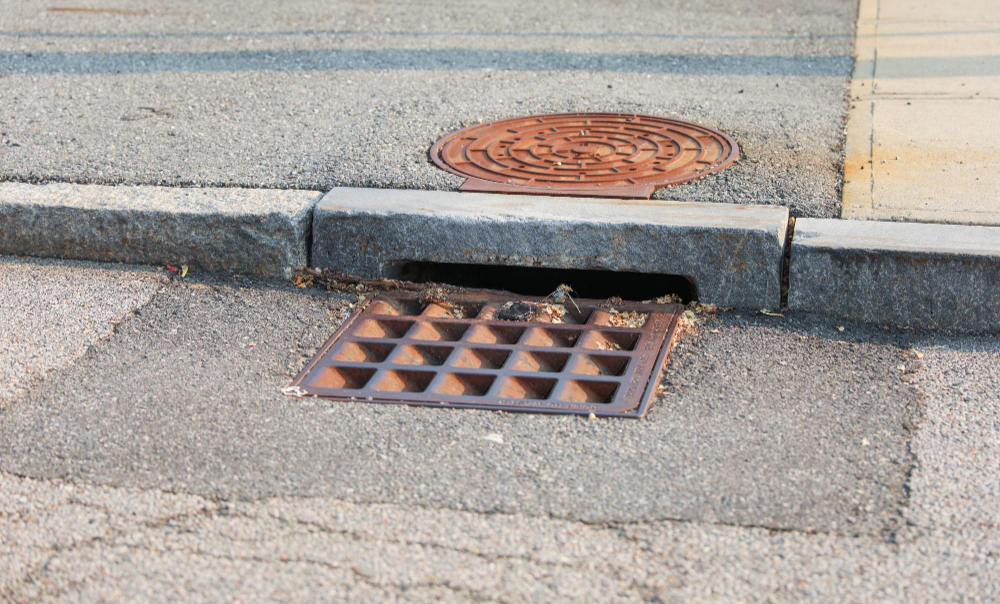
The cover gets the attention and the frame does the difficult job.
The frame is the ring bedded into the road surface, and the cover sits in it. Almost every problem with a street cover is a frame problem.
A cover that rattles under traffic is one whose seating has worn, so it rocks slightly on each wheel that crosses it. That rocking is both the noise and the mechanism of further wear, since each rock hammers the seat.
A cover that has sunk relative to the road is a bedding failure: the mortar or concrete under the frame has broken down, and the frame has settled while the road around it has not. The result is a depression that vehicles drop into, which accelerates everything.
A cover proud of the surface is usually the reverse – the road was resurfaced around it and the frame was not raised to match, or the road has worn down while the frame has not.
This is why replacing a cover is rarely a matter of replacing a cover. It means breaking out the road around the frame, resetting or renewing the frame, and rebuilding the surface, which is why a job that looks like swapping a lid closes a lane for a day.
Not All of Them Are Round, and the Exceptions Prove the Rule
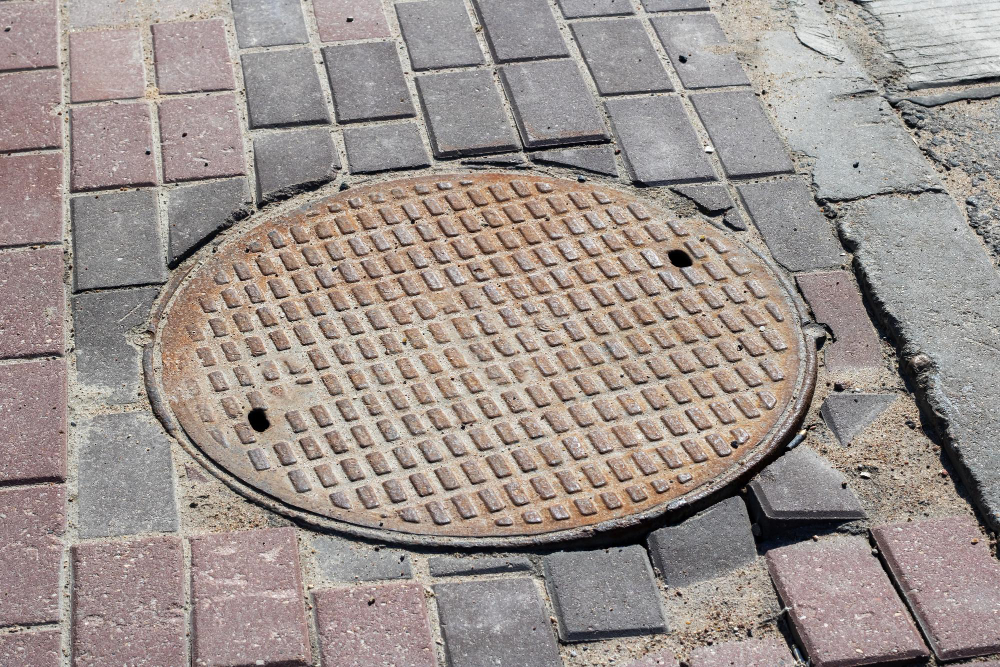
Rectangular access covers exist in quantity, and noticing where they are makes the logic clearer.
They are common in footways, in service ducts, in private yards and over long narrow chambers such as cable runs and valve pits. What those places have in common is either that nobody is working directly below a shaft, or that the chamber is not a vertical shaft at all but a long trough with a wide opening, so a lid cannot fall in regardless of its shape, or that the cover is one of several over a continuous run.
The round cover belongs specifically to the vertical shaft that a person climbs down. Where that is the situation, the shape is round. Where it is not, other shapes are used freely, and they are used because rectangles are easier to lay out in rows, easier to fit into paving patterns and better suited to covering a long opening.
The interview answer, in other words, is right about the case it describes and would be wrong as a general statement about covers in the street.
Why They Sit Where They Do, and Why That Is Being Rethought
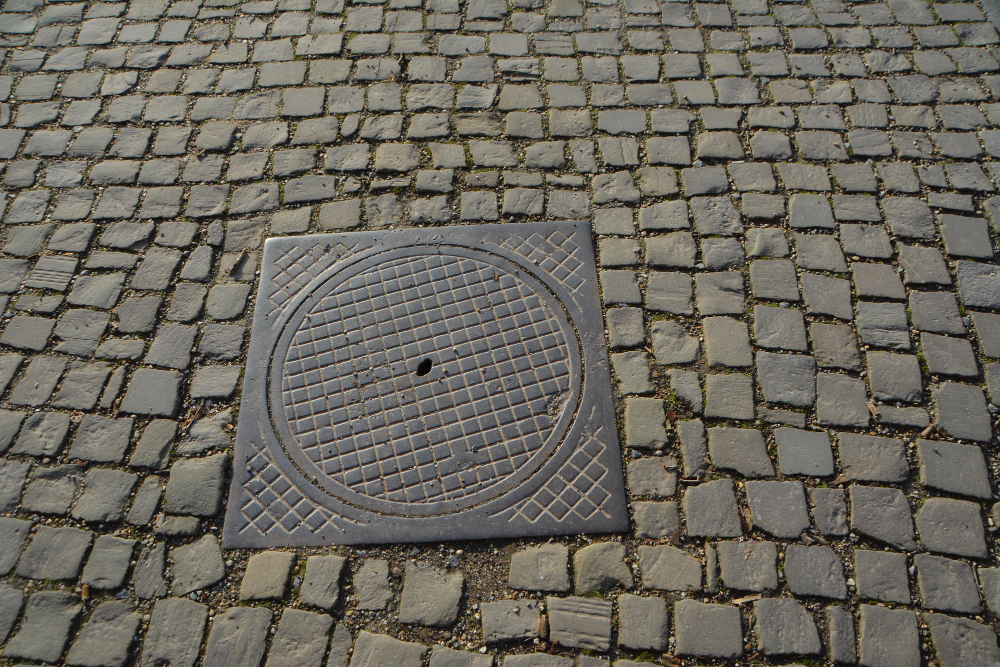
The position of a cover in a road is not arbitrary, and it has been getting more attention as traffic has changed.
Historically, chambers were built where the pipe or cable needed them – at junctions, bends, changes of gradient and at regular intervals along a run so that the length between access points was short enough to work along. The road was then laid around them. Since the pipes usually follow the line of the street, and the street’s centre was the natural place to run them, a great many covers ended up in wheel paths.
That turns out to be the worst place for them. A cover in the wheel path takes a concentrated, repeated load from every vehicle, which wears the seating, loosens the frame and breaks down the bedding. A cover a metre to the side takes a fraction of the punishment and lasts considerably longer.
It is also the worst place for two-wheeled traffic. Metal in a road is more slippery than the surface around it, particularly when wet, and a cover in the line a cyclist or a motorcyclist would naturally take is a hazard that the rest of the road is not. Where new work allows it, covers are now placed away from wheel paths and out of cycle lanes, and existing ones are sometimes moved during resurfacing.
None of that is possible everywhere, because the chamber has to be over the thing it gives access to. But it explains why newer streets often have their ironwork arranged in a line along the edge rather than scattered down the middle, and it is one of the few visible differences between a road laid recently and one laid decades ago.
What Is Actually Under There
The word manhole is doing a lot of work and is largely being retired in the industry in favour of access chamber, partly for the obvious reason and partly because it implies something that is often not true: that a person goes in.
Many covers give access to a chamber that nobody enters. Beneath is a small void containing a valve, a stop tap, a cable joint or a meter, reached with a tool from above. Others cover proper shafts with steps down into a sewer, a duct large enough to walk along, or a junction chamber.
The ones people do enter are treated as seriously dangerous. Confined spaces can accumulate gases or lose oxygen, and entry is a controlled procedure with testing, ventilation and a person stationed at the surface. This is one reason the covers are heavy and unlabelled as to their contents beyond the utility name: opening one is not an ordinary act.
Many covers also have small holes or slots, which serve as lifting points for the key and, in some designs, allow a small amount of ventilation – though sealed covers are used deliberately where gas or odour must not escape.
So the disc in the road is a load-bearing, non-skid, self-draining, theft-resistant, labelled, stress-even structural component that cannot be dropped down its own hole in any orientation, sitting in a frame that is doing most of the suffering. It is a remarkably complete piece of design for something nobody has ever looked at on purpose.
Like our content? Follow us for more.