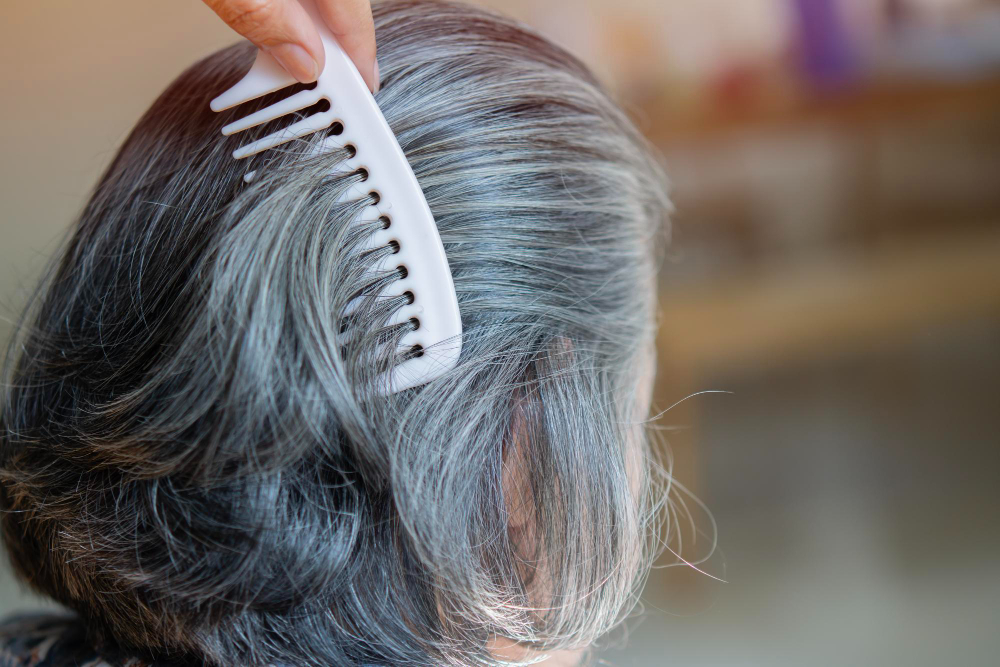
The everyday language is wrong in a way that hides something interesting. People say hair turns grey, goes grey, is going grey, as though the strands on a head are slowly changing. They are not. A hair is a column of dead protein, and it has no machinery of any kind. Whatever colour it had when it was extruded is the colour it has until it falls out.
The Colour Is Injected at the Factory
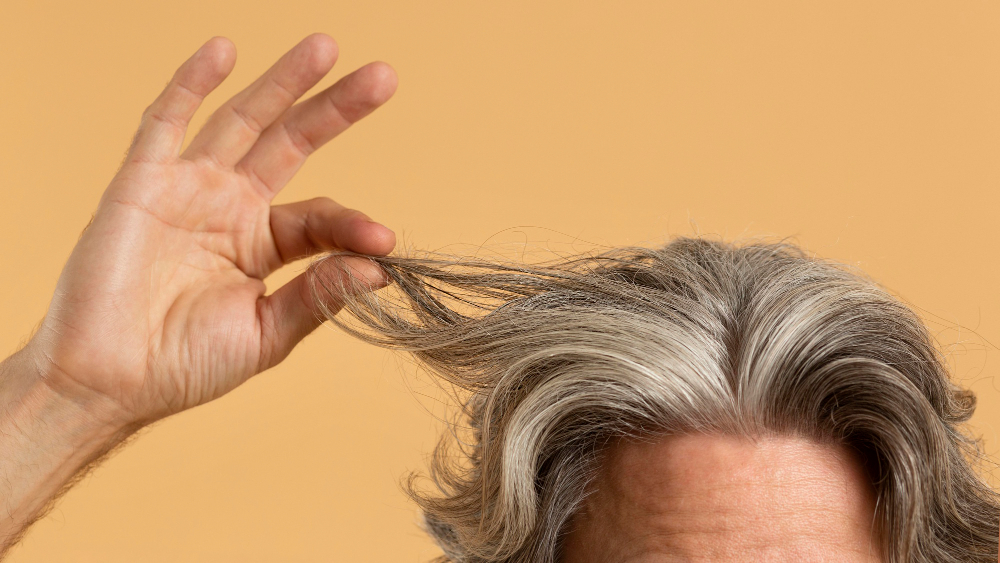
A hair is produced at the base of a follicle, in a small bulb of rapidly dividing cells. Those cells push upwards, fill themselves with keratin, die, and harden into the strand you can see. By the time a hair emerges from the skin, everything in it is dead.
Sitting among those dividing cells is a population of melanocytes, the same pigment-producing cells that colour skin. They manufacture melanin and transfer it into the keratin cells as they form, so the pigment is locked inside the hair as it is built.
There are two kinds. One is dark brown to black, the other is reddish-yellow, and every natural hair colour is a ratio of the two plus how much total pigment is present. Black hair is loaded with the dark type; blonde hair has very little of anything; red hair has an unusual proportion of the second type.
So colour is a manufacturing step. A follicle with working melanocytes produces coloured hair. A follicle without them produces hair with nothing in it.
Like our content? Follow us for more.
Which Means Grey Happens One Follicle at a Time

Every follicle is an independent operation. It has its own pigment cells, its own cycle, its own schedule, and it does not consult the follicle next to it.
This is why greying looks the way it does. It does not wash across a head evenly. Individual strands appear, scattered, while their neighbours carry on unchanged, and the proportion climbs over years as more follicles drop out of pigment production.
It also explains why greying tends to start in particular places – often the temples, often the sideburns – rather than everywhere at once. Follicles in different regions are not synchronised and do not run on the same clock.
And it explains the part that makes the whole subject counter-intuitive. Pluck a grey hair and the follicle will grow another one, and it will also be grey, because the pigment cells are gone. Pluck a coloured one and the replacement will be coloured. The follicle, not the hair, is the thing with a state.
There Is No Such Colour as Grey Hair
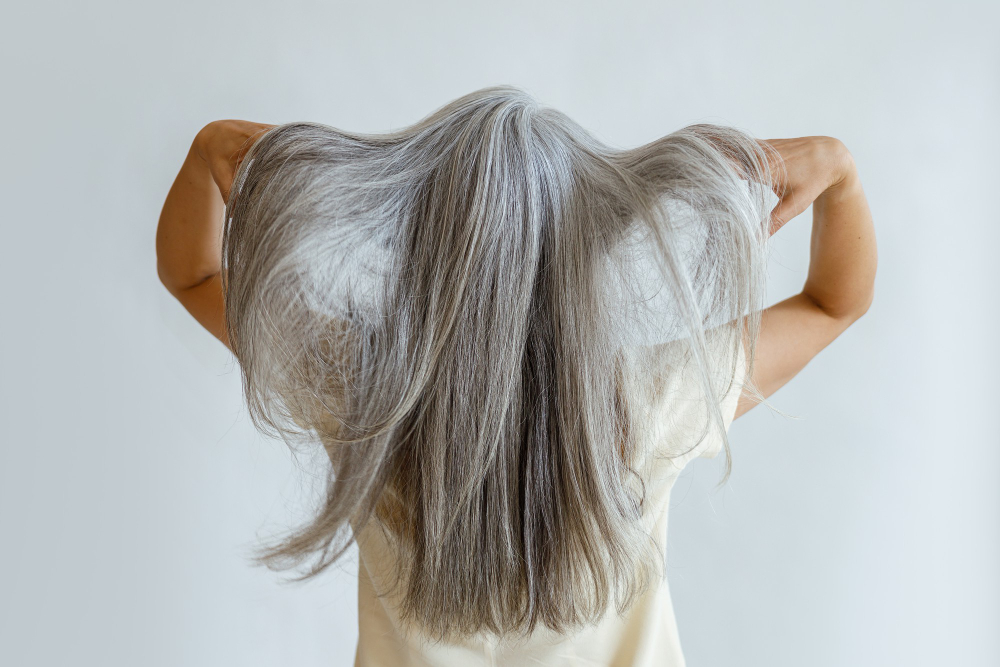
Look closely at a head described as grey and there is very little grey in it. There are white hairs and there are coloured hairs, mixed.
A hair with no pigment is not grey. It is colourless, and it looks white for the same reason that snow, foam and crushed glass look white: the internal structure scatters light of all wavelengths rather than absorbing any.
Grey is what the eye reports when white and dark strands are interleaved at a density it cannot resolve individually. It is an optical average of a salt-and-pepper mixture, which is why a head looks greyer from across a room than it does close up, and why the same head can read as grey in one light and distinctly white-and-brown in another.
There is a second contribution. Unpigmented hair is slightly translucent, so light passes into it, and hair that is going white often looks silvery rather than flatly white for that reason.
The Cells Run Out, and the Reason They Run Out Is the Interesting Part

Melanocytes in a follicle do not last forever. They are replenished from a reserve of stem cells sitting higher up in the follicle, which supply fresh pigment cells each time the follicle restarts a growth cycle.
Greying occurs when that reserve fails. The leading account is that the stem cells are progressively lost or stop responding to the signals that would mobilise them, and once that reserve is exhausted, a follicle cannot produce new melanocytes and has no way to restart. The hair it grows from then on has no pigment.
Why the reserve fails is not fully settled, and it appears to be several things at once. Accumulated damage plays a part: the process of making melanin is chemically aggressive and generates reactive compounds, so the pigment cells are, in effect, poisoned slowly by their own product. Follicles also produce hydrogen peroxide in small quantities as a by-product of normal metabolism, and the enzyme that normally breaks it down becomes less effective with age, allowing it to accumulate and interfere with pigment production. Recent work has also suggested that some stem cells become stuck in a state where they neither mature into pigment cells nor return to the reserve.
All of these are active areas of research rather than settled fact, and the honest summary is that the mechanism of the failure is understood in outline and disputed in detail.
Genetics Sets the Timetable, Not Stress
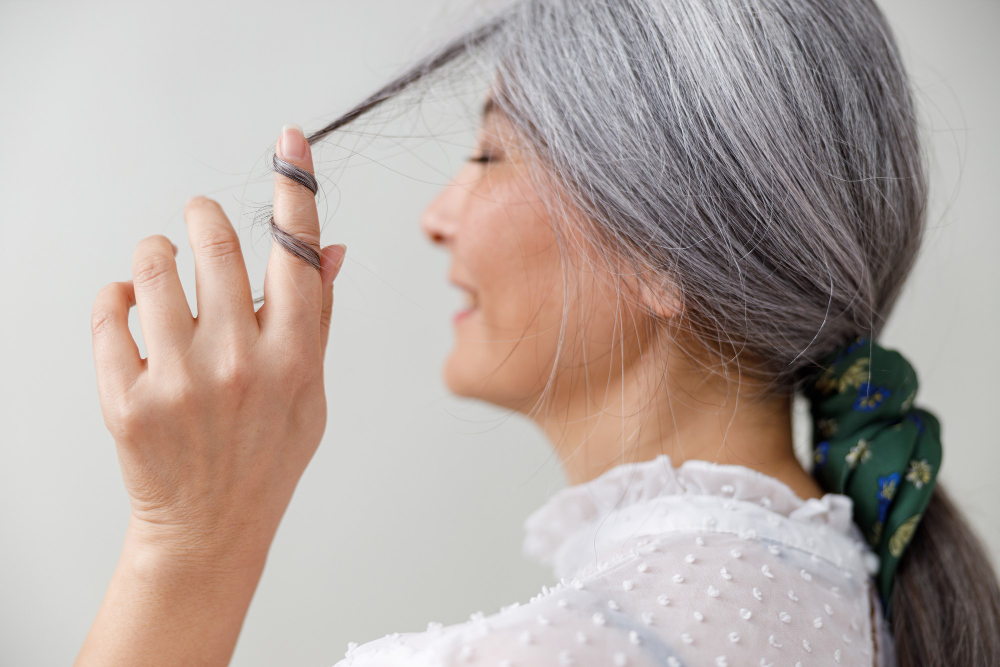
The single largest predictor of when somebody greys is when their relatives did. Timing runs strongly in families, and the first gene identified as affecting greying was found only in the last decade, so the genetic picture is still being assembled.
The folk explanation is stress, and the relationship is real but much more limited than the folklore suggests. Work on mice has shown that intense stress can deplete the pigment stem cell reserve, through the same nerve signalling involved in fight-or-flight, and that once depleted the cells do not come back. That is a real mechanism.
What it does not support is the familiar story of somebody’s hair going white overnight from shock. That cannot happen, because the hair already on the head is dead and unchangeable. Any change has to grow out, at roughly a centimetre a month.
The apparent overnight cases in history are generally explained by a rare condition in which the immune system attacks pigmented hairs specifically, causing them to fall out and leaving the already-white ones behind. The head becomes white rapidly, but nothing changed colour; the coloured hairs left.
There is one more wrinkle. Some research suggests that in humans the greying process may not be entirely one-way, and that individual hairs have been observed regaining pigment when a period of stress ended. That finding is limited and not yet firmly established, so it is best treated as an interesting possibility rather than a fact.
Why the Texture Changes Too
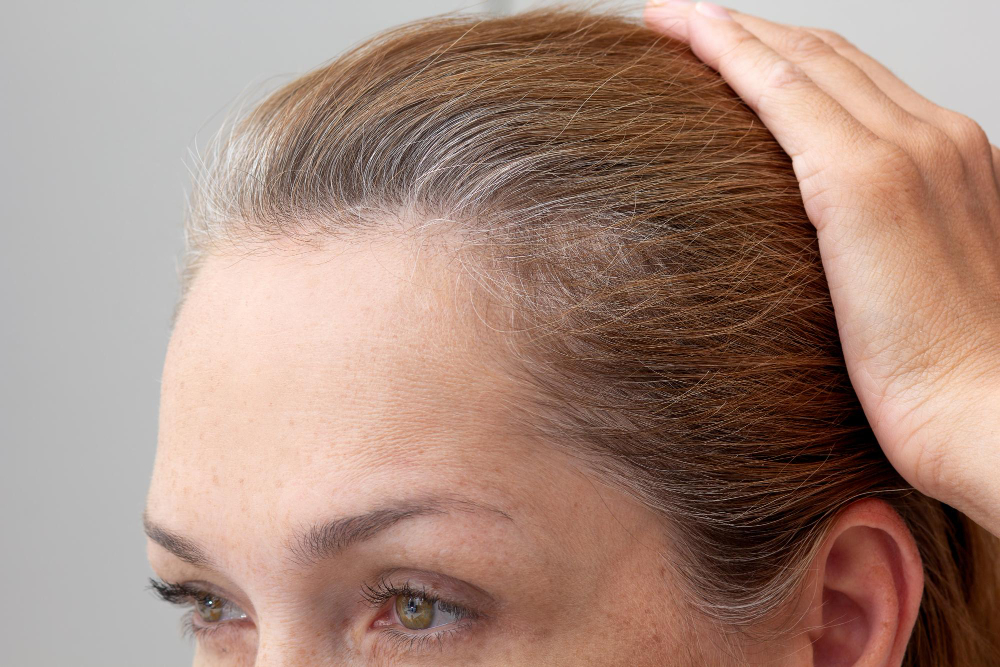
People often report that white hairs feel different – coarser, wirier, more inclined to stand up – and this is not imagination.
The follicle changes in more ways than pigment. Oil production from the associated gland tends to decline with age, so the hair is less lubricated and feels drier and rougher. The strand’s cross-section and the way it curls can change as well.
The result is that a white hair frequently behaves differently in a head of coloured ones, which is part of why the first few are so noticeable. They catch the light differently and they sit differently.
Other Animals Do It, and One Species Uses It

Greying with age is not uniquely human. Dogs and horses grey conspicuously, usually starting around the muzzle, and many other mammals show the same pattern.
Silverback gorillas are the clearest case of the change being informative. The silver back of a mature male is age-related pigment loss in a specific region, and it is read by other gorillas as an indication of maturity and status. The animal is not signalling deliberately, but the signal is nonetheless reliable, because it cannot be faked – it only appears with age.
That is arguably true of human greying too. It is a visible, involuntary and reasonably accurate marker of how long somebody has been alive, and a great deal of effort goes into concealing it precisely because it is difficult to counterfeit in the other direction.
A Colour That Was Never Removed
The useful correction is small and it changes the whole picture.
Nothing on your head is changing colour. Each follicle is a small factory with a supply of pigment cells that it draws from a reserve, and when that reserve is finished, the factory carries on producing hair using the same process minus one step. What comes out is colourless and looks white, and the head looks grey only because the new output is mixed in with the old.
So greying is not decay, and it is not the hair ageing. It is a manufacturing change, made independently by a few hundred thousand separate follicles over a couple of decades, each one on its own schedule, and every strand carries the decision that was made on the day it was built.
Like our content? Follow us for more.