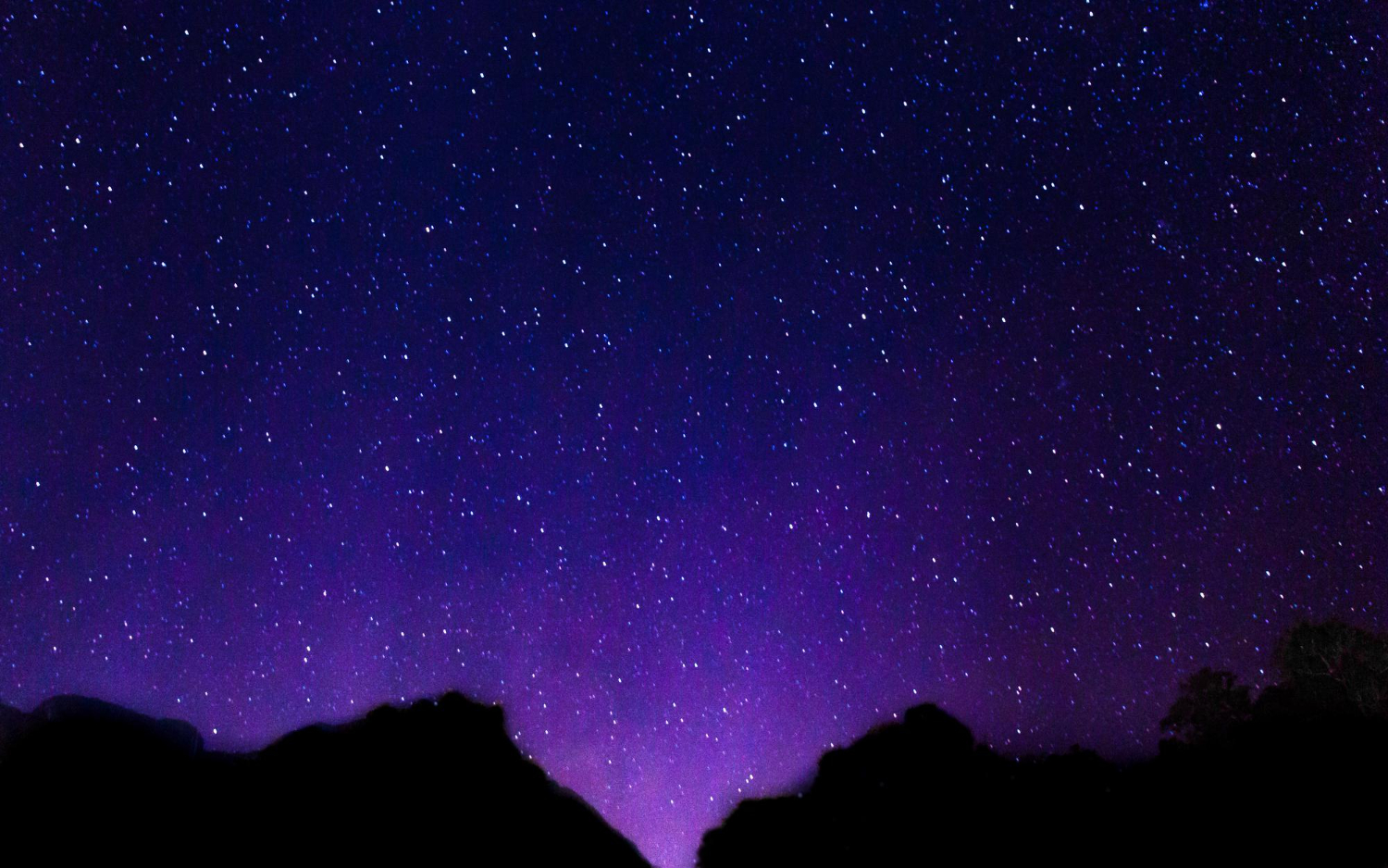
Almost nobody looks at a dark night sky and thinks it requires explanation. It is dark because the sun has set, which seems sufficient.
It is not sufficient, and noticing why is one of the more elegant pieces of reasoning in the history of science, because it can be done with no equipment and no mathematics beyond arithmetic.
The argument runs like this. Suppose the universe goes on forever and has always existed, filled more or less evenly with stars. Now point in any direction at all and follow that line outward. It travels through space until it hits something. In an infinite universe filled with stars, it must eventually hit a star, because there is no direction in which stars run out.
If every line of sight ends on a stellar surface, then every point in the sky should be as bright as the surface of a star. The night sky should not merely have stars in it — it should be uniformly and overwhelmingly luminous, in every direction, all the time.
It is dark. Something in the assumptions is wrong, and identifying which took a very long time.
Why Distance Does Not Save You
The first objection everyone raises is that distant stars are faint, so surely the far ones contribute almost nothing.
This is the part of the argument that makes it beautiful, because the arithmetic cancels exactly.
Light spreads out as it travels, so a star’s apparent brightness falls with the square of its distance. Double the distance and it appears one quarter as bright. That is the intuition behind the objection and it is correct.
But now count how many stars there are at that distance. Consider a thin shell of space at some radius from you. The surface area of a sphere grows with the square of its radius, so a shell twice as far away has four times the area and, at even density, contains four times as many stars.
Four times as many stars, each one quarter as bright. The shell contributes exactly the same total light as the nearer one.
Every shell contributes equally. Add up an infinite number of shells each contributing the same amount, and the total is unbounded. Distance does not rescue the argument — it makes it worse, because there is more distant universe than near universe.
Like our content? Follow us for more.
The Explanations That Do Not Work
Several intuitive solutions have been proposed over the centuries, and it is instructive that they fail.
The most obvious is dust: perhaps interstellar material absorbs the light from distant stars before it reaches us. This was seriously proposed and it does not work, because of thermodynamics. Dust absorbing starlight continuously would heat up, and once heated it would radiate. Given enough time it would reach equilibrium with the radiation falling on it and glow just as brightly as the stars it was hiding. Absorption postpones the problem rather than solving it.
Another proposal is that stars are not distributed evenly — that they are clumped into structures with vast empty spaces between, so that many lines of sight escape without hitting anything. There is real structure in the universe, and this changes the arithmetic somewhat, but it does not produce a dark sky in an infinitely old universe.
A third is that the universe might simply contain a finite number of stars in an infinite space. That would give a dark sky, but it raises immediate problems of its own about why matter would be confined to one region, and it does not match what is observed.
The failure of these attempts is what made the paradox durable. It is not a puzzle that dissolves under closer inspection; it truly constrains what the universe can be like.
The Answer Is Time
The resolution is that one of the original assumptions is false. The universe has not existed forever.
If the universe has a finite age, then light has only had a finite time to travel. Since light moves at a fixed speed, we can only see out to a certain distance — the distance light could cover in the time available. Beyond that, there may well be stars, and their light simply has not arrived yet.
That converts an infinite sum into a finite one. Only a limited number of shells are contributing, so the total light received is limited, and the sky can be dark.
This is the essential resolution, and it is worth appreciating what it means: the darkness of the night sky is direct, everyday evidence that the universe had a beginning. You do not need a telescope to observe it. You need only notice that it is dark and follow the argument.
There is a second contributing factor. Space is expanding, which stretches the wavelength of light travelling through it. Light from very distant sources is shifted toward the red and beyond, out of the visible range entirely and into the infrared and microwave. So some of the light that has reached us is no longer light we can see.
The relative weight of these two effects is worth stating carefully: the finite age of the universe is the dominant explanation, and the expansion is a real but secondary contributor. Popular accounts frequently reverse that emphasis.
Who Actually Noticed
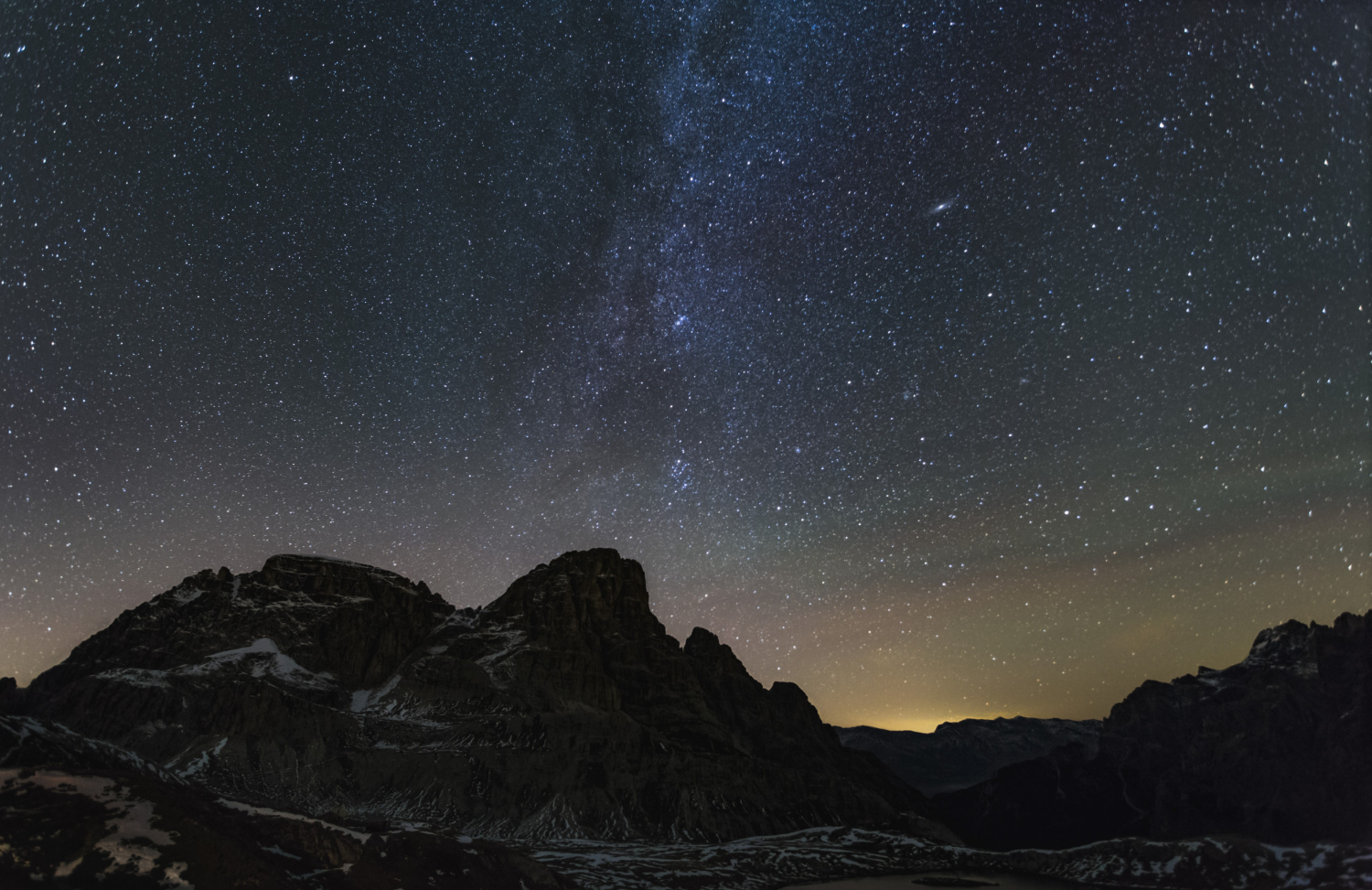
The paradox carries the name of Heinrich Wilhelm Olbers, a nineteenth-century German astronomer, and he was far from the first to raise it.
Versions of the observation appear substantially earlier, with Thomas Digges noting the difficulty in the sixteenth century, and it recurs through subsequent centuries as astronomers wrestled with the implications of an infinite cosmos. Olbers’ name attached to it through a familiar process by which the person who states a problem memorably ends up owning it.
There is a pleasing historical footnote. The poet and writer Edgar Allan Poe proposed, in a prose work of the 1840s, that the darkness of the sky could be explained if the light from the most distant regions had simply not had time to reach us. That is essentially the correct answer, arrived at by a writer decades before it was established scientifically, and it is regularly cited as one of the more remarkable pieces of intuition in the subject.
What the Argument Rules Out
It is worth being clear about the logical shape of this, because it is a rare case where an everyday observation truly constrains cosmology.
The paradox is not a proof that the universe is finite in extent. It does not show that space runs out somewhere.
What it rules out is a specific combination: a universe that is infinite in extent, unchanging over time, eternally old, and filled with stars at roughly uniform density. Hold all four of those simultaneously and the sky must blaze. It does not, so at least one has to go.
For most of the history of the question, the assumption nobody wanted to drop was eternity. A universe with a beginning raised uncomfortable questions, and a static eternal cosmos seemed the more austere and scientific option.
The darkness was steadily telling everyone otherwise the entire time, and the observation required no equipment whatsoever.
That is the part worth appreciating. A person in the sixteenth century, with no telescope and no mathematics beyond arithmetic, could stand outside, notice that it was dark, follow the reasoning, and correctly conclude that something fundamental about the standard picture of the universe was wrong.
Working out which assumption to drop took another four hundred years, but the evidence was available every clear night to anybody who thought about it hard enough.
The Sky Is Not Actually Dark
There is a final twist, and it is the part that makes the whole story satisfying.
The night sky is not empty. It is filled, uniformly and in every direction, with radiation — the cosmic microwave background, the remnant glow of the early universe, arriving from everywhere at once.
In a real sense the original argument was right. Every line of sight does end on a hot surface, and the sky is uniformly bright. The surface is the early universe rather than a star, and the radiation has been stretched by billions of years of expansion from something searingly hot into microwaves.
So the sky is glowing in every direction, and it is invisible to us only because our eyes evolved to detect a narrow band of wavelengths that this radiation no longer occupies.
Point a suitable instrument at any patch of apparently empty sky and it registers that glow, at almost exactly the same intensity regardless of which patch you choose.
Which means the answer to why the night sky is dark is, in the end, that it is not. It is uniformly bright at wavelengths we cannot see, and the darkness we experience is a statement about human eyes as much as about the universe.
Like our content? Follow us for more.