Around the edge of every car windscreen there is a solid black band, and along its inner edge a row of black dots that get smaller and further apart until they fade into the clear glass.
Almost everybody has looked at this and assumed it is decorative, or a sun shade, or something to do with the wipers.
It is three separate engineering solutions stacked on top of each other, and the dots in particular exist to stop the glass breaking.
The Solid Band Is There to Hold the Glass In
A modern windscreen is bonded into the body of the car with polyurethane adhesive rather than held in a rubber gasket. That bond is structural – it contributes to the stiffness of the body shell and, in a rollover, to keeping the roof where it is.
The adhesive has one weakness: ultraviolet light degrades it. Sunlight reaching the bead through the glass would break it down over years, and the bond would fail at the edges where it is most needed.
So the glass is printed with a band of black ceramic paint, fired into the surface, which is completely opaque to ultraviolet. The adhesive sits behind it, in permanent shade, and is protected for the life of the vehicle.
The band also does two cosmetic jobs that matter commercially. It hides the adhesive bead, which is an untidy thing to look at, and it hides the metal flange, the wiring and whatever else runs around the perimeter of the aperture.
Like our content? Follow us for more.
The Dots Are a Temperature Gradient
The dots are the interesting part, and they exist because of what happens when you have black paint next to clear glass in sunlight.
Black ceramic absorbs heat. Clear glass does not, nearly as much. On a sunny day, the painted band gets substantially hotter than the glass next to it, and the boundary between them is a line where hot glass meets cooler glass.
Glass expands when it is heated. Hot glass next to cold glass means one region trying to grow while the region beside it does not, and that produces stress exactly along the boundary. A sharp boundary concentrates that stress at a line, and a line of concentrated stress in glass is where a crack starts.
The dots spread the transition out. Instead of a single hard edge, the pattern creates a zone several centimetres wide in which the proportion of black paint falls gradually from solid to nothing. The heating changes gradually across that zone rather than abruptly at a line, the expansion changes gradually with it, and the stress is distributed over a wide band instead of concentrated at an edge.
That is the whole purpose. The dots are a way of making a hard boundary into a soft one, using nothing but the density of a printed pattern.
The Same Trick Appears Wherever Two Materials Meet
Once you understand what the dot pattern is doing, the technique turns up everywhere, because the problem is general: any abrupt change in a material or a load path concentrates stress at the change.
The response is always the same – spread the transition out. A fillet radius at the corner of a machined part instead of a sharp internal corner. A tapered doubler plate rather than an abruptly thicker one. The gradual thinning at the end of an adhesive joint. The reinforcement at the edge of a patch spread over a wide area rather than ending in a line.
Aircraft structures are full of this and so are bridges, and in every case somebody has worked to avoid a hard edge where the loads change, because that edge is where the crack will start.
The windscreen dots are an unusually visible example – the gradient is not hidden inside a component, it is printed on a piece of glass at eye level in front of every driver – and they are also the one almost nobody has ever had explained to them.
The Glass Itself Is Two Sheets With Plastic Between Them

Worth knowing what the band is printed on, because a windscreen is not a single piece of glass and the other windows in the car are made completely differently.
A windscreen is laminated: two sheets of glass bonded either side of a tough plastic interlayer. When it breaks, the glass fragments stay stuck to that layer, which is why a damaged windscreen goes opaque and stays in one piece rather than disappearing. It also means the screen remains a barrier after an impact, which matters for keeping occupants inside the vehicle.
The side and rear windows are usually toughened instead – heat treated so the glass is under internal stress, which makes it much stronger and means that when it does fail it shatters completely into small blunt pieces. That is the right answer for a window that may need to be broken to get somebody out, and the wrong answer for the one directly in front of a driver’s face.
So the two technologies are chosen for opposite failure behaviour: the windscreen is designed to break and stay, and the side glass is designed to break and go.
The interlayer also blocks most ultraviolet, which is why people get sunburnt through a side window on a long drive and far less through the windscreen – a difference nobody expects and which follows directly from the construction.
The Band Also Hides a Growing Amount of Equipment
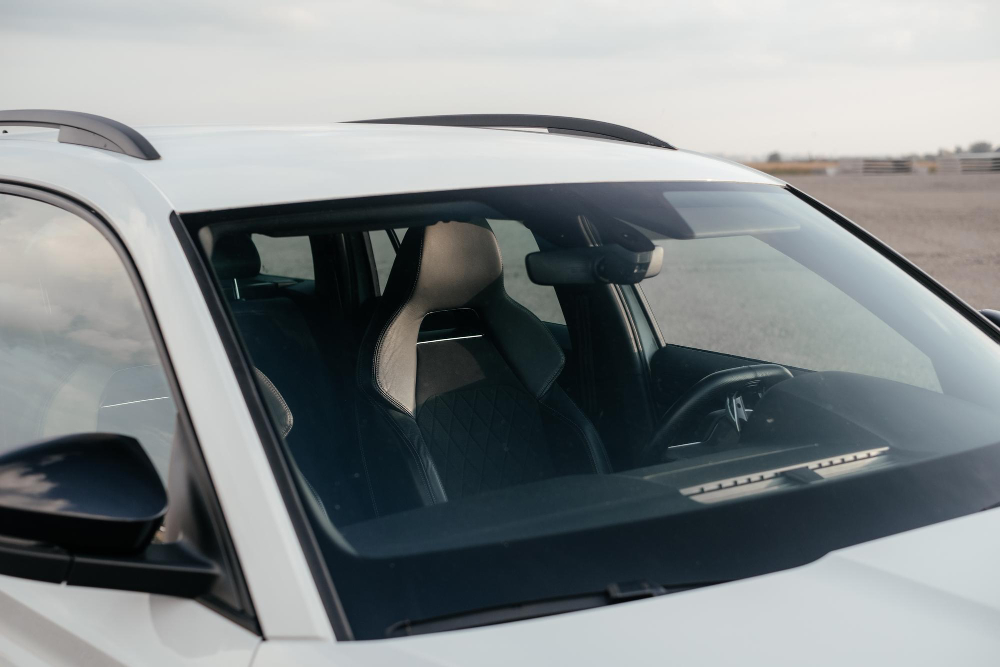
The area behind the band has become valuable real estate, which is why it has grown.
Rain sensors, light sensors, the camera for lane keeping and emergency braking, the mirror mounting, the toll transponder bracket and on some vehicles heating elements and antennas are all located in or immediately behind the printed area, because it is the one part of the glass that does not need to be seen through.
That is why the band is deeper at the top centre on a great many cars, and why there is frequently a cut-out shaped window within the black area – a clear aperture for a camera to look through, surrounded by paint to keep stray light off the sensor.
It is also why windscreen replacement has become considerably more complicated and expensive. A screen is no longer a piece of glass; it is a mounting for several sensors that have to be recalibrated after fitting, and getting that wrong affects systems the driver is relying on.
The Band Is Also Why the Edge of the Screen Is Not Optically Perfect
There is a side effect of all this that drivers notice and misattribute.
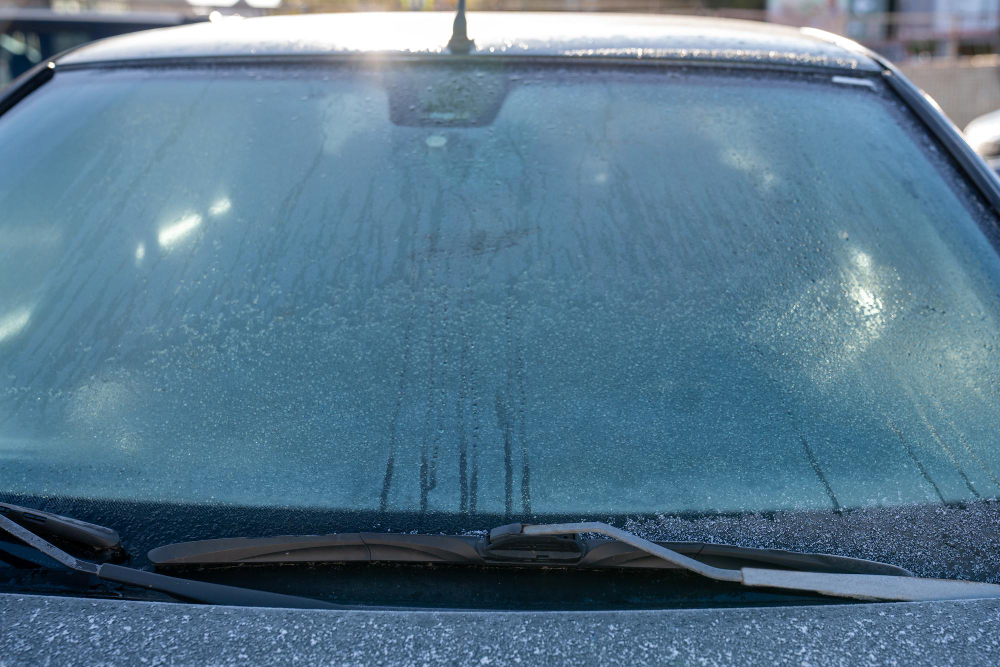
The outer few centimetres of a windscreen, immediately inside the band, frequently show slight optical distortion – straight lines beyond it bend a little as you move your head. People assume this means the screen is faulty or was badly fitted.
It is a consequence of the manufacturing. The glass is heated and formed over a mould to the curvature of the aperture, and the regions near the edge are where the forming is most severe and where the glass is clamped and supported. Those are the areas where thickness varies most and where the surface deviates most from the intended curve.
Optical quality standards for automotive glazing are accordingly stricter in the central area the driver looks through than at the periphery, which is a sensible allocation of effort – the edges are specified to be adequate and the middle is specified to be good.
Which means the distortion at the edge is designed in rather than a defect, and a screen with none at all would cost considerably more to produce for a benefit nobody would ever use.
The one case where it matters is a sensor looking through the glass, which is why the camera aperture is positioned where the optical quality is controlled and why that area is checked specifically.
Why It Is Dots Rather Than a Gradient of Grey
There is a reasonable question here, which is why the transition is made of discrete dots instead of simply printing the paint progressively thinner.
The answer is that the printing process cannot do that reliably. Ceramic paint is applied through a screen and then fired, and the result is either paint or no paint at a given point – the thickness is set by the screen and the firing, and a deliberately thin layer fires unevenly, changes colour and does not protect anything consistently.
So the only variable available is coverage: what proportion of the area has paint on it. A pattern of shrinking dots varies coverage smoothly while keeping every individual dot at full thickness, which the process can do perfectly well and repeatably across a production run of millions.
This is called halftoning and it is exactly how a photograph is printed in a newspaper – a continuous tone reproduced with dots of a single ink at varying sizes and spacings, because the press can only put ink down or not.
Two completely different industries arrived at the same solution to the same constraint, which is that a process capable only of on and off can still produce a gradient if you vary how much of the area is on.
Look at the top edge of your own windscreen next time you are sitting in traffic.
The dots are not decoration, and the car in front almost certainly has a different pattern.
The pattern is specific to the glass, because the stress gradient depends on the shape of the aperture, the curvature of the screen and where the band needs to be deepest. It is designed for that one part, which is another reason a replacement screen has to be the right one rather than approximately the right size.
Like our content? Follow us for more.