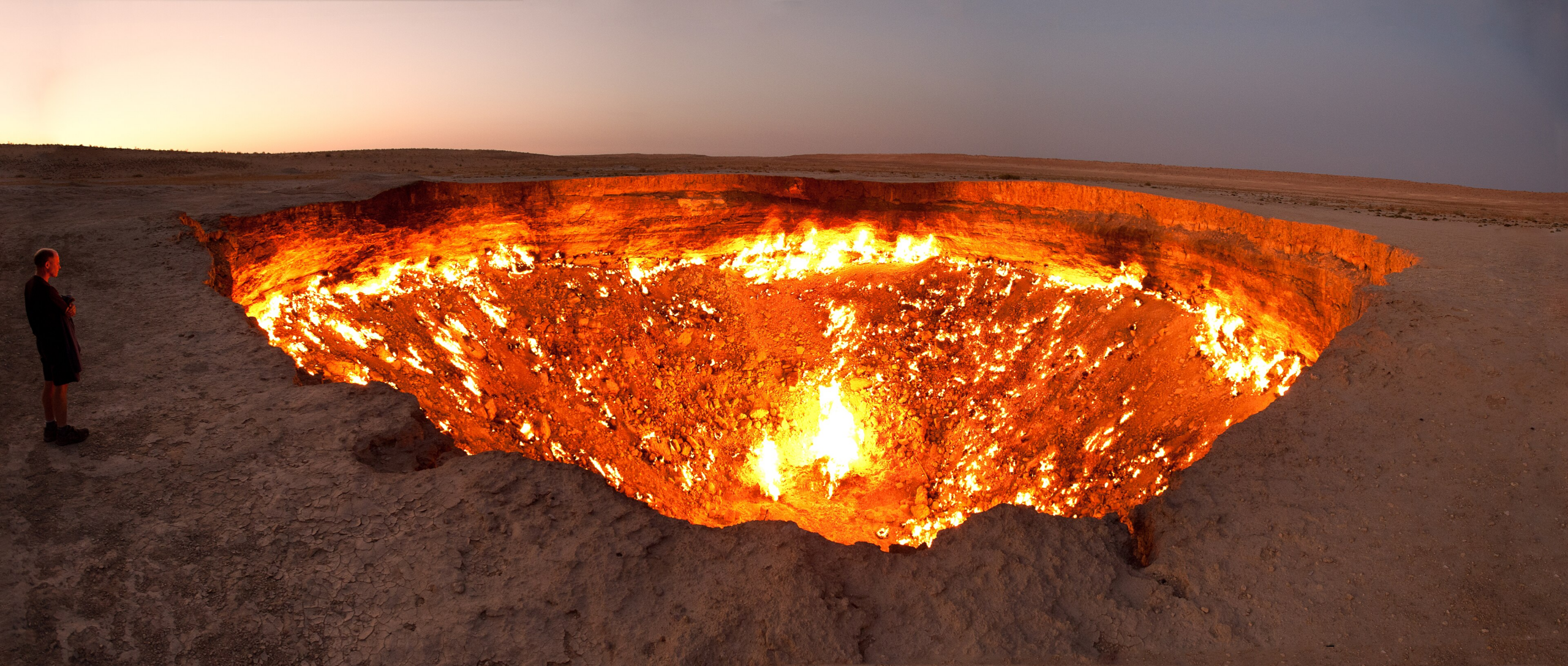
There’s a hole in the middle of one of the emptiest deserts on Earth, and it’s on fire. It has been on fire since around the time “American Pie” topped the charts. Nobody lit it on purpose, nobody has managed to put it out, and getting there requires a visa to one of the most closed countries in the world, a four-wheel-drive, and a driver who knows which unmarked track through the dunes leads to the glow on the horizon.
The Darvaza gas crater — “the Gateway to Hell” to nearly everyone who writes about it, and to the Turkmen shepherds who live nearest to it — is one of those places that sounds invented until you see the photographs: a pit some 200 feet across and 100 feet deep, its floor and walls veined with hundreds of individual flames, exhaling heat and a low jet-engine roar into the black Karakum night. It may also be a sight with an expiration date, which has moved it up a certain kind of traveler’s list in a hurry.
A Drilling Accident With a Very Long Afterlife
The crater’s origin story is part documented fact, part Soviet-era fog. The account most often told goes like this: in 1971, Soviet geologists drilling for natural gas in the Karakum hit a pocket whose roof collapsed, swallowing the rig and leaving a crater venting methane into the air. Fearing the gas would poison people and livestock in the area, the engineers lit it, expecting the pocket to burn itself out within a few weeks.
The desert had other plans. The crater sits atop one of the largest natural gas provinces on the planet — Turkmenistan’s reserves rank among the top handful worldwide — and instead of a few weeks, the fire has run for more than fifty years. Even the origin details are contested: some Turkmen geologists have said the collapse happened in the 1960s and the ignition came later, in the 1980s, and because Soviet drilling records from the area are sealed or lost, no one can settle it. The uncertainty suits the place. A fire this old is allowed a foggy birth certificate.
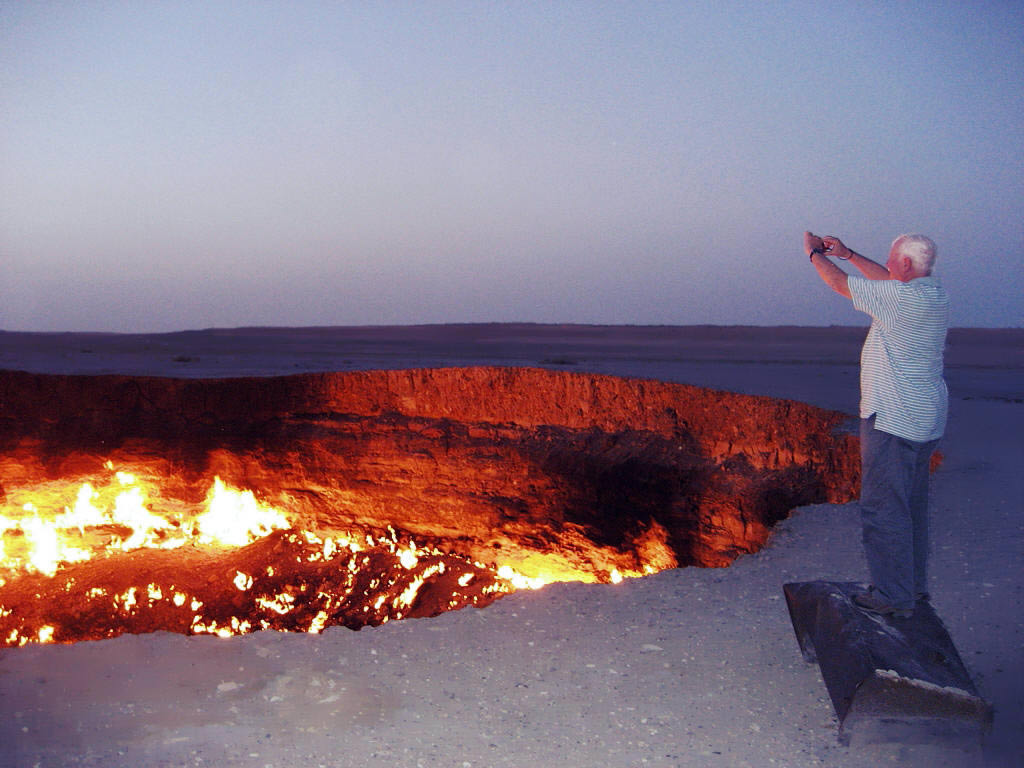
What isn’t contested is the effect. Stand on the rim at night — there are no railings, no ticket booth, no visitor center, nothing but desert and a hole full of fire — and you feel the heat change with the wind, hear the flames breathe, and understand immediately why every name anyone has given this place involves the underworld.
Like our content? Follow us for more.
The Strangest Tourist Attraction in the World’s Quietest Country
What makes Darvaza such a rare travel experience isn’t only the crater — it’s the country around it. Turkmenistan admits fewer tourists than almost any nation on Earth; visitor numbers in a typical year run in the low thousands, a rounding error compared to its Silk Road neighbors. Independent travel is tightly controlled, most visitors enter on guided tours or carefully choreographed transit visas, and the capital, Ashgabat, is its own spectacle — a city of white marble buildings and gold statues holding multiple world records for its sheer volume of polished stone, with streets that can feel eerily empty.
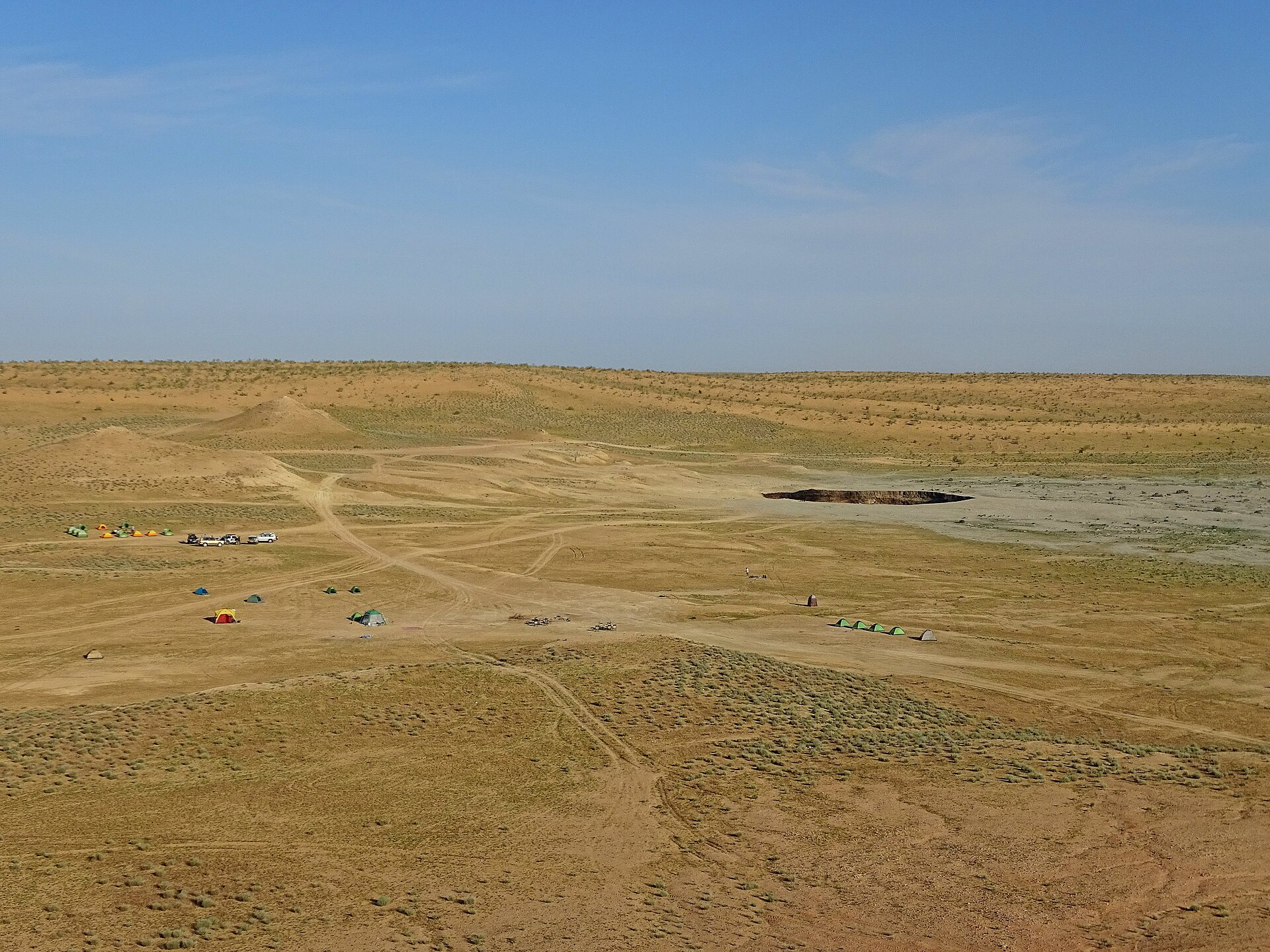
That context turns a Darvaza trip into a two-part show. Travelers typically drive about three hours north from Ashgabat across the Karakum — a desert covering most of the country — leaving the highway at the tiny settlement of Darvaza for a rough track through the dunes. The classic itinerary arrives before sunset, when the crater looks almost modest, a smoking pit in tan sand. Then the light drains out of the sky, and the pit takes over. Tour outfits set up camp on nearby dunes; dinner is cooked over coals while the horizon glows like a grounded sunset that refuses to finish. Most visitors report the same thing — they planned to look for twenty minutes and stayed on the rim for hours.
Two smaller craters from the same drilling era sit nearby, one bubbling with mud, one filled with turquoise water, both worth the short detours and both useful reminders that this desert is essentially floored with gas.
The Government Keeps Trying to Blow It Out
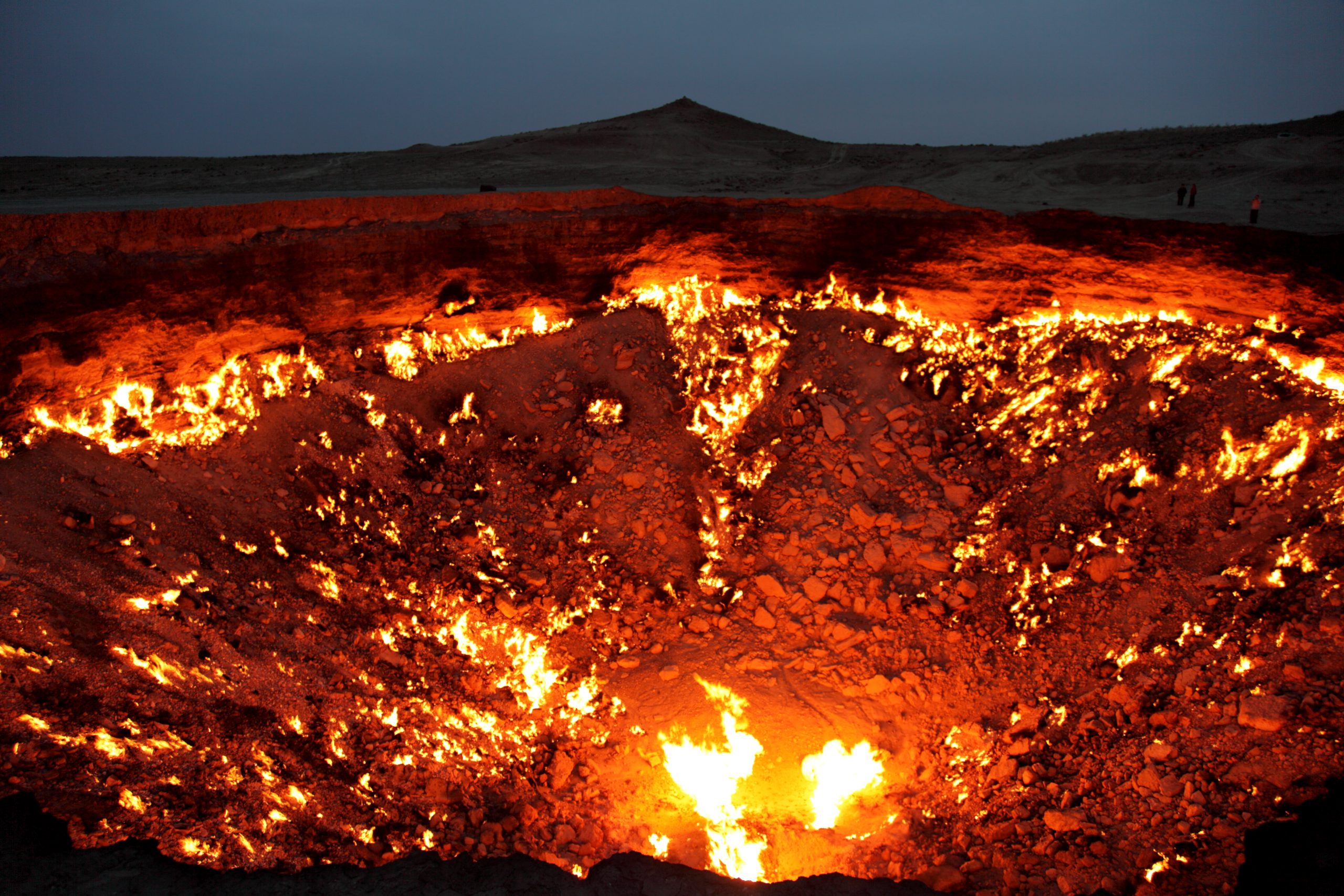
Here’s the wrinkle that gives every Darvaza trip a ticking-clock feel: Turkmenistan’s government has repeatedly, publicly resolved to extinguish the crater. Presidential directives ordering scientists to find a way to put it out or capture its gas have come more than once — the reasoning is a braid of lost revenue (the crater burns sellable methane around the clock), environmental concern over the emissions, and national image. One president underlined the point in 2019 by having himself filmed doing doughnuts around the crater’s rim in a rally truck, to squash rumors and, apparently, for style.
And in recent years, something has actually changed. Reports and visitor accounts since the mid-2020s describe the flames noticeably diminished — officials have said nearby wells drilled to draw down the gas reduced the fire substantially, and travelers now sometimes find a weaker glow than the famous photographs promise. Whether the crater is truly winding down or merely breathing differently is honestly unclear; the fire has been pronounced nearly finished before and kept burning. But the direction of travel is obvious enough that tour operators have started telling clients the honest thing: if you want to see it at full roar, sooner beats later, and no one can promise what next year’s flame looks like.
What It Takes to Actually Go
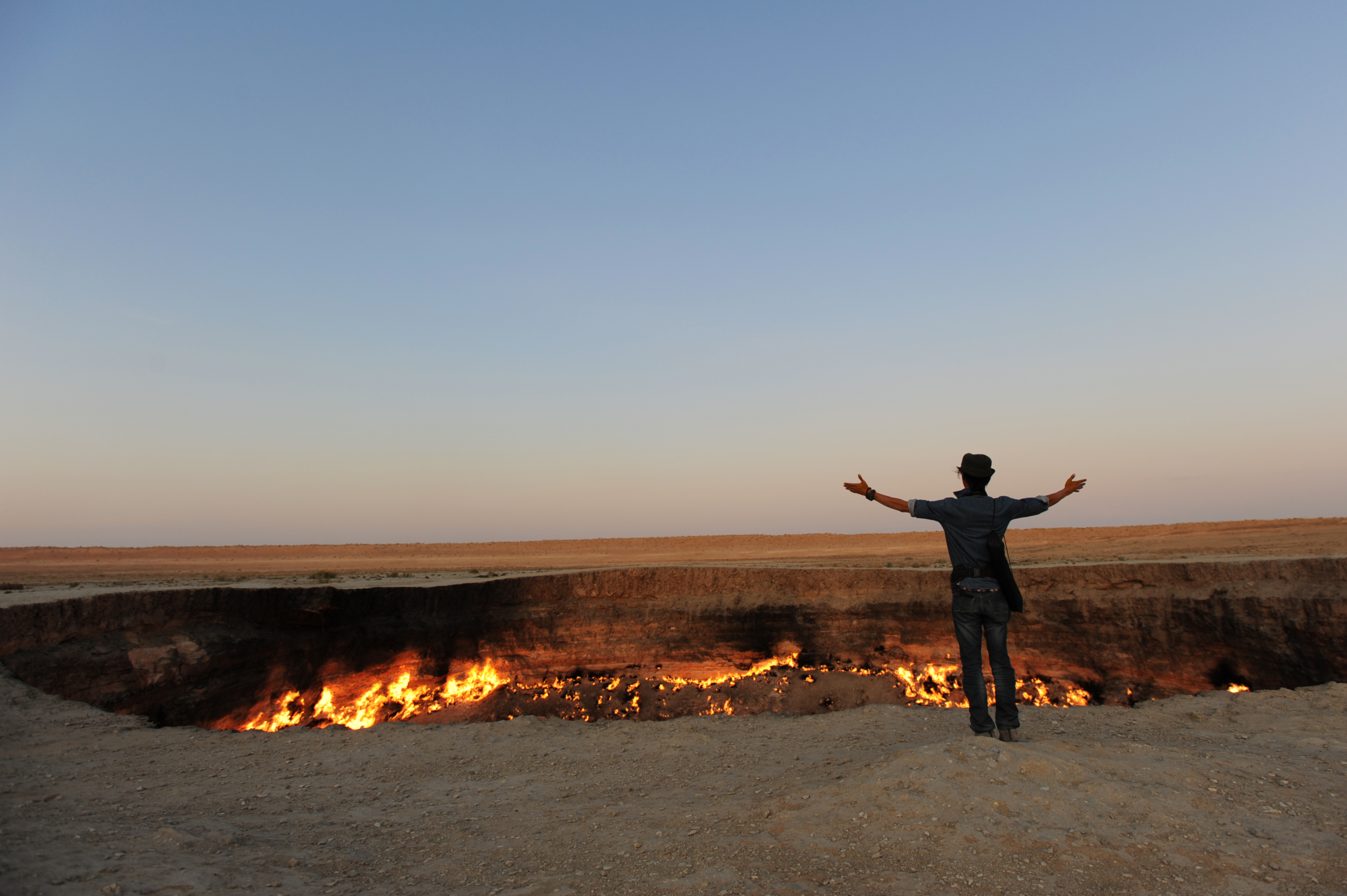
A Darvaza trip demands more planning than most bucket-list stops. Nearly all travelers need a visa arranged in advance through a licensed Turkmen tour operator, whose invitation letter is the key that opens the process; approvals can take weeks and are never guaranteed. Most visitors either book a multi-day guided itinerary — typically Ashgabat, the crater overnight, and sometimes the ancient Silk Road ruins of Merv or Konye-Urgench — or thread the country on a short transit visa between Uzbekistan and Iran, a classic overlander’s move that allows a tight but feasible crater detour.
On the ground, the essentials are simple: a 4×4 with a driver who knows the track, warm layers (desert nights turn cold fast, even in summer), sturdy shoes for loose sand near an unfenced hundred-foot drop, and a healthy respect for the rim — there are no barriers, and the edge is exactly as stable as desert sand ever is. Camping gear usually comes with the tour; so does dinner. Cell coverage does not exist out there in any usable form, and for most travelers who make the trip, that turns out to be one of its best features.
Why It’s Worth the Trouble
Plenty of natural wonders are more beautiful than a burning pit in a flat desert. Almost none are stranger, and none combine the same ingredients: a Cold War accident, a half-century flame, a hermit state’s marble capital, and a night sky split between more stars than most people have ever seen and an orange glow that has outlived the country that lit it. Travelers who make it rank the crater alongside sights ten times more famous, and the small number who’ve stood on that rim form a kind of quiet club — you can spot them at parties, because someone says “weirdest place you’ve ever been,” and they smile.
The Gateway to Hell has burned through eleven U.S. presidencies, the fall of the empire that created it, and every prediction of its end. It may finally be dimming. If the flames do go out in the coming years, Darvaza will become a story travelers tell about a place that used to exist — and the ones who went while it roared will be very, very smug. There’s still time to be one of them.
The camping itself deserves a word, because the crater is only half the night. The Karakum after dark delivers a sky most visitors have never actually seen — zero light pollution for a hundred miles in any direction, the Milky Way laid out edge to edge — and the standard move is to walk a few dunes away from the glow, let your eyes adjust, and stand between two spectacles: firelight on one horizon, several thousand stars on the other. Camel herds wander the area by day, shepherds from the nearby settlement sometimes ride over to say hello, and some tours arrange dinner in a traditional yurt. Bring a headlamp, bring more water than seems reasonable, and charge the camera and a backup battery before you leave Ashgabat, because nothing at the crater will charge them for you, and the pictures you take on that rim are the ones people will be asking to see for the next twenty years.
Like our content? Follow us for more.