

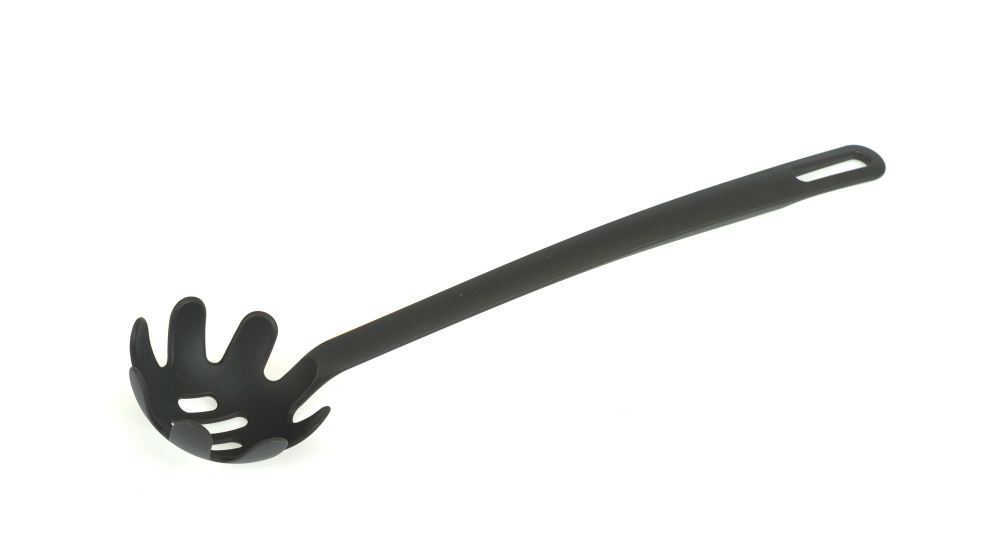
A pasta spoon has a hole in the middle of it, and the overwhelming majority of people who own one assume the hole is there to let water drain through.
Water drains through the slots around the edge. The hole in the centre does something else: it is a gauge. Feed dry spaghetti through it until the bundle fills the opening, and that is approximately one portion.
Whether it is a good gauge is a separate question, and the answer is interesting.
What the Hole Is Actually Sized To
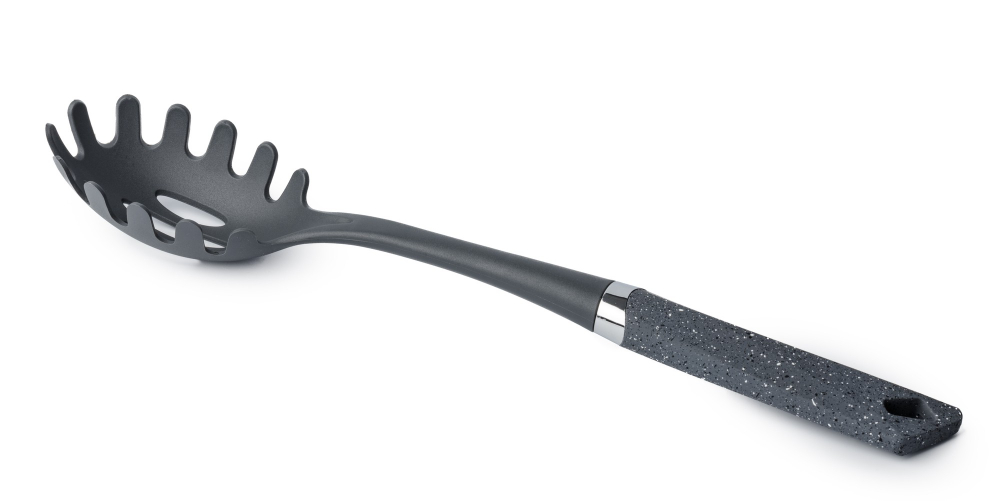
The convention is that the hole holds roughly a single serving of dry long pasta – commonly taken as somewhere around eighty to a hundred grams, though it varies between manufacturers and nobody enforces anything.
That is the whole feature. There is no mechanism, no marking and no instruction, which is precisely why it goes unnoticed. A hole in a spoon reads as a drainage feature, and the fact that it is a specific diameter chosen for a specific purpose is invisible unless somebody tells you.
It works reasonably well for what it is. Dry spaghetti packs into a round opening quite consistently, so the volume of the bundle is a decent proxy for its weight, and anybody who has used it a few times develops a feel for whether to pack it tight or loose for their household.
It fails completely for anything that is not long and straight. Penne, shells, fusilli and everything else will not pass through it, and the hole tells you nothing at all about them.
Like our content? Follow us for more.
Why Portion Guides Exist on So Many Objects
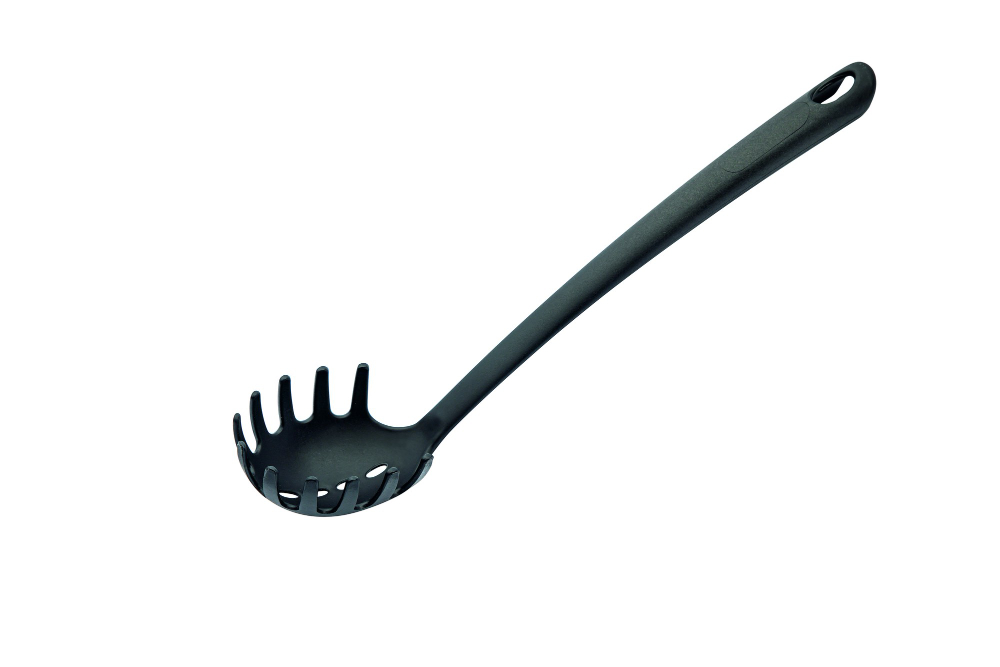
Once you notice this one, the same idea turns up everywhere, and it exists because weighing is a step people will not take.
A kitchen scale is accurate, available and cheap, and most people cooking a weekday meal will not get one out for pasta. So designers build the measurement into something already in your hand: the hole in the spoon, the markings inside a rice cooker cup, the fill lines moulded into a measuring jug, the scoop supplied with coffee or detergent, the shaped recess in a spaghetti measure that gives you one, two, three or four portions.
Each of those trades accuracy for the fact that it will actually be used, which is nearly always the right trade. A rough measurement taken every time beats a precise one taken never.
The pasta spoon is the purest version because it costs nothing at all – the hole had to be some size, and somebody chose a useful one.
The Portion It Gives You May Not Be Your Portion
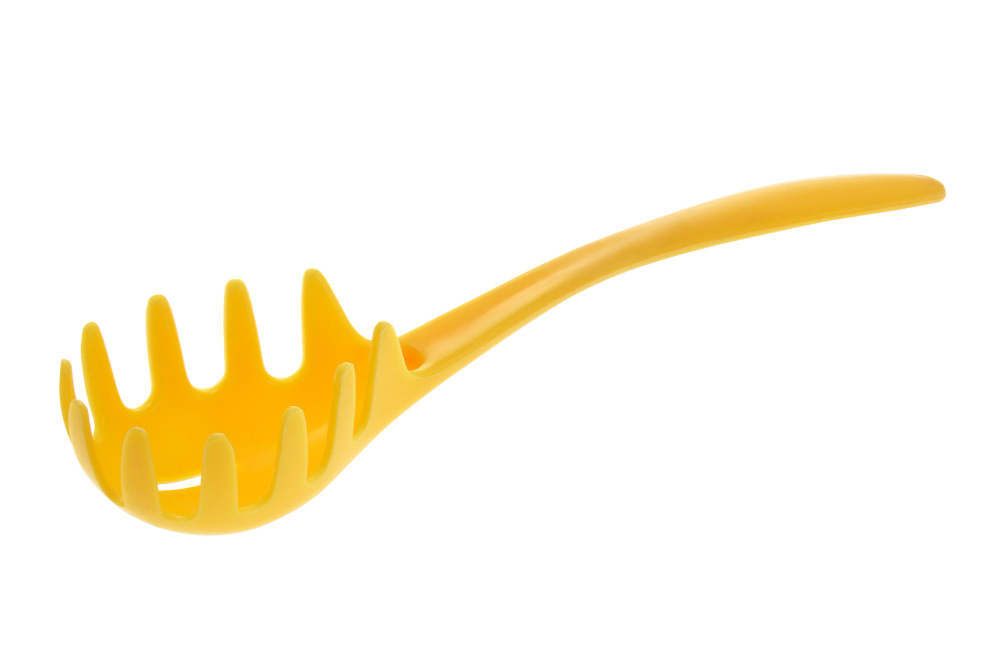
Worth being clear about this, because it is where the feature is oversold.
Standard portion sizes are conventions established by manufacturers and by nutritional guidance, and they are not a statement about how much any particular person should eat. Requirements differ enormously with body size, activity, age, what else is in the meal and what the rest of the day looks like.
A hole in a spoon is a convenient repeatable unit. It is not advice. Somebody cooking for a hungry teenager who has been out all day and somebody cooking a side portion to go with a large main course are both correctly served by ignoring it in opposite directions.
What it is genuinely useful for is consistency. If you find that one hole-full plus a bit is right for you, that is now a repeatable measurement you can make with no equipment, in a second, every time – and repeatability is the actually useful property, not whether the default matches a published figure.
The Hole Also Stops the Pan Boiling Over, Sort Of
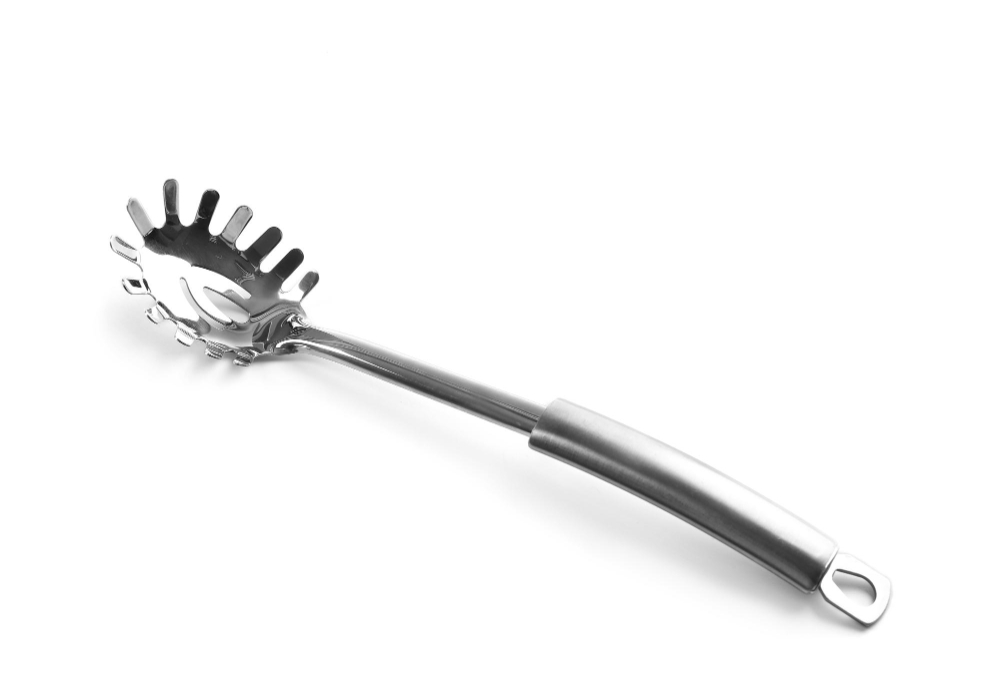
There is a second claimed function, and it is worth examining because it is half true.
Leaving a wooden or slotted spoon across the top of a pan is widely said to stop it boiling over, and the pasta spoon with its hole is sometimes offered as a particularly good version of this. The mechanism given is usually that the spoon breaks the bubbles, which is roughly right and not the whole story.
A pan boils over because starch released from the pasta stabilises the bubbles, turning what would be a brief froth into a persistent foam that climbs. Anything cooler than the foam that it touches will collapse the bubbles it contacts, because the film holding a bubble together is extremely fragile and a temperature difference is enough to break it.
A spoon across the pan therefore does something, and what it does is limited. It collapses the foam that reaches it, which buys a few seconds. It does not reduce the amount of starch in the water, it does not lower the heat, and a pan that genuinely wants to boil over will go round it.
The actual answers are a bigger pan, less heat and keeping an eye on it, none of which makes for a satisfying trick.
The spoon-across-the-pan method works often enough to persist and fails often enough that everybody has a story about it, which is the reliable signature of a folk technique with a real but inadequate mechanism behind it.
The Rest of the Spoon Is Also Doing Specific Things
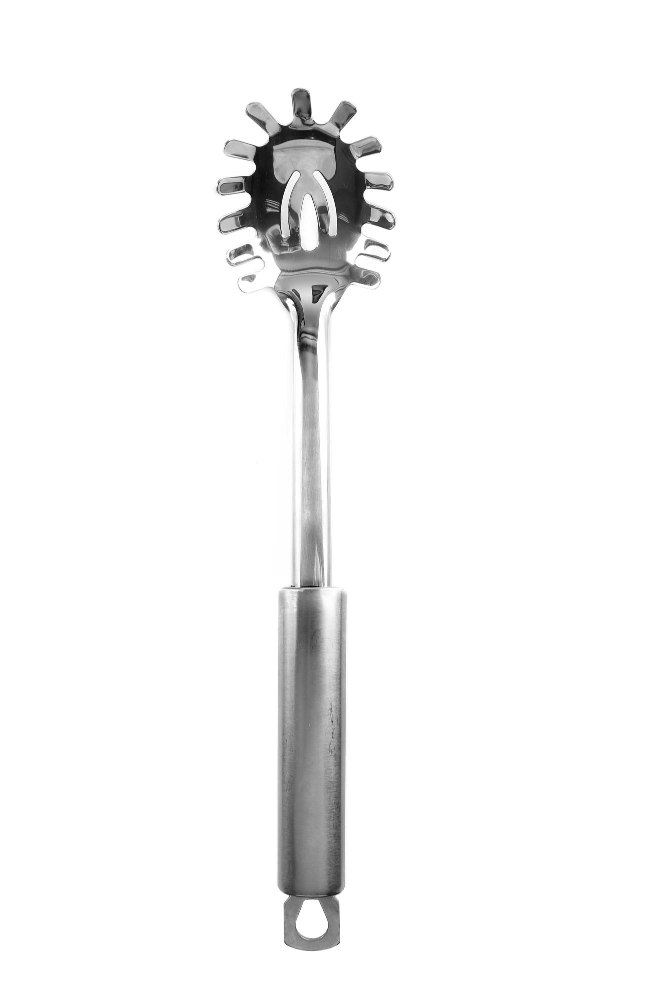
The hole is the famous feature and the rest of the design is not accidental either.
The teeth or fingers around the rim exist to grip long pasta, which is slippery, heavy with water and inclined to slide off anything smooth. They work by catching between strands rather than by friction, which is why a smooth spoon is hopeless at it and a toothed one lifts a full serving cleanly.
The slots drain, which stops the dish filling with cooking water.
The bowl is usually shallower and wider than a regular spoon, because you are lifting a loose mass rather than a liquid, and depth would make the pasta harder to release.
And the whole thing is usually long-handled, because the pan is tall, full of boiling water and in use at the moment you need to reach into it.
None of that is remarkable individually. Together they make a tool that does one job considerably better than a fork or tongs, which is why it exists as a separate object at all rather than being something you already own.
Long Pasta Is the Only Kind That Can Be Measured This Way
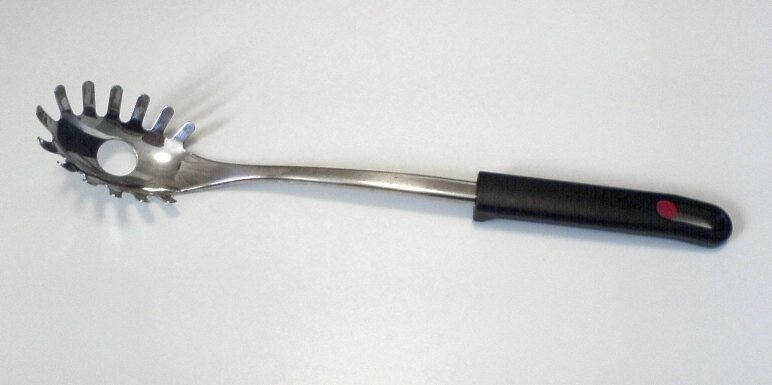
There is a reason the gauge exists for spaghetti and for nothing else, and it says something about why portioning is awkward generally.
Long straight pasta is the only common shape that packs predictably. Push a bundle of it through a round hole and the strands lie parallel with a consistent amount of air between them, so volume maps onto weight reliably enough to be useful.
Every other shape fails. Penne, shells and spirals pack with large and variable gaps depending entirely on how they fall, so the same volume can differ substantially in weight from one scoop to the next. Small shapes pack more densely than large ones. Anything curved interlocks unpredictably.
This is why portioning advice for short pasta is given by weight or by a vague measure like a mugful, and why nobody has produced a satisfactory gauge for it – the physical property that makes spaghetti measurable does not exist in the other shapes.
It is also why the same problem turns up in every bulk solid. Flour, rice, sugar, coffee and cereal all have a packing density that varies with how they were poured, settled, shaken or scooped, which is why baking recipes that specify cups produce inconsistent results and ones that specify grams do not.
The pasta spoon works because spaghetti happens to be the easy case.
Why Nobody Was Told
The genuinely odd thing is the complete absence of communication.
The feature is useful, it is free, it is built into an object millions of people own, and there is no marking on the spoon, no note in any packaging, and no reason anybody would deduce it. People discover it from somebody else, usually with mild indignation at not having been told sooner.
This is not unusual. A great many products carry features their owners never learn about, because the knowledge lives with the designer and the manufacturer and there is no mechanism to get it to the person holding the thing. Printed instructions are thrown away, moulded symbols are not understood, and the shop assistant who might once have explained it has been replaced by a shelf.
The hole in the pasta spoon is the friendliest possible example – nothing is lost by not knowing, and it is pleasing to find out.
The same gap applies to features where the cost of not knowing is considerably higher, which is the point worth taking away. If a simple useful feature on a common object can go unexplained for decades, it is worth occasionally reading the thing that came in the box.
Go and look at yours. If the hole is in the middle of the bowl rather than at the edge, it is a measure.
Feed the spaghetti through and see how close your usual handful was.
Most people find they have been cooking substantially more than one portion per person for years, which is not a problem and does explain a certain amount about how much pasta ends up in the fridge.
Like our content? Follow us for more.
