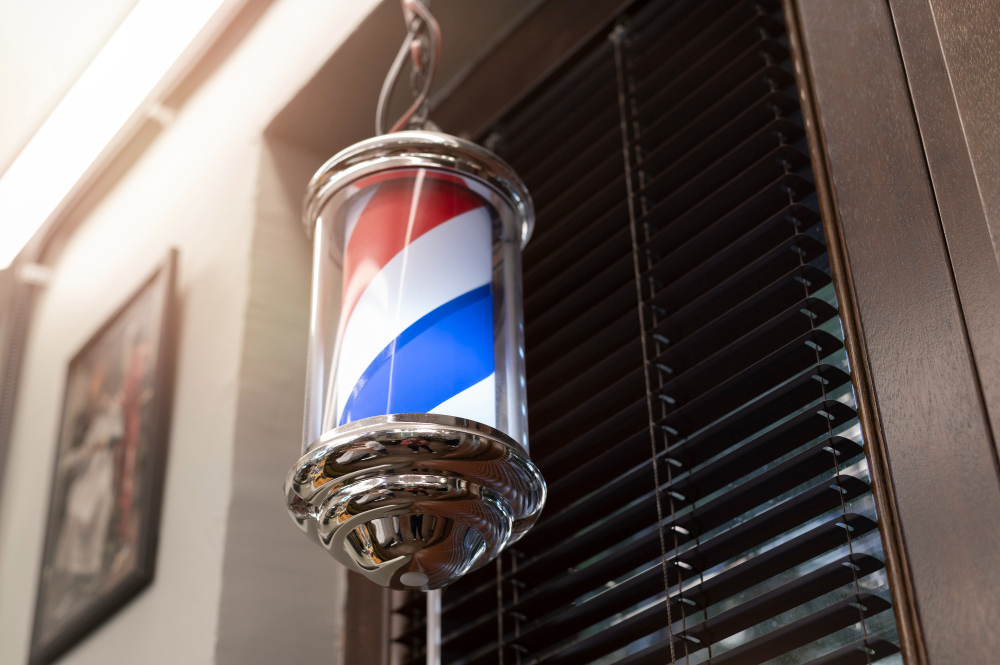
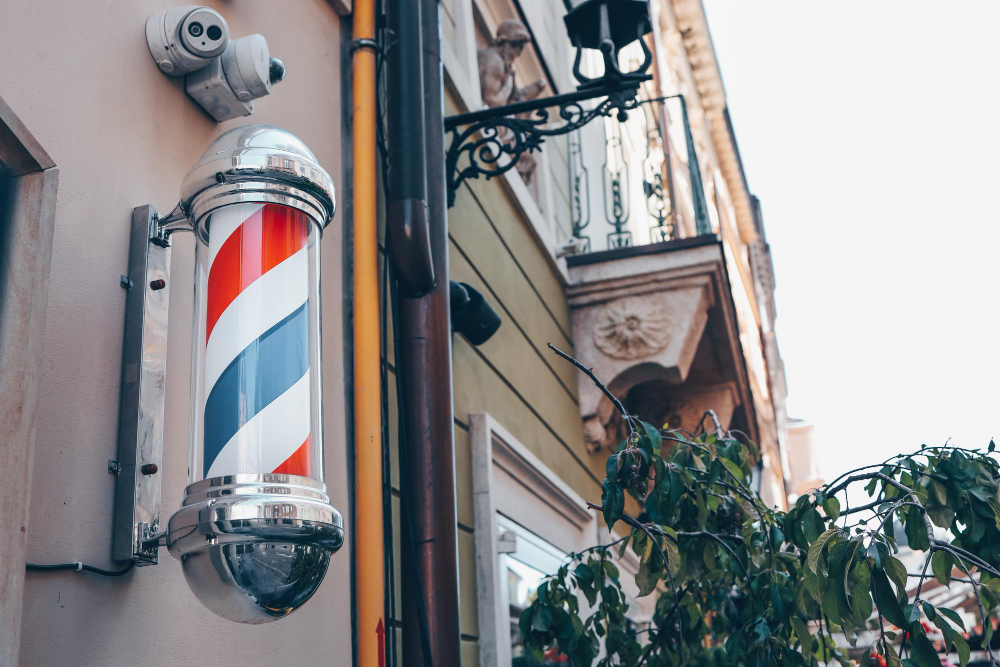
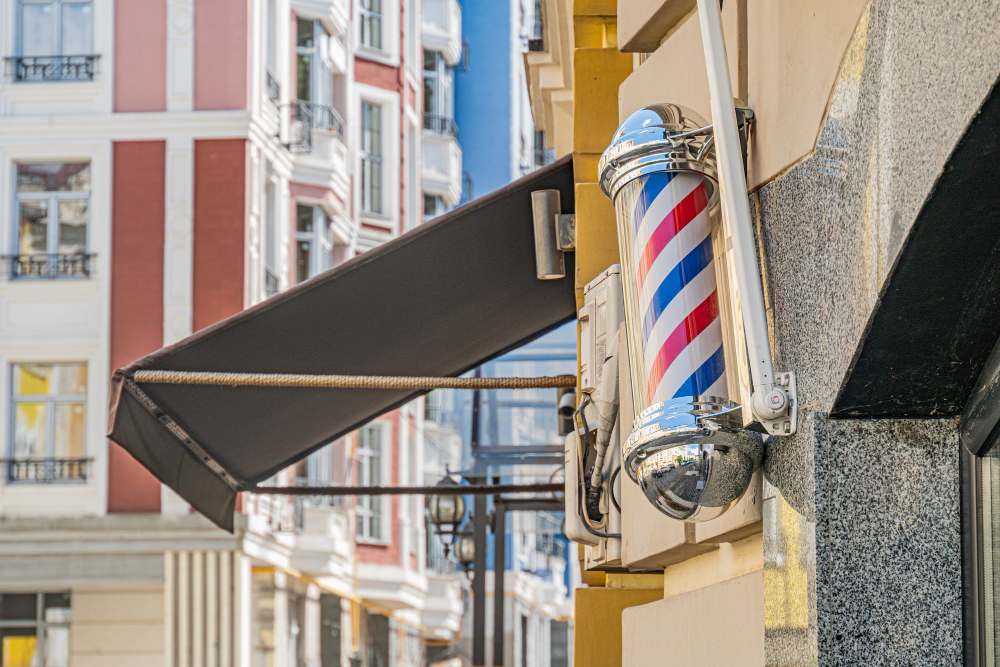
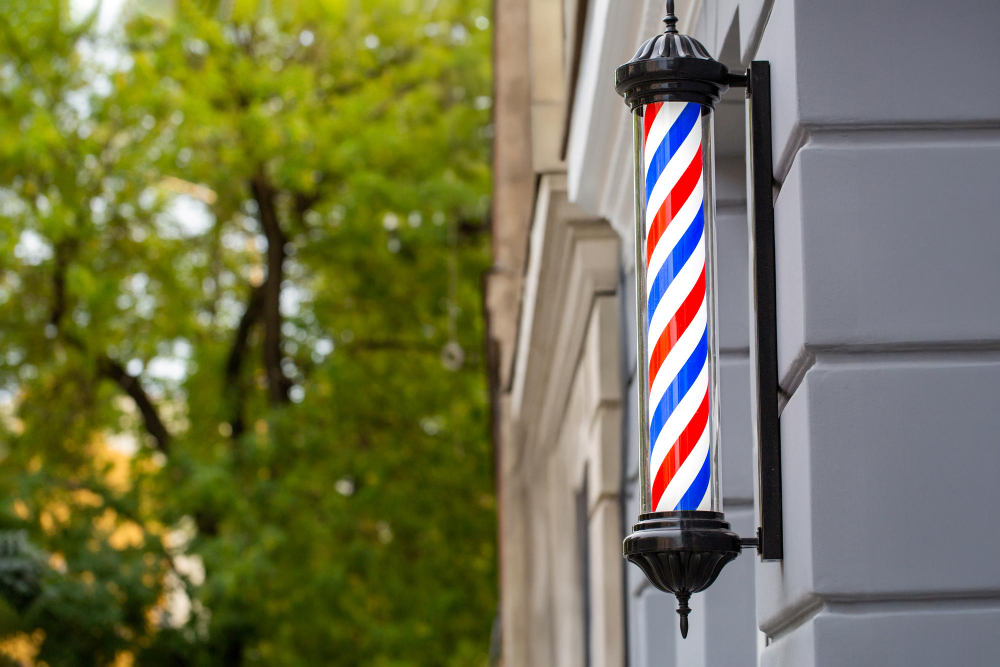
Outside barber shops there is a pole with spiralling red and white stripes, frequently with a brass or gold ball at one or both ends, and in many places it turns.
It is one of the oldest trade signs still in everyday use, and almost nobody who passes one knows what it depicts.
It is a record of surgery. For several centuries the person who cut your hair also opened your veins, pulled your teeth and dealt with your abscesses, and every element of the pole refers to that work.
Why the Barber Was Also the Surgeon
The combination seems bizarre and had a straightforward logic behind it.
A barber had the equipment: sharp blades, kept sharp, and the manual skill to use them precisely on a person who was awake. He had premises, a regular clientele, and a trade in which handling people’s bodies was already normal.
Physicians, by contrast, were university-educated, expensive, and in much of this period regarded manual work on the body as beneath them. Diagnosis and the prescribing of regimens were learned professions. Cutting was a craft, and crafts were done by craftsmen.
So the practical work – bloodletting, tooth extraction, lancing, setting, amputation in extremity – fell to the man with the razors, who learned it by apprenticeship like any other trade. The arrangement lasted for centuries and was formalised, with barbers and surgeons organised together in the same guilds in several places before eventually separating.
Like our content? Follow us for more.
Every Part of the Pole Means Something
The standard reading of the sign is remarkably literal.
The pole itself represents the staff the patient gripped during bloodletting. Gripping something makes the veins in the arm stand out and keeps the arm steady, and a stick was kept for the purpose.
The red stripes are blood, and the white are the bandages. Freshly washed bandages were hung on the pole outside to dry, where the wind wound them round it in a spiral – which is the frequently repeated explanation for the pattern and is plausible rather than documented, and it may equally be that the spiral was simply drawn on.
The ball at the top is generally said to represent the basin, used either to hold leeches or to catch the blood. Some poles have one and some have two.
How much of this is original intention and how much is later rationalisation is genuinely uncertain. What is not uncertain is the association between the sign and the practice – the pole was a bloodletting sign before it was a haircut sign, and it stayed.
Bloodletting Was Not a Fringe Practice
It is tempting to read this as a sign commemorating quackery, and that undersells how central the practice was.
Bloodletting was mainstream medicine for a very long time, across multiple unconnected medical traditions, performed on the recommendation of the most educated practitioners available, for a very wide range of conditions. It was not a folk remedy at the edges – it was the treatment, more or less, for decades at a time.
It was also, for almost all of those conditions, actively harmful, and it very probably contributed to a large number of deaths among people who would otherwise have recovered.
The interesting question is why it persisted, and the answer is instructive. Most conditions improve on their own. A patient bled on Tuesday who is better by Friday provides apparent evidence that bleeding works, and a patient who dies was clearly too ill to save. Without controlled comparison there is no way to distinguish a treatment that helps from one that harms, when most people get better either way.
Bloodletting is the standard example used to explain why controlled trials are necessary, and it earned that position – it is the clearest case in medical history of a universally practised intervention that was confidently believed, extensively documented, and wrong.
The uncomfortable part of that example is what it implies about confidence. The practitioners were not careless or stupid. They were observant, they kept records, they discussed cases, and they were as certain as anybody has ever been about anything, for a very long time, on the basis of evidence that genuinely looked compelling from the inside. What they lacked was a method for distinguishing their impression from the natural course of illness, and no amount of care or intelligence substitutes for that.
The Other Trade Signs Worked the Same Way
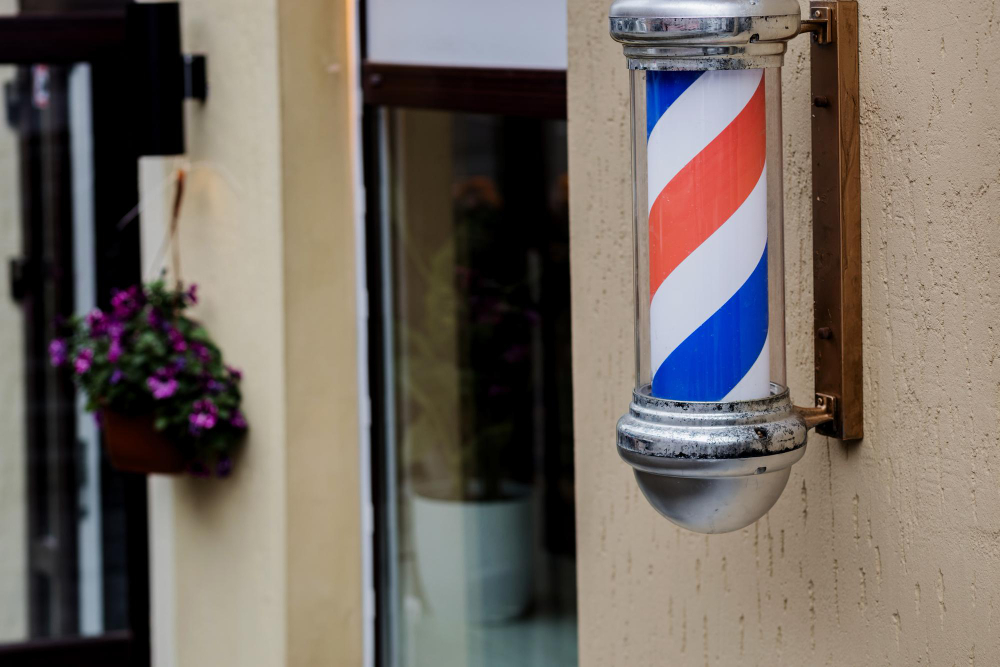
The pole belongs to a whole visual language that has almost entirely disappeared, and it is worth seeing it in that context.
Streets were once lined with objects rather than words. Three balls for a pawnbroker. A boot for a shoemaker. A glove, a key, a padlock, a pair of spectacles, a kettle, a horse’s head, a sheaf of wheat – each one hung outside the premises as a three-dimensional sign, frequently enormous, projecting over the pavement.
They were not decoration. A substantial proportion of the population could not read, and a painted name told them nothing. A shop had to be identifiable by what it looked like, and the sign was the identification.
Several of these signs became so standardised that they functioned as a vocabulary. The three balls meant pawnbroker everywhere, not because anybody legislated it but because the convention spread and held. A person arriving in an unfamiliar town could find the trades they needed by looking up.
The signs also got dangerous. They were heavy, they hung from brackets over the street, and in several places they were regulated or removed after accidents – which is the beginning of the shift to signs flat against the building and then to written shopfronts.
So the barber’s pole is a survivor of a complete system, and it is the only member of that system most people now encounter.
The Split, and Who Kept the Pole
Barbers and surgeons eventually separated, as surgery professionalised and acquired training, institutions and status of its own.
The division is the origin of a convention that survives in some places, where surgeons are addressed differently from other doctors – a deliberate retention of the older craft title rather than the academic one, which began as a marker of lower status and was subsequently kept as a point of distinction. That reversal, from a sign of being outside the profession to a mark of belonging to its most prestigious branch, happened over a couple of centuries.
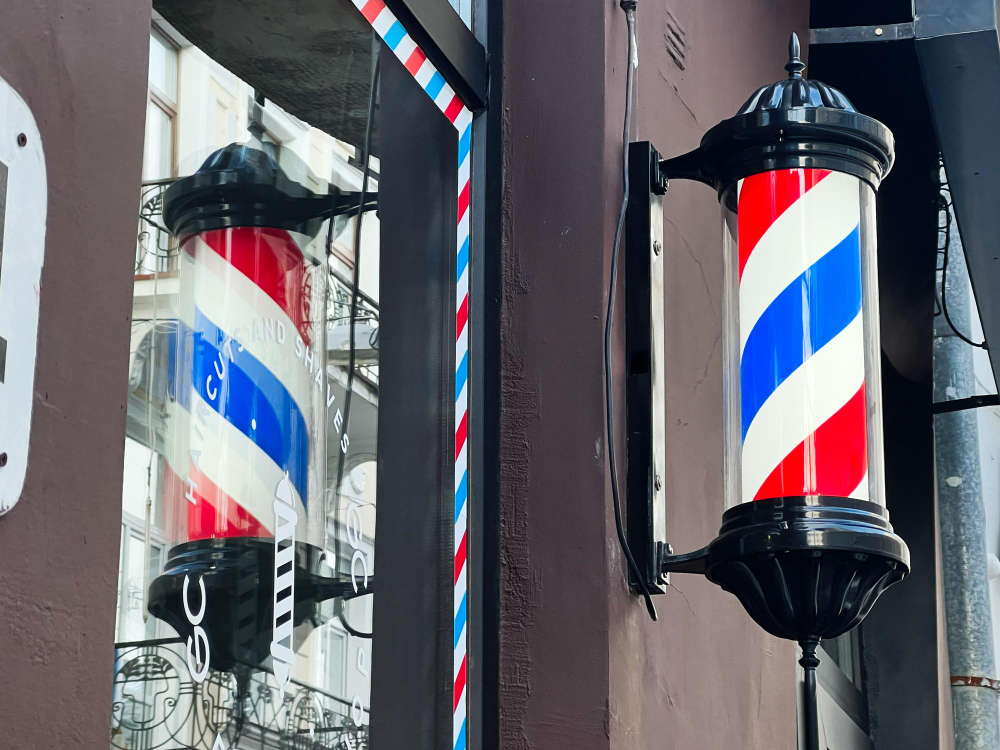
The barbers kept the pole, which is slightly odd given that the surgical work went the other way, and which has never been satisfactorily explained by anybody. The likeliest explanation is simply that the pole marked a shop and surgeons stopped having shops, so the sign stayed with the premises rather than with the practice.
Colour conventions diverged afterwards in different places, with some regions adding a third colour, and the explanations offered for the addition are various, contested and mostly retrospective. The pattern with all of these is consistent: a visual convention spreads first and acquires its explanation later, supplied by people who encountered the sign already in place and reasoned backwards to why it might look like that. Some of those reconstructions are probably right. None of them is evidence.
Why It Survived When Almost No Other Trade Sign Did
The pole is unusual in still being used. The overwhelming majority of trade signs – the three balls, the boot, the glove, the padlock, the key, the giant spectacles – have disappeared from streets almost entirely.
They existed because customers could not reliably read, so a shop was identified by a picture of what it did. Literacy removed the need, signage regulation removed many of them, and written shopfronts replaced the rest.
The barber’s pole survived for a specific reason: it became decorative before it became obsolete. It is distinctive, it is three-dimensional, it can be lit and made to rotate, and it says barber instantly to people who have no idea what it depicts. The meaning was lost and the function was not.
Which makes it a curious object – a sign that works perfectly while communicating nothing of what it shows, understood by everybody and interpreted by almost nobody, advertising haircuts with a picture of a bandaged arm.
There is one more reason it held on. Barbering is among the very few trades that could not be done remotely, could not be mechanised, and did not consolidate into large premises – a barber shop in any period is one or two people, a chair and a street frontage, which is precisely the kind of business that keeps a traditional sign because it has no marketing department to replace it with something else.
The next one you pass, look for the ball at the top.
That is the basin, and the spiral is the bandage.
And if it is turning, notice which way the stripes appear to travel. A rotating cylinder with diagonal stripes creates the illusion that the pattern is moving along the pole rather than around it, endlessly, never arriving – which is the same effect that makes a rotating barber pole oddly difficult to stop looking at, and which was a selling point for the motorised version long before anybody described the illusion.
Like our content? Follow us for more.