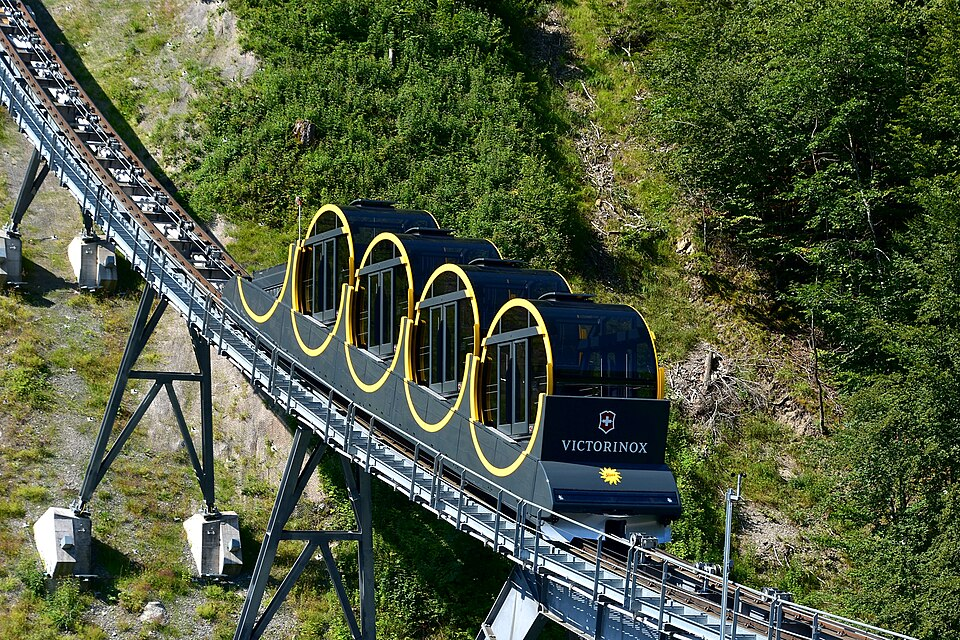
A gradient of 110 percent means the track rises 110 metres for every 100 metres it advances horizontally, which works out at a slope of 47.73 degrees. That is steeper than any staircase in an ordinary building and close to the angle at which loose gravel will not stay put.
The Stoosbahn in central Switzerland climbs at that angle for part of its route, and it solves the problem of what happens to the passengers by rotating the cabins as it goes. They are barrel-shaped, they turn on hydraulics, and the floor stays level all the way up.
What the numbers actually are
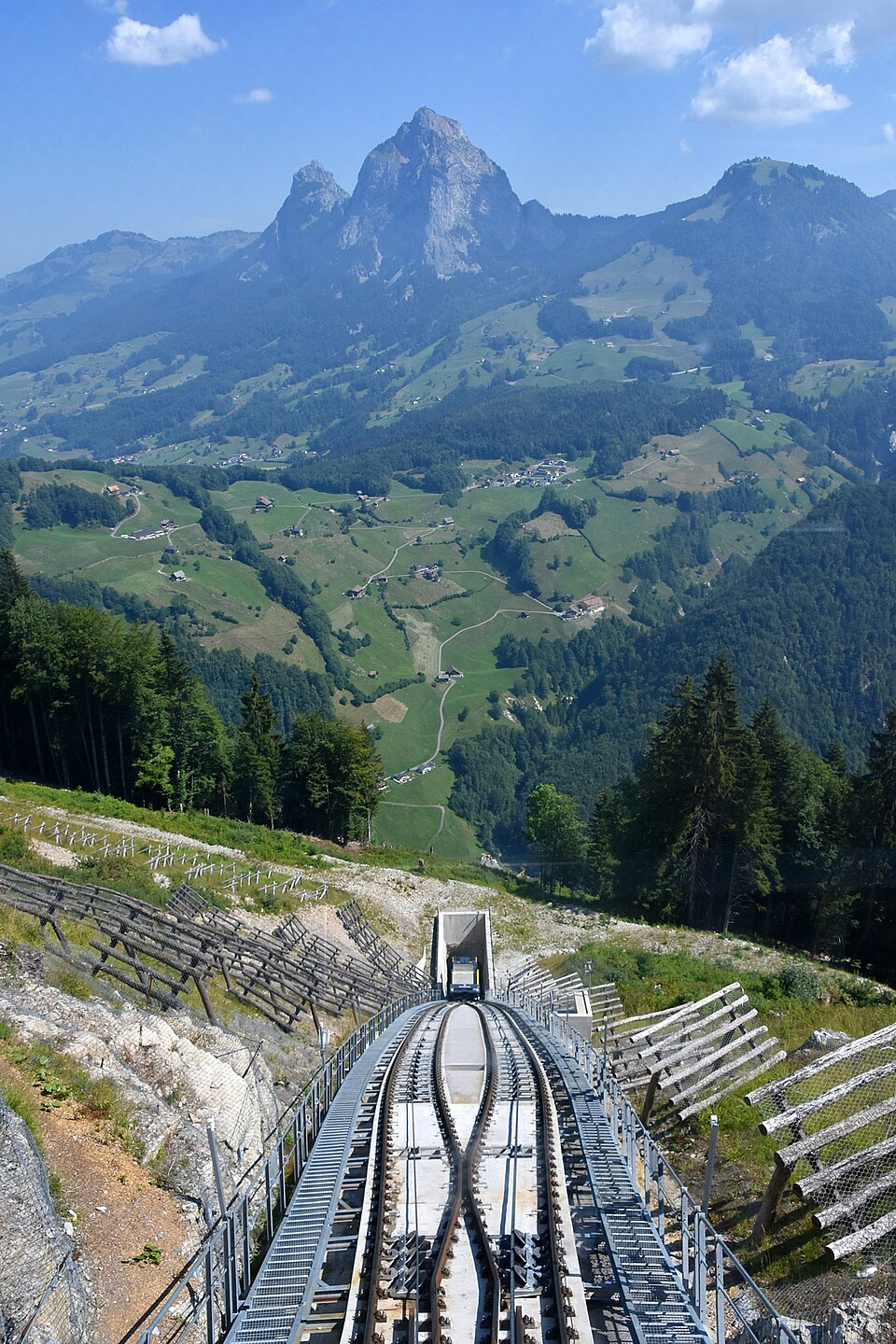
The maximum gradient is 110 percent, stated in railway practice as 1,100 per mille, and equal to 47.73 degrees. The vertical rise over the whole run is 744 metres, about 2,441 feet, and the journey takes four minutes.
The length is where the published figures disagree. The specification gives 1,740 metres, about 5,710 feet, while the track itself is described elsewhere as 1,547 metres. Both numbers are in circulation and they are not reconciled, which is worth knowing before quoting either.
Capacity is 1,500 passengers an hour. There are two cars, each carrying 136 people in four cylindrical cabins of 34, which is a configuration you will not find anywhere else.
The railway cost 52 million Swiss francs, above the earlier estimates, and opened on 15 December 2017, with the formal handover to public operation at 12:17 on 17 December.
Four minutes for 744 metres of rise is worth putting beside something familiar. It is roughly the vertical equivalent of climbing a sixty-storey building twice over, done sitting down, in less time than it takes to find a parking space at the bottom. The old line took appreciably longer over a shallower route, and the time saving is a large part of what the money bought.
Like our content? Follow us for more.
The rotating cabins, which are the whole point
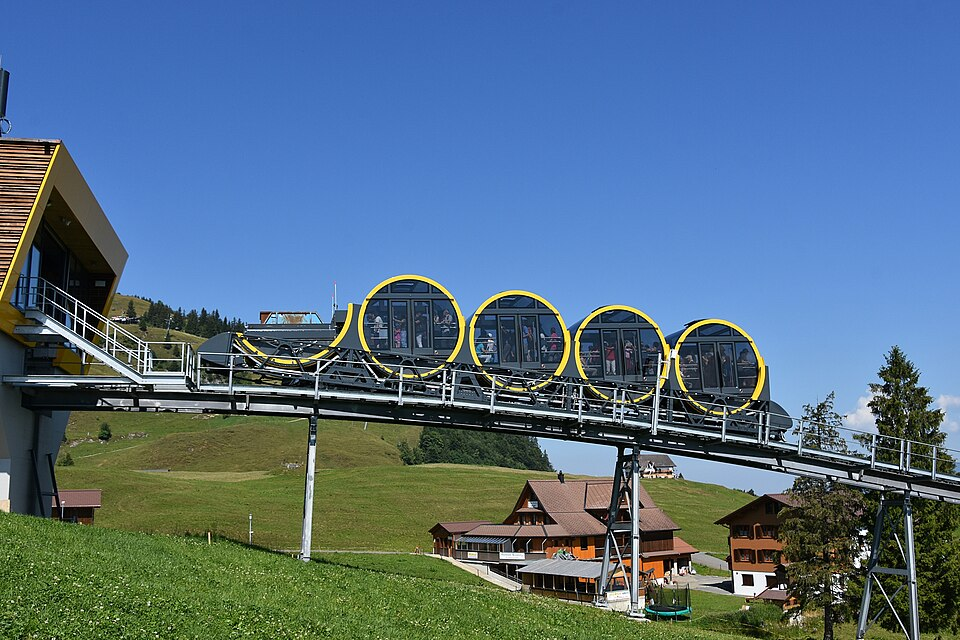
On an ordinary funicular the cabin is built as a stepped wedge, so that each compartment sits level when the car is on the designed gradient. It works, and it is why the inside of a funicular looks like a flight of boxes.
The weakness of that arrangement is that it is only correct at one angle. A line whose gradient changes along its length has cabins that are level at one point and tilted at others, and the steeper the line the worse the problem becomes.
The Stoosbahn’s cabins are cylinders that rotate about a horizontal axis, driven hydraulically, continuously adjusting as the gradient changes beneath them. The floor is level at the bottom station, level at the top, and level throughout the varying gradients between.
The practical gain is not comfort but access. Because the floor is level and flush at both stations, a pram or a wheelchair can be rolled straight on, which on a conventional stepped funicular is impossible.
Why a line that steep exists at all
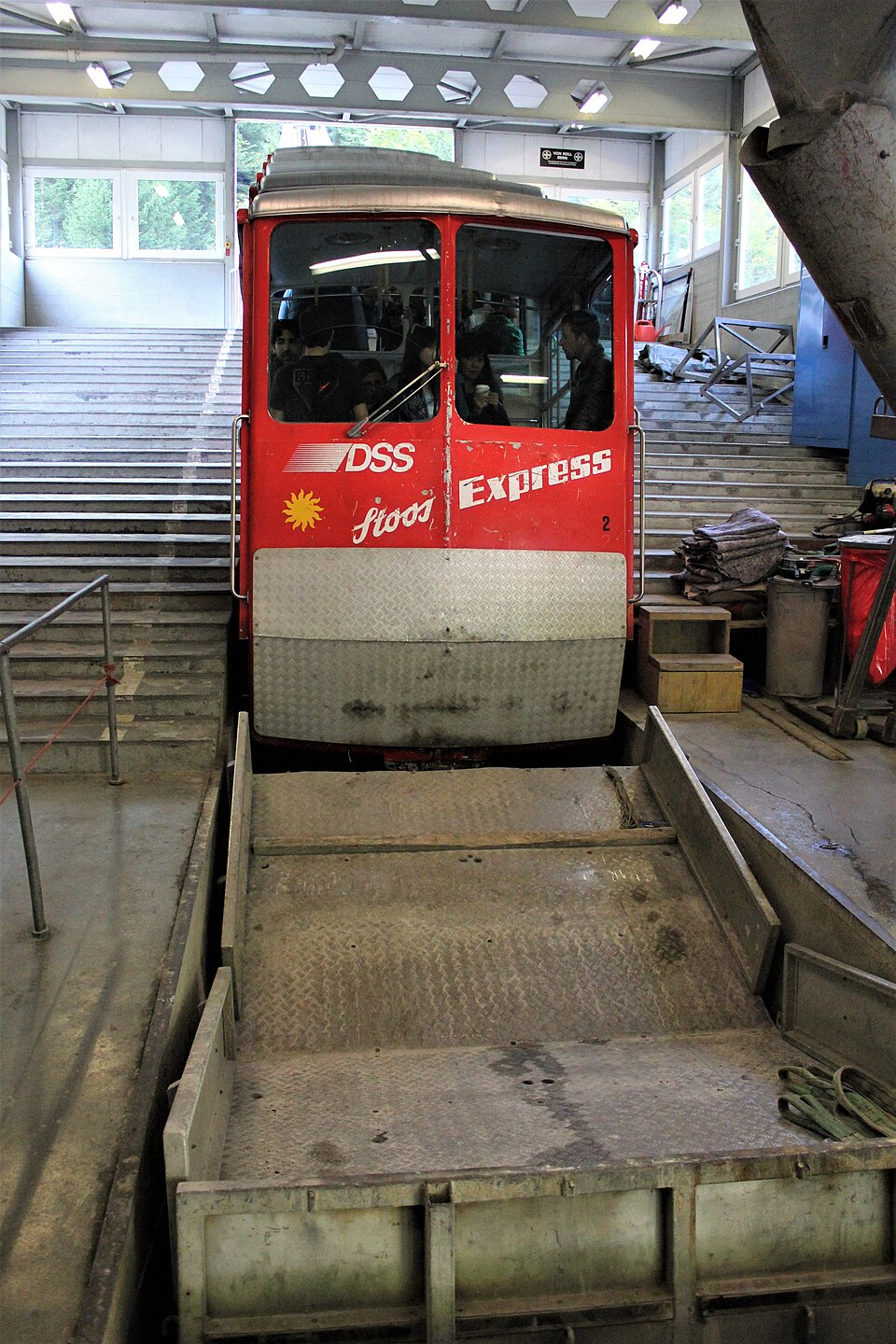
It replaced an earlier funicular on a different route, which had run since 1933 and had become technically outdated. A feasibility study concluded that bringing the old line up to modern safety standards would require extensive renovation without delivering much in return.
An aerial cableway was considered and abandoned. The reason is unusually specific: a nearby shooting range meant that protecting the cableway from stray bullets would have taken disproportionate effort, which is the kind of constraint that does not appear in engineering textbooks.
The new upper station was sited to give more direct access to the adjacent ski area, which is the commercial logic behind the project. The route it took is steeper than the old one because the new alignment is more direct.
Stoos itself sits on a shelf high above the valley, and the railway is the practical way up. That combination — a settlement that needs a link, and a slope that offers no gentle route — is what produces extreme funiculars generally.
It is also why the steepest lines in the world are clustered in a handful of countries. Building one requires a particular combination of mountainous terrain, a population already living above the valley floor, and the public willingness to spend heavily on a link that will never carry large numbers. Switzerland, Austria and a few others have all three; most places with the terrain have neither of the others.
How a funicular works, and why steepness is survivable
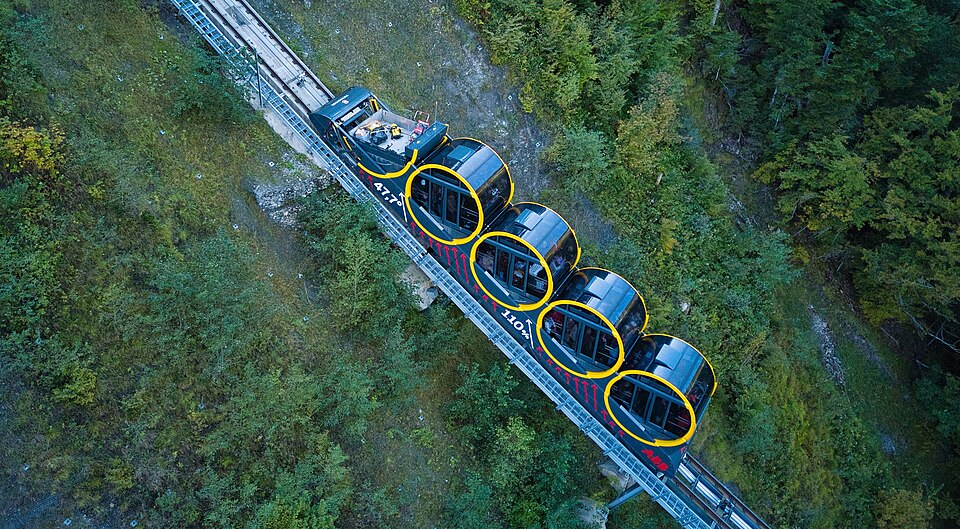
A funicular is two vehicles on one cable over a pulley at the top, each counterbalancing the other. The motor only has to move the difference in weight between them plus friction, which is why funiculars have always been able to manage gradients that would defeat an adhesion railway.
That also explains why they are cheap to run and expensive to build. The energy cost is low because the descending car is doing most of the lifting, while the capital cost is in the alignment: a dedicated, graded, fenced right of way with a tunnel or a cutting wherever the ground does not cooperate.
The safety case rests on redundancy rather than on the cable alone. Funiculars carry independent braking that grips the track, with systems designed to engage automatically if the cable tension is lost or if the car exceeds its designed speed.
Steepness, in itself, is not the hazard it intuitively seems. The forces are well understood and the geometry is fixed. What steepness does is make everything about the installation — stations, evacuation, maintenance access — harder to arrange.
Getting off in an emergency
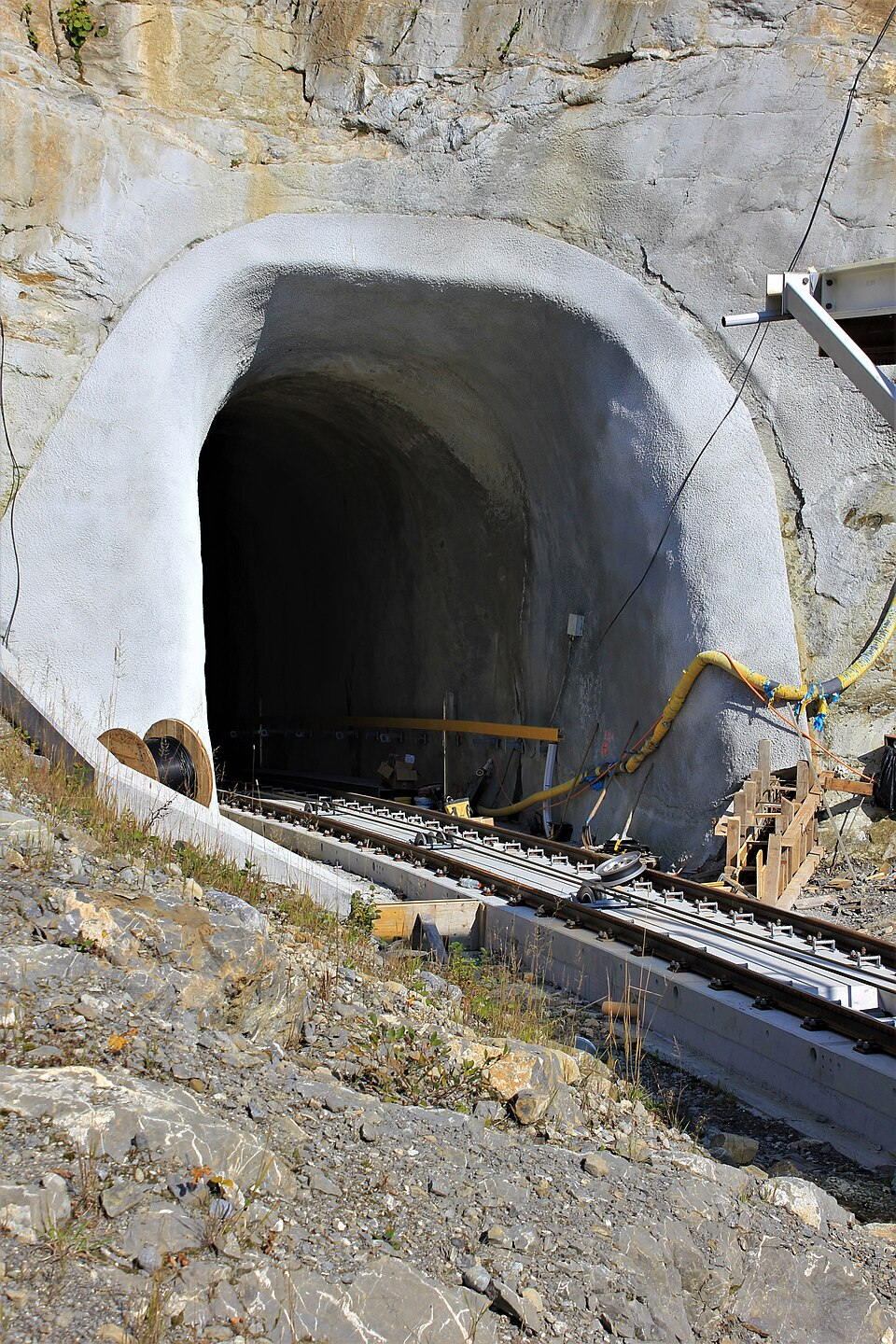
This is the part of a steep railway that takes the most design effort. An evacuation route on a 47-degree slope cannot be a walkway in the ordinary sense, and carrying somebody down one is not a realistic plan.
The approach taken on modern steep funiculars is to make the vehicles recoverable rather than to make the track walkable: auxiliary drives that can move a stranded car to a station under their own power, and procedures built around bringing the car to people rather than people down the track.
Where a walkway does exist alongside the track it is a stepped structure with handrails, intended for staff and for a last resort, and it is designed on the assumption that it will be unpleasant to use.
The reason to mention it is that it shapes the whole installation. Station spacing, tunnel sections and the position of passing points are all partly determined by how a car would be recovered from each part of the line. A design that looks like an aesthetic choice from the outside is frequently a recovery decision underneath.
The other contenders, and what each of them measures
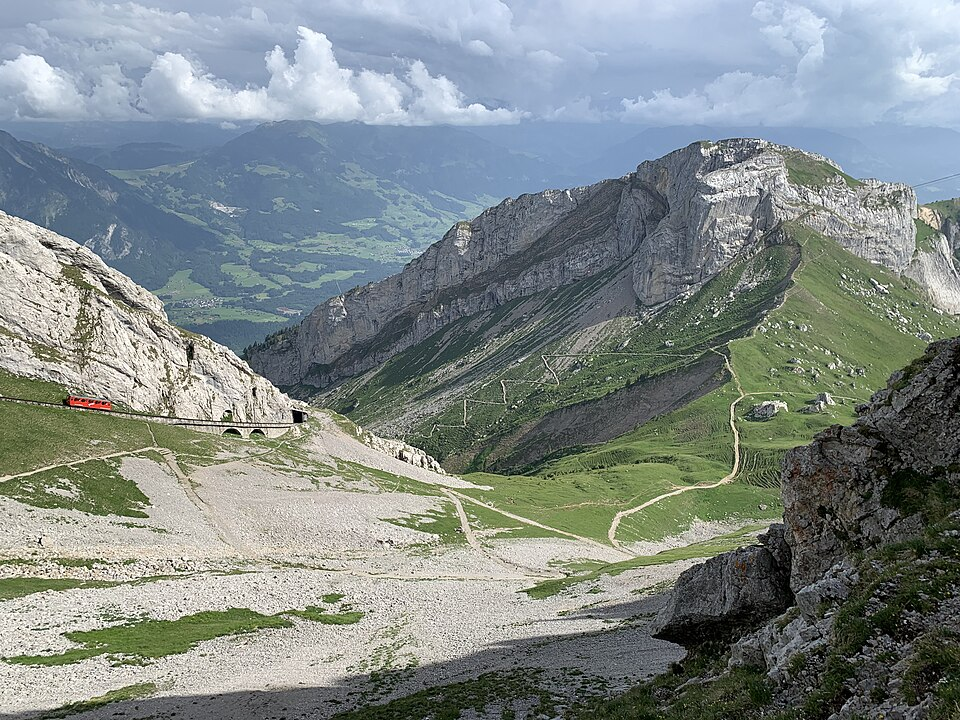
Several railways are described as the world’s steepest and the claims are not in conflict, because they are measuring different categories of railway. A funicular is cable-hauled. A rack railway drives a toothed wheel into a toothed rail. An adhesion railway relies on friction between a plain wheel and a plain rail.
The steepest rack railway and the steepest adhesion railway are both much shallower than this, because both have to transmit force through a mechanical contact rather than through a cable. The steepest adhesion gradients in regular main-line use are a small fraction of what a funicular manages.
There are also inclined lifts, cliff railways and mine inclines that are steeper still, and whether they count depends on whether you require a public passenger service on a defined route.
So the honest phrasing is the steepest funicular open to the public, which is the claim the operator and the record bodies make, rather than the steepest railway of any kind.
Riding it
Four minutes, 744 metres of rise, and a sensation that the cabin is slowly tilting while the mountain outside swings through nearly fifty degrees. The windows are the thing to watch, because the rotation is visible against the landscape rather than felt underfoot.
The practical notes are the ordinary alpine ones: it runs to a timetable rather than continuously, it is busy at the start and end of the ski day, and the fare is a cable-car style fare rather than a railway one, often bundled with onward lifts.
The honest summary: the Stoosbahn in Switzerland opened on 15 December 2017 and reaches a maximum gradient of 110 percent, which is 1,100 per mille or 47.73 degrees; it rises 744 metres in four minutes, carries 1,500 passengers an hour in two cars of 136 across four rotating cylindrical cabins each, and cost 52 million Swiss francs; its published length is given as both 1,740 metres and 1,547 metres and the two figures are not reconciled; the rotating cabins exist to keep the floor level through changing gradient, whose real benefit is step-free boarding; it replaced a 1933 funicular judged not worth renovating, and an aerial cableway was rejected partly because of a nearby shooting range; and the record is specifically for a funicular, because rack and adhesion railways cannot approach these gradients at all.
Like our content? Follow us for more.