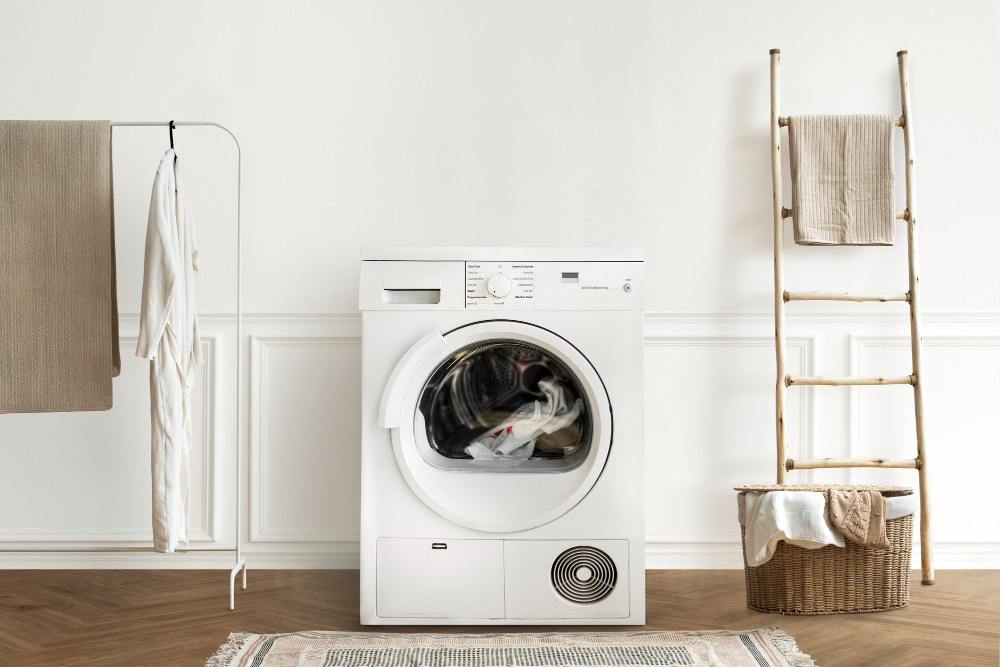
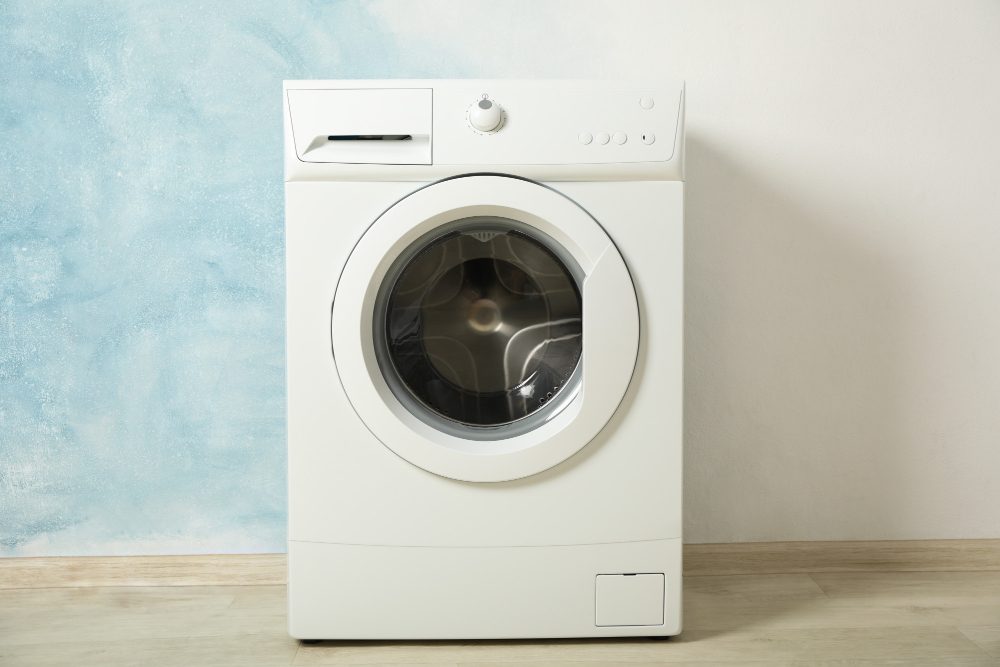
At the bottom front of almost every washing machine there is a small panel – a flap, a hinged cover or a clip-off plate. Behind it is a filter.
Its job is to catch everything that gets through the drum and would otherwise reach the pump: lint, hair, grit, and the coins, buttons, hair grips, screws and small pieces of children’s toys that come out of pockets.
The manufacturer intends it to be checked periodically. A large proportion of owners do not know it exists, and a blocked filter is the single commonest reason a machine stops draining and is declared broken.
What Actually Happens When It Blocks
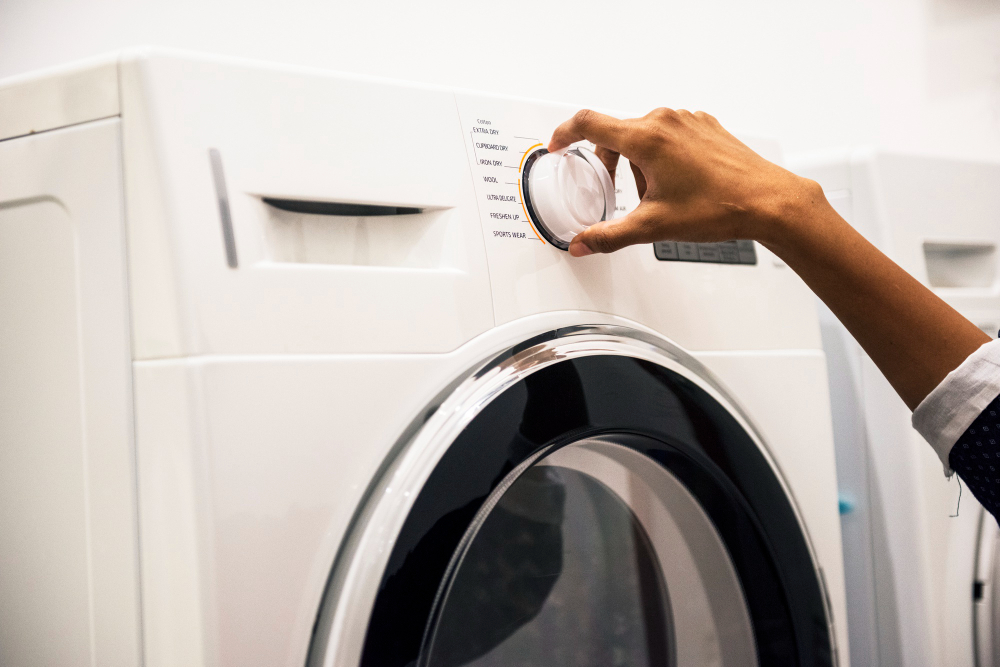
The filter sits between the drum and the pump. When it clogs, water cannot get through to be pumped away.
The machine detects that the water level has not fallen when it should have, and stops. Depending on the model it shows an error, it hangs on a cycle, or it simply refuses to spin, because spinning a drum full of water is not something it will do.
So the symptoms are a machine that will not drain, will not spin, stops partway, or sits with water in the bottom – all of which read as a serious fault and are frequently a handful of fluff and a hair grip.
The second consequence is harder on the machine. A pump trying to move water through a restriction runs hot and works against a load it was not designed for, and a pump that has been doing that for months is a pump that fails. So a filter that has never been cleaned does not only cause a blockage – it shortens the life of the component behind it.
Like our content? Follow us for more.
There Is Always Water Behind It
The reason this is worth knowing before opening it rather than afterwards: the filter housing holds water, and opening it releases that water onto the floor.
It is not a large amount and it is more than a cloth will handle. The sensible preparation is a shallow tray or a baking dish to catch it, a towel underneath, and the machine switched off at the socket first.
Many machines also have a small drain hose tucked beside the filter specifically so the housing can be emptied in a controlled way before the filter is removed. It is a short length of tube with a cap, it is there precisely because the designers knew about the water, and it is as unknown as the filter itself.
The filter then unscrews – usually anticlockwise, usually by hand – and comes out with whatever it has been holding.
Where the Panel Is and Why It Is Hidden
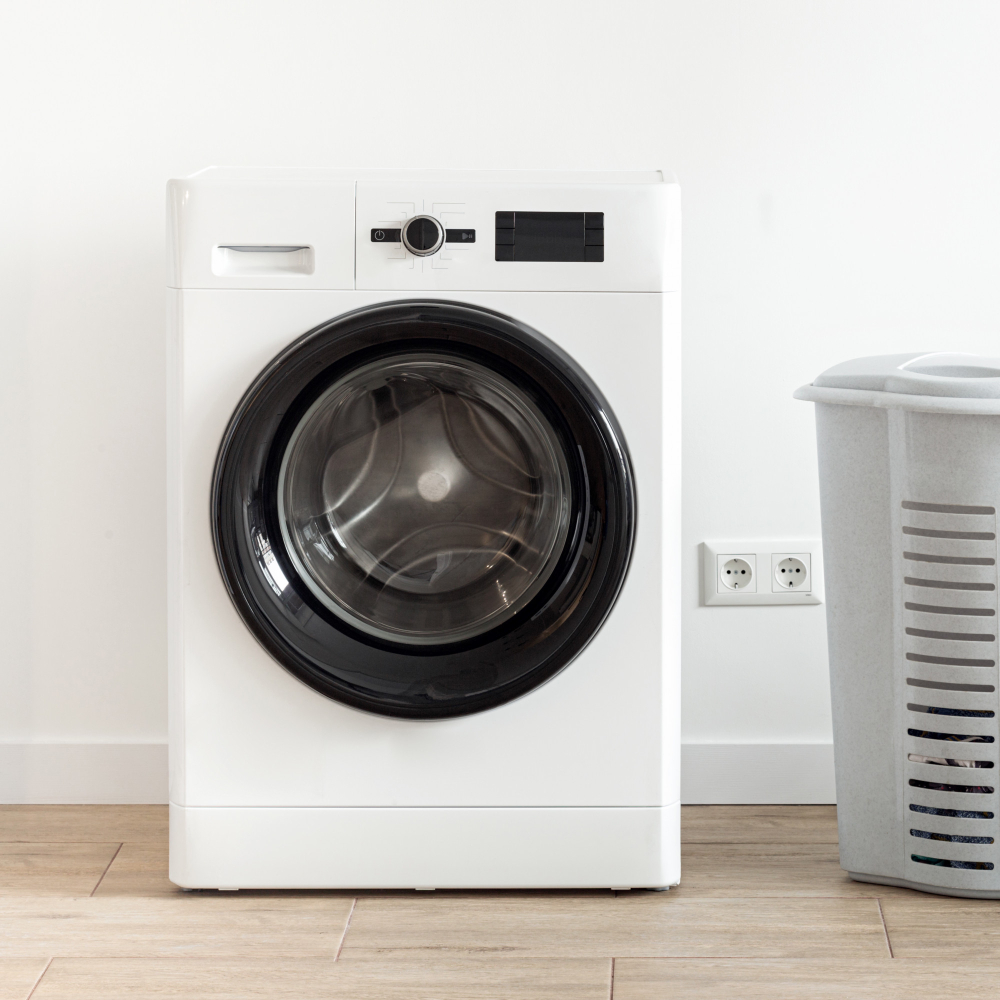
Finding it is the first obstacle, and on some machines it is genuinely well concealed.
On most, it is a rectangular flap across the bottom front, the full width or a corner of it, opened with a fingernail, a coin or a flat screwdriver in a small slot at one edge. On others it is a small circular cover. On integrated machines fitted behind a cupboard door, it is behind the plinth, which has to come off first – and on those it is frequently never opened in the life of the machine, because the obstacle is one step too many.
The reason it is unobtrusive is appearance. A washing machine is a large white object in a room people want to look tidy, and a prominent access hatch across the front of it is not what sells one in a showroom.
So the feature most needing to be noticed is deliberately made least noticeable, which is a direct conflict between how the product is sold and how it is meant to be used.
Manufacturers who print a line about it on the inside of the flap are addressing a problem they created, at the one moment it cannot help – the instruction is readable only to somebody who has already found the thing.
What People Find in Them
This is the part that makes people open it.
Coins are the most common thing, in quantity, from years of pockets. Hair grips, buttons, safety pins, small screws, paper clips, children’s toy parts, bra wires, pet hair compacted into a mat, and an accumulation of lint that has gone grey and solid.
The bra wire deserves a specific mention, because it is the one that does damage. A wire that escapes a garment is thin, stiff and exactly the wrong shape – it can pass through the drum holes and jam between the drum and the outer tub, where it makes a grinding noise, scores the drum and in some cases perforates it. Washing underwired garments in a mesh bag is the standard preventive measure and takes no effort.
Also worth knowing: an object that reaches the filter has already passed through the drum, which means it has been rattling around inside the machine. The noise people describe as something loose in the drum is frequently something that has already got out of it.
How Often, and What Else to Check While You Are There

Manufacturers typically suggest checking it every month or two, and in practice it depends entirely on the household – pets, long hair, children, heavily soiled work clothing and a habit of not emptying pockets all shorten the interval dramatically.
A reasonable approach is to check it once, see what has accumulated, and set the interval from that.
While the panel is open, two other things are visible. The pump impeller is usually behind the filter and can be turned by hand to check it is free and nothing is wrapped round it. And the condition of what comes out tells you something: a filter full of grit suggests something getting in that should not be, and a filter full of degraded fabric fibre on every check suggests a load problem rather than a filter problem.
None of this requires tools or any disassembly beyond unscrewing the filter by hand, which is why it is designed as an owner task rather than a service task. Anything beyond that – persistent faults, leaks, noises or error codes that return after cleaning – is a job for a qualified engineer rather than for an article.
The Detergent Drawer Is the Other Neglected Part
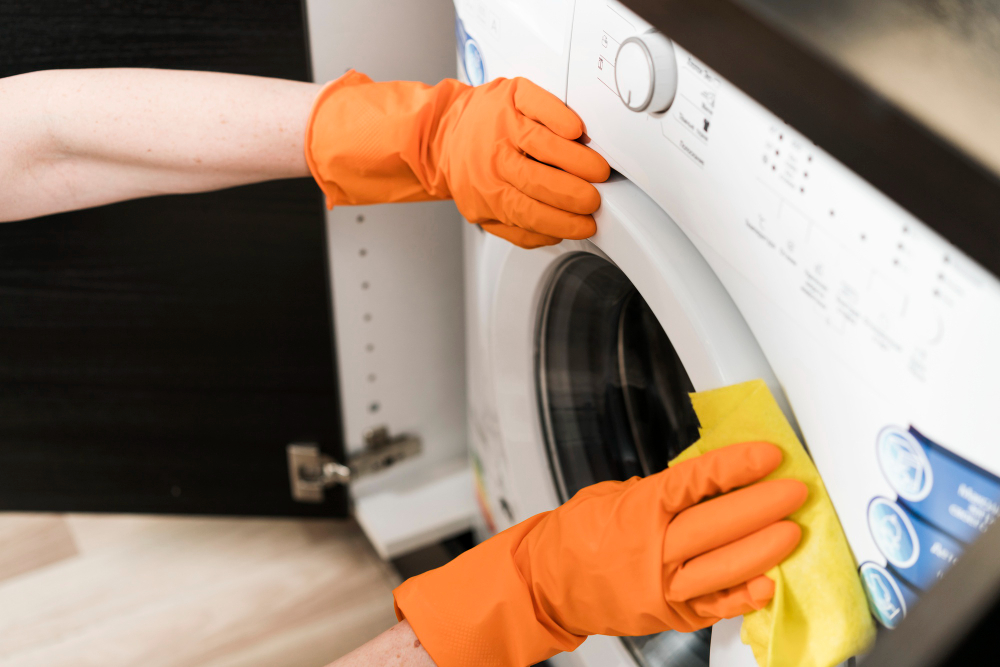
Since the panel is open, the drawer at the top is the other component that silently degrades and is equally easy to deal with.
The drawer and the housing it slides into accumulate a build-up of undissolved detergent, fabric conditioner and the black mould that grows in the permanently damp cavity above it. Conditioner in particular does not rinse away cleanly and forms a thick deposit in the siphon that draws it out of the compartment.
When that siphon blocks, conditioner is not drawn into the wash at all, and it simply sits in the drawer and overflows into the next cycle at the wrong moment. People conclude the machine has stopped using conditioner, which is correct, and that the machine is faulty, which is not.
The drawer on most machines comes out completely – there is usually a tab or a release inside the compartment – and the housing above it can be reached and wiped. Both wash in a sink.
It is the same category of task as the filter: designed to be done by the owner, taking a few minutes, never done, and eventually producing a symptom that gets diagnosed as a broken machine.
Why a Known Feature Goes Unused
The filter is documented in every manual, marked on the machine on many models, and is the first thing any engineer checks.
It goes unused for a specific reason worth naming: there is no feedback. The machine does not ask to have it cleaned, nothing gets visibly worse in a way that points at it, and performance degrades slowly over years until it fails suddenly. By the time anybody is motivated, the symptom is a machine that will not work, which reads as a fault rather than as maintenance.
Compare a feature with feedback – a vacuum cleaner that visibly loses suction, a razor that pulls, a filter with an indicator light. Those get maintained, because the object tells you.
So the general rule is that unprompted periodic maintenance does not happen, on anything, for anybody, unless something reminds you. The machines that have started adding a reminder for this are responding to exactly that, decades late.
In the meantime, the useful substitute for a reminder is attaching it to something that already happens. Once a season, at the same time as some other thing you reliably do, is far more likely to survive than a resolution to do it every six weeks.
Find the panel at the bottom front of your machine and open it.
Put a tray down first, because there will be water in there.
And if the machine has been doing something odd for months – not draining fully, stopping on the spin, making a noise you have learned to ignore – open it before you call anybody out. It is free, it takes five minutes, and on a substantial proportion of the machines declared broken every year it is the entire problem.
Like our content? Follow us for more.