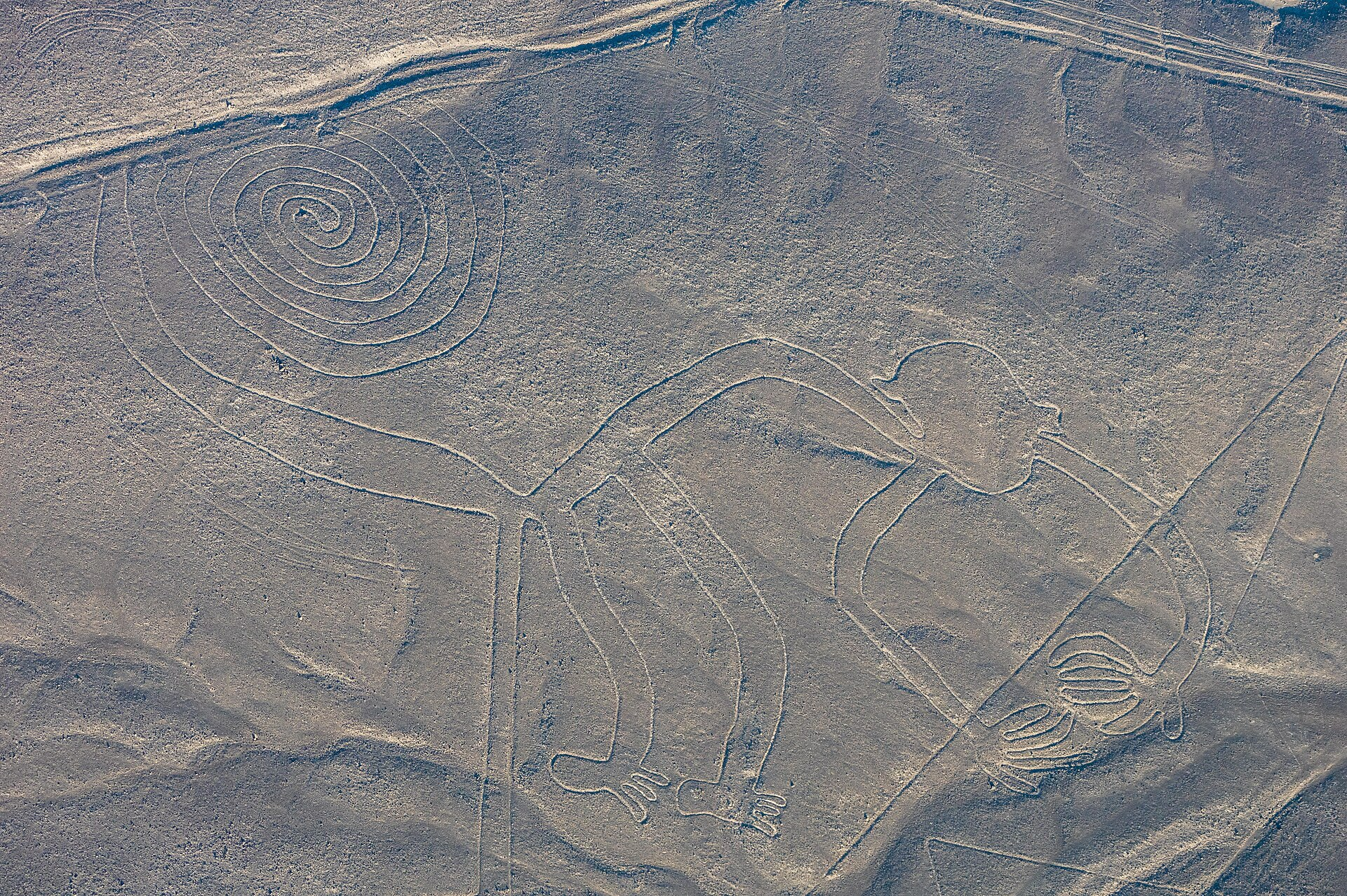
In the dry coastal desert of southern Peru, spread across a vast plateau, are some of the most remarkable artworks ever made — and for most of the time they’ve existed, essentially nobody could see them properly. The Nazca Lines are a collection of hundreds of enormous designs carved into the desert floor: gigantic animals and figures, straight lines running arrow-straight for miles, triangles, trapezoids, and spirals, covering an area of hundreds of square miles. They are so large that from the ground they read as meaningless scratches and shallow paths. It is only from the air, or from a nearby height, that they resolve into the astonishing images they actually are.
They were created by the Nazca culture — and in part an earlier culture — beginning more than two thousand years ago and continuing over many centuries, and they have survived because of the extraordinary stillness and dryness of the desert they’re drawn in. They are a real wonder, a UNESCO World Heritage Site, and one of the world’s great archaeological puzzles, because while we understand fairly well how they were made and who made them, the question of exactly why has never been fully answered. Here is what’s known, and what isn’t.
How They Were Made
The technique is, in principle, simple, which is part of what makes the scale so impressive. The desert floor of the Nazca region is covered with a layer of reddish-brown stones and pebbles, darkened over time by exposure, sitting on top of lighter-colored ground beneath. To make a line or a figure, the creators removed the dark surface stones along the intended path and piled them at the edges, exposing the pale earth underneath. The contrast between the light exposed ground and the dark surrounding surface creates the visible design.
Because the lines are essentially shallow trenches a few inches deep, made by moving stones rather than by deep carving, they might seem fragile. In fact they’ve endured for well over a thousand years, and the reason is the environment. The Nazca desert is one of the driest places on Earth, with almost no rain, very little wind at ground level, and a stable climate — conditions that have left the designs largely undisturbed for centuries. In a wetter or windier place, they would have vanished long ago. Here, they simply stayed.
The precision achieved with such basic methods is one of the real marvels. Some of the straight lines run for miles while deviating only slightly from true, and the animal figures are rendered in confident, flowing, continuous lines at enormous scale. How the Nazca laid out designs this large and this accurate, when they could never have seen the whole thing from the ground, is a real question — proposed answers include working from scaled-up small drawings using stakes and cords, but the achievement remains impressive by any account.
Like our content? Follow us for more.
What’s Actually Out There
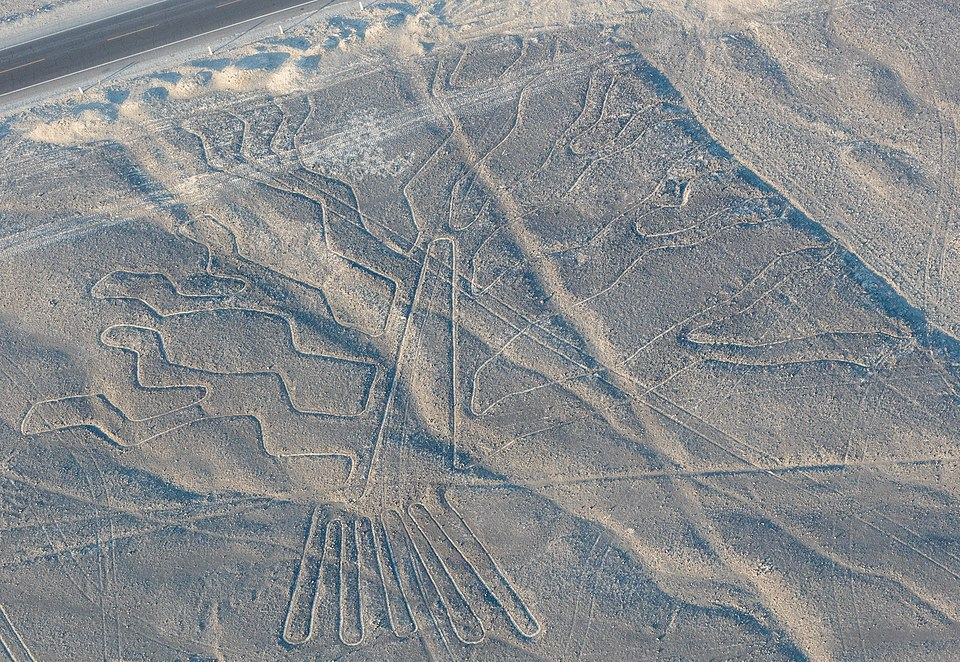
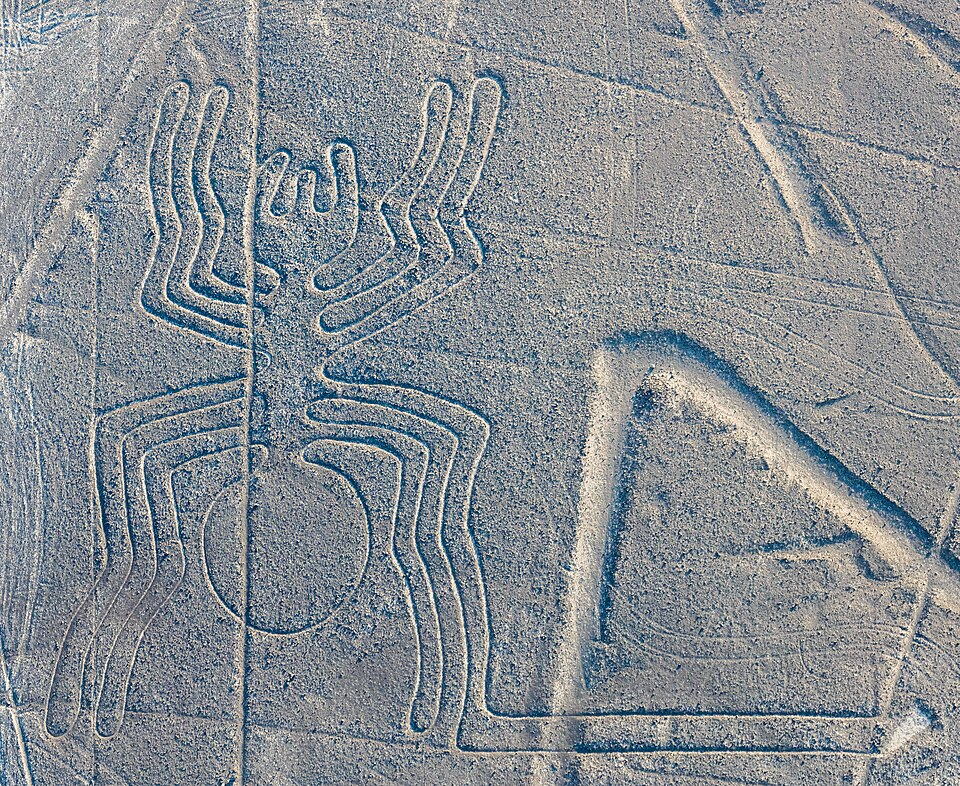
The designs fall into a few broad categories. There are the famous figurative ones — the biomorphs — depicting animals and plants: a hummingbird with outstretched wings, a monkey with a whimsically spiraled tail, a spider, a condor, a pelican, a dog, flowers and trees, and a number of others. These are the images that appear on every poster, and they are astonishing, rendered as single unbroken lines at a scale of tens or hundreds of feet.
Then there are the far more numerous non-figurative designs: enormous geometric shapes, especially long straight lines and elongated trapezoids and triangles, some running for miles, along with spirals and zigzags. These vastly outnumber the animal figures and cover much of the plateau in an overlapping network. And there is at least one prominent humanlike figure, often called the “astronaut” or the “owl-man,” a figure with a rounded head set on a hillside — a name that, unhelpfully, has fed a great deal of nonsense over the years.
New discoveries continue. In recent years, researchers using aerial imagery, drones, and increasingly artificial intelligence to analyze survey data have identified many previously unknown figures, substantially expanding the known catalogue. The Nazca plateau, it turns out, is even more densely covered than was long believed, and the total number of designs keeps climbing as technology reveals fainter and smaller examples that the eye had missed.
Why Were They Made?
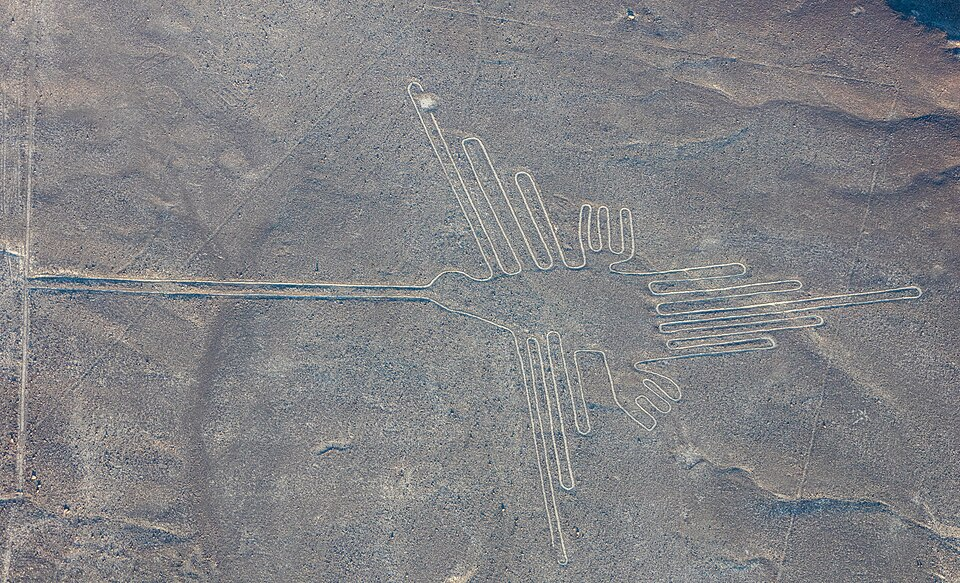
This is the question everyone asks, and the honest answer is that no single explanation is fully settled — though some are far better supported than others, and the truly credible theories all share a crucial feature: they are entirely human.
The leading explanations connect the lines to water and ritual, which makes deep sense in a desert culture whose survival depended on scarce water. One prominent theory holds that the lines and figures were related to religious and ceremonial practices, possibly walked in procession as part of rituals — many of the lines can be traced as continuous paths, consistent with being walked. Another influential idea connects them to water and fertility: pointing toward sources of water, marking underground water flows, or serving in ceremonies appealing to deities for rain in a punishingly arid land. The figures may have been offerings meant to be seen by gods above, which would explain why visibility from the ground didn’t matter — the intended audience was in the sky, in a religious rather than extraterrestrial sense.
An older theory proposed that the lines formed a giant astronomical calendar, with lines pointing to significant risings and settings of the sun, moon, and stars. This idea was influential for a time but has largely fallen out of favor, as statistical analysis found that the lines don’t align with celestial events more often than chance would predict. Elements of astronomical meaning may still be present, but the “giant observatory” explanation is no longer the leading view.
What all the credible theories have in common is that they attribute the lines to the Nazca people themselves, working for their own cultural, religious, and practical reasons. Which brings us to the theory that needs to be set aside.
Setting the Aliens Aside
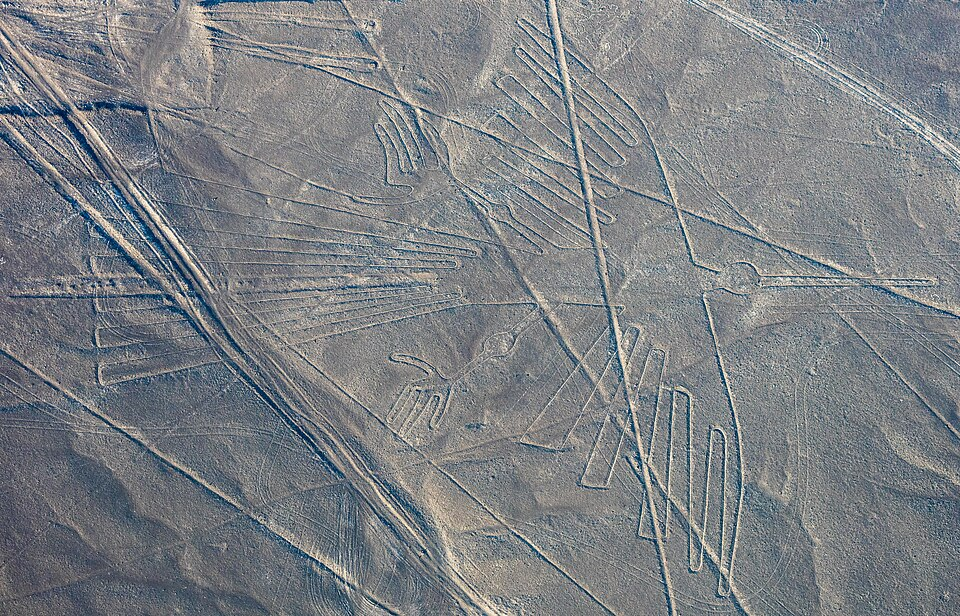
The Nazca Lines have, unfortunately, become a fixture of a certain genre of pseudo-archaeology that claims they were made by, or as signals to, extraterrestrials — the “astronaut” figure and the resemblance of some trapezoids to runways being cited as evidence. This idea deserves to be addressed directly and dismissed, because it is both wrong and steadily insulting.
It is wrong because there is no evidence for it and abundant evidence against it: we know how the lines were made, with simple local techniques entirely available to the Nazca; we can date them to the Nazca period; the “runways” are far too soft to land anything on and align with nothing aeronautical; and the figures are stylistically consistent with Nazca art found on their pottery and textiles. And it is insulting because its underlying premise is that ancient Indigenous people could not possibly have created something this sophisticated on their own, requiring alien intervention to explain their achievement. That premise is both false and demeaning. The Nazca were a capable, sophisticated culture entirely able to make these designs, and did. The real mystery is why — a rich, open, human question — not who, which is not really in doubt.
Seeing Them
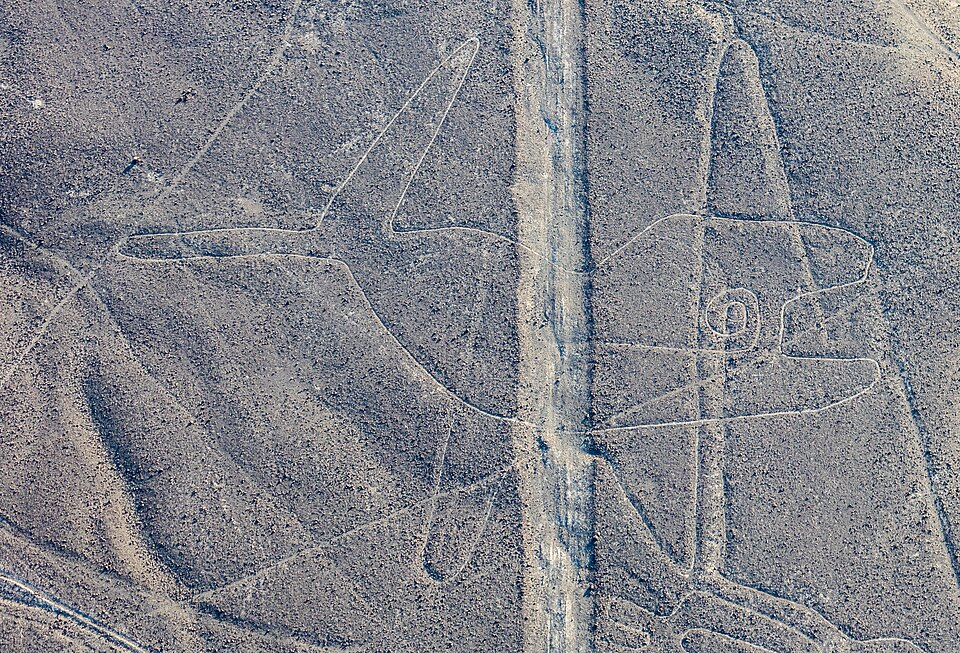
For travelers, the Nazca Lines present a specific practical challenge, which is the whole point of them: they can’t really be appreciated from ground level. The classic way to see the figures is from the air, on a small-plane sightseeing flight from the local airfield, which banks over the major designs so passengers can see the hummingbird, the monkey, the spider, and others laid out below. These flights are the iconic Nazca experience, though they’re not for everyone — the small planes and tight turns can be rough.
There are ground-based options too: an observation tower beside the highway that crosses the plateau offers a view of a couple of figures from height, and some nearby hills provide vantage points. The lines lie along the route between Lima and other southern Peruvian destinations, making them a natural stop on a longer trip. A crucial point for any visitor: the plateau itself is protected and fragile, and walking on the lines is prohibited and really damaging — the designs have survived because they’ve been left undisturbed, and footprints last a very long time in that desert. The lines are to be seen from above or from designated viewpoints, never walked on.
The Desert’s Great Question
The Nazca Lines endure as one of the world’s great wonders precisely because they combine near-total certainty about the how and the who with a honestly open question about the why. We can stand confidently on the facts: a sophisticated ancient culture, using simple and well-understood techniques, created hundreds of enormous designs across the desert over many centuries, and the dry stillness of the place preserved them until aircraft finally let humanity see them whole.
And then the desert keeps its one real secret. Whether the lines were ceremonial paths, appeals for water, offerings to gods above, or some combination we haven’t fully grasped, the people who spent generations making them left no explanation we can read. That open question is the right one to carry away — not the tabloid mystery of who made them, which has a clear and human answer, but the deeper and more interesting one of what they meant to the people who walked out into the desert, moved the stones, and drew a hummingbird the size of a building for an audience they could only imagine.
Like our content? Follow us for more.