


There is a difference between materials that are gathered and materials that are extracted, and it explains why some textiles were cheap and others were not.
Wool is gathered. It comes off an animal as fibre, needs cleaning, and is then ready to be spun. The processing is real and it is not extraction.
Plant fibres are different. The useful material is inside a stem, bound to everything else, and getting it out means destroying the parts you do not want without damaging the parts you do.
Flax is the clearest case, the process is truly strange, and the sequence has barely changed in several thousand years because nothing better has been found.
What Is Actually in the Stem
The anatomy explains the whole problem.
A flax stem has a woody core, a layer of long strong fibres arranged in bundles around it, and an outer skin — with the fibre bundles held in place by material that cements them to each other and to everything around them.
Those fibres are the point. They are long, unusually strong, and become stronger when wet rather than weaker, which is the property that made the material valuable.
The difficulty is that they are not separable by any mechanical means while the cement is intact. Crushing the stem breaks everything together; pulling it apart tears the fibres.
So the cement has to be removed chemically or biologically before anything mechanical can work, and that is the stage the entire process is organised around.
Like our content? Follow us for more.
Letting It Rot on Purpose
The removal method is controlled decomposition, and the deliberateness is the interesting part.
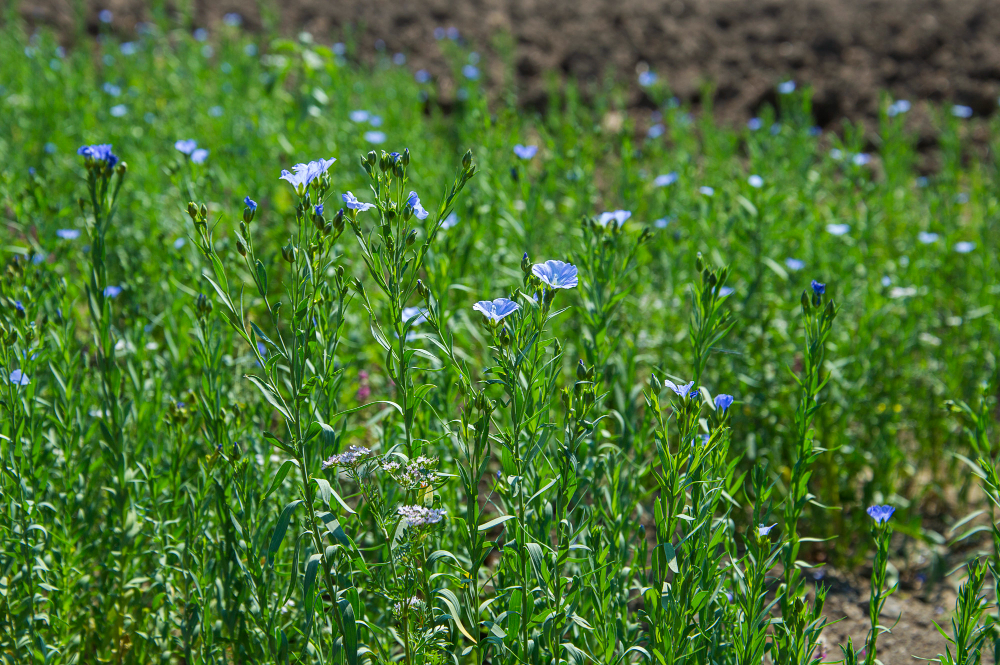
Stems are exposed to moisture and to the bacteria already present on them and in the environment, and those organisms consume the binding material preferentially because it is more accessible than the fibre.
Left in a field under dew and rain, that takes weeks, and the process is uneven because conditions vary across a field and the stems are turned to even it out.
Submerged in still water it is faster, more uniform and produces a paler fibre — and it consumes an enormous volume of water, which becomes foul and which historically went back into whatever it came from.
That is why the process was carried out at a distance from settlements and why it was regulated or prohibited in some places, on entirely reasonable grounds.
The judgement of when to stop is the skilled part. Under-processed stems will not release the fibre; over-processed ones yield fibre that is weak, discoloured or falling apart, and the window between those states is not wide.
Testing is done by taking a stem and attempting to separate it by hand, which is a physical judgement nobody has successfully specified in writing.
There is a variation worth noting. Where the fibre is separated by chemical treatment rather than by bacteria, the process is far faster and more controllable, and it produces a fibre that is weaker and behaves differently.
Speed and consistency are bought at the cost of the properties the material was wanted for, which is why the biological route persisted.
Breaking, Scraping and Combing
Once the cement is gone, three mechanical stages separate the fibre.
Breaking crushes the woody core into short fragments without damaging the long fibres, which are flexible enough to survive being bent while the brittle core is not.
Scraping removes those fragments by drawing a blade down the length of the stem, knocking out the broken material and leaving the fibre bundles.
Combing draws the fibres through progressively finer sets of pins, which aligns them, separates the bundles into finer strands and removes the shorter ones.
That last stage produces two products. The long aligned fibres are the valuable material; the shorter tangled material pulled out is a lower grade used for coarser purposes, and the proportion between them determines the value of the whole crop.
Each stage removes material, and the total yield of usable fibre from a quantity of stems is a modest fraction of what was harvested.
There is a yield figure worth stating. The usable long fibre is a small proportion of the harvested stem by weight, with the woody core, the short fibre and the losses at each stage accounting for the rest.
That ratio is why the material was expensive even before any weaving happened.
Why the Cloth Behaves As It Does
The properties of the finished material all trace back to the fibre.
The fibres are long and smooth with little natural crimp, which means yarn made from them is dense, smooth and cool against skin, and reflects light in a way that gives the cloth a characteristic sheen.
They conduct heat away from the body more readily than woollen yarn, which is why the material is associated with hot weather.
They absorb moisture readily and release it quickly, and they become stronger wet, which is why the cloth was used where it would be washed constantly and hard.
And they are stiff. The fibre resists bending and does not spring back, which is why the cloth creases sharply and why the creases stay — a property that is a defect or a characteristic depending on who is describing it.
That stiffness also softens with use. Repeated washing and flexing breaks down the structure progressively, which is why old cloth of this kind is noticeably different from new, and why it was regarded as improving rather than wearing out.
Why It Lost to Cotton

The commercial history turns on processing rather than on the material.
Cotton fibre is attached to a seed and requires separating from it, which is a mechanical problem — and mechanical problems are amenable to machinery.
Flax fibre requires a biological stage that takes weeks, is weather-dependent, produces an unpleasant by-product and depends on a judgement that resists mechanisation.
When textile production industrialised, the fibre whose preparation could be mechanised became dramatically cheaper and the one that could not did not, and the gap widened continuously.
The material itself did not become worse. It became expensive relative to an alternative that was adequate for most purposes, which is the usual mechanism by which a traditional material becomes a premium one.
Flax remained in use where its specific properties mattered and retreated from everything else, which is where it has stayed.
What Else Comes Out of the Plant

A point about the crop belongs here, because the plant produces two things and they conflict.
Flax is grown either for fibre or for seed, and the requirements are opposed.
Fibre wants tall, thin, unbranched stems grown close together so that the plants compete for light and extend upward without putting energy into side shoots.
Seed wants short, branched, well-spaced plants with room to produce as much as possible, which is exactly the opposite arrangement.
So a field is sown for one purpose or the other, at different densities, and harvested at different times — fibre before the seed is fully mature, because waiting makes the fibre coarser.
That means the two products are not by-products of each other in the way people assume. A fibre crop yields poor seed and a seed crop yields poor fibre, and varieties have been selected in both directions for a very long time.
There is a further consequence for harvesting. Fibre flax is pulled rather than cut, because the fibres run the full length of the stem and cutting wastes the portion below the blade.
Pulling an entire crop by hand is enormously laborious, which is one more reason the material never competed on cost — the harvest itself resisted mechanisation for a long period for the same structural reason the rest of the process did.
What the Process Demonstrates
The general point concerns processes with a biological stage.
Almost everything in the sequence above is mechanical, controllable and improvable. One stage is not: it depends on organisms working at their own rate, under conditions that cannot be fully controlled, with an endpoint that has to be judged rather than measured.
That single stage set the pace of the whole process, resisted every attempt to industrialise it, and ultimately determined the commercial fate of the material.
Which recurs wherever a biological step sits inside an industrial sequence. The steps that can be engineered get faster and cheaper, the biological one does not, and eventually it becomes the entire cost — at which point the product is either premium or replaced.
And in this case the step is somebody walking into a field, picking up a stem, bending it in their hands and deciding that today is the day, which is an unusual thing to find at the foundation of an industry that clothed a continent.
Which is worth remembering about any traditional material that became a luxury. It rarely got better and rarely got worse; something else got cheaper, and the step that could not be mechanised turned out to be the whole price.
Like our content? Follow us for more.
