There is a picture most people have of a watermill that misses the part that mattered.
The picture is a wheel turning in a river, driven by the current — water flowing past, pushing paddles, the building alongside.
That arrangement exists and is the least effective version. The overwhelming majority of mills worked differently, using a diverted channel and a height difference, and the reason is simply that flowing water carries far less usable energy than falling water.
Understanding the distinction explains why mills are where they are, why so much of the surviving evidence is earthworks rather than buildings, and why a landscape can be read for mills that were demolished centuries ago.
Flow Versus Fall
The physics is the foundation and is worth stating clearly.
Energy can be taken from water in two ways: from its motion, or from its weight descending through a height.
Taking it from motion means a paddle in a current, and the available energy depends on the speed of the flow, which in most rivers is modest — so a wheel driven that way delivers very little.
Taking it from weight means arranging for water to be at a height, letting it fall onto or into something, and recovering the energy as it descends. The available energy depends on the volume and the height, and even a modest height produces far more than a current does.
That is why almost every mill is built around creating a height difference rather than around finding a fast current, and why the wheel is the last component rather than the first.
Like our content? Follow us for more.
How the Height Is Made
The method is simple in concept and substantial in execution.
Water is taken from the river at a point upstream, through a controlled opening, into an artificial channel.
That channel is cut to run almost level — falling only very slightly along its length, just enough to keep water moving.
The river, meanwhile, continues to fall at its natural gradient, which is steeper.
So the two diverge in height. After a distance, the channel is running well above the river beside it, and the difference between them is the available fall.
At the mill, the water is delivered to the wheel, drops through that difference, and returns to the river below.
The whole arrangement is therefore a length of channel, a control structure at the intake, a wheel and a return — and the length of channel required depends entirely on how gently the river falls, which is why mills on steep streams need almost none and mills on lowland rivers need a great deal.
The Wheel Types and What Decides Them
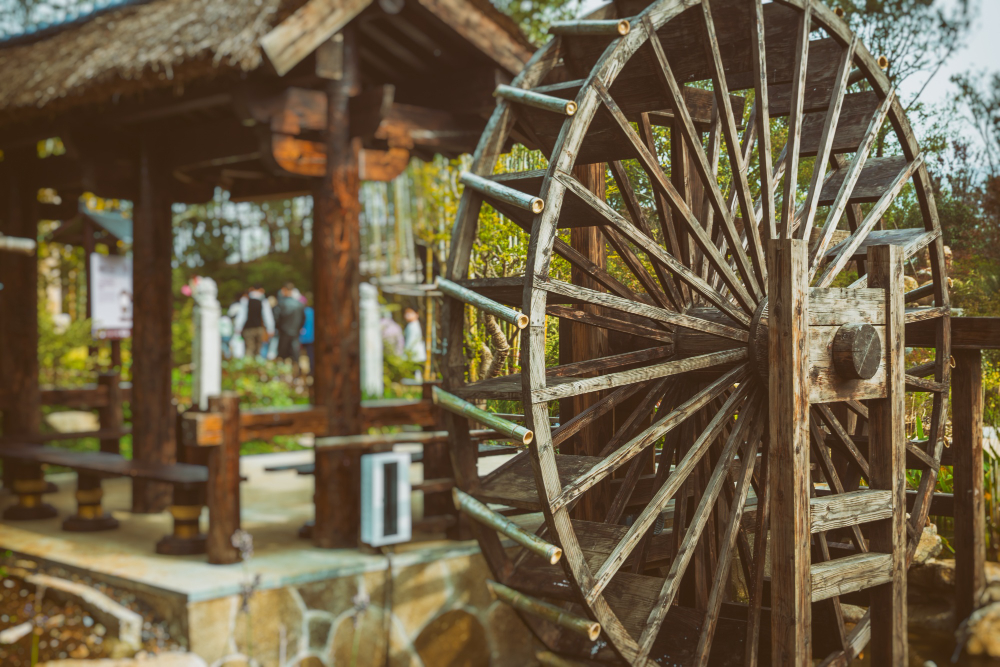
The three arrangements correspond to how much fall is available.
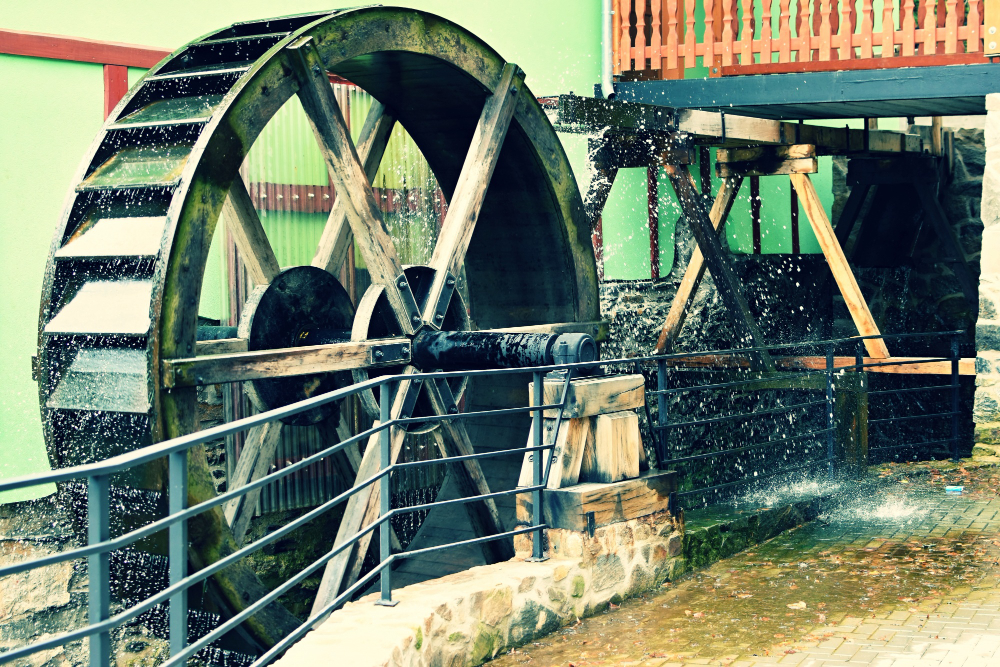
Where water can be delivered to the top of the wheel, it fills buckets on the descending side and turns the wheel by weight. That is the most efficient arrangement and requires a fall at least equal to the wheel diameter.
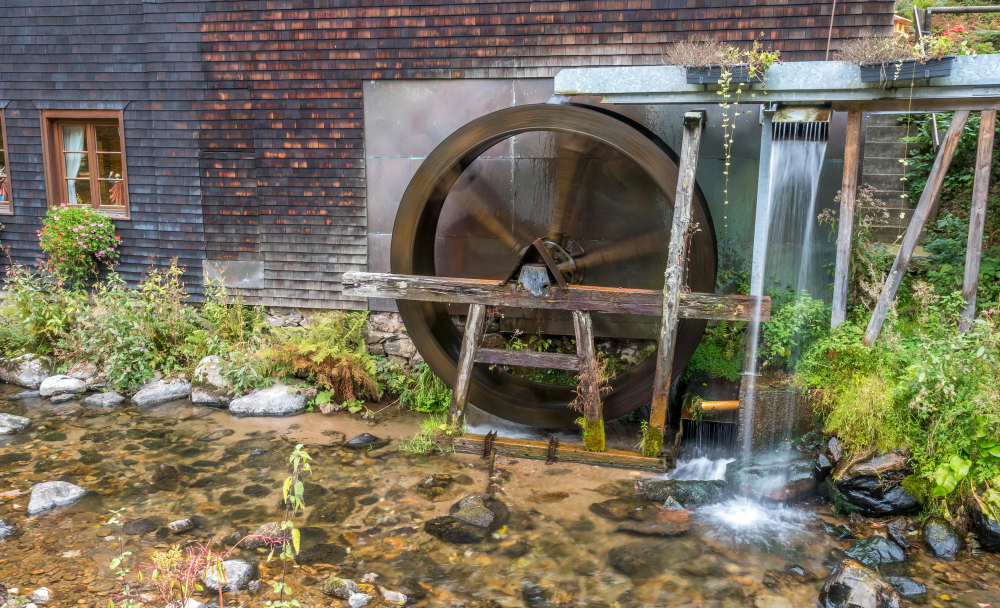
Where the fall is less, water is delivered at about the level of the axle, filling buckets that carry it down through half a turn. Less efficient, and it works with a smaller height difference.
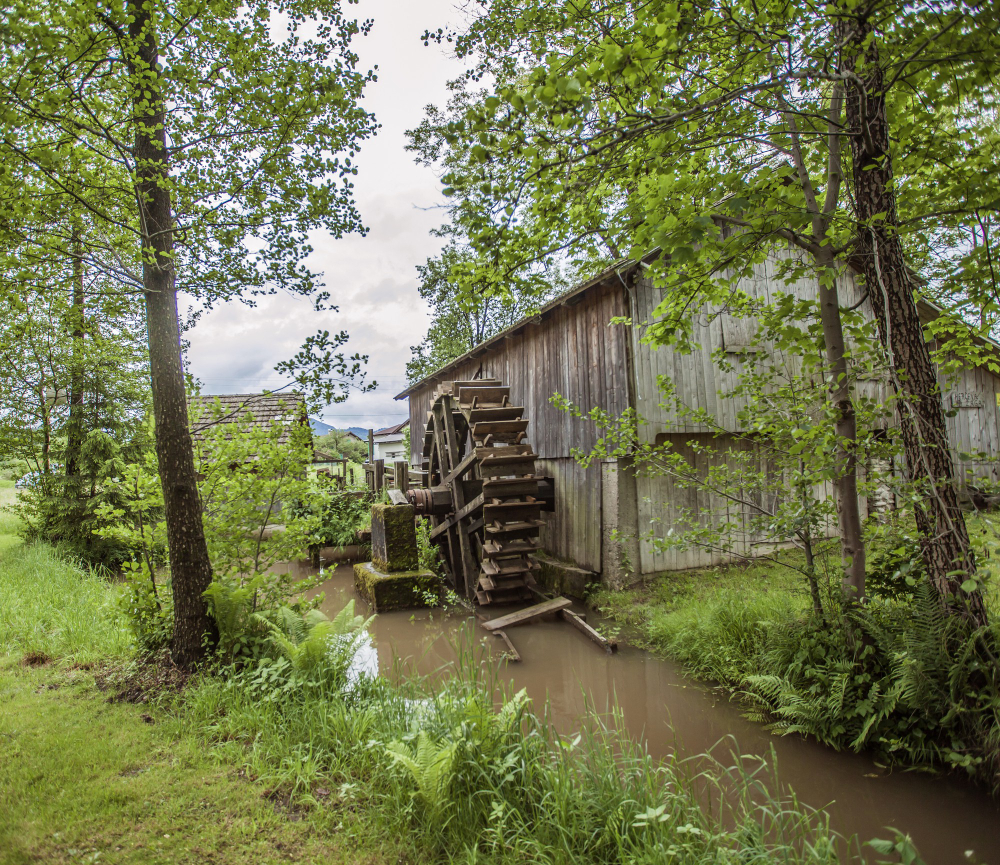
Where there is almost no fall, paddles dip into a current and are pushed. Least efficient by a wide margin, and it is what the site permits rather than what anybody would choose.
So the wheel type is a reading of the site rather than a design preference, and a surviving wheel tells you how much fall was available.
Later installations used a different device entirely — an enclosed wheel through which water passes rather than over, which handles varying flow better and is more compact, and which largely replaced the open wheel where the investment was justified.
There is a legal dimension worth noting. Because a mill depends on a flow that passes on to everybody downstream, the right to divert water, to hold it back and to release it was defined, disputed and recorded.
Those rights outlasted the mills in many places, which is why some obligations attached to a watercourse are substantially older than anything visible on it.
The Problem of Not Enough Water
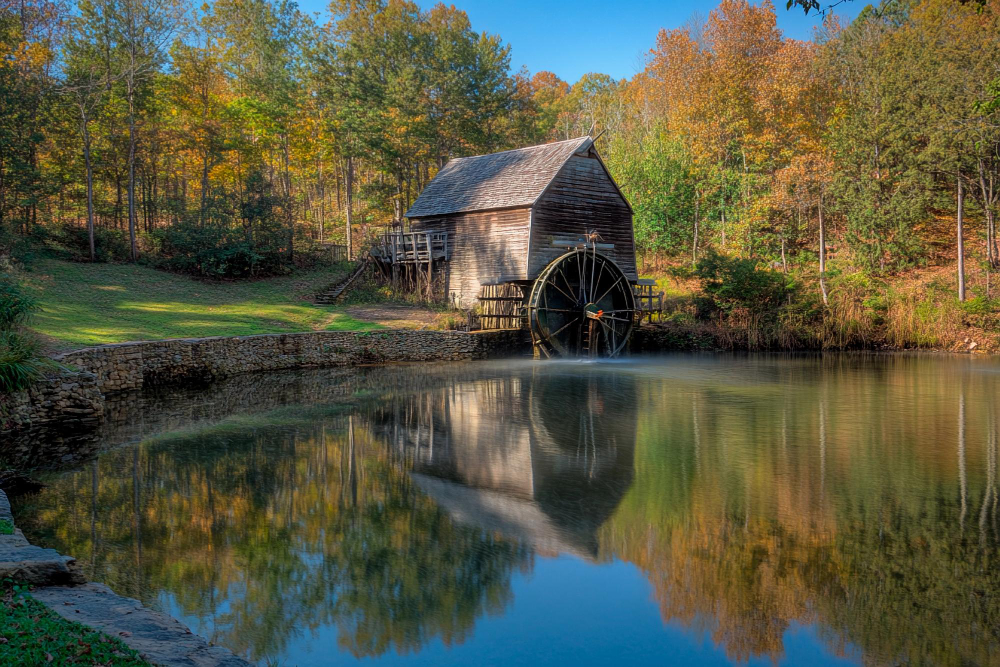
The supply is never constant, and managing that is the operational reality.
Rivers vary enormously through the year, and a mill needs a predictable flow rather than an average one.
The standard solution is a pond above the mill, filled continuously and drawn down during working hours, which converts a small steady inflow into a larger intermittent supply.
That means a mill can work at a rate the river could not sustain continuously, for as long as the pond lasts, and then must wait for it to refill.
Working hours were therefore set by water rather than by daylight in many places, which is an unusual constraint and produced working patterns that look strange from outside.
Too much water is a problem as well. High flows can damage a wheel, flood the workings and reverse the flow at the outlet, so the intake has controls to shut off supply and the channel has an overflow to discharge surplus safely.
What Is Left in the Landscape
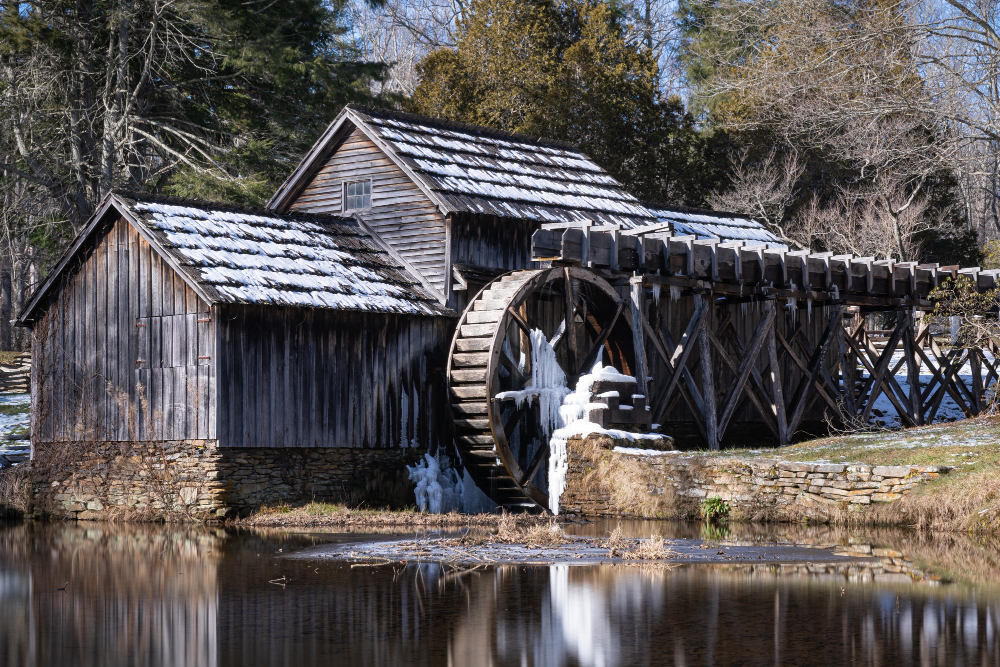
The evidence is substantial and is mostly not the building.
The channel survives as an earthwork — a ditch running along a contour, frequently with a raised bank on the downhill side, at a gradient noticeably gentler than the valley.
The pond survives as a flat area, sometimes still wet, with a bank across its lower end and a visible outlet.
The intake survives as a disturbance in the river bank, and frequently as a weir across the river, since a weir was needed to raise the level enough to feed the channel.
The return channel survives as a ditch rejoining the river downstream of the site.
And the building may be entirely gone, because a building is worth demolishing for materials and an earthwork is not.
That is why mill sites are so findable. The expensive, permanent, immovable part of the installation was the water engineering, and it is still there.
What the Mill Was Actually For

The range of work is broader than the name suggests, and the pattern is worth noting.
Grinding grain is the association, and it was the most numerous application by a wide margin, because everybody needed it and it was required everywhere people lived.
But the same power was applied to a considerable range of other processes: driving hammers for working metal, powering bellows for furnaces, crushing material for building and for industry, sawing timber, working cloth, and driving pumps.
Each of those required a different mechanism between the wheel and the work, and several required the rotation to be converted back into reciprocating motion — a hammer, a saw or a pump needs something moving up and down rather than round.
That conversion is done with a cam or a crank, which is the same problem as an engine solves in the opposite direction, and it was worked out for water power several centuries earlier.
The consequence is that a mill site may have nothing to do with grain, and the surviving evidence rarely says which. A leat, a pond and a wheel pit are the same whatever was being driven.
What frequently distinguishes them is what is downstream — waste material, altered ground, the residue of a process — and the place names, which preserve the function far more reliably than the earthworks do.
How to Read One
A practical sequence turns a walk along a river into something more interesting.
Look for a weir, and then look upstream and downstream of it for a channel leaving the river on either side.
Follow that channel and note its gradient against the valley — if it is running level while the ground falls away, it is artificial and it is going somewhere.
Look for a flat area or a bank that could have held water.
Look for where the channel returns to the river, since the gap between departure and return brackets the site.
And look at the buildings present, since a mill building has particular features — an opening where water entered, a stone or brick base where the wheel sat, and frequently a difference in floor levels inside.
Which means a stretch of river that appears entirely natural may contain the complete infrastructure of an industry, laid out over a distance of several hundred metres, doing nothing at all and requiring no maintenance because it is a shape in the ground rather than a structure.
And that is why these sites are worth looking for. The building is the part that was worth demolishing, the water engineering is the part that was not, and what survives is the half that actually took the work.
Like our content? Follow us for more.