
There is a reason water clocks were difficult and sand timers were easy, and it comes down to a surprising difference between liquids and piles of small solid grains.
A liquid draining through a hole flows faster when the container is full and slower as it empties, because the weight of liquid above the hole drives the flow and that weight decreases continuously.
Any timer built on draining water therefore has to compensate — by shaping the vessel so that the level falls evenly, or by keeping the source topped up — and getting that right was a substantial engineering problem that occupied a great deal of ingenuity.
Sand requires none of it. A granular material flows through a narrow opening at nearly the same rate from the first grain to the last, which means the simplest possible container measures a consistent interval without any correction at all.
Why Grains Do Not Behave Like Liquid

The physics is truly strange and it is worth stating clearly.
In a liquid, pressure increases with depth, and that pressure at the bottom is what drives the flow through the opening.
In a pile of grains, pressure does not increase indefinitely with depth. Grains press against each other and against the walls of the container, and those contacts form chains of force that transfer much of the weight sideways into the walls.
The effect is that beyond a modest depth, adding more grains on top adds almost nothing to the pressure at the bottom — the walls are carrying it.
So the conditions at the opening are essentially the same whether the upper chamber is full or nearly empty, and the flow rate is correspondingly constant.
That behaviour was noticed long before it was explained, and the explanation concerns how forces distribute through a granular material, which is a field of physics that is still actively researched.
Like our content? Follow us for more.
What Actually Sets the Rate

The flow is controlled by the opening rather than by the quantity above it.
Grains approaching the opening form a region above it where they are moving freely, and the rate at which they pass through is governed by the size of the opening relative to the size of the grains.
A larger opening passes grains faster; finer grains pass faster through the same opening; and the relationship is steep, so small changes in either produce substantial changes in the interval.
Below a certain ratio of opening to grain size, flow stops entirely because grains lock against each other across the gap and form an arch.
That jamming is the main failure mode, and it is why the material and the neck have to be matched carefully.
And the angle of the upper chamber matters less than intuition suggests, since the grains form their own funnel at their own natural angle regardless of the container’s shape.
There is a direction point worth noting. A well-made timer runs the same interval in both directions, which requires the neck to be symmetrical and both chambers to be shaped alike.
An asymmetric glass runs differently depending on which way up it starts.
Why Sand Was Not Always Sand

The filling was chosen with considerable care, and it frequently was not sand from a beach.
Ideal grains are uniform in size, rounded rather than angular, dry and resistant to breaking — because irregular or breaking grains change the flow over time.
Ordinary sand is variable, angular and can contain fine dust that clogs the neck or coats the glass.
Makers used sieved and washed material, crushed and graded stone, powdered eggshell, and metal filings, each chosen for uniformity and durability.
Moisture is a serious problem, since damp grains cling together and flow unevenly or not at all, which is why the glass must be sealed and why the timers were kept dry.
And the grains gradually wear against each other and against the neck with use, which means an old timer can run slightly differently from when it was made — a slow drift that users were aware of.
There is a spread point worth noting. Sets of timers of different durations were sometimes mounted together in one frame, allowing several intervals to be measured without resetting.
Why It Could Not Be Made to Measure Exactly
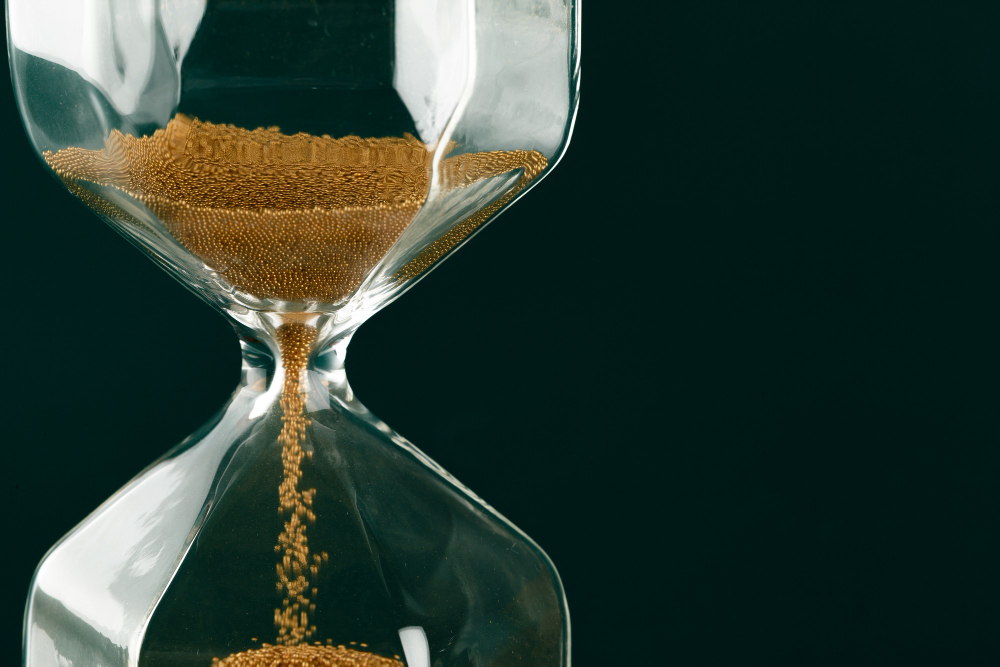
A sand timer is consistent and not precise, and the distinction matters.
Consistent means it measures the same interval each time it is turned. Precise would mean that interval is a known exact quantity.
Setting the interval required filling, testing against a reference and adjusting the quantity until the result matched — there was no way to calculate it in advance.
Timers of nominally identical size varied, and a set of them would disagree with each other slightly.
Temperature and humidity shift the rate a little. Tilting the glass changes it. And the moment of turning introduces an error of its own.
So the instrument was used where consistency mattered more than exactness — measuring equal intervals repeatedly — rather than where an exact time of day was needed.
There is a reading point worth adding. A sand timer gives no intermediate information in any useful form – the upper chamber can be glanced at to estimate how much remains, but only roughly, because the grains form a sloping surface and the chamber is curved.
Its only precise moment is the end.
Where It Was Actually Used

The applications explain why the device persisted long after mechanical clocks existed.
At sea, a short timer was used to measure speed: a knotted line was paid out behind a vessel for the duration of one turn, and the number of knots that ran out gave the speed — which is where a unit of speed at sea takes its name.
Longer timers divided the working day aboard ship into watches, turned by whoever was on duty and marked by a bell.
On land, they timed speeches, sermons, lessons and cooking, and measured intervals in manufacturing processes where a fixed duration mattered.
The advantages were decisive for those uses. A sand timer works on a moving ship where a pendulum does not, needs no winding, has no mechanism to fail, and can be read at a glance from across a room.
Its disadvantage — that it measures one interval and must be turned — did not matter where one interval was all that was needed.
How It Was Made

The construction was more delicate than the finished object suggests.
Early versions were two separate glass bulbs joined at their necks, with a thin plate or disc between them pierced by a small hole that set the flow rate.
The joint was bound with thread or wax, which made the whole assembly fragile and vulnerable to damp getting in at the seam.
Later versions were blown as a single piece of glass with the narrow waist formed during blowing, which eliminated the joint and sealed the contents completely.
The glass was then set into a frame of wood or metal with columns between two end plates, which protected it and allowed it to be turned over and stood on either end.
Filling a single-piece glass required the grains to be introduced before the final end was sealed, and the interval was adjusted by adding or removing grains before closing — a process of trial against a reference that could not be corrected afterwards.
That is why each timer was individual. Once sealed, its interval was fixed for as long as the glass survived, and any error was permanent.
What It Is Now
The device survives in a narrower role, and the reason is instructive.
As a precise timer it has been entirely superseded. As a visible timer, it has something no digital display offers: the remaining time is shown as a physical quantity, and the rate of passage is directly visible.
That makes it useful wherever the point is to see time running out rather than to know a number — games, short tasks, anything where the visual is the function.
It also retains the quality of being impossible to adjust. Nobody can pause it or add time, which is occasionally exactly the property wanted.
Which is a fair summary of a very old instrument that works because of an odd property of sand. It was never exact, it was always consistent, and it did one thing in conditions where more sophisticated instruments failed — and it is still doing it on kitchen shelves, for the same reason.
And it is worth appreciating how little is involved. Two bulbs, a narrow neck and a quantity of fine grains, calibrated once by trial – and it works because sand does something liquids do not, which nobody needed to understand in order to use.
Like our content? Follow us for more.