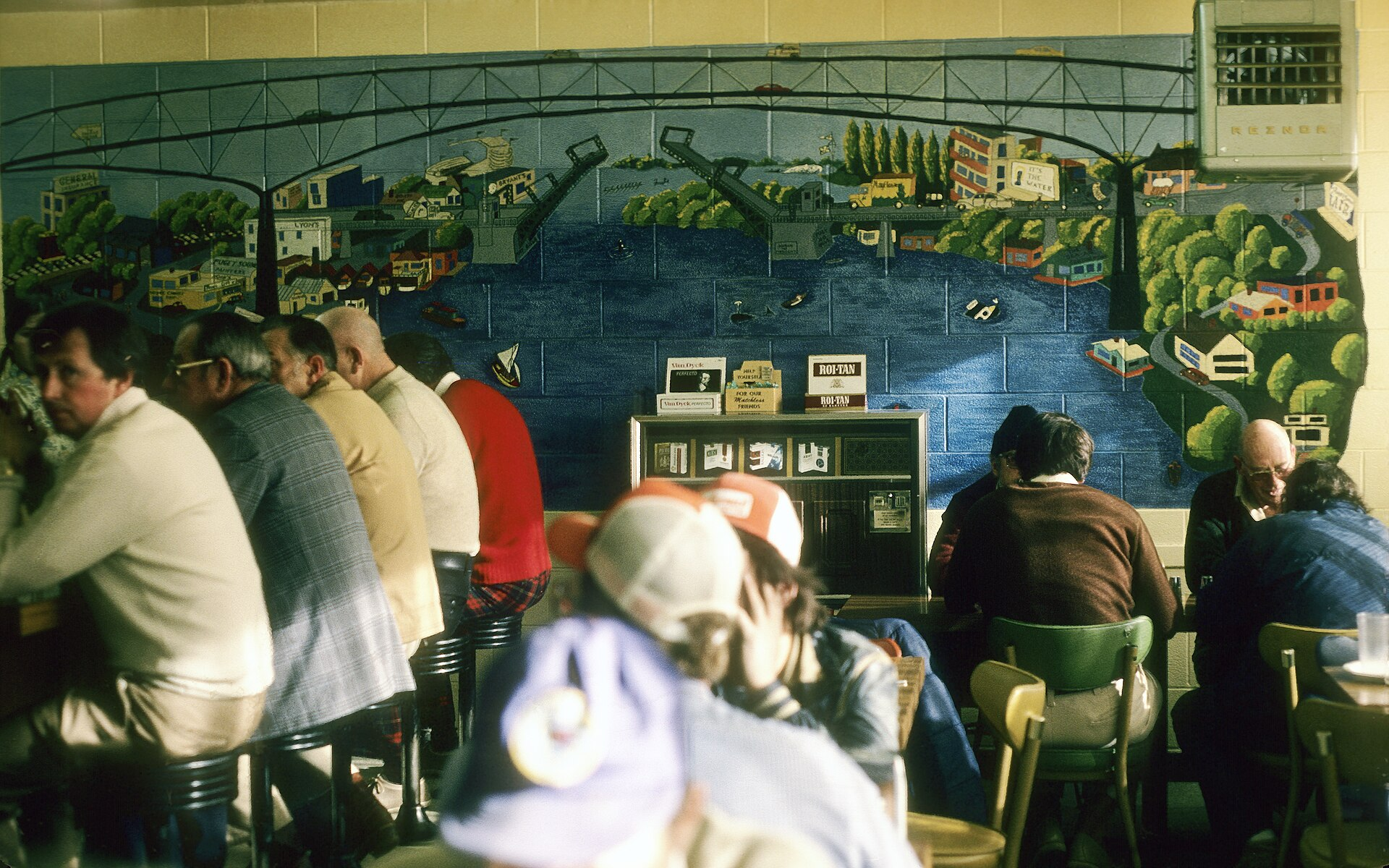
Anybody over a certain age in the United States had this exchange hundreds of times without ever once finding it strange. You walked in, somebody picked up a laminated menu and asked whether you wanted smoking or non-smoking, and you gave an answer, and were led to a table.
What makes it worth revisiting is not the nostalgia. It is that the arrangement was an engineering claim – that a room can be divided into air that has smoke in it and air that does not – and the claim was false, and it was known to be false by essentially everyone involved, including the industry that fought to keep it. The smoking section was not a failed attempt at a solution. It was a successful attempt at something else.
What the Division Actually Consisted Of
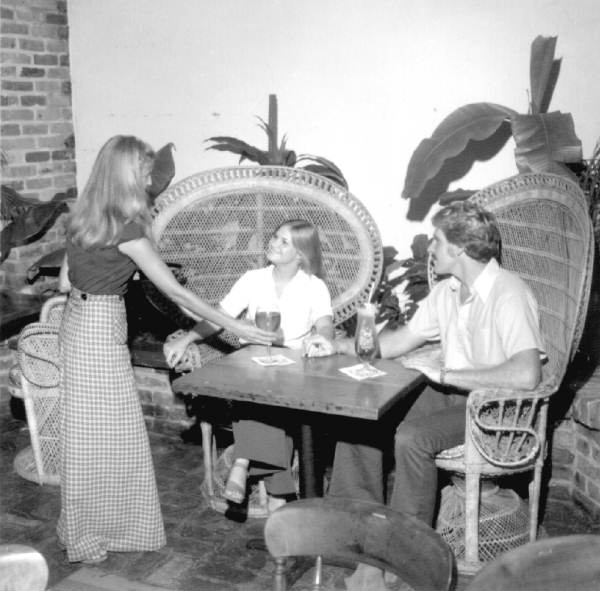
The physical reality of the separation is the first thing to establish, because memory tends to upgrade it.
In the overwhelming majority of American restaurants, the smoking section was a set of tables at one end of a single undivided dining room. There was no wall. There was frequently no screen. The boundary was a line on the host’s seating chart and nothing else – sometimes marked by a change in carpet, a row of planters, a low partition about chest height when seated, or a sign on a post.
The ventilation, where any existed, was the same system serving the whole room, which meant it was actively mixing the two halves rather than separating them. In many buildings the return air grille happened to be on the non-smoking side, which meant the entire volume of the room was being pulled across the non-smoking tables on its way out.
And the staff crossed the line continuously. A server working a shift moved between both sections every few minutes for hours. For employees the division did not exist even notionally.
So the arrangement asked a customer to choose between two conditions that were, in air terms, very nearly identical. A table fifteen feet from a lit cigarette in a shared room with shared air is not meaningfully different from a table five feet from one.
Like our content? Follow us for more.
Why It Was Built That Way
Here is the part that explains the whole thirty years.
The smoking section was not a response to a demand for clean air. It was a response to a demand for a reason not to do anything more drastic. By the point at which the health question had become difficult to ignore publicly, restaurants faced two possible futures: an accommodation that let smoking continue, or a prohibition that ended it indoors.
The accommodation was overwhelmingly preferable to everyone with a commercial stake. For the restaurant it meant no lost custom, no confrontation at the door, and the ability to answer any complaint with a procedure. For the tobacco industry it preserved indoor smoking, which was the single most important thing to preserve, because indoor smoking is habitual smoking. For the regulator it produced a visible policy that had been adopted voluntarily and therefore needed no enforcement budget.
The section worked beautifully for all three. It just did not work for air.
That is the cynical reading and it is also the documented one: designated indoor smoking areas were promoted, through the period, precisely as the alternative to bans, and the argument made for them was explicitly that they were a reasonable middle path that made bans unnecessary. The purpose of the middle path was to be a middle path.
The Physics Nobody Disputed
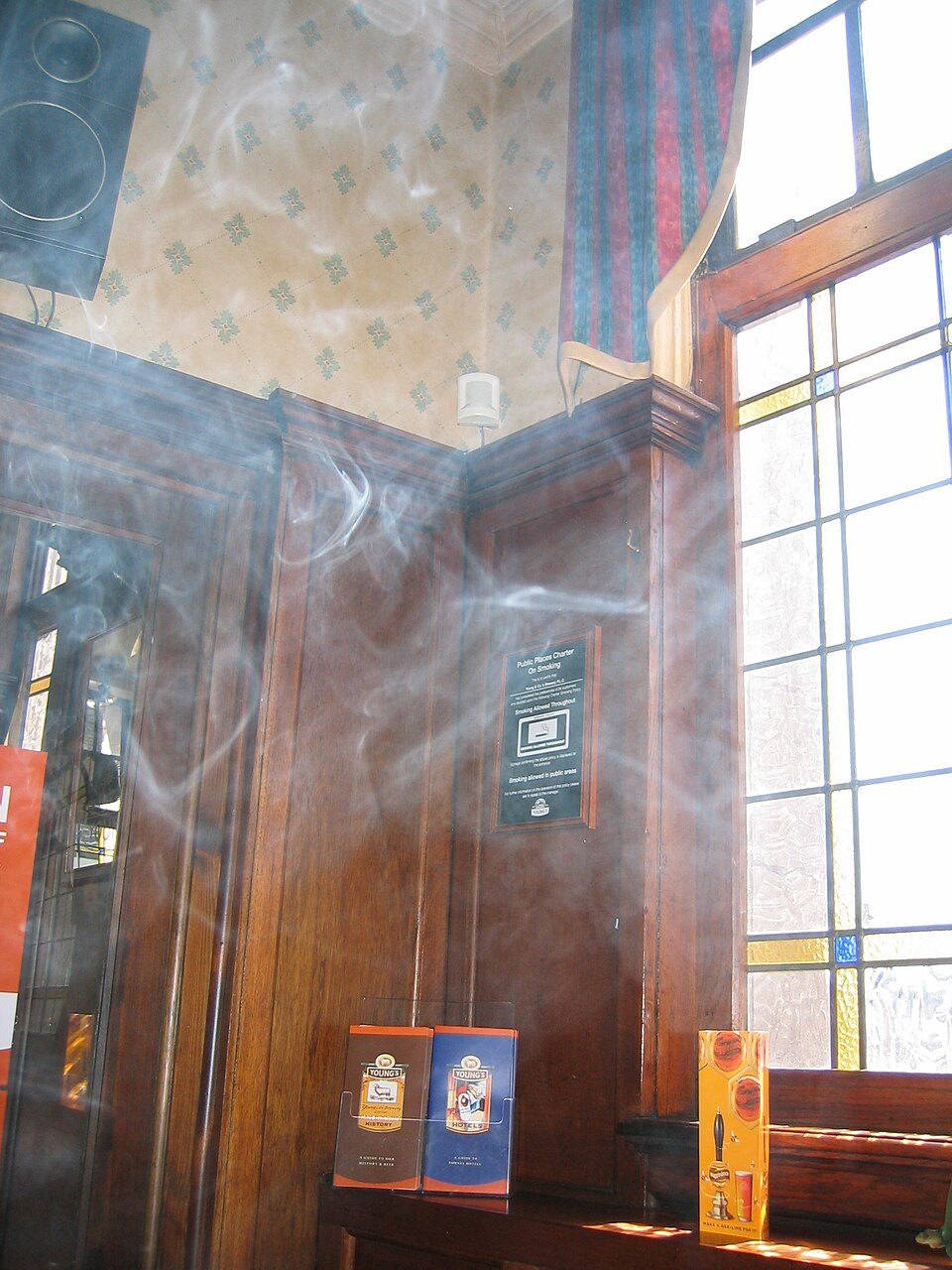
What is striking in hindsight is that the technical case against the arrangement was never really contested on the merits. It was simply not the point.
Smoke in a room is not a localized object. The visible plume is a tiny fraction of what is produced, and the bulk of it is submicron particles and gases that behave like any other component of the air: they distribute through the available volume by diffusion and by whatever air movement exists, which in a restaurant is constant and vigorous because of doors, servers walking, kitchen extraction and the heating or cooling system.
To actually separate the two halves you need three things simultaneously: a floor-to-ceiling physical barrier with a sealed door, a dedicated and independent ventilation system for the smoking enclosure, and that enclosure held at negative pressure relative to the rest of the building so that air flows only inward. That is the specification for a sealed negative-pressure room, and it is how you would handle any other airborne contaminant.
Almost no restaurant had any of the three, and even in the rare cases where a properly separate room existed, it was usually at neutral or positive pressure and vented through the shared system, which meant it was exporting air to the rest of the building.
And none of this was obscure. It is standard ventilation engineering, and the relevant professional bodies said so throughout. The gap between what was known and what was practiced was total and openly visible.
The Employee Problem That Finally Broke It
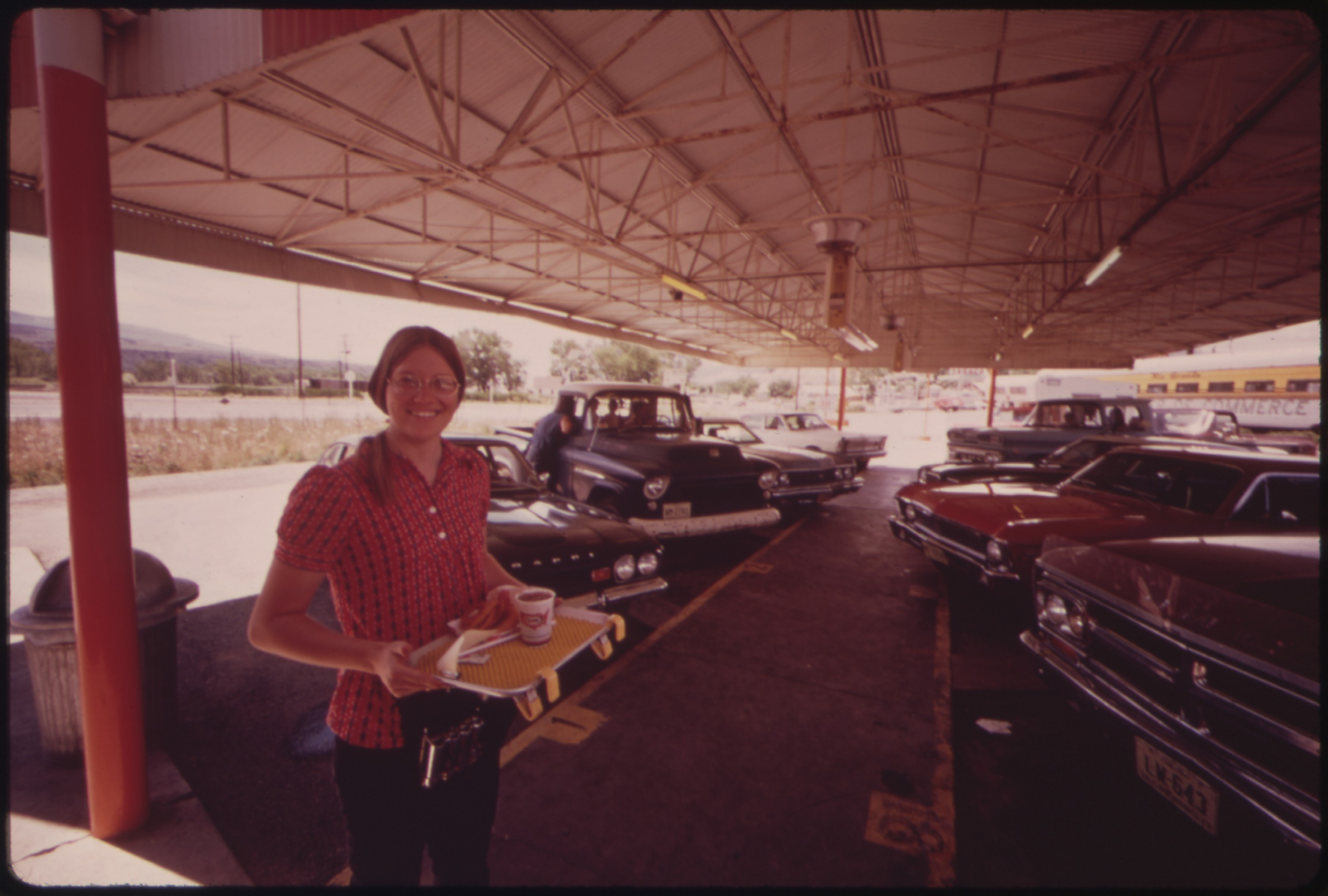
The thing that actually ended the smoking section was not customer complaint. Customers could choose a different restaurant, and many did not care.
It was the staff.
A server, bartender or busser did not get a choice of section, worked eight-hour shifts in the room, and did so for years. Once the question was framed as workplace exposure rather than customer preference, the whole accommodation collapsed, because workplace exposure is governed by an entirely different logic. You cannot ask an employee to choose a section. You cannot offer them a potted plant. The only available controls are substitution, enclosure or elimination, and the first two were not being done.
That reframing is the single most important move in the entire history of the issue, and it is worth noticing how little it had to do with restaurants specifically. It turned a question about hospitality and etiquette into a question about occupational safety in a workplace, and occupational safety does not negotiate with seating charts.
Once that framing took hold, the sequence that followed was rapid by the standards of the preceding decades: hospitality workplaces moved from accommodation to prohibition over a relatively short span, jurisdiction by jurisdiction, and the designated indoor section ceased to exist as a category.
What the Transition Revealed
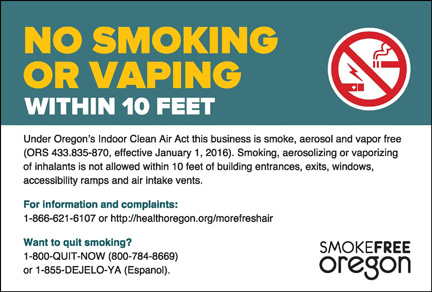
The predictions made during the argument are worth recalling because they were specific and testable, and the outcome is the clearest verdict available on the whole arrangement.
The case for keeping indoor smoking rested on a commercial claim: that prohibition would reduce restaurant and bar revenue substantially, because a meaningful share of custom would stay home. That claim was made confidently and repeatedly.
What happened instead, across a very large number of jurisdictions that made the change at different times and could therefore be compared, was that hospitality revenue did not fall in any durable way. In many places it rose, and the most commonly offered explanation is the obvious one: the number of people who had been avoiding smoky rooms was larger than the number who would stop going out.
The second testable claim was that air quality would improve, which it did, immediately and by a large margin, in a way that was measurable with ordinary particulate instruments on the night the rule changed. That measurement is the retrospective proof that the sections had never been doing anything: if the division had been working, removing smoking from one half should have produced a modest improvement in half the room. Instead it produced a dramatic improvement everywhere, including at the tables that had been labeled non-smoking for thirty years.
The Part That Is Hardest to Explain in Hindsight

What is hardest to convey to anybody who did not live through it is how completely normal all of it felt.
Ashtrays were standard table furniture, placed by the server along with the silverware. They were on airplane armrests, in hospital waiting rooms, in doctors’ offices, in bank lobbies, in supermarkets and in the back of taxis. A restaurant without ashtrays would have been the thing requiring explanation.
And the question itself – smoking or non-smoking – was asked in a neutral tone, like a question about a window seat. It carried no moral charge and implied no judgment. It was simply one of the two or three facts a host needed in order to seat you, along with how many of you there were.
That neutrality is the detail that dates the period most precisely. Not the smoke. The complete ordinariness of being asked.
The Honest Summary
The restaurant smoking section was an administrative fiction that everybody participated in for about thirty years. It divided a seating chart rather than a volume of air, it provided no protection that any ventilation engineer would have recognized as protection, and its real function was to occupy the political space where a prohibition would otherwise have gone.
It lasted as long as it did because it was useful to the restaurant, to the industry and to the regulator, and because the people with no choice in the matter – the staff – were not party to the arrangement that was supposedly protecting them.
What ended it was not better science, because the science had not changed. It was a change in the question. For as long as the issue was what the customer preferred, a line on a chart was a sufficient answer. The moment the issue became what the room did to the person working in it, the line stopped being an answer at all.
Like our content? Follow us for more.