There is a common assumption about layered rocks that slate steadily breaks.
The assumption is that a rock which splits into sheets does so along the layers in which it was originally deposited, like separating the pages of a book that was bound that way.
Many rocks do exactly that. Slate does not, and the reason is the most interesting thing about it.
The plane along which slate splits was created long after the material was deposited, by pressure applied from the side, and it frequently runs across the original layering rather than along it. That property — a splitting plane imposed by force rather than inherited from deposition — is what makes it possible to produce enormous numbers of thin, flat, identical sheets from a single block.
How the Splitting Plane Forms
The sequence is worth setting out because each stage matters.
The material began as fine mud, settling in still water and building up in flat layers over a long period.
Buried and compacted, it became a soft layered rock, splitting readily along its bedding and not much use for anything.
Then it was caught in mountain-building, and squeezed under enormous pressure from the sides while being heated.
The microscopic flat, plate-like minerals within it responded by rotating so that their flat faces lay perpendicular to the direction of squeezing, and new minerals growing during the process formed in the same orientation.
The result is a rock in which an enormous number of microscopic plates are all lying parallel, in a plane determined entirely by the direction of the pressure.
That parallel alignment is a plane of weakness running through the whole mass, and the rock splits along it cleanly — which is a property called cleavage, distinct from the original bedding, and frequently at a steep angle to it.
Like our content? Follow us for more.
Why That Makes It Useful
The practical consequences follow directly.
Because the plane is consistent through a large volume of rock, sheets can be split from it repeatedly, to a thickness limited only by skill and the quality of the rock.
Because the sheets are thin and flat, they are light for the area they cover, which matters enormously for a roof.
Because the rock is dense and non-porous, it absorbs almost no water, which means it does not soften, and frost cannot split it by freezing inside it.
Because it is chemically stable, it resists the acids and salts that degrade many other materials, and a slate roof can last for a very long time.
And because the material is uniform, the sheets can be trimmed to standard sizes and laid in regular courses, producing a covering that is both light and precise.
That combination is rare, and it is why slate was carried extraordinary distances from a small number of producing areas to roof buildings that had no local supply.
There is a size point worth adding. Slates were produced in a range of standard sizes, and larger ones command more work and more waste, since a big flawless sheet is far harder to split than several small ones.
Why the Splitting Is Done by Hand
The extraction and processing sequence explains the economics.
Blocks are removed from the quarry face and reduced to manageable pieces roughly along the cleavage.
A splitter then works each piece down, driving a broad chisel into the edge and halving it repeatedly — halving again and again rather than slicing off thin sheets, because halving keeps the stresses even and produces flat results.
That halving is done by feel. The splitter judges where the rock will part, how hard to strike and when a piece has reached its limit, and the judgement cannot be made by a machine that cannot feel the rock.
The sheets are then trimmed to size, traditionally with a blade against a fixed edge, leaving the characteristic bevelled edge on the underside.
Mechanisation has taken over the heavy work of extraction and much of the trimming, and the splitting itself has proved persistently difficult to automate for the same reason.
There is a transport point worth adding. Because slate is heavy and the producing areas are few, moving it was a substantial part of its cost, and railways and shipping transformed how far it could economically travel.
Buildings roofed in slate far from any source are evidence of that network rather than of local geology.
The Waste Problem
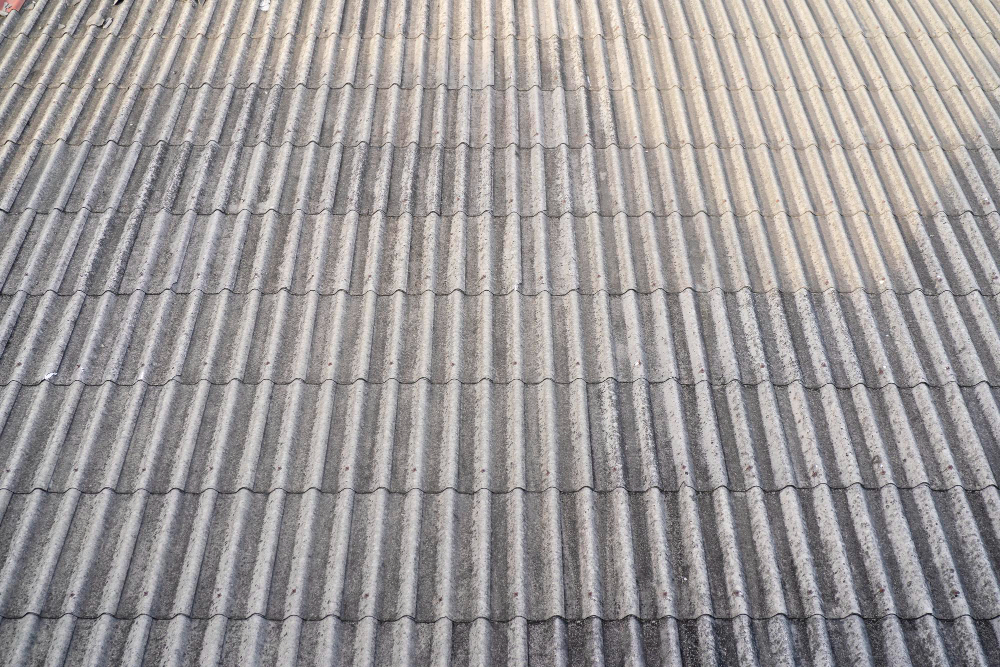
The quantity of material discarded is the defining fact of the industry.
Only a modest fraction of the rock removed from a slate quarry becomes usable product; the great majority is waste, broken during extraction, split badly, or simply unsuitable.
That waste has to be put somewhere, and it accumulates as enormous spoil heaps which in many districts are larger and more visible than the quarry itself.
Those heaps reshape the landscape permanently, since the material is inert, does not compact much and supports very little plant growth for a long time.
They also record the industry: the size of the heaps indicates the scale of working, and their arrangement indicates how material was moved.
That ratio between product and waste is why slate quarrying had such a large footprint relative to the quantity of roofing it produced.
How It Is Laid
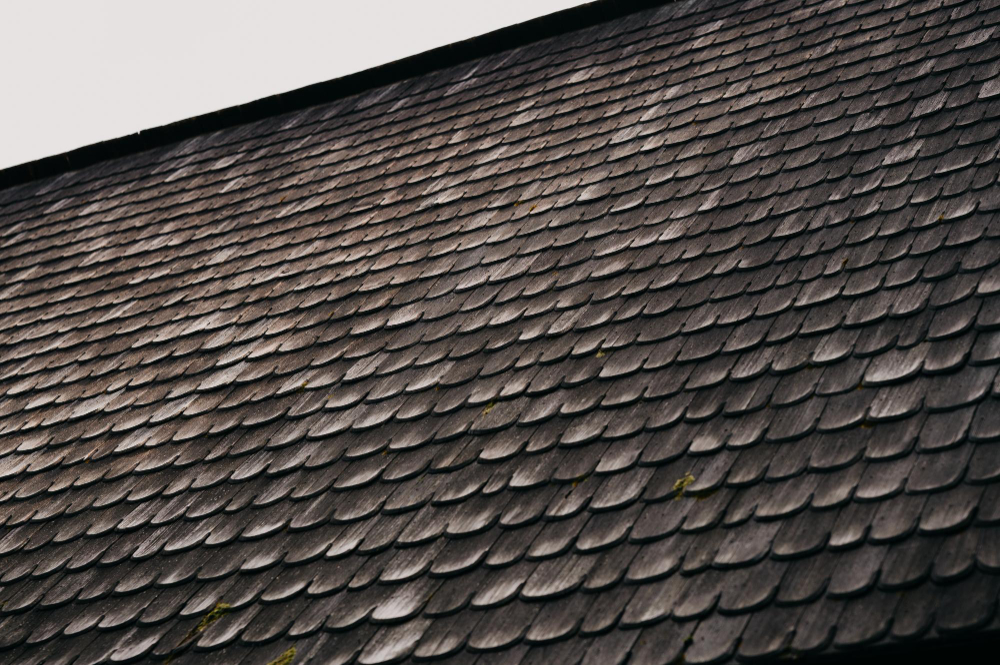
The arrangement on a roof follows from the material being impermeable but not sealed.
Slates are hung in overlapping courses, each covering the joint between the two below it, so that water running down the surface always meets solid material rather than a gap.
Each slate is overlapped by not one but two courses above it over part of its length, which is what produces a covering with no direct path through.
That overlap is what keeps the roof watertight, since nothing is sealed and the joints are open — water is shed by geometry rather than excluded by a barrier.
Because of the double overlap, a substantial proportion of every slate is hidden, and the visible portion is substantially smaller than the slate itself.
The steeper the roof, the less overlap is needed, because water travels down faster and is less likely to be driven sideways by wind; a shallow roof needs more overlap and therefore more material.
And the whole covering is designed to breathe, with air able to move beneath it, because a roof that traps moisture underneath rots the timbers holding it up.
Reading a Slate Roof
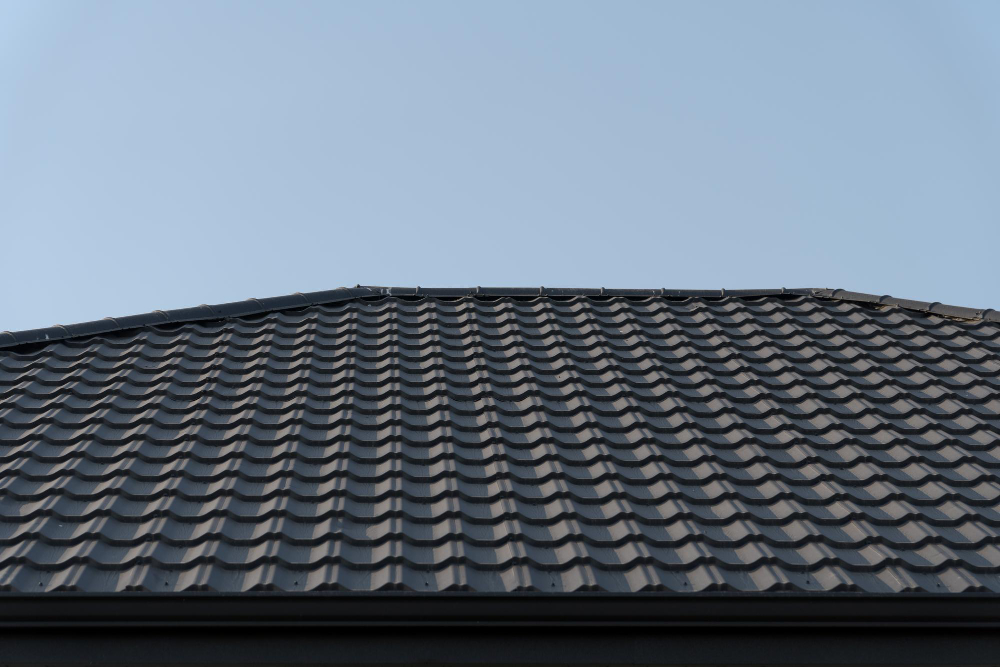
The roof itself carries a good deal of information.
Sizes vary, and older roofs frequently use slates that diminish in size from the bottom of the roof to the top, with the largest at the eaves — an arrangement that uses material efficiently and produces a distinctive appearance.
Thickness varies with source and period, and thicker slates require stronger supporting timbers, which means the roof structure beneath reflects the covering chosen.
Colour indicates origin, since the mineral content of the rock differs between producing areas and produces distinct shades that stay consistent.
Fixing method is visible at the edges: slates hung on pegs, nailed at the head or nailed through the centre each behave differently and fail differently.
And repairs stand out, because replacement slates rarely match the original in colour, thickness or size, and are frequently held with a visible metal clip rather than being nailed like the originals.
There is a failure point worth adding. Slate itself rarely fails; what fails is the fixing, as nails corrode and slates slip, which is why a roof in poor condition frequently has sound slates lying in the gutter.
What Replaced It and What Did Not
The commercial position changed and the material persisted.
Manufactured tiles of concrete and other materials are far cheaper, are produced to exact dimensions, and require less skill to lay, which displaced slate for most new construction.
They are also heavier in many cases, and have a shorter life, which is a trade that suits new building and suits repairs to old buildings badly.
Slate remains standard for repairing and maintaining buildings originally roofed with it, because the alternatives differ in weight, in appearance and in how they weather.
And it survives in other uses that exploit the same properties — flat, stable, non-absorbent surfaces — that made it useful on a roof.
Which is a reasonable thing to consider looking up at an old roof. Every one of those sheets was split by hand from a block of compressed mud that was squeezed sideways inside a mountain, along a plane that has nothing to do with the way it was originally laid down.
Which makes a slate roof an unusually direct piece of geology. The angle those sheets split at was set by a collision between landmasses, and somebody later found it, split it by hand and nailed it over a house.
Which makes a slate roof an unusually direct piece of geology. The angle those sheets split at was set by a collision between landmasses, and somebody later found it, split it by hand and nailed it over a house.
Like our content? Follow us for more.