

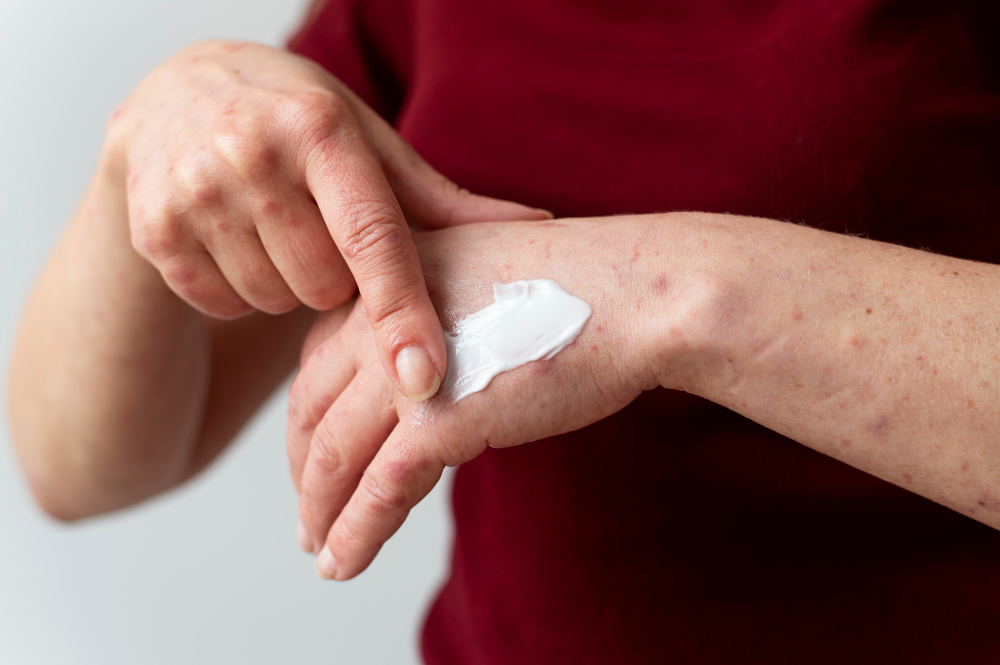
Most explanations of bruising stop at the first sentence: a knock breaks small blood vessels under the skin, blood escapes into the tissue, and you can see it. That is correct and it accounts for about a day of what a bruise does. The remaining week or two, the part everyone actually notices, is a clean-up operation, and the colours are the by-products of it becoming visible through the skin one after another.
Nothing Is Broken on the Surface
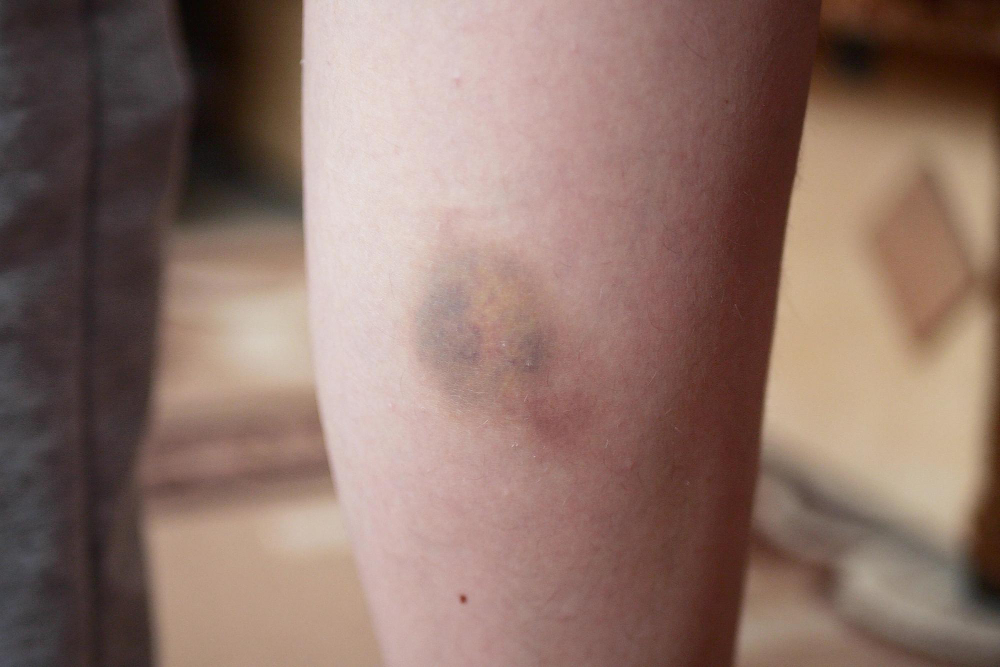
The defining feature of a bruise is that the skin is intact. A cut bleeds outwards; a bruise bleeds inwards. The impact was enough to rupture capillaries and small vessels in the tissue beneath, but not enough to break the skin above them, so the blood has nowhere to go and spreads into the spaces between cells.
That trapped blood is the entire problem the body now has to solve. Outside a blood vessel, blood is not a useful fluid. It is a few millilitres of foreign material sitting in tissue that was not built to contain it, full of iron, which is reactive and which the body is unwilling to waste. The bruise is the process of taking it apart and recovering what is worth recovering.
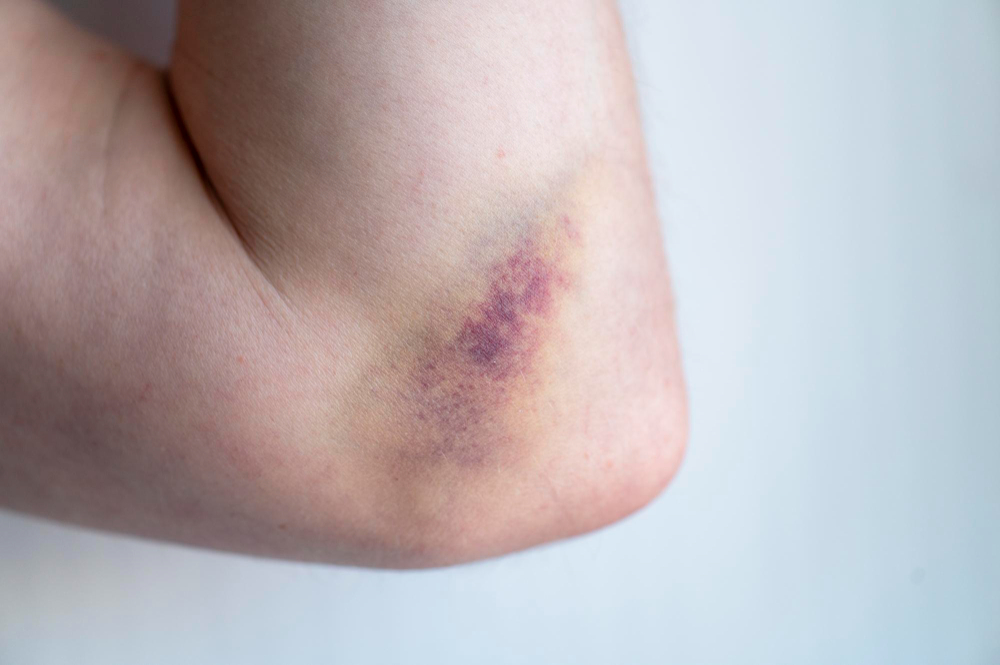
The first stage is the obvious one. Freshly spilled blood is red, and immediately after an impact a bruise often looks red or simply flushed. Within hours the blood loses its oxygen to the surrounding tissue, and haemoglobin without oxygen is a darker, bluer red, which is the same reason veins look blue through the skin when the blood inside them is not blue at all. Combined with the way skin scatters light, that gives the familiar deep purple-black of a day-old bruise.
Like our content? Follow us for more.
The Colours Are Named Compounds, in Order
Then the clean-up begins, and this is the part worth knowing.
White blood cells called macrophages move into the area and start consuming the escaped red blood cells. Inside them, the haemoglobin is broken down, and it does not break down in one step. It goes through a defined sequence of compounds, each with its own colour, and because a bruise sits just under a translucent layer of skin, you can watch the sequence happen.
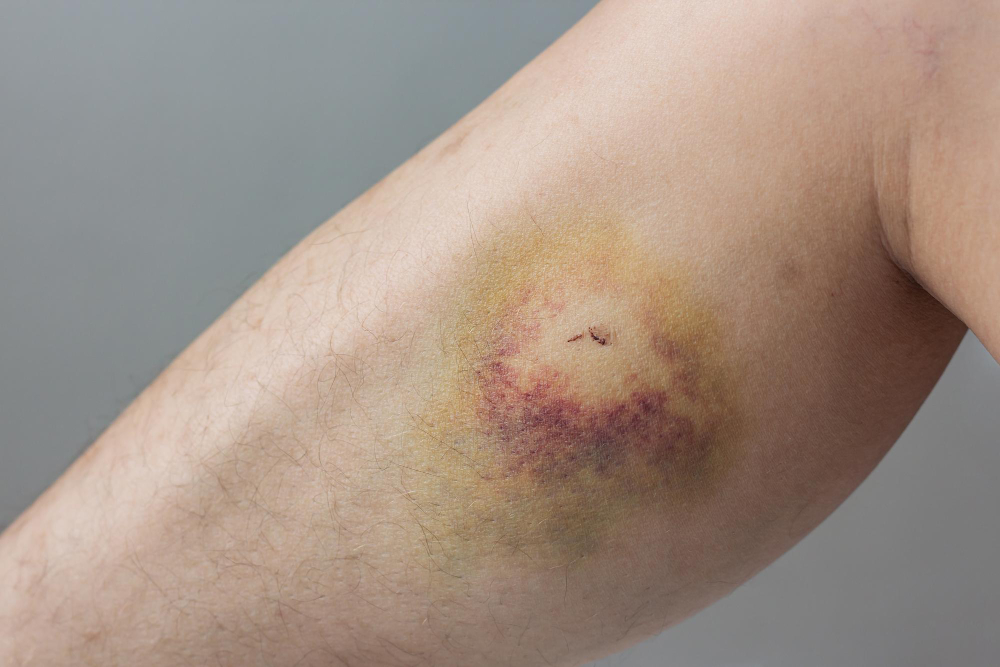
The haem group is first converted to biliverdin. Biliverdin is green. This is where the greenish stage of a bruise comes from, usually somewhere between the fourth and seventh day, and it is a real pigment rather than a trick of the light.
Biliverdin is then converted to bilirubin by an enzyme. Bilirubin is yellow-brown. This produces the yellowish stage that appears towards the end, generally from around the seventh day onwards, and it is the same compound responsible for the yellow tinge of jaundice when it accumulates in the body for other reasons, and for the colour of a bruise’s outer margin as it fades.
The iron released from the haemoglobin is separately captured and stored, chiefly as a protein-bound compound that is golden-brown, and the body holds onto it rather than discarding it, because iron is too valuable to throw away.
So the standard progression, red to purple-black to green to yellow-brown to nothing, is not a bruise getting weaker. It is a chemical pathway running to completion beneath the skin, and the colours are simply the intermediate products becoming visible in the order they are made.
Why Some Bruises Are Enormous and Some Barely Show
The same knock produces very different bruises on different people and in different places, and the reasons are mostly mechanical.
Tissue that has less to hold it in place bruises more. Loose tissue with fewer supporting fibres allows blood to spread further from the point of impact, producing a larger, more diffuse bruise, while blood released into dense, tightly packed tissue stays put and produces a small, concentrated one. This is why a bang on the shin, where skin lies almost directly over bone, produces a small hard lump, while the same force to a soft area produces a broad mark.
Depth matters for visibility. A bruise deep in muscle may be substantial and yet never show at the surface at all, or take days to work its way up and appear somewhere unexpected.
Skin thickness and translucency change how much you can see, which is why bruises look more dramatic on thin-skinned areas and on pale skin, and why on darker skin a bruise is often more easily identified by swelling, warmth and tenderness than by colour change.
Age is the big one. Skin thins with age, the small blood vessels become more fragile, and the layer of supporting tissue that normally cushions them and holds everything in place gets thinner. The result is that older skin bruises from contact that would not have marked it decades earlier, particularly on the forearms and the backs of the hands, where sun exposure over a lifetime has additionally weakened the supporting structure. These marks are often flat, dark red rather than purple, and they can take longer to clear.
Gravity Moves It
One of the more disconcerting features of a large bruise is that it travels. A bruise on the thigh may reappear days later around the knee; a black eye may spread down the cheek.
This is straightforward. The blood is a fluid sitting in tissue spaces, and those spaces connect. It drains downwards under gravity along whatever paths exist, and it becomes visible wherever it ends up. The bruise appearing somewhere new is not a new injury and not the injury spreading. It is the original leak relocating.
It is also why a bruise often looks worst a day or two after the impact rather than immediately. The blood needs time to spread out from the broken vessels and reach the depth where it can be seen. A knock that looked unremarkable in the evening can look alarming by the following afternoon without anything having got worse.
Why Cold Helps at the Start and Not Later
The common advice to apply something cold immediately after a knock has a clear mechanism, and so does the fact that it stops being useful after the first day.
Cold makes small blood vessels constrict. Immediately after an impact, some of the damaged vessels are still leaking, so narrowing them reduces the volume of blood that escapes into the tissue, which means a smaller bruise. Cold also reduces swelling and dulls pain in the area. All of that applies to the first several hours.
After that the bleeding has stopped on its own and there is nothing left to restrict. At that stage the limiting factor is how quickly the blood supply can bring in cells to clear the spilled blood and carry the products away, and constricting the vessels works against that. This is the logic behind the conventional advice to switch to gentle warmth after the first day, which encourages circulation to the area.
The honest caveat is that the evidence for how much any of this changes the overall healing time is thin. A bruise clears on a timetable set mostly by the volume of blood and the local blood supply, and the main practical benefit of cold early on is comfort and a somewhat smaller mark rather than a dramatically faster recovery.
Why a Bruise Hurts More Than It Looks Like It Should
A bruise is tender out of proportion to the visible damage, and that is because pain is coming from pressure rather than from a wound.
Blood accumulating in a confined tissue space raises the pressure there, and that pressure acts on nerve endings that are perfectly intact and working normally. There is no cut and no torn nerve; there is a nerve being squeezed. The inflammatory response that arrives to clear the blood adds to this, since the chemical signals that recruit clean-up cells also lower the threshold at which nearby nerves fire.
This is why a bruise is worst to press on, why it often aches more on the second day than on the first, and why the tenderness generally fades before the colour does. The pressure resolves as the volume of trapped blood falls, while the pigments left behind take longer to clear.
When a Bruise Is Worth Mentioning
Almost all bruises are exactly what they look like and need nothing but time. A few patterns are worth raising with a doctor rather than watching.
Bruises that appear without any remembered cause, particularly if they are appearing repeatedly or in numbers, are worth asking about, since easy bruising can reflect how blood is clotting or the effect of a medication. Bruising that is unusually large relative to the knock that caused it falls into the same category. A bruise that is not improving at all after a couple of weeks, or that becomes hot, increasingly painful or swollen rather than gradually settling, is worth a look. So is a firm lump that persists under a bruise after the colour has gone, and any significant bruising to the head or abdomen, or around an eye following a substantial blow.
This is a general description of how bruising works rather than medical advice, and anything that worries you is a reasonable thing to ask a doctor about.
For the ordinary kind, though, the sequence is fixed and quietly impressive. Something hit you, a few vessels gave way, and your body responded by sending in cells to eat the escaped blood, disassemble the haemoglobin through a chain of intermediates, reclaim the iron for reuse and dispose of the rest. The green and the yellow are not the bruise fading. They are the receipt.
Like our content? Follow us for more.
