

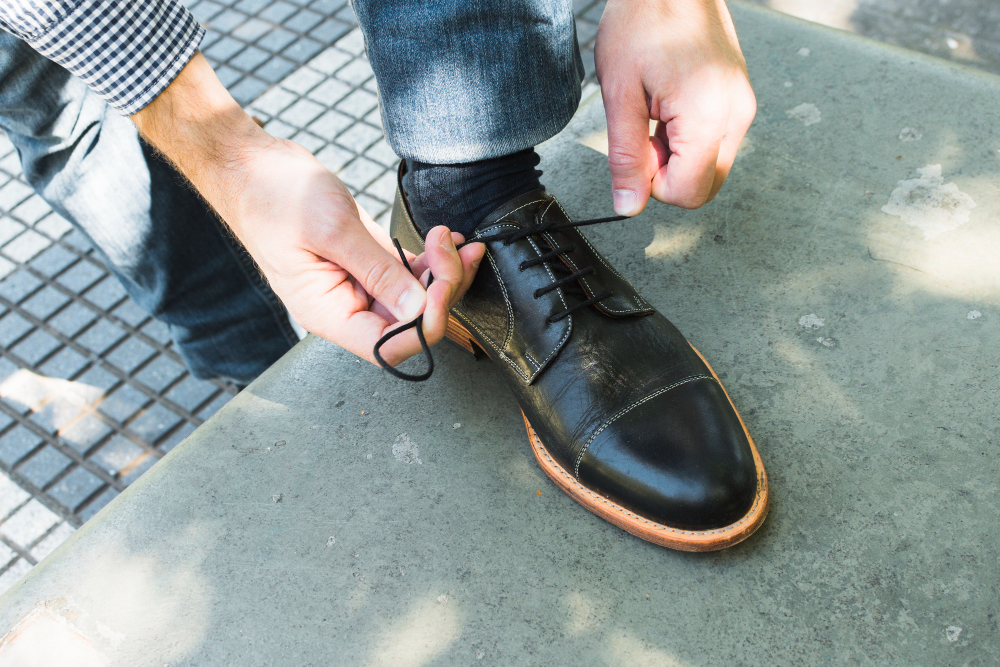
The first thing to abandon is the picture of a knot gradually working its way loose over the course of a walk, getting a little slacker with every step until it finally gives up. That is not what happens, and anybody who has watched their own lace go can confirm it: the bow is there, and then it is on the floor.
Researchers who filmed the process at high speed found that a shoelace knot holds its shape almost perfectly for hundreds or thousands of steps, with no measurable change, and then fails in the space of one or two strides. The slack does not accumulate. It arrives all at once.
That pattern – long stability followed by sudden total failure – is the signature of a system where something has to be overcome before anything happens at all, and once it is overcome there is nothing left to stop it. It is the same shape of behaviour as a pile of sand that holds its slope until one grain too many lands on it.
Like our content? Follow us for more.
Two Forces Are Doing Two Completely Different Jobs
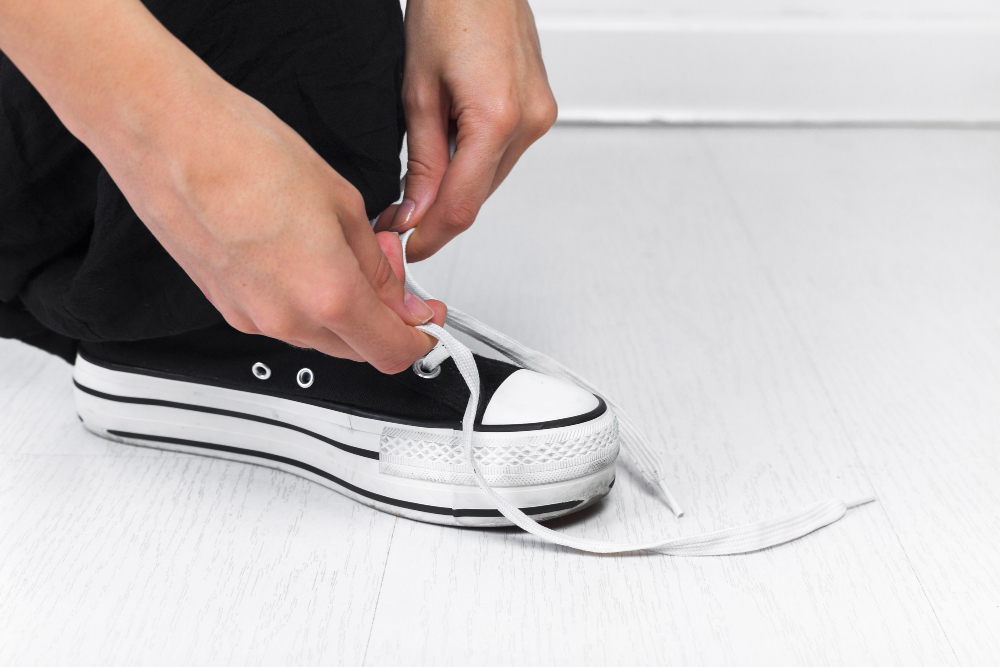
What makes the knot fail is not one thing. It is two, operating in different places on the same bow, and the work that separated them is the reason this is now reasonably well understood.
The first is impact. Every time the foot strikes the ground, the whole shoe decelerates hard, and the knot is squashed and released. That repeated compression is doing something very specific: it is working the knot’s core loose. The tight central tangle that is actually holding everything in place is being stretched and relaxed, over and over, and it slowly gives up its grip. This is the part that accounts for the long quiet period before anything visible happens.
The second is inertia acting on the free ends. As the leg swings through, the loose ends and the loops are whipped forward and back, and because they have mass they pull on the knot. Effectively there are two small invisible hands tugging at the ends of your laces with every stride – not hard, but in exactly the direction that would undo the bow if you did it deliberately.
Neither of these is enough on its own. A knot subjected to impact with the free ends restrained survives. A knot whipped about without the impact of footfall survives. It is the combination: the impact loosens the core until it no longer has the friction to resist, and at that moment the inertial tug on the ends has something to work with.
Which Is Why the Failure Is So Sudden
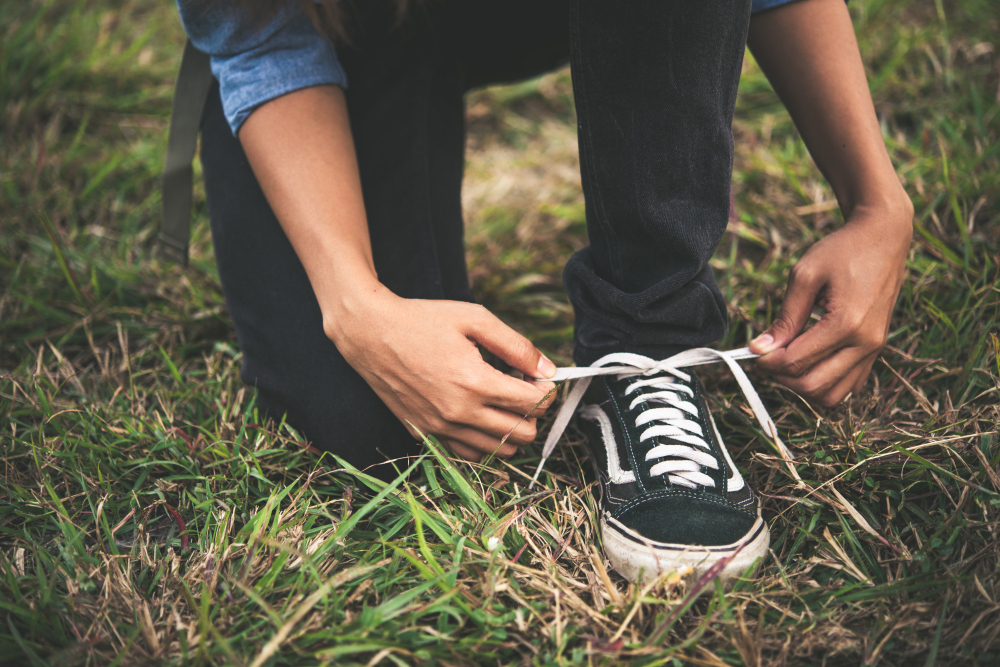
Put those two together and the all-or-nothing behaviour makes sense.
While the core is tight, the friction inside it is far greater than the small inertial pull on the ends can overcome. The ends are tugging, but nothing moves. The impact keeps degrading the core, invisibly, with no outward sign – the bow looks exactly as it did when it was tied.
Then the core reaches the point where the friction holding it has fallen below the pull on the ends. One end slips a little. That slip immediately reduces the friction further, because there is now less material pressed together, which allows more slip, which reduces friction again.
That is a runaway process, and it runs in milliseconds. The knot does not have a gradual decline followed by a fall. It has a threshold, and on the far side of the threshold it is already gone. By the time the lace is visibly loose it is not loosening – it has finished.
There Is a Second Knot, and Most People Tie the Bad One
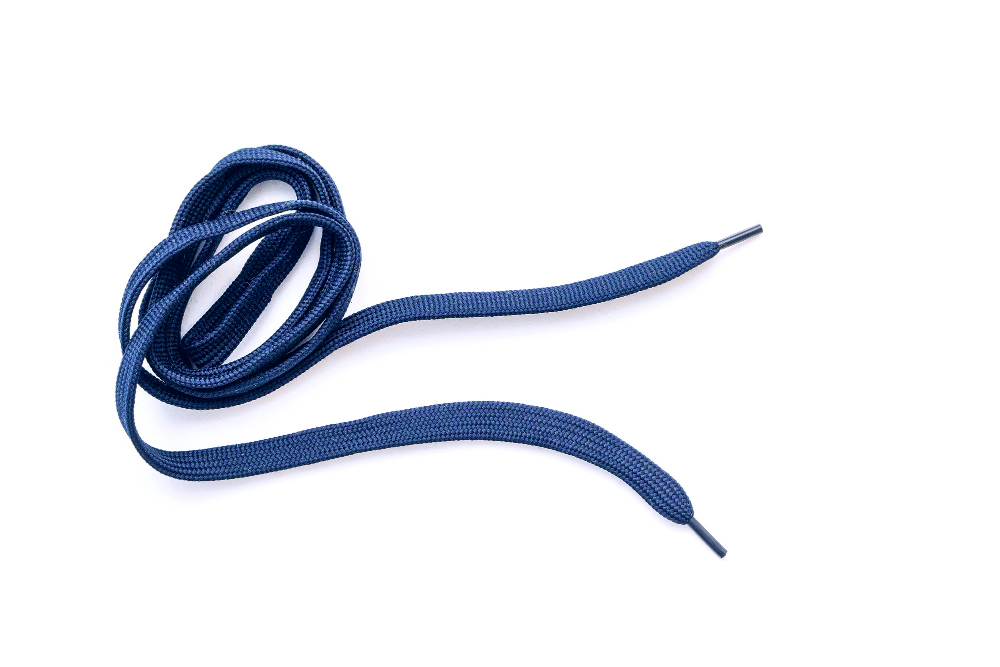
Everything above applies to any shoelace bow. But not all shoelace bows are the same, and this is the part most people have never been told.
The standard bow is built in two steps. First a simple crossing of the two laces, pulled tight. Then a second crossing, this time using loops instead of free ends, which is what makes the result a bow rather than a permanent knot.
Those two steps each have a direction. You can cross right over left or left over right, and you can make the second crossing in either sense as well. That gives two meaningfully different results, and they are both extremely common because almost nobody was taught that the choice existed.
If the two steps go in the same direction, the result is the weaker form – the one traditionally called a granny. If they go in opposite directions, the result is the stronger form, structurally related to the reef or square knot. The difference in how long they survive being walked on is not subtle, and it is the single largest factor in whether a particular person spends their life retying their shoes.
You Can Tell Which One You Have by Looking at It
The useful part is that the two versions are distinguishable without undoing anything, because they sit differently on the shoe.
The stronger version lies flat, with the bow running across the foot, loops to the sides, roughly perpendicular to the length of the shoe. It looks symmetrical and settled, and it stays where it was put.
The weaker version sits skewed. The bow twists so that it points along the shoe rather than across it – one loop up toward the ankle and one down toward the toes – and it has a tendency to roll onto its side. If your bows always end up crooked, and you have always assumed that was just how shoelaces are, it is not: it is a readable symptom of which of the two knots you have been tying since you were about five years old.
The reason the skewed one fails sooner comes down to how the forces land on it. In the flat version the two halves oppose each other squarely, and the pull on one end is resisted by the structure of the other. In the twisted version the geometry is already off, the two halves are not braced against one another properly, and a pull on an end is much more readily converted into slip rather than into friction.
Why the Weak Version Is So Widespread
The weak bow survives in such numbers for a very ordinary reason: it works well enough to get out of the door, and the feedback is delayed and ambiguous.
If a knot failed immediately, nobody would tie it that way. Instead it holds for a while, and when it does come undone the obvious explanation is that it was not pulled tight enough. So the lesson everybody draws from a failed lace is pull harder, which does not address the problem at all, and the actual cause goes unexamined for decades.
It is also, in the way these things go, learned by imitation at an age before anybody is explaining mechanics. A parent ties a child’s shoes facing them, which reverses the handedness of what is being demonstrated, and the child copies the appearance of the movement rather than its structure. The result propagates through families without anybody choosing it.
This is a general pattern worth recognising. A design that fails sometimes, later, for reasons that are easy to misattribute is far more durable than a design that fails immediately, because nothing ever corrects it.
What Is Actually Holding a Knot Together
Underneath both versions is the same principle, and it is a little surprising the first time it is spelled out: a knot has no mechanism. There is no catch, no interlock, nothing that hooks into anything else. What holds is friction, arranged by geometry so that tension in the lace presses parts of the lace against other parts of the lace.
That is why the material matters so much. A flat cotton lace has a large contact area and a rough surface, and it grips itself. A round synthetic lace with a slick finish has very little of either, and no amount of pulling will make it behave, because the problem is not tightness – it is that the surfaces slide.
It also explains why the core loosening is so decisive. The friction available is proportional to how hard the surfaces are pressed together. Degrade that pressure and you have not weakened the knot slightly; you have removed the only thing that was ever holding it.
And it explains why a bow is deliberately the weak kind of knot. A bow is a slipped knot: it is built so that pulling one end dismantles it completely. That is the entire point of it. The remarkable thing is not that shoelaces come undone. It is that a knot engineered to fall apart at a touch manages to survive several thousand impacts first.
A Failure With a Mechanism
The combination here is unusually satisfying for something so small. A knot fails suddenly rather than gradually; it needs two separate forces to do it, with one quietly destroying the friction while the other waits to exploit the result; and the version of the knot that most people happen to tie is measurably the worse of the two available, with the evidence sitting in plain view on their own feet.
None of it requires any equipment to verify. Look down at your own laces and see which way the bow is pointing. Whichever answer you get, it has been pointing that way since before you can remember.
Like our content? Follow us for more.
