Everybody Has Twenty-Four, and the Missing-Rib Story Is Not Anatomy
Twelve pairs. Twenty-four in total. The same number in men and women, with no difference whatsoever in the usual arrangement.
The widely held belief that men have one fewer comes from a creation narrative in which a rib is taken from the first man, and it is a theological claim rather than an observation about bodies. It has never been true of any population and it would not persist if it were: an injury to a parent does not alter what a child is born with, which is a point that was understood long before anybody could count ribs on a film.
It is nonetheless one of the most durable pieces of misinformation about human anatomy in existence, and it is still believed by a substantial number of adults, which makes it a reasonable place to start.
Like our content? Follow us for more.
But the Count Does Vary, Just Not in That Way
There is real variation in the number of ribs, and it has nothing to do with sex.
A small proportion of people – somewhere in the region of one in a few hundred – have an extra pair above the normal first, attached to the lowest bone of the neck. Others have an extra pair below the twelfth. And a few people are missing the twelfth pair altogether.
None of these is rare enough to be a curiosity and none has anything to do with being male or female. They are ordinary developmental variation of the kind that occurs at the boundaries of any repeating structure, which is exactly where you would expect it: the top and bottom of a series are where the pattern has to stop, and where stopping it one segment early or late makes the least difference.
So the honest version is that most people have twenty-four, a noticeable minority do not, and the ones who do not are distributed without regard to the thing everybody thinks determines it.
Only Seven Pairs Actually Reach the Breastbone
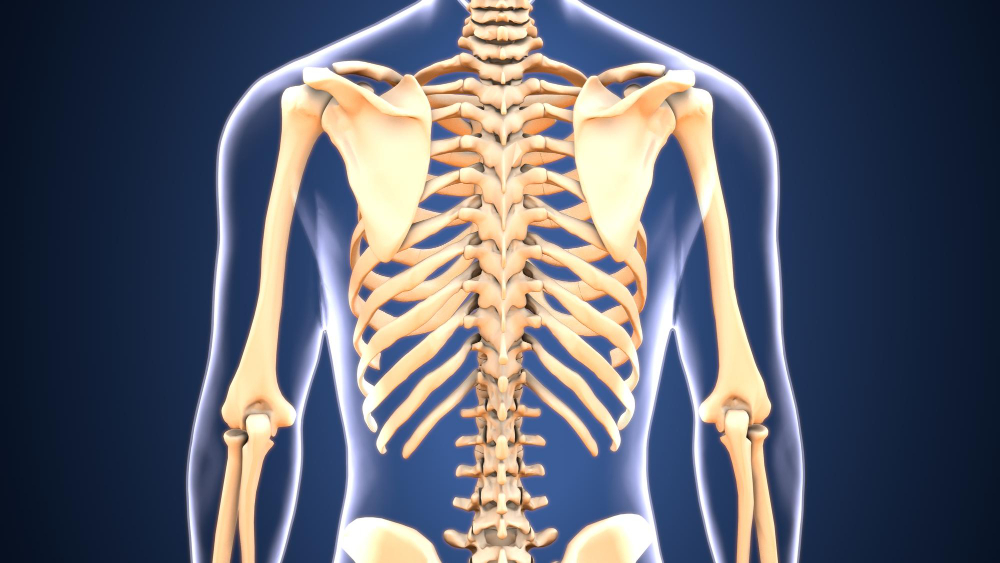
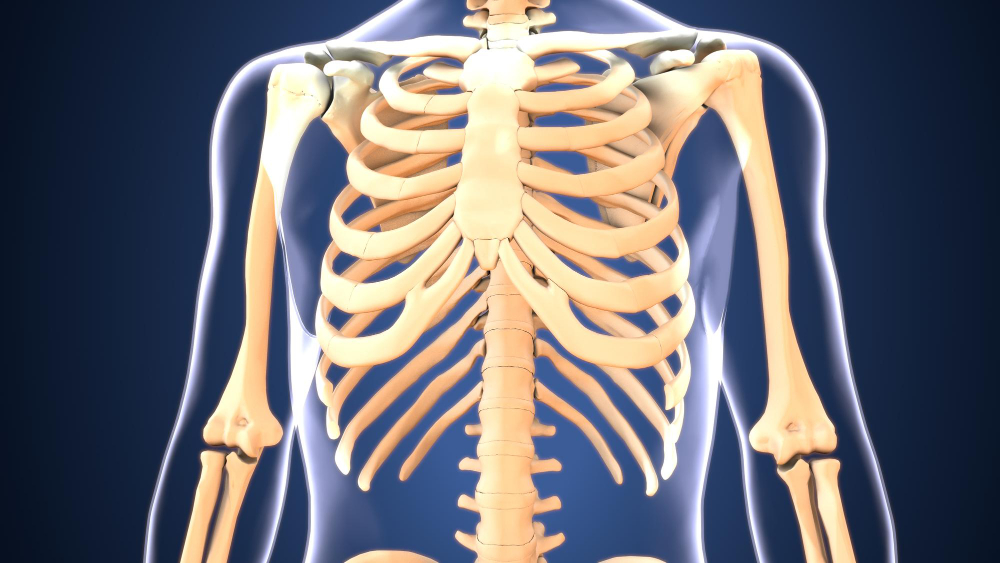
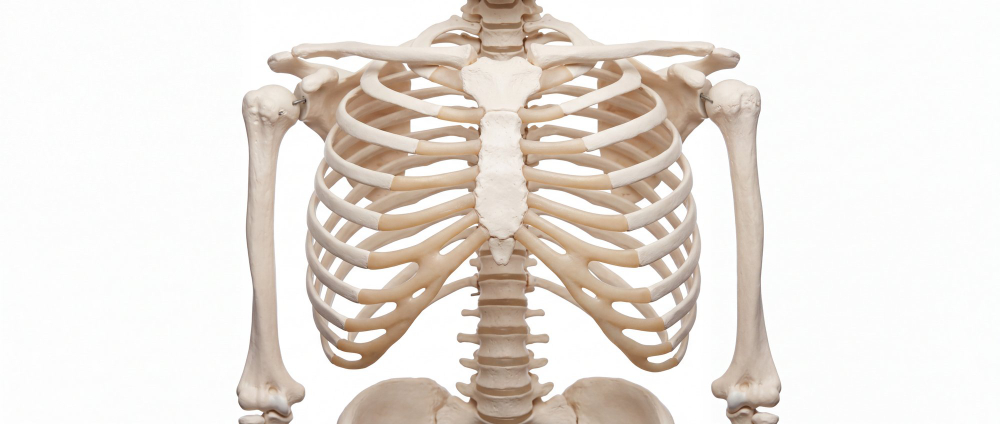
The mental image is of a cage where every bar runs from the spine round to the front and joins the breastbone. That is true of the top seven pairs and of nothing below them.
Each of those seven has its own strip of cartilage running forward and joining the breastbone directly. They are the only ones that do.
The next three pairs do not reach it. Their cartilage angles upward and joins the cartilage of the rib above, so they are attached to the front of the body indirectly, through the rib in front of them, in a sort of chain. That upward sweep is why the lower front of the rib cage forms a V rather than continuing round, and the edge of that V is the thing you can feel beneath the breastbone.
Which means the solid continuous cage of the diagram is about half an arrangement. Below the seventh pair, the front of it is a series of struts leaning on each other.
And the Bottom Two Pairs Are Attached to Nothing at All
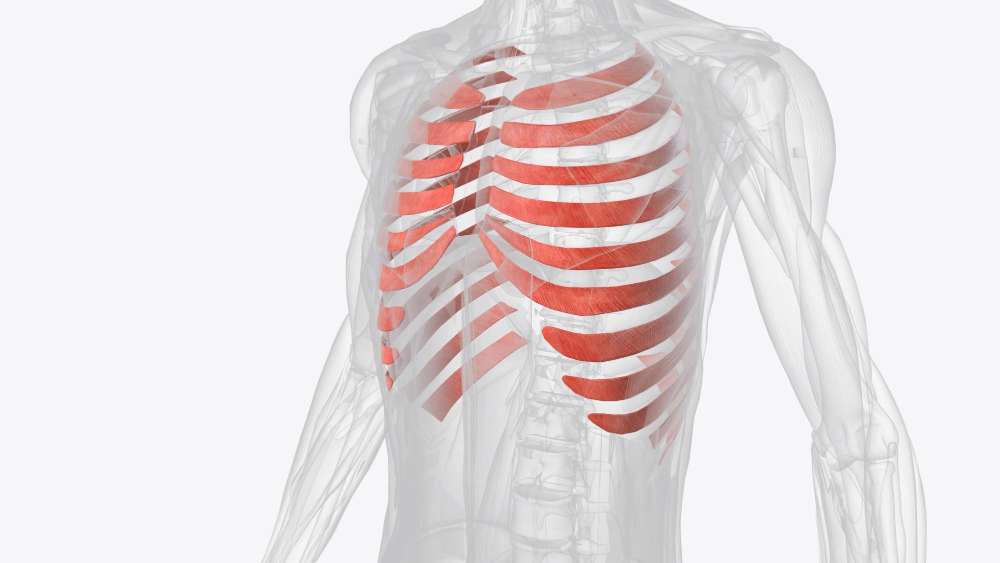
The eleventh and twelfth pairs are the ones that surprise people. They come round from the spine, they get about halfway, and then they stop. There is no cartilage running forward, nothing joining the breastbone, and nothing joining the rib above.
They end in the muscle of the body wall and that is it. The front ends are free.
This is the normal arrangement in every healthy person, it is not a defect and nothing is missing. Those ribs are not trying and failing to reach the front; they are doing a different job – covering the back and sides low down, where the kidneys are, while deliberately leaving the front unenclosed so that the abdomen can change shape.
Which it has to. A rigid ring at that level would make eating a large meal, bending forward and breathing deeply all considerably harder than they are.
You Can Find the Loose Ends in About Ten Seconds
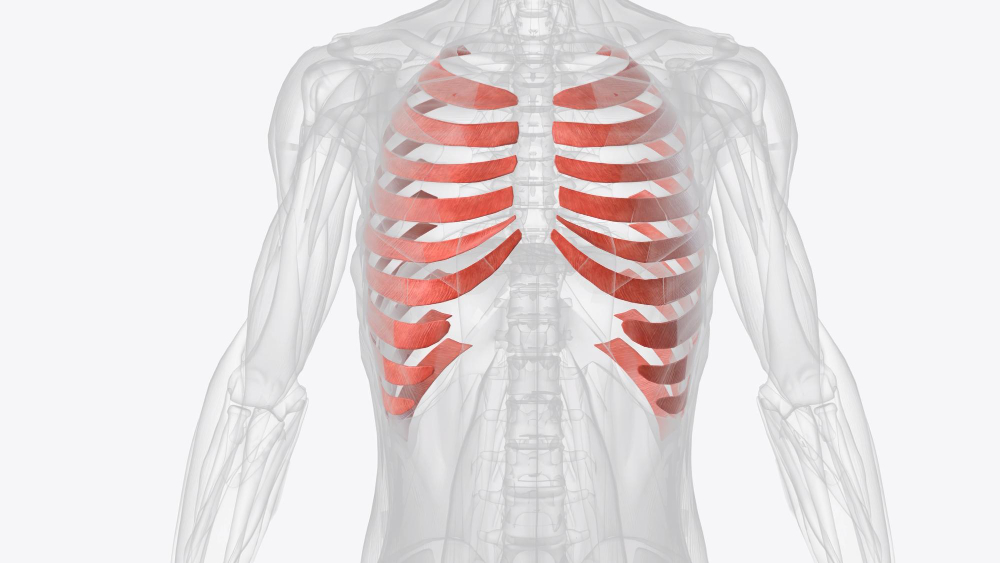
This is worth doing, because it converts a fact into something you know about yourself.
Put a hand flat on your side, low down, below the obvious edge of the rib cage at the front and round toward the back. Press in gently and work upward and backward.
What you are looking for is a bony edge that simply finishes – a firm curved end with soft tissue beyond it in the direction it was travelling. It is easier on some people than others depending on build, and it is easier from behind the side than from the front.
Everybody has four of these, two on each side, and almost nobody has ever noticed them. They are not under the skin anywhere you would normally press, and they are in a region most people only touch when something hurts.
The First Rib Is Almost Impossible to Find
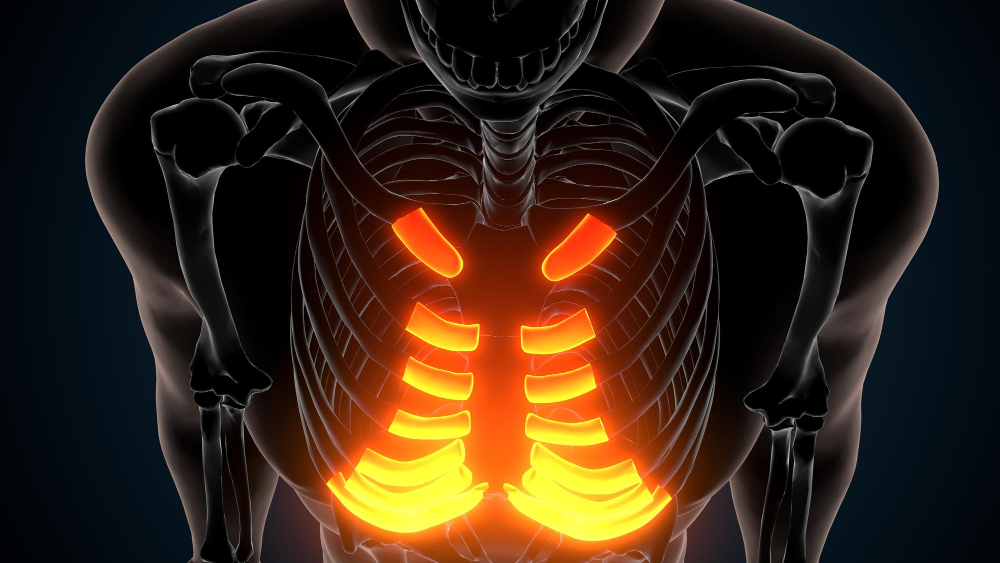
At the other end of the series is the one nobody can locate on themselves, and for good reason.
The first rib is not shaped like the others. It is short, broad, flattened and held almost horizontally rather than sweeping downward, which makes it more like a small shelf than a bar. It also sits right at the top of the chest, tucked underneath the collarbone, with a great deal of other structure on top of it.
So while the twelfth is loose at one end and findable, the first is buried, pinned in place and effectively inaccessible. The two ends of the same series of twelve bones are about as different as two members of one set can be, and almost all of the difference is accounted for by what each one has to accommodate – a lot of traffic at the top, and the need to deform at the bottom.
They Are Springs Rather Than Bars
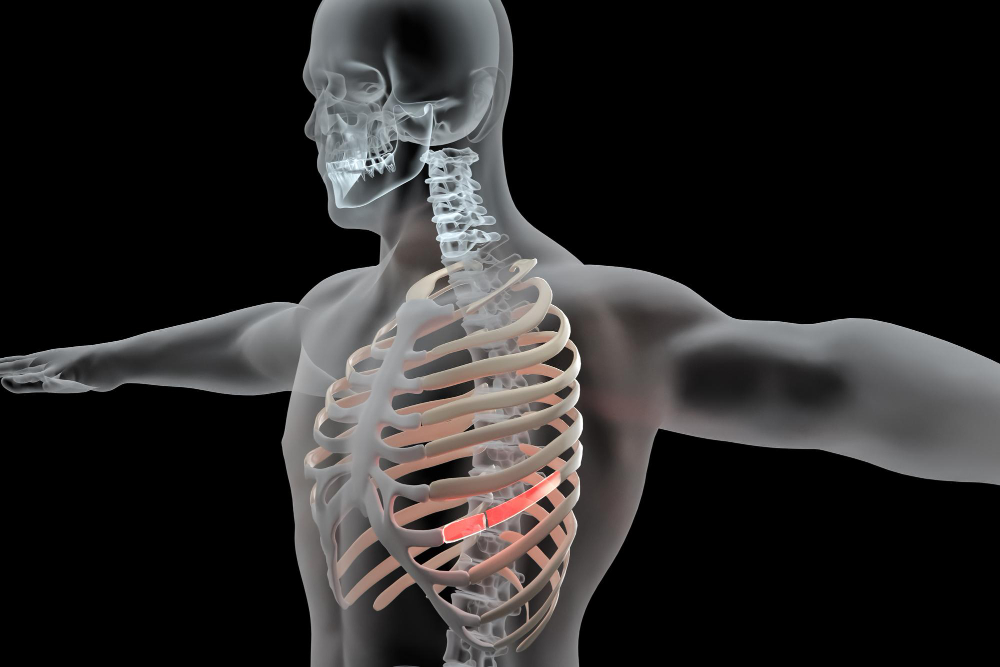
The word cage is doing real damage to most people’s understanding here. A cage is rigid. This is not.
Each rib meets the spine at joints that allow it to rotate, and because the ribs run downward and forward, rotating them lifts the whole front of the chest up and out. Two distinct movements happen at once – the upper ribs swing the breastbone forward and up, the lower ones swing out sideways – and the total change in the enclosed volume is substantial.
The individual bones also flex. A rib is a long curved piece of bone loaded across its curve, which is a shape that bends elastically rather than holding its form absolutely, and that bending is part of the design rather than a weakness in it.
So the structure is an articulated set of springs that changes shape continuously and never stops. It has to be, because the thing it surrounds has to be able to get bigger.
Which Is Why the Front Is Cartilage
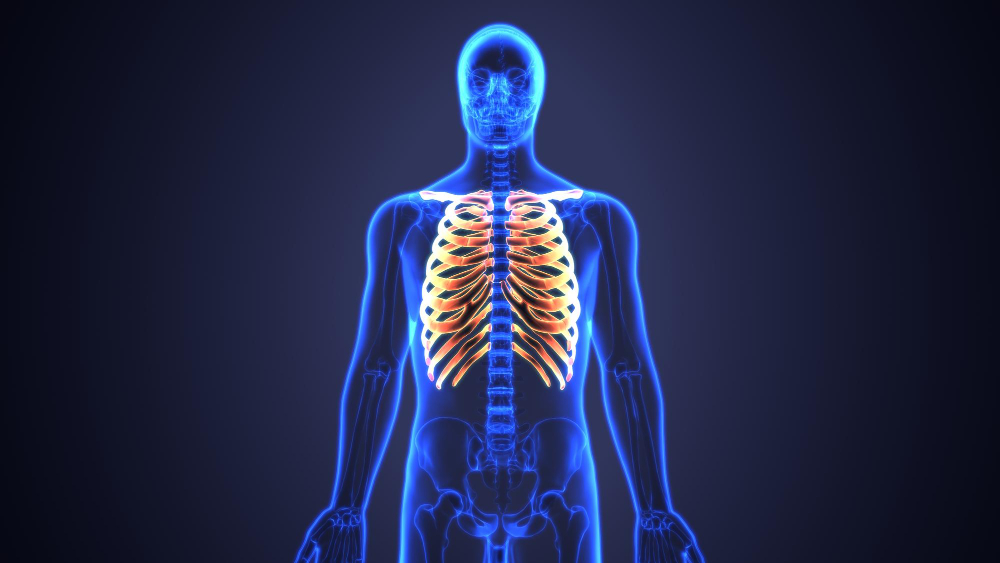
If the ribs were bone all the way round and joined to a bony breastbone, none of the movement in the previous section could happen. A closed ring of bone does not change shape.
The strips at the front are cartilage precisely so that they can twist and bend, and the amount of movement that occurs there is considerable. The cartilage is doing the job of a hinge made of material rather than a hinge made of parts – no bearing surfaces, no lubrication and no moving components, just something that deforms and springs back a few thousand times a day for a lifetime.
It is one of the clearest examples in the body of a structural problem solved by choosing a different material rather than by designing a mechanism.
The Cartilage Turns to Bone as You Get Older
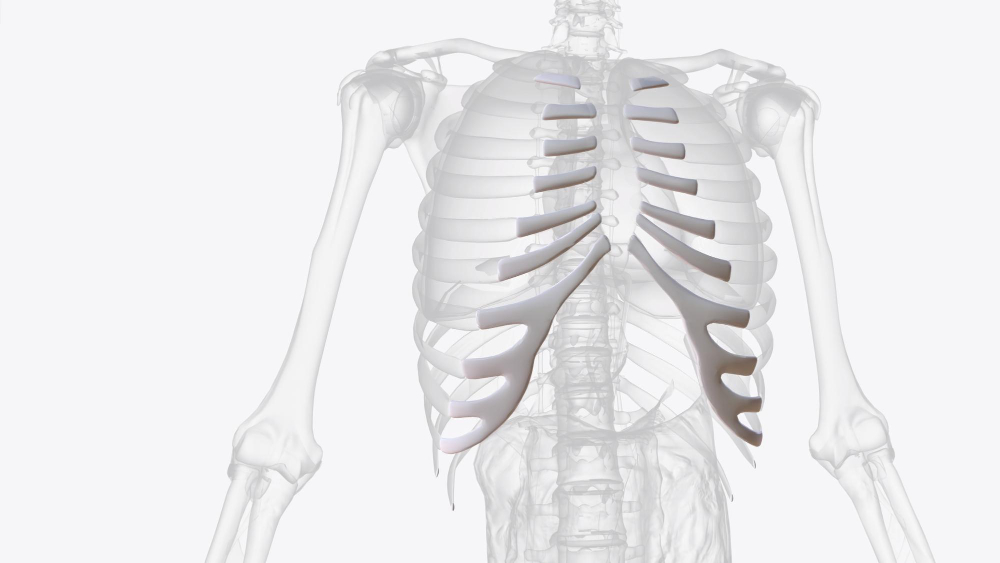
Those strips do not stay cartilage. Over decades they progressively mineralise, beginning early in adult life and continuing steadily, until in older people a good deal of what was flexible is effectively bone.
The consequence is a cage that gets stiffer, which changes the mechanics of breathing – more of the work has to be done by other means as the ribs contribute less movement. It is one of the quiet, entirely normal structural changes of ageing, and it happens to everybody at different rates.
It also runs the other way at the start of life. Young ribs are far more flexible than adult ones, bend a long way before they do anything else, and behave much more like springs and much less like bone. The whole cage is on a slow one-way trip from flexible to rigid, and the age of a skeleton can be estimated from how far along that trip the front of the rib cage has got.
A Rib Will Grow Back
The last of these is the least known and the most surprising: a rib is one of the very few bones in the human body that regenerates if it is removed.
The reason is the thin membrane wrapped around the outside of the bone. If a rib is taken out and that wrapper is left behind in place, the cells in it will build a new rib inside it, following the old shape, over a period of months. The result is not always a perfect copy but it is a functioning rib where there was none.
This is well enough established that ribs are used as a source of bone for rebuilding elsewhere in the body, on the basis that the donor site will refill itself. Almost nothing else in the skeleton behaves that way, and nobody has a complete account of why ribs in particular are so willing.
Which is a reasonable place to finish, because it is the fifth or sixth thing on this list that contradicts the idea of a cage. A rigid protective enclosure is not what you would expect to find made of springs, half-attached at the front, loose at the bottom, slowly turning to bone, and capable of rebuilding its own components.
Like our content? Follow us for more.