

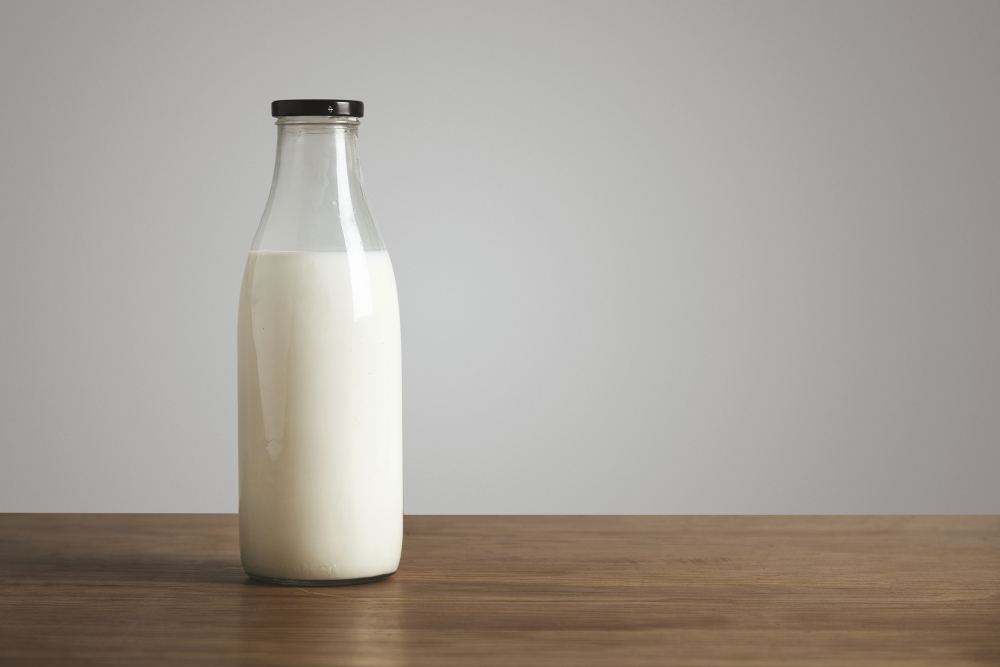
For most of the twentieth century, small birds opened milk bottles.
They would land on a bottle left on a doorstep, peck or tear through the foil cap, and drink the cream off the top. It happened in enormous numbers, across whole countries, for decades, and it became one of the most cited examples in the study of animal behaviour – the clearest available evidence that wild animals could invent something and pass it on.
Then people went back and looked at the data properly, and the story got considerably more complicated.
What the Birds Were Actually After

The target was never the milk. It was the cream.
Unhomogenised milk separates in the bottle, and the cream rises to the top – the few inches directly beneath the cap. That cream is extremely high in fat, which for a small bird in cold weather is close to ideal: dense energy, immediately available, requiring no processing.
Small birds of this kind are already well equipped for the job. They habitually probe, tear and pry at things to get at food under bark and inside buds, and a foil cap is mechanically very similar to the sort of covering they open all the time. They are also light enough to perch on the rim of a bottle and strong enough in the neck and bill to puncture thin metal.
So the behaviour required no new physical ability. What it required was the idea – the association between a particular object on a doorstep and a reward concealed under its lid.
That is why the case was interesting. The novelty was not the action but the target, and the target had only existed for as long as doorstep delivery had.
Like our content? Follow us for more.
Why It Became the Standard Example

The behaviour was first recorded in the early twentieth century, in a small number of places. Over the following decades, reports accumulated across an enormous area, and the pattern of those reports looked exactly like something spreading.
New locations appeared adjacent to old ones. The frequency rose over time. It appeared first in some regions and later in others, and the sequence looked geographic rather than random. Researchers mapped it, and the map looked like the diffusion of an innovation through a population – the same shape you get when a technique passes from individual to individual.
That interpretation was enormously attractive, because it offered something otherwise very hard to demonstrate in the wild: culture in a non-human animal. Not an instinct, not an individually learned trick, but a specific invented behaviour transmitted socially across generations and across a landscape.
It went into textbooks. It was taught for decades. If you studied animal behaviour at any point in the second half of the twentieth century, you encountered the milk bottles.
What the Re-Examination Found

The problem is that a map of reports is not a map of the behaviour. It is a map of the behaviour plus the people who noticed it plus the people who wrote in about it, and those three things are not the same.
When researchers revisited the original records with that in mind, several things emerged. Reports clustered where observers were concentrated rather than simply where birds were. The apparent spread tracked the spread of doorstep delivery itself, which was expanding across the same period – meaning that in many places the behaviour could not have appeared earlier because the bottles were not there yet. And the timing in many locations was consistent with birds working it out independently rather than learning it from a neighbour.
That last point is the serious one. The behaviour is not difficult. A bird that routinely opens things will, on encountering a shiny covered object with food under it, sooner or later open that too. If the discovery is easy enough, it will be made repeatedly and independently wherever the opportunity exists, and the resulting pattern of reports will look very like diffusion without any transmission occurring at all.
Later experimental work on the same species has shown that these birds genuinely are capable of social learning, and that techniques really do spread through their populations under controlled conditions. So the capacity is real. What is doubtful is whether the milk bottles were an example of it, or whether they were a large number of independent inventions that happened to look like one spreading idea.
The Dairies Fought Back, Which Tells You the Scale
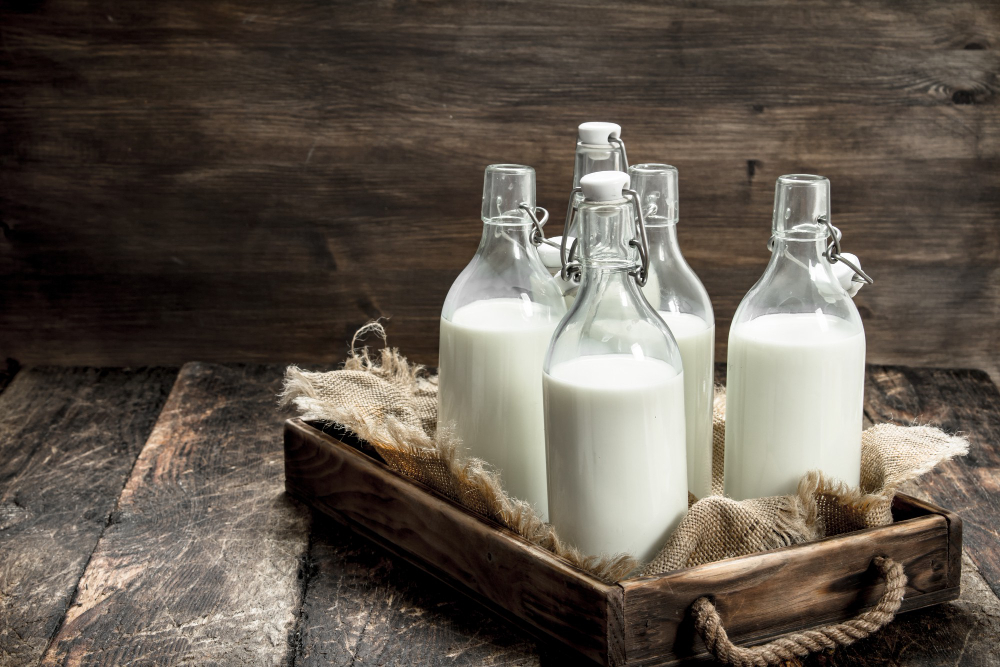
One measure of how big this was is that it became a commercial problem rather than a curiosity.
A pierced cap is not a minor nuisance to a dairy. The milk is contaminated, the customer will not accept it, and the bottle has to be replaced – and in a delivery operation with very thin margins per bottle, a few per cent of deliveries ruined is a serious cost. Households complained. Dairies responded.
The responses were various and mostly ineffective. Thicker foil was tried and the birds got through it. Bottles were delivered into covered boxes or under upturned flowerpots, which worked where customers remembered to use them. Customers were advised to take the milk in promptly, which addressed the problem only for people who were awake. Some deliveries were simply made earlier, on the reasoning that the birds were not active before first light – which was true, and which meant the bottles then sat on the step through the entire morning feeding window instead.
The measure that actually worked was the one adopted for unrelated reasons: the move away from glass on the doorstep altogether.
The commercial record is also useful evidence in its own right, because dairies had a direct financial interest in knowing where and when this was happening. Their accounts of it are independent of the ornithological reports and broadly corroborate the scale, which is part of why nobody doubts the behaviour itself even while the explanation is contested.
Why the Question Cannot Be Settled Now

The behaviour has largely gone, because the bottles have.
Doorstep delivery in glass declined steeply from the 1970s onwards, replaced by cartons and plastic bottles bought in shops. Where glass survived, the caps changed – thicker foil, and in many cases a different cap design that a bird cannot easily get through. And homogenised milk, which does not separate, removed the reward entirely: there is no cream layer under the cap to take.
Each of those changes closed the opportunity independently, and together they ended the behaviour almost completely within a couple of decades.
Which means the natural experiment is over. The original question – was this transmission or repeated independent invention – would be answerable with careful observation if the behaviour were still happening at scale. It is not, and the surviving evidence is the historical record of reports, which is precisely the evidence that turned out to be unreliable.
It is a genuinely frustrating outcome, and a fairly common one in this kind of research. The phenomenon was studied enthusiastically while it was happening, with the methods and assumptions of the time, and by the time better methods existed the thing itself had disappeared.
What Is Left of the Story
Several things survive the reassessment, and they are worth separating from what does not.
The birds really did open the bottles, in very large numbers, over a very wide area, for a very long time. That is not in dispute and never has been.
The behaviour really was an invention in the sense that mattered – an association between a brand-new object and a food reward, made by wild animals with no help, within a few years of the object appearing. Whether it spread by teaching or by repeated discovery, the animals solved a problem that did not exist before.
These birds really are capable of social learning, which has been demonstrated since by direct experiment rather than by inference from maps.
And the behaviour really did end because the human habit it depended on ended, which is the part with the widest application. A great deal of animal behaviour around people is a response to a specific human practice, and when that practice changes the behaviour goes with it – usually without anybody recording that it has gone.
What does not survive is the confident textbook version: that this was a documented case of culture diffusing through a wild population. It might have been. The evidence that was taken to prove it turned out to be a record of who was watching.
If you remember finding the foil pecked through in the morning, you witnessed something that genuinely puzzled researchers and still does.
And the reason you cannot see it any more has nothing to do with the birds. They are still out there, still opening things, still perfectly capable of it. What vanished was the bottle on the step, the foil on the bottle, and the cream under the foil – three separate human decisions, none of them made with birds in mind, which between them closed a fifty-year opportunity that nobody thought to study properly while it lasted.
Like our content? Follow us for more.

