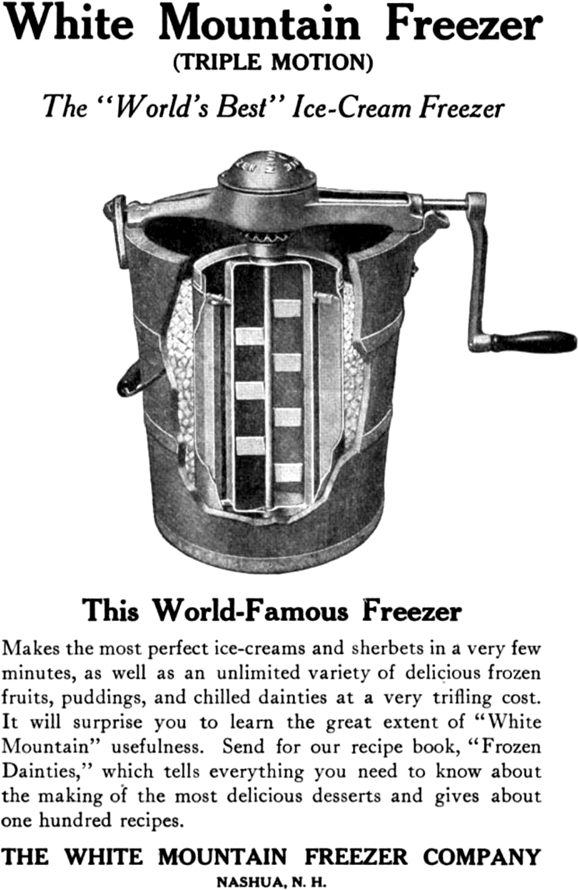
The object is unmistakable. A wooden bucket bound with metal hoops, a cast iron frame across the top with a crank handle and a geared head, and inside it a tall metal canister with a wooden paddle – the dasher – standing in the middle.
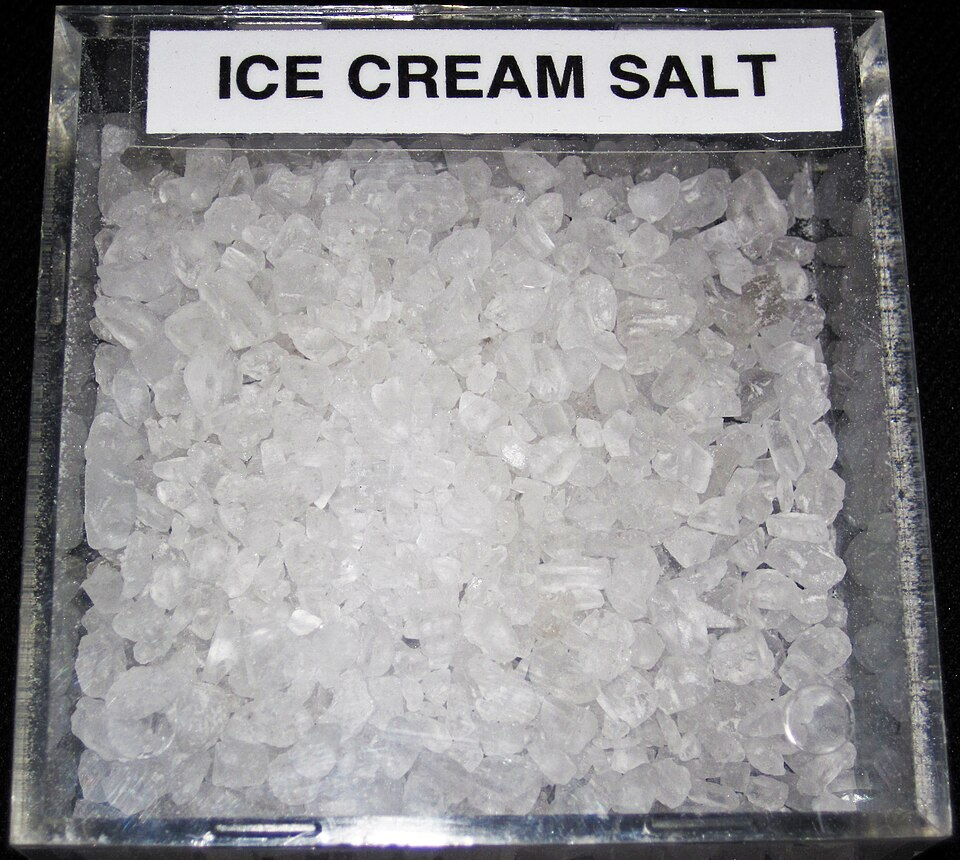
Making ice cream in one was an operation rather than a task. Somebody made the custard. Somebody fetched the ice and broke it up. Somebody got the rock salt. The canister went in, the ice and salt went around it in layers, and then the crank had to be turned, continuously, for half an hour or more, by whoever could be made to do it.
Which was the children. Universally, across the entire country, for generations. If you were eight years old in an American family with one of these, you have turned that handle until your arm ached, and you were told that you could not have any until it was done.
The physics underneath it is genuinely elegant, almost nobody who used one could explain it, and the reason it worked is the opposite of what most people assume.
Salt Does Not Make Ice Colder
Here is the piece that everybody gets wrong, including a great many people who made ice cream in one of these every summer for twenty years.
The usual explanation is that salt makes the ice colder. It does not. Salt cannot add cold to anything.
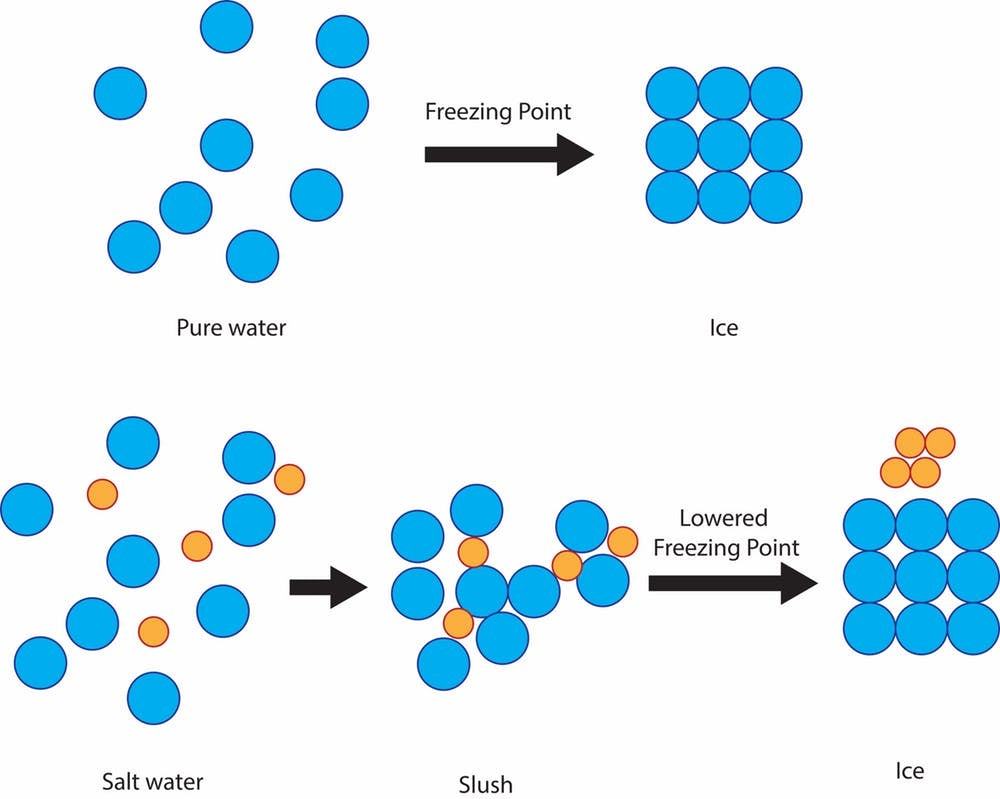
What salt does is lower the temperature at which ice and water can coexist. Pure ice in pure water sits at freezing point, and nothing much happens. Add salt and that equilibrium point drops, which means ice that was sitting stably at freezing point is suddenly above the new melting point – so it starts to melt.
And melting is the whole trick, because changing from solid to liquid requires a substantial amount of energy. That energy has to come from somewhere, and it comes from the surroundings: from the water in the bucket, from the metal of the canister, and through the canister wall from the custard inside it.
So the mixture of ice and salt is not a cold source. It is a heat pump driven by melting. The ice steals energy out of everything around it in order to melt, and that theft is what drops the canister well below freezing – considerably below what plain ice could ever achieve.
The salt is a trigger. The melting does the work.
Like our content? Follow us for more.
Which Is Why the Proportions Mattered
Because the mechanism is melting, the amount of salt is not a matter of taste or tradition. It changes the result.
Too little salt and not enough ice melts, so the brine does not get cold enough and the custard takes forever or never properly freezes. Too much salt and the brine gets very cold very quickly, which sounds good and is not – the mixture freezes hard against the inside of the canister faster than the dasher can scrape it off and mix it in, and the result is coarse and grainy with ice crystals in it.
Every family had a ratio, passed down, defended, and usually arrived at by trial. Different households used different ice sizes and different salt grinds, which changes how fast the melting runs, which is why one family’s method did not transfer cleanly to another’s.
This piece gives no proportion, timing or method of any kind, because frozen dairy preparation is properly a matter for current food-safety guidance and that guidance is specific and freely available. The historical point is only that the ratio was doing real thermodynamic work, and that households were tuning a physical process without having any language for what they were tuning.
The Dasher Was Not Stirring, It Was Scraping
The wooden paddle inside the canister is usually described as stirring the mixture, and that undersells what it does.
The mixture freezes at the wall of the canister first, because that is where the cold is. If it stayed there, you would end up with a frozen shell and a liquid middle. The dasher’s job is to scrape that frozen layer off the wall continuously and fold it back into the warmer liquid, which does two things at once.
It moves the frozen material away so that new liquid contacts the cold wall. And it keeps the ice crystals small by breaking them up before they can grow, which is the entire difference between smooth ice cream and something with a gritty texture. Crystal size is the single most important variable in the texture of any frozen dessert, and mechanical agitation during freezing is how you control it.
It also beats air into the mixture, which matters more than anybody realises. Ice cream without incorporated air is dense and unpleasantly hard; the air makes it scoopable and light. Commercial production controls that incorporation precisely as a measured quantity, and a child turning a crank was doing the same job by hand, badly and variably.
So the hand-cranked texture was genuinely different from the commercial product – frequently denser, sometimes grainier, and dependent on how determinedly the crank had been turned.
The Crank Got Harder and That Was the Signal
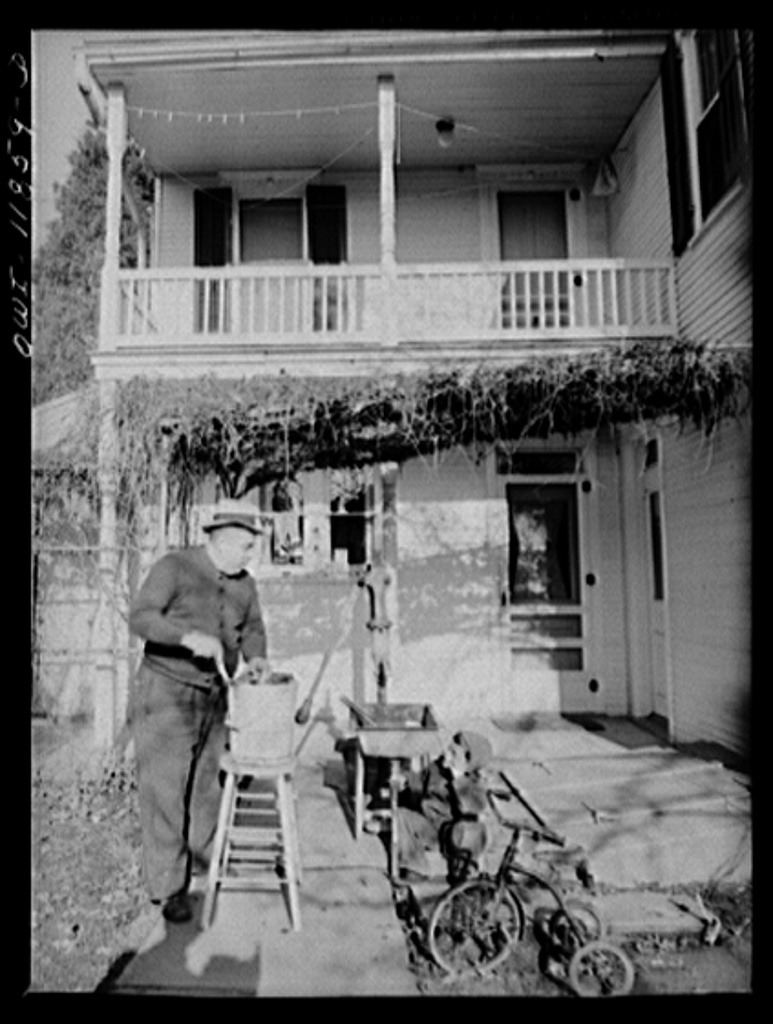
There was no thermometer and no timer. The indicator was resistance.
At the start the crank turns easily, because the canister contains liquid. As the mixture thickens the crank gets harder. Towards the end it becomes genuinely difficult to turn, which is the point at which the adults took over from the children, and when it would barely turn at all the ice cream was done.
Then the canister was lifted out, the brine wiped off the lid so no salt water got in, and the dasher pulled out – which was the moment the whole operation had been building toward, because whoever pulled the dasher got to lick it. The hierarchy around who had that right was taken extremely seriously and remembered for life.
After that the canister was usually packed back into fresh ice and salt, with a cork in the lid hole and a cloth or newspaper over the top, and left to harden for a while. Ice cream straight off the dasher is soft; the ripening period firmed it up and improved the texture.
That waiting was the hardest part of the entire afternoon.
It Was a Social Event by Necessity
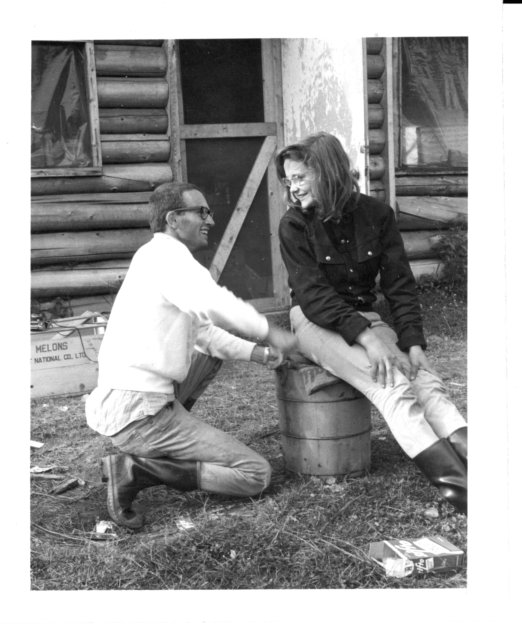
The thing worth noticing is that all of this made ice cream a collective activity, and it was collective because the technology forced it to be.
One person cannot easily do it. Somebody has to cook and cool the custard. Somebody has to get and break the ice, which before domestic freezers meant buying a block. Somebody has to turn the crank for a long time. And the finished quantity is substantial – a gallon or more – which does not keep, because a household without a freezer compartment has nowhere to put it.
So you made ice cream when there were enough people to justify it and enough people to help: a Sunday with relatives, a birthday, a holiday, a church gathering, an evening when neighbours came. The ice cream social as an institution exists because of exactly this – a dessert that required communal labour and had to be eaten immediately created its own occasion.
Which means the memory people have of these afternoons is not sentimentality attached to a dessert. The gathering was a functional requirement of the equipment.
The Freezer Compartment Ended All of It
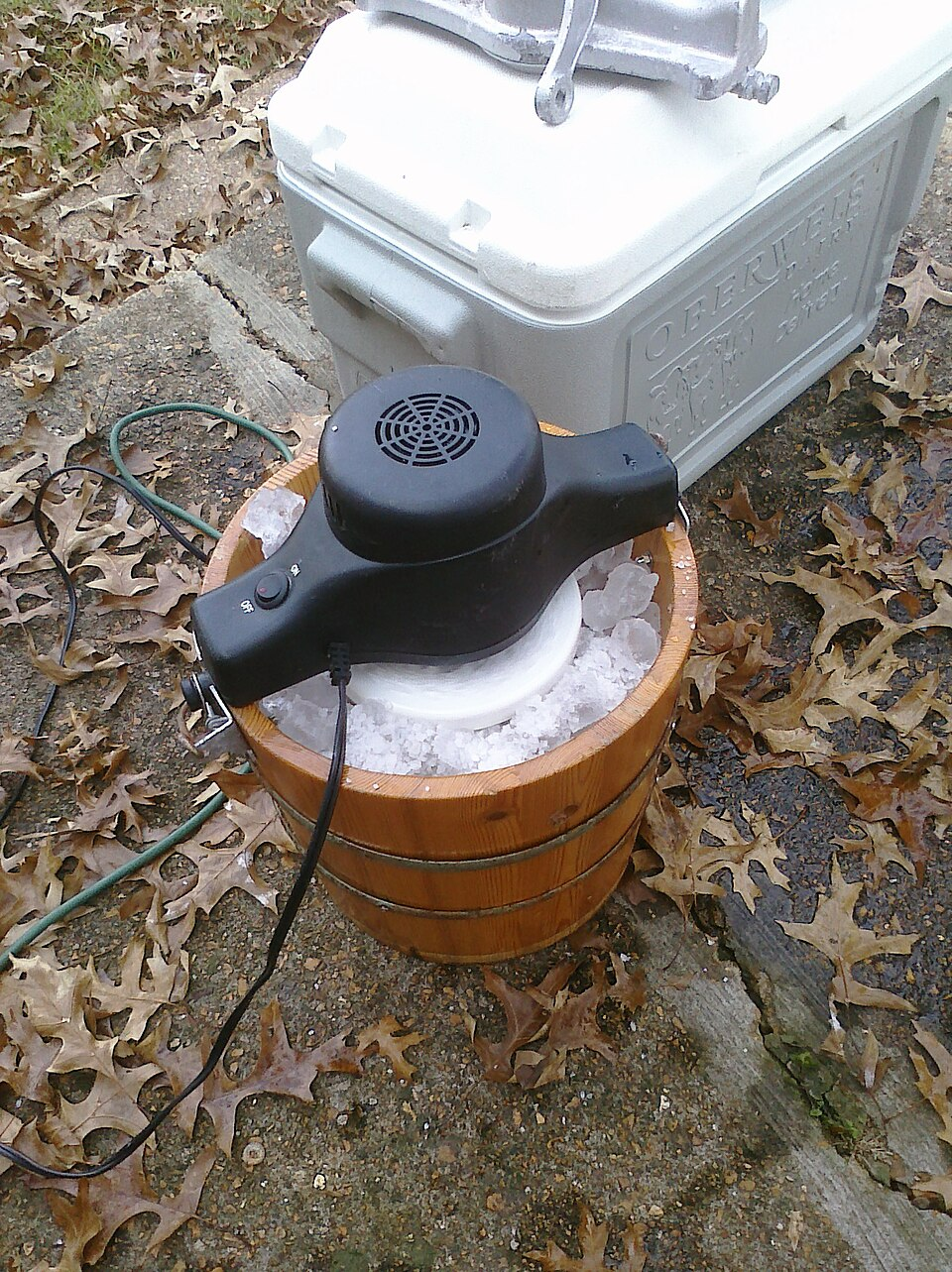
The decline came from two directions and the second one is the decisive one.
Electric motors replaced the crank first. A motorised unit does the same job with the same ice and salt and no aching arm, which removed the child labour and, with it, most of the ceremony. The result was the same ice cream with none of the afternoon.
Then the home freezer arrived and changed the entire proposition. Once a household could store frozen food, commercial ice cream became available at any moment in any quantity, kept indefinitely, at a price that no home production could match once you counted the ice, the salt, the cream and the hours.
And more fundamentally, the constraint that had created the occasion disappeared. You no longer had to assemble a crowd to justify a gallon you could not store. You could have a bowl of ice cream on a Tuesday, alone, for almost nothing – which is an unambiguous improvement in access to ice cream and the complete end of the thing that made it an event.
The freezers themselves went to attics and garages, and now sell as decorative objects, usually with the dasher missing.
What the Object Was Teaching
The hand-crank freezer is a rare example of a household appliance that demonstrated a real scientific principle while being used, to people who had no idea they were watching it.
Every child who turned that handle was operating a demonstration of latent heat – the fact that changing the state of a substance absorbs energy without changing its temperature – and of freezing point depression, and of crystal nucleation, and of the relationship between agitation and texture in a freezing emulsion. None of them knew it. All of them knew that you needed the salt, that too much salt made it gritty, that you had to keep turning, and that it got harder at the end.
That is practical knowledge of a physical process held entirely as procedure, with no theory attached, which is how most human technical knowledge has always been held.
And the result is that the one piece of the operation everybody remembers – the crank getting too hard to turn – was in fact the moment the physics had finished its work, announced by nothing but resistance in a child’s arm.
Like our content? Follow us for more.