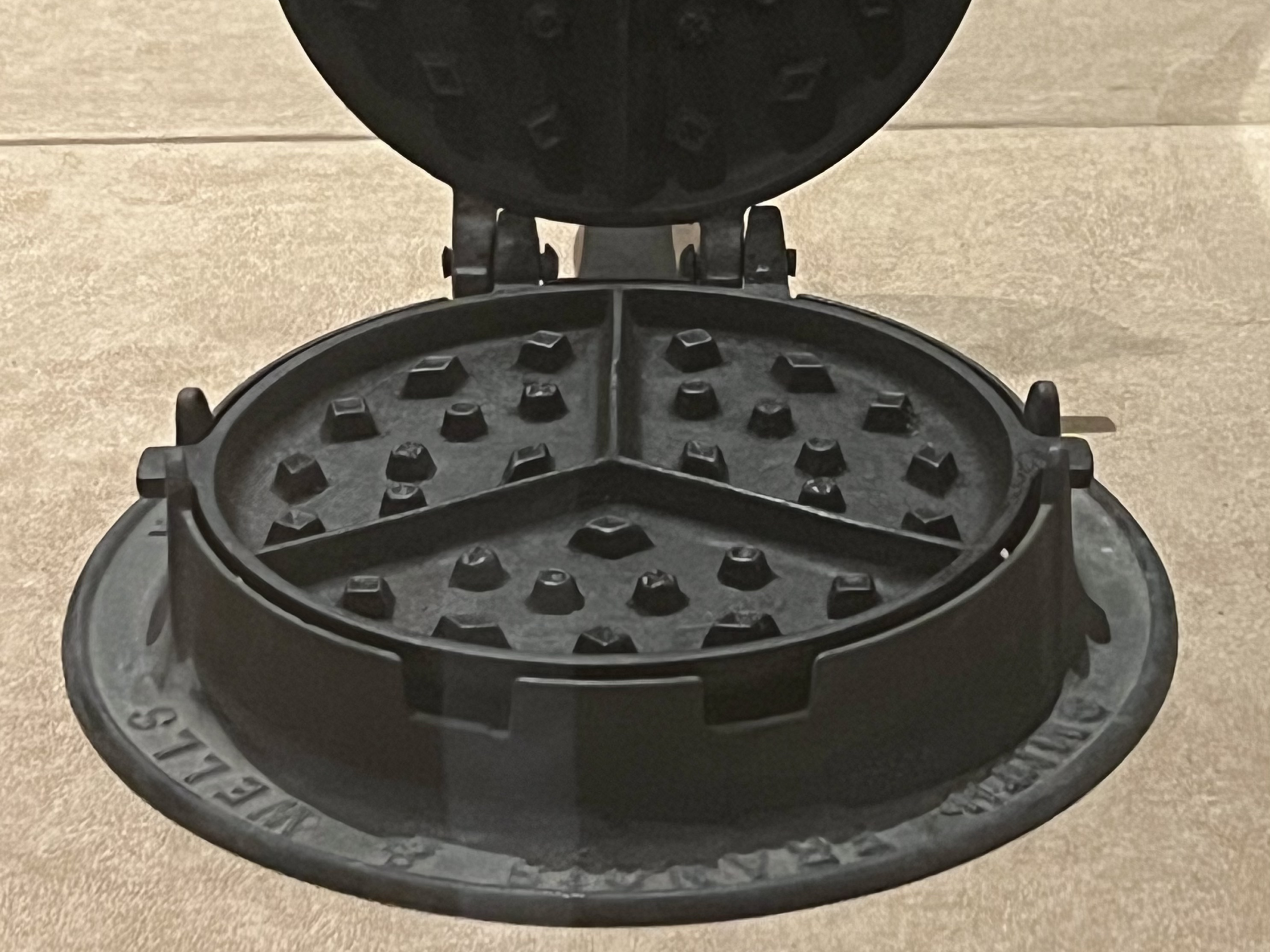
It comes out of a cupboard as two heavy hinged cast iron plates with a ring around them and a pair of long handles, and people cannot work out which way up it goes.
It goes over a hole in the stove. You take the lid off a wood or coal range, drop this into the opening so the plates sit down in the heat, and cook on it – and when one side is done you grab the handles and rotate the whole appliance through half a turn in its ring so the other face is underneath.
That swivel ring is the clever part and it is the thing nobody expects: the appliance is designed to be turned upside down, repeatedly, while full and extremely hot.
A Waffle Has to Cook From Both Sides at Once
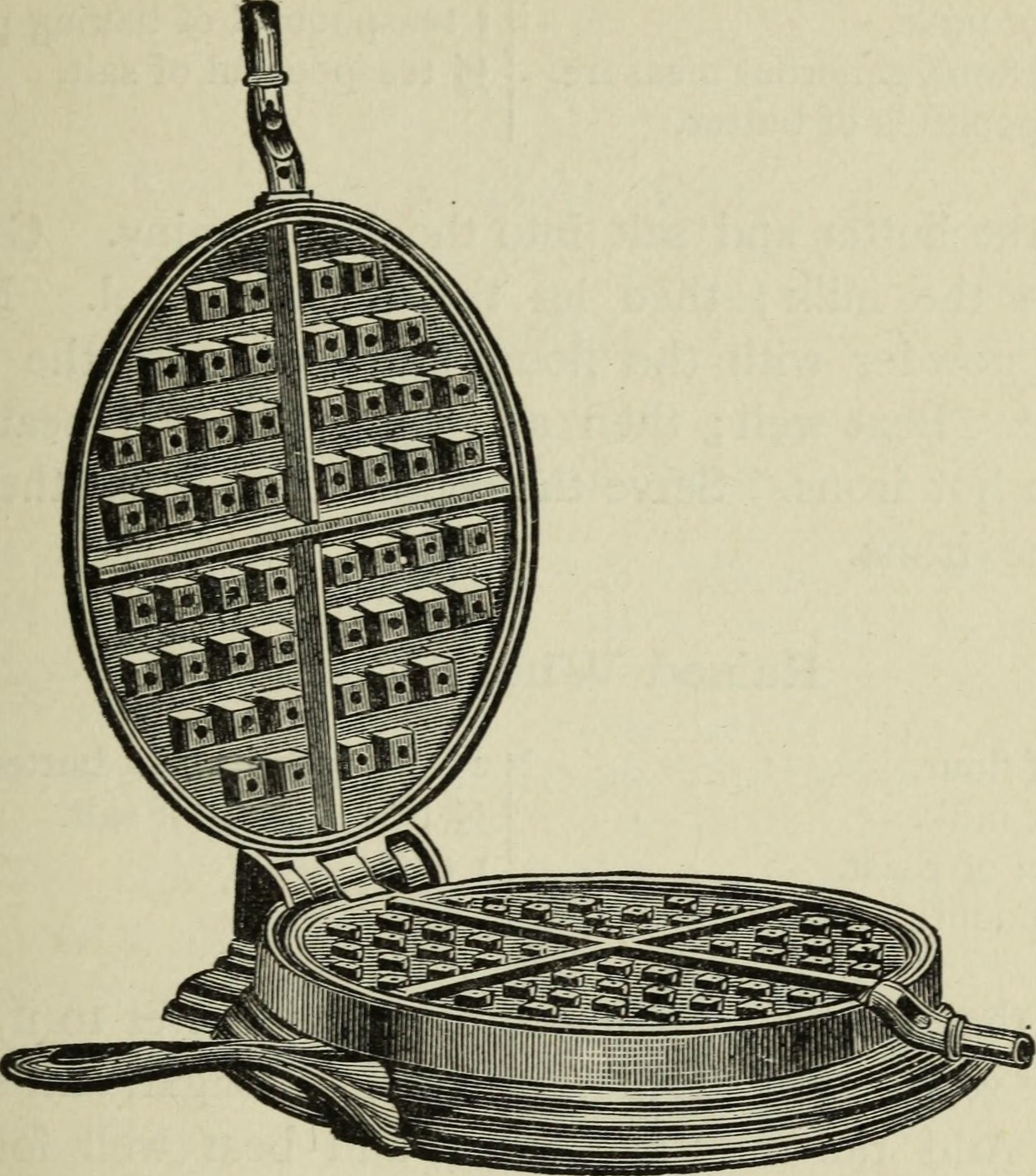
Start with why the object has this shape, because it follows from the food.
A waffle is batter cooked in contact with two patterned surfaces simultaneously. That is the whole definition – the pattern comes from the plates and the texture comes from being gripped between them, which is why a waffle is crisp outside and soft inside while a pancake cooked on one surface is neither.
So the appliance has to be two plates that close on the batter, and both plates have to be hot.
With a griddle, heat comes from below and the top of the food is exposed. With an enclosed iron, you have a problem: the bottom plate is in the fire and the top plate is in the air. One cooks and the other does not.
The solution adopted was simply to swap them over. Cook with one face down, turn the whole thing over, cook with the other face down. That is the function of the swivel ring, and it means a waffle iron is one of very few appliances designed around being inverted in use.
Like our content? Follow us for more.
The Ring Is the Engineering
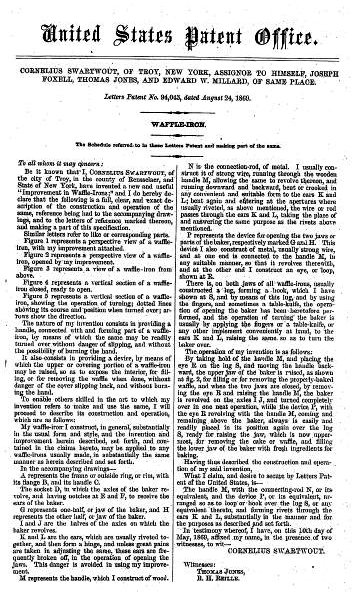
The ring is a collar that sits in the stove opening and carries two pivots, one on each side of the hinged iron.
Which means the iron hangs in the ring and rotates about a horizontal axis. Lift the handles, turn, and set it down again – and the plates are now reversed while the whole assembly stays seated in the hole.
Doing it the other way, by lifting the iron off the stove, turning it over and putting it back, is possible and was done with simpler models, and it is considerably worse. You are inverting a heavy hot object full of liquid batter over an open stove hole with nothing supporting it.
The ring removes that. It keeps the iron captive and supported through the whole rotation, with the pivots taking the weight, and it also holds the iron at a fixed height so the plates sit in the same place in the heat every time.
For a piece of cast iron kitchen equipment, that is a thoughtful solution to a specific problem.
The Plates Sat in the Fire, Not Above It
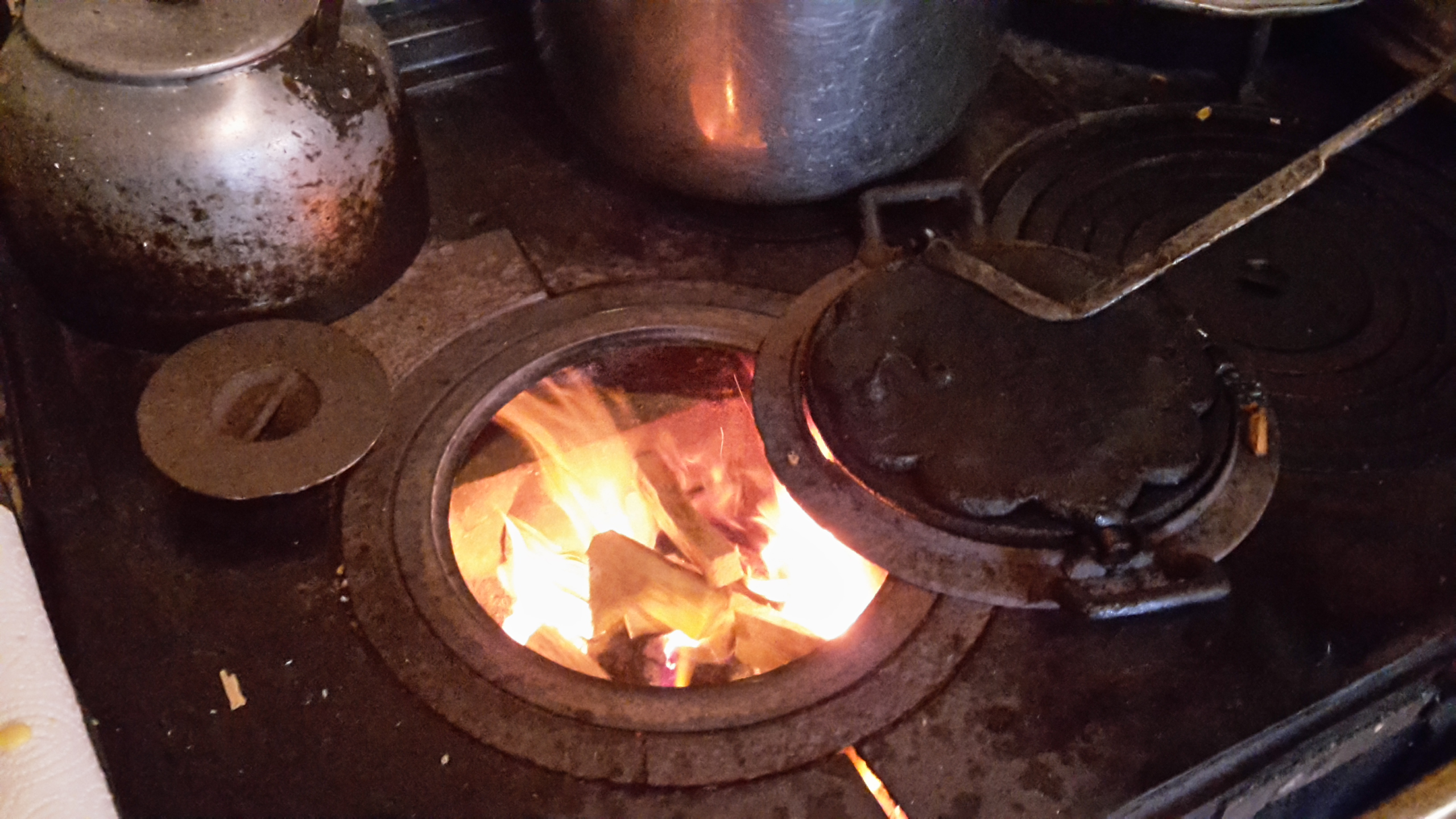
Worth stating because it explains why these worked at all on a wood stove.
A range top is a cast iron surface with removable lids over the firebox. Take a lid out and you have direct access to the fire – and the hole is a known diameter, which is why stovetop appliances were made to fit it.
So the waffle iron’s plates were not heated through a stove top. They sat down into the opening, close to or in the flame path, taking heat directly.
That is a great deal more heat than a griddle on the surface gets, and it is why these could cook quickly. It is also why they could burn a waffle in moments, because there was no way to reduce the heat except by moving the iron or by letting the fire down.
The seasoned cook’s method was to manage the fire and the position rather than the appliance – exactly as with everything else on a range.
There Was No Temperature Control At All
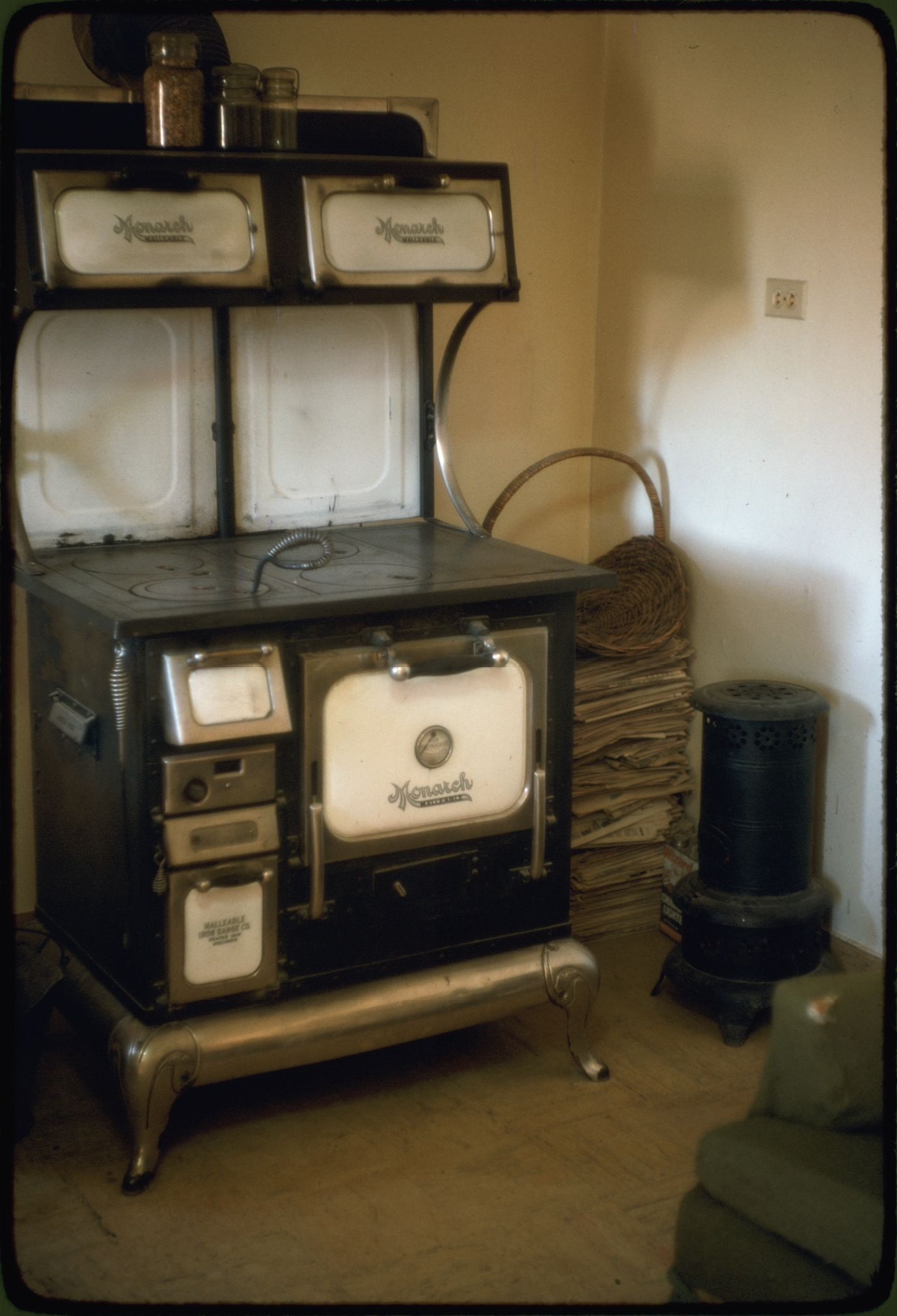
This is the skill the object demanded, and it is why the results varied so much between households.
No dial. No thermostat. No indicator light. The iron was as hot as the fire made it, and the only information available was what the cook could see, hear and smell.
So the judgement was: is the iron hot enough, which was tested by the behaviour of a drop of water or of the first waffle; how long on this side, which was judged by steam and by smell; and is the fire doing what it did five minutes ago, which on a wood range it very likely was not.
The first waffle was almost always sacrificed. Everybody who cooked on these says so – it came out pale, stuck, or burnt, and its function was to tell the cook what the iron was doing that morning.
And the iron had to be greased between waffles, because batter in a patterned cast iron plate will weld itself in place given any excuse at all.
It Was a Special-Occasion Appliance
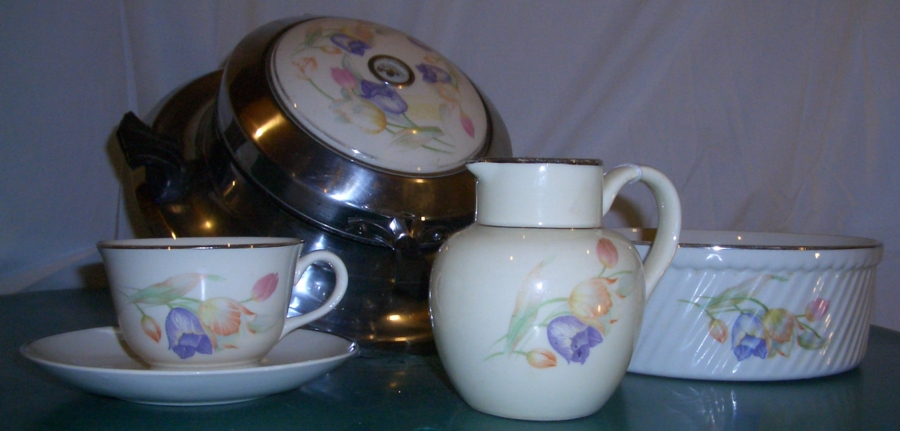
Worth noting, because it affects how people remember it.
A stovetop waffle iron is a performance. It requires a hot fire, constant attention, a cook standing over it turning it, greasing between each one, and it produces a single waffle at a time – which means feeding a family takes a long time and somebody eats last.
So waffles were not a casual breakfast in most households. They were Sunday, or company, or a birthday, or a supper treat – and the appliance came out of the cupboard for the occasion and went back afterwards.
That is a different relationship to a food than the modern one, where the appliance lives on a counter and the barrier to making waffles is approximately zero.
The Longer Lineage Is Worth Knowing
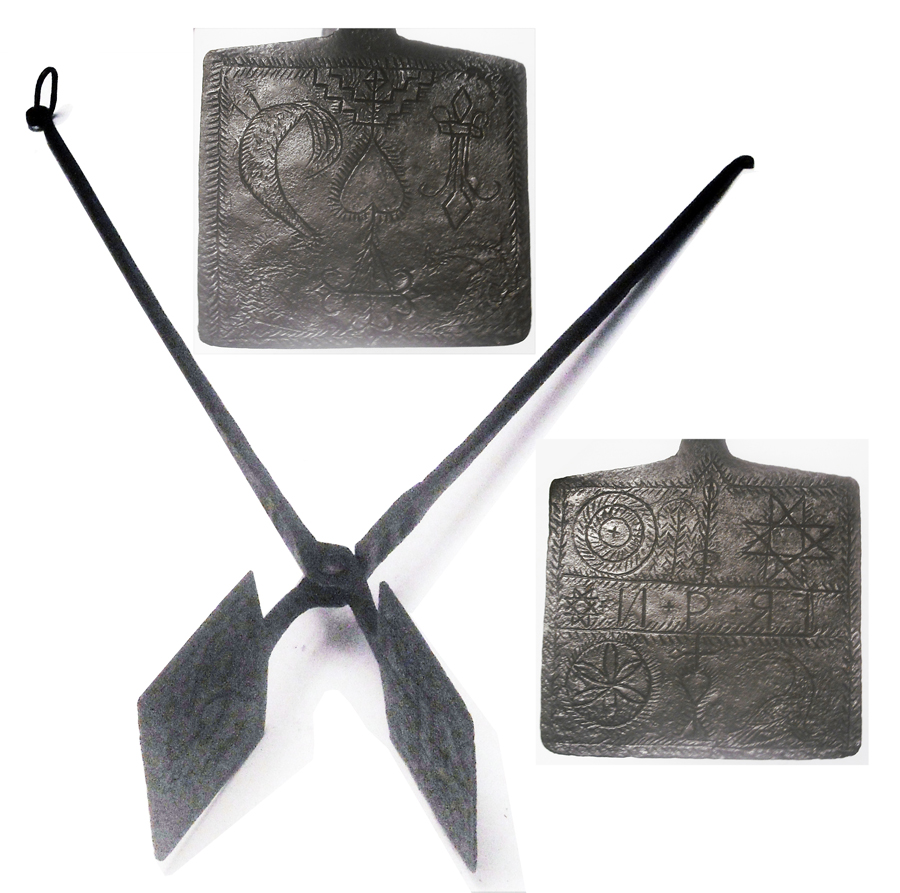
The stovetop version is not where this starts, and the earlier form explains the shape of it.
Before ranges, irons of this kind were made with very long handles and no ring at all, and they were used in a fireplace – pushed into the embers, or held over them, with the length of the handles being the only thing keeping the cook’s hands out of the fire. Those are the ones with handles two or three feet long that turn up occasionally and look absurd.
The pattern on the plates goes back a long way too, and the designs were not always a grid. Hearts, religious motifs, initials, dates, coats of arms and geometric figures were all cast into plates, which means an old iron frequently produced something closer to a decorated biscuit than to a modern waffle.
What the cast iron range did was shorten the handles. Once the heat was in a hole in a flat surface at waist height rather than in a fireplace at floor level, the iron no longer needed reach – it needed to sit in an opening. So the handles came in, the ring appeared, and the appliance became the compact thing people now find in cupboards.
Which is a neat illustration of how a change in one appliance reshapes everything designed to work with it.
Then Electricity Solved the Only Real Problem
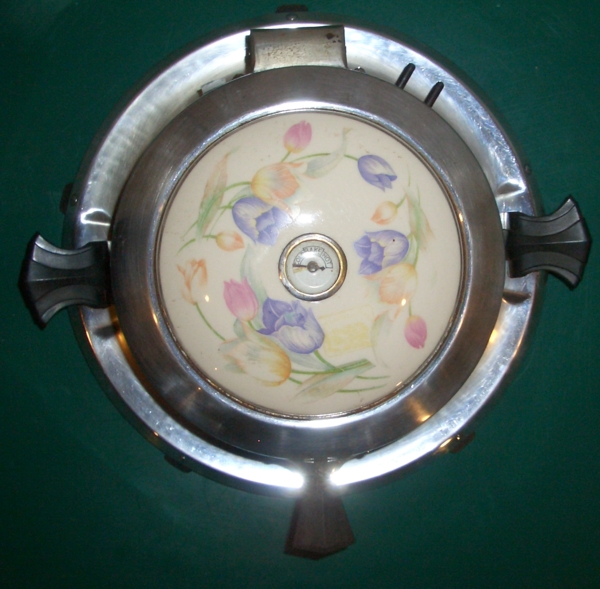
The electric waffle iron is a straightforward and complete improvement, and it is worth being clear about why.
It heats both plates. That is the whole thing. An element in each half means neither plate is in the fire and neither is in the air, which abolishes the reason the stovetop version had to be turned over at all.
So the swivel ring vanished, the inverting vanished, and with them the risk of handling a hot heavy object full of batter.
Then the thermostat arrived and removed the judgement. A heat setting and an indicator light tell the cook what no amount of experience could reliably tell them on a wood range, and the sacrificial first waffle stopped being necessary.
And the cord meant the appliance no longer needed a hole in a stove – which mattered enormously once stoves stopped having holes. A gas or electric range has a flat sealed top, so every stovetop appliance that depended on direct access to a firebox became unusable at a stroke, regardless of its merits.
Then the Stove Hole Disappeared
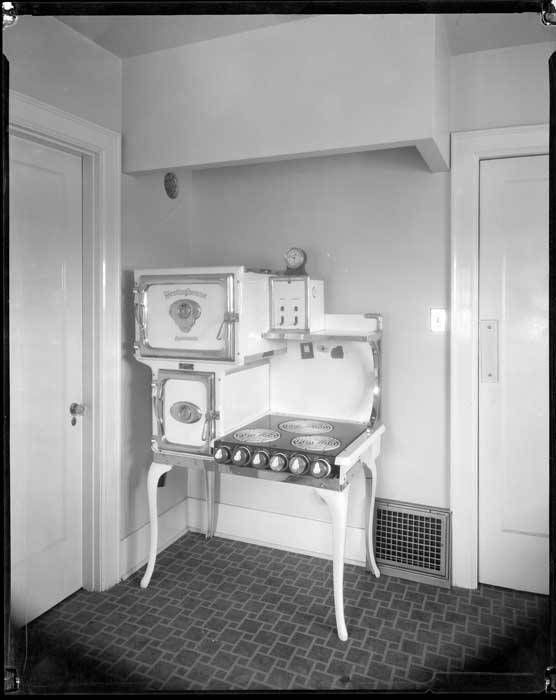
That last point deserves emphasis, because it killed a whole class of equipment and not just this one.
The removable stove lid was effectively a standard fitting – a known-diameter opening giving direct access to fire – and manufacturers built to it. Waffle irons, toasters, broilers, special pots and a range of other devices were made to drop into it.
When ranges became gas and then electric, that opening ceased to exist. There is no hole in the top of a modern stove and no fire underneath it, which means none of those appliances can be used as designed even if somebody wants to.
So they did not lose a competition on quality. The socket they plugged into was removed from every kitchen in the country.
The Pattern Is the Giveaway
If you find one, the way to identify it is the plates.
Deep square or diamond cells in a grid, on both faces, with the two patterns mirroring each other so they interlock when closed. That is a waffle iron and it is nothing else – no other appliance has that geometry, because no other food needs it.
Look at the ring as well. If it is there, with the pivots intact, you have the complete thing – and it is worth rotating it once by hand, empty and cold, just to feel how the mechanism works.
Then consider that somebody did that, hot, over an open fire, holding two long handles, once per waffle, for a table of people waiting.
Like our content? Follow us for more.