

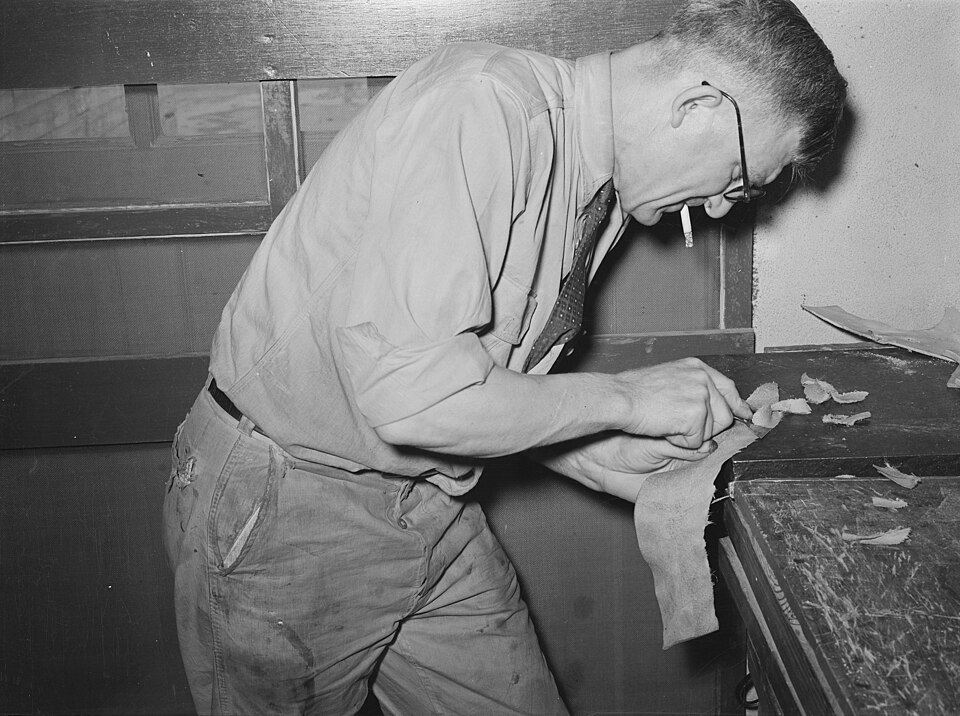
A saddler in 1960 sat on a wooden bench with a pair of hinged wooden jaws gripped between his knees, holding the work. He stitched with two needles on one waxed thread, pushing each needle through a hole he had just made with an awl, pulling both sides tight, and repeating it several thousand times for a single set of harness.
The machine existed. He was not using it, because a saddler’s hand stitch does something a machine stitch cannot, and because the thing he was making had to hold a half-ton animal to a loaded cart on a hill. What was changing, and changing fast, was that there were fewer of those animals every year.
The two trades, which were not the same
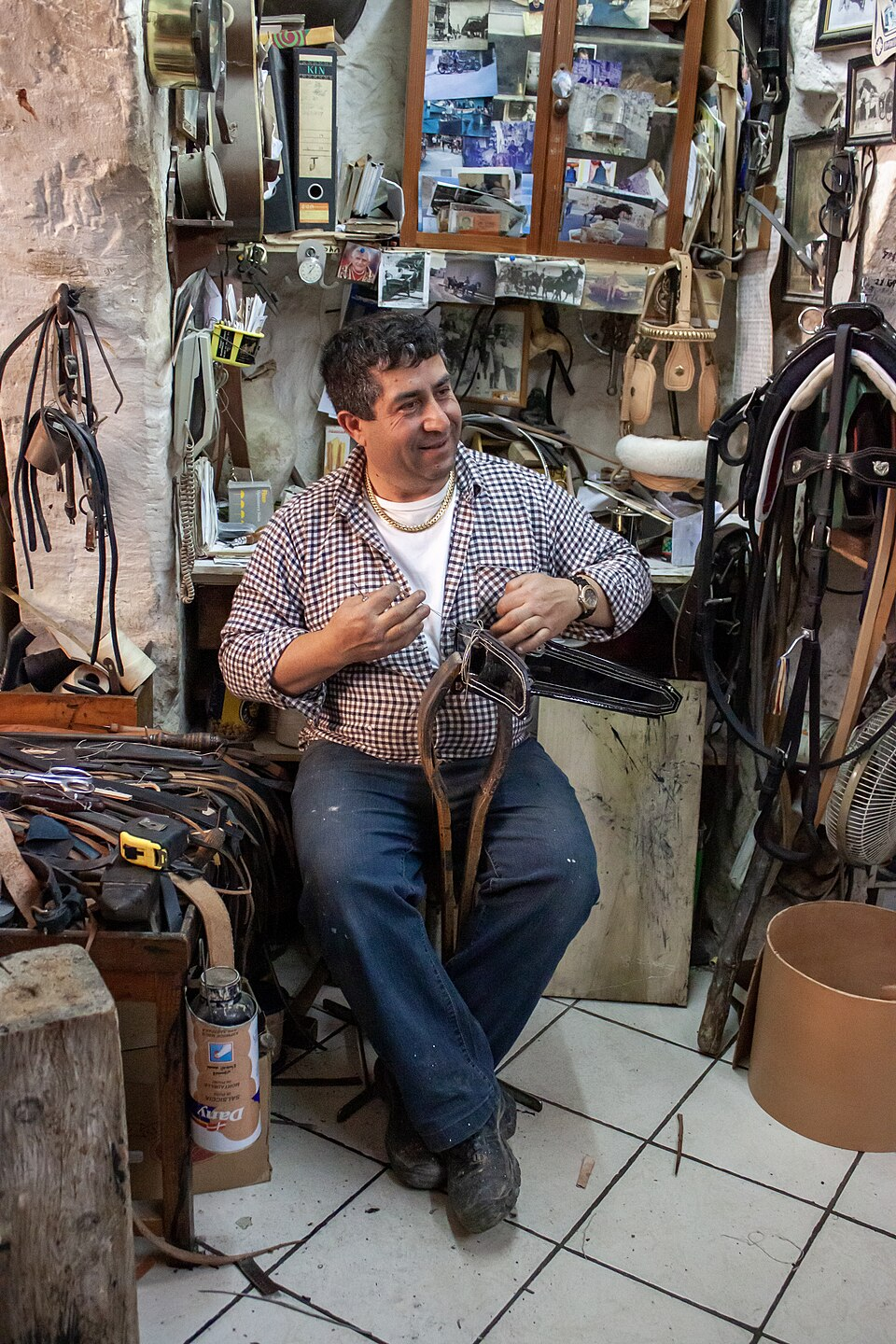
Saddlery and harness making were related but distinct, and the men in them knew the difference even when the shop sign said both.
Saddlery is riding equipment: saddles, bridles, girths, stirrup leathers. Harness making is draught equipment: the collar, traces, breeching and reins by which a horse pulls a vehicle or an implement. A third specialism, collar making, was separate again and was regarded as the most difficult of the three.
The economics differed too. Riding work was a smaller, steadier, often wealthier market. Harness work was volume trade serving farms, breweries, railway cartage, coal merchants and municipal departments, and it was the half that was about to disappear.
In 1960 a provincial saddler’s shop was typically living on repairs. The new harness orders had thinned to very little, and the work coming through the door was patching what was already out there for owners who had not yet replaced the horse.
Like our content? Follow us for more.
The stitch, and why it was worth the hours
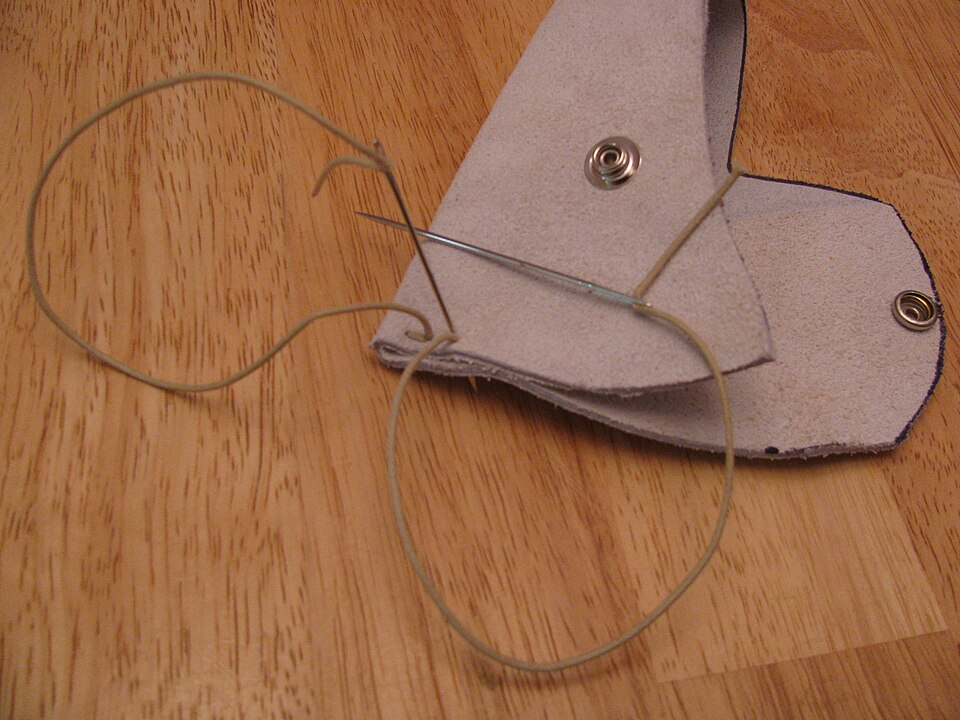
A saddler’s hand stitch uses one thread and two needles, one at each end. The awl makes an angled slit, the first needle goes through, the second follows from the other side through the same hole, and both are pulled up hard so the thread locks on itself inside the leather.
The consequence is the whole point. A machine lockstitch has a thread on each face and a loop between them; cut one stitch and the seam can run. A hand stitch of this kind is independently locked at every hole, so a single broken stitch stays a single broken stitch and the seam holds.
On a bridle that is a nicety. On a trace carrying the pull of a working horse, or on a stirrup leather, it is the difference between a repair and an accident, and it is why the best saddlery is still hand stitched today for the load-bearing parts.
The thread itself was linen, several strands rolled together on the thigh and then run through a wax compound of beeswax and resin, which both lubricated it through the leather and sealed the hole behind it against water.
A good hand would set eight or more stitches to the inch, perfectly even, with the slant of every one matching. That evenness is how a saddler’s work is judged, and it is visible from across a room to anybody who knows.
The tools, nearly all of which were held still while the work moved
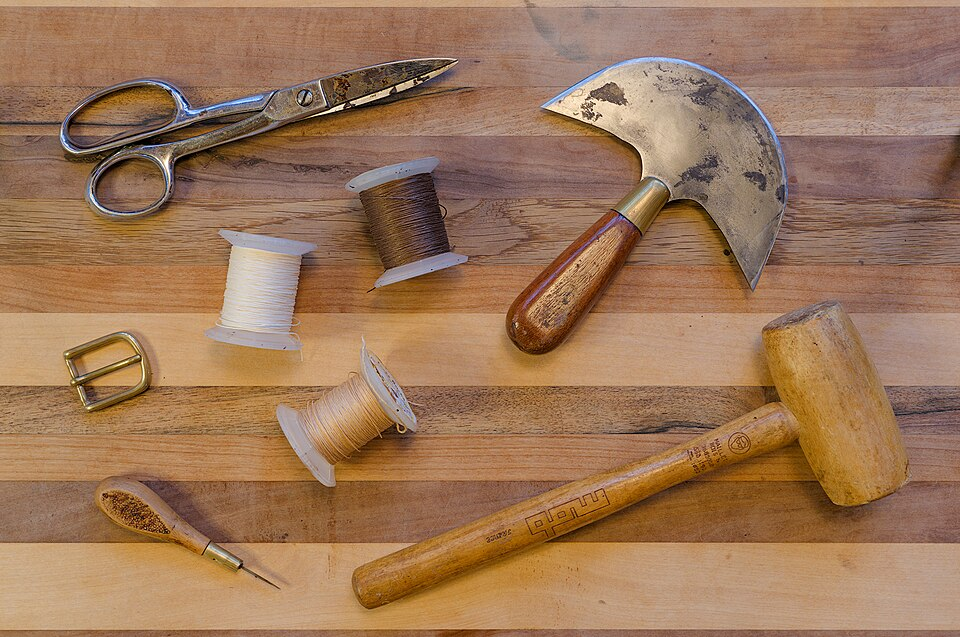
The defining tool is the clams or stitching horse: two curved wooden jaws, sprung together, clamped by the worker’s knees or by a foot treadle, holding the leather upright and free at both faces so both hands are available.
The round knife, a half-moon blade on a central handle, cut and skived leather by being pushed or rocked rather than drawn. The awl had a diamond section so that it cut a slit rather than punching a hole, which is why a saddler’s stitching closes up behind the thread.
Then a long list of small irons: the creaser that runs a line along an edge, the edge shave that takes the corner off, the pricking iron that marks stitch spacing, the palm iron that drove the needle through when the leather was thick.
Almost none of it was powered, and almost all of it is still made and still used, which is unusual. A saddler’s bench from 1960 would be functional in a working shop tomorrow.
What a set of harness actually was
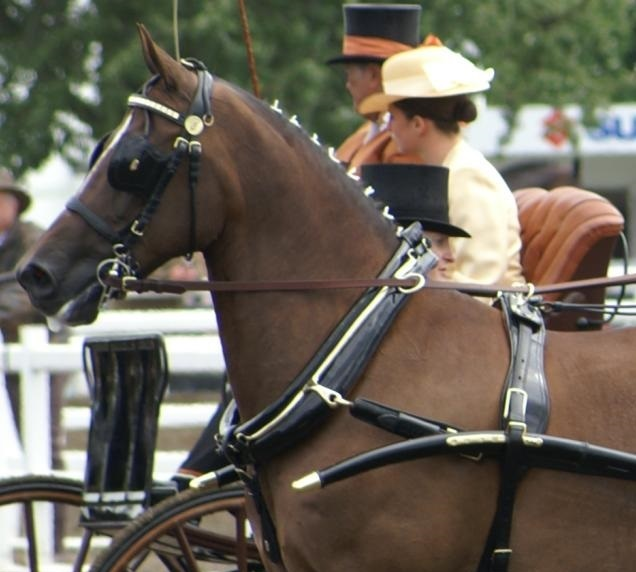
It is worth knowing what the saddler was making, because the vocabulary has gone and the objects are unfamiliar.
The collar sits on the horse’s shoulders and is the part through which all the pulling happens. It was stuffed, traditionally with rye straw, and shaped to one animal, which is why collars were not interchangeable and why collar making was the specialism it was.
The hames are the two curved metal pieces strapped around the collar; the traces run back from them to the vehicle. The saddle, in harness, is a small pad on the back carrying the weight of the shafts through a bearing strap. The breeching is the strap around the hindquarters that lets the horse hold a load back on a descent, which is the harness equivalent of brakes.
Then the bridle, with blinkers on a working harness, and the reins, which on a cart horse were long and heavy and took a particular kind of leather to stay manageable in rain.
Every one of those parts was an assembly of straps, buckles, loops and keepers, each stitched. A full set for a single horse represented weeks of work.
The leather, which was a different material then
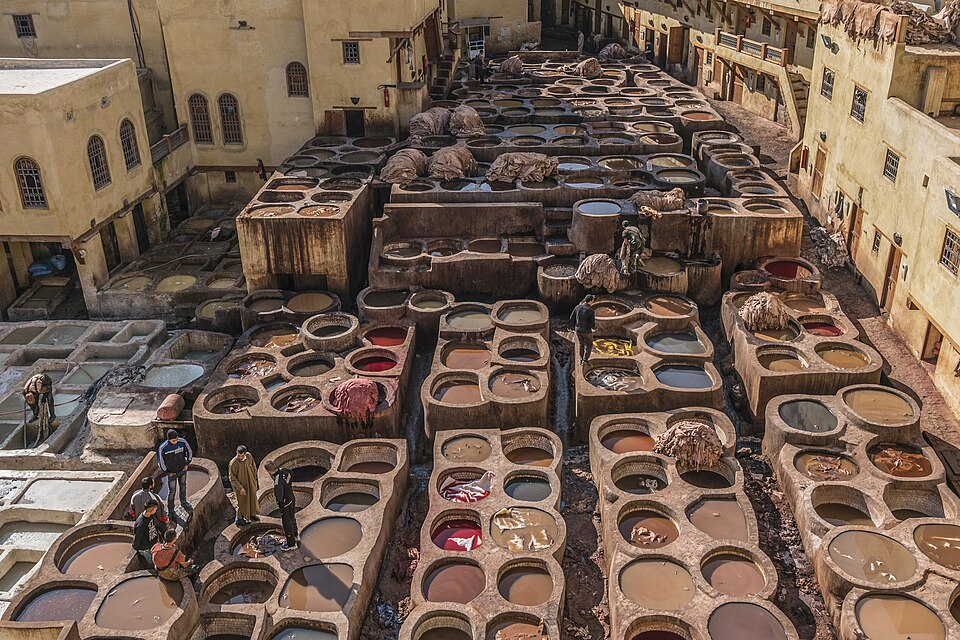
The leather was vegetable tanned, using tannins extracted from bark, in pits, over a period measured in months rather than hours. That slow process produces a firm, dense leather that holds a shape and takes a crease.
It was then curried: worked with tallow and oils, traditionally including fish oils, to make it supple and water-resistant without softening it. Harness leather had to live outdoors, get wet, dry out and not crack.
The butt, the thickest and most uniform part of the hide from the back and rump, was reserved for bridle and harness work because it had the least stretch. Lesser parts went to lesser uses, and a saddler who used a flank where a butt belonged was cutting a corner that would show within a year.
Much modern leather is tanned by a faster chemical process that produces a softer, more uniform material which is excellent for many things and wrong for others. Traditional bark-tanned harness leather is still made, by a very small number of tanneries, largely for this trade.
The saddle tree, hidden inside
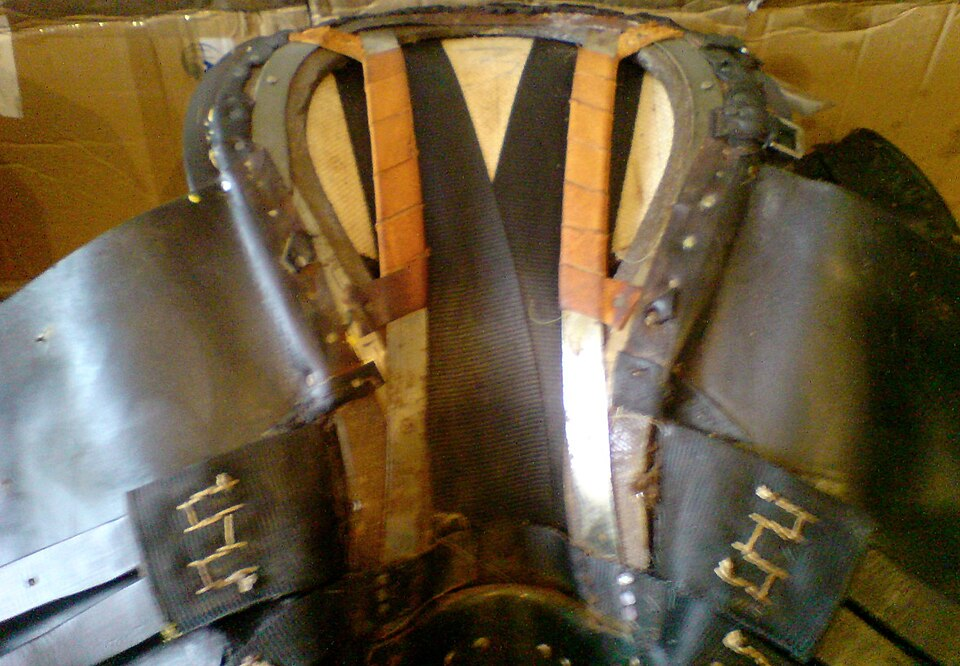
A traditional saddle is built on a tree: a frame, historically of laminated beech, with steel springs let into it to give controlled flex, then covered in webbing and hide and built up with flocking and leather.
The tree determines everything about how the saddle sits, and it is sized and shaped to the animal rather than to the rider. That is the fact that non-riders find surprising and that the whole modern discipline of saddle fitting rests on.
Tree making was itself a separate trade, and a small one. A saddler bought trees in, as he bought his leather and his buckles, and his craft was everything from the tree outward.
A saddle that does not fit presses unevenly, and the consequences for the horse are the reason fitting is now a qualified occupation with its own training and assessment rather than a matter of a shopkeeper’s judgment.
What ended it, and what did not
The tractor. Mechanisation of farm work through the 1940s and 1950s, and the replacement of horse cartage by motor lorries in towns, removed the working horse from economic life within roughly two decades.
For the harness trade that was terminal. There is no partial market for cart harness; either there are working horses or there are not. Shops closed, apprenticeships stopped, and a body of knowledge about collar fitting and draught gear came very close to being lost entirely.
What survived, and then grew substantially, was riding. Leisure riding expanded through the second half of the century into a large industry, and saddlery with it, which is why the trade exists today in reasonable numbers while harness making is a specialism practised by a handful.
The work also found adjacent homes. The same skills make luggage, belts, gun cases, bellows, industrial leather fittings and, increasingly, high-value repairs on expensive goods, which has become a real market in its own right.
The honest summary: saddlery and harness making were distinct trades, with collar making a third and the hardest; the saddler’s hand stitch uses two needles on one waxed linen thread and locks at every hole, so a broken stitch cannot run, which is why load-bearing saddlery is hand stitched still; the clams held the work while both hands were free, and the diamond-section awl cut a slit that closed behind the thread; the leather was bark tanned over months and curried with tallow and oils, with the butt reserved for harness because it stretched least; a saddle is built on a tree sized to the horse, which is why fitting is now a qualified occupation; and the tractor and the motor lorry ended the harness half of the trade within about twenty years while leisure riding later rebuilt the other half.
Like our content? Follow us for more.
