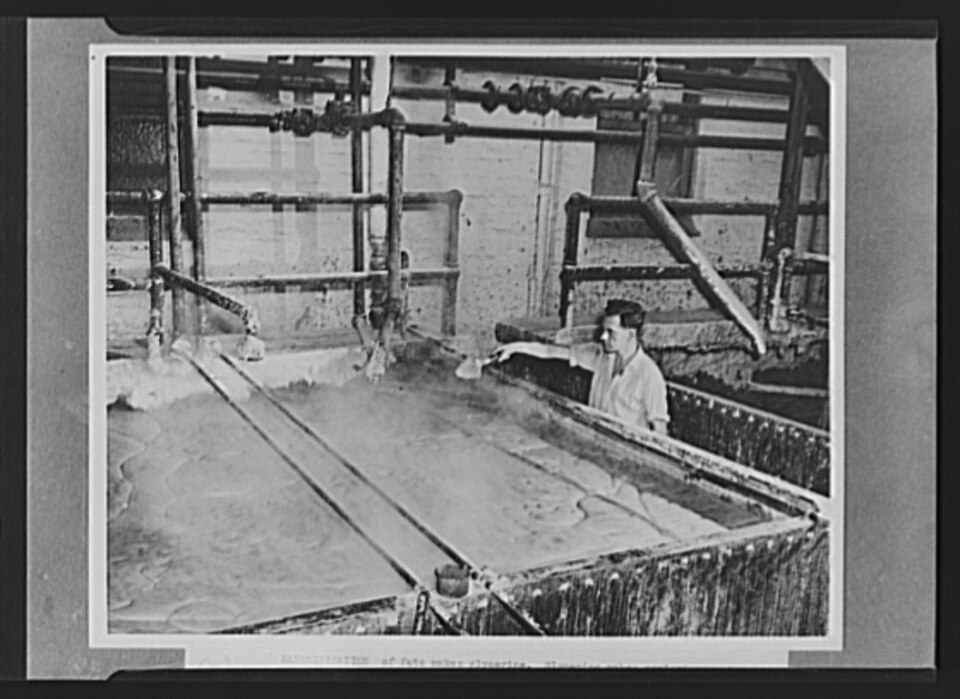
A soap pan in 1960 was an open iron vessel several storeys deep, heated by steam coils, holding many tons of boiling fat and caustic alkali. Men worked on a platform at the rim, taking samples on a long-handled dipper, judging by the feel of the cooling sample between finger and thumb whether the batch had gone far enough.
That test was called the taste or the tongue test in some works, and in the older ones it had meant exactly that. By 1960 it mostly did not, but the point stands: a process involving tons of caustic soda at boiling point was controlled by a man’s judgment of a sample in his hand.
The chemistry, which is older than chemistry
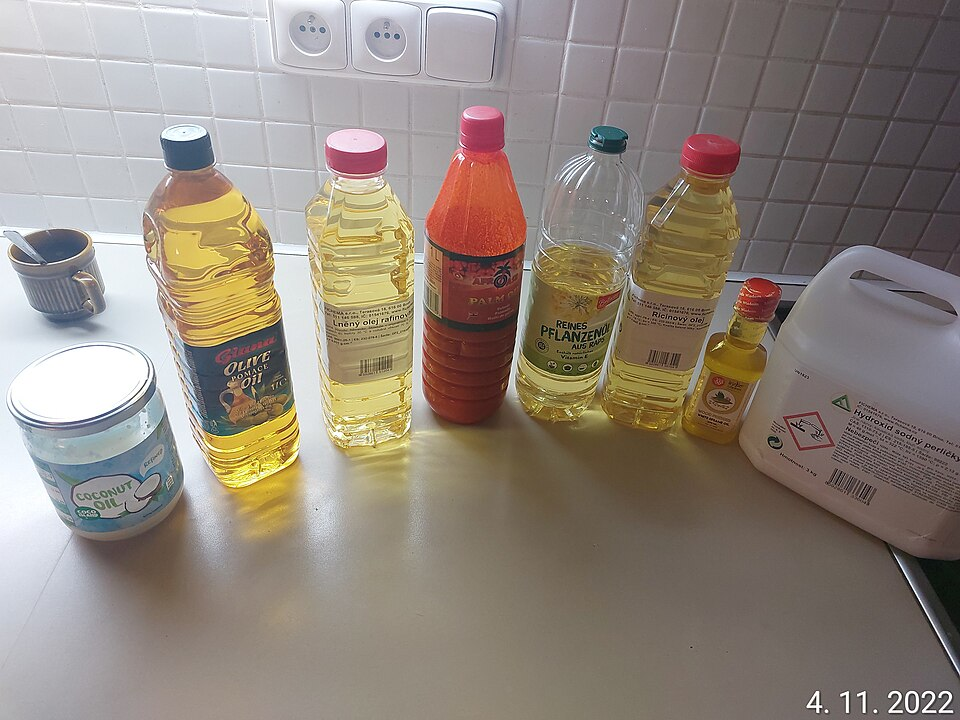
Soap is made by reacting a fat or oil with an alkali. The reaction splits the fat into its fatty acids, which combine with the alkali to form soap, and glycerol, which comes out as a by-product.
The fats were tallow, a rendered animal fat, together with vegetable oils, principally palm, palm kernel and coconut. The proportions determined the character of the soap: more tallow gave a harder bar with a dense lather, more coconut gave a soap that lathered freely including in sea water.
The alkali was caustic soda for hard soap and caustic potash for soft soap, which is the distinction between a bar and the soft paste sold for scrubbing.
None of this was understood in modern terms for most of its history. Soap was made for centuries by boiling fat with wood ash or with lime-treated soda ash, and the recipes were empirical and jealously held.
What the nineteenth century added was cheap manufactured alkali, which turned soap from a craft into an industry, and what the twentieth century added was understanding why any of it worked.
Like our content? Follow us for more.
The boiling house
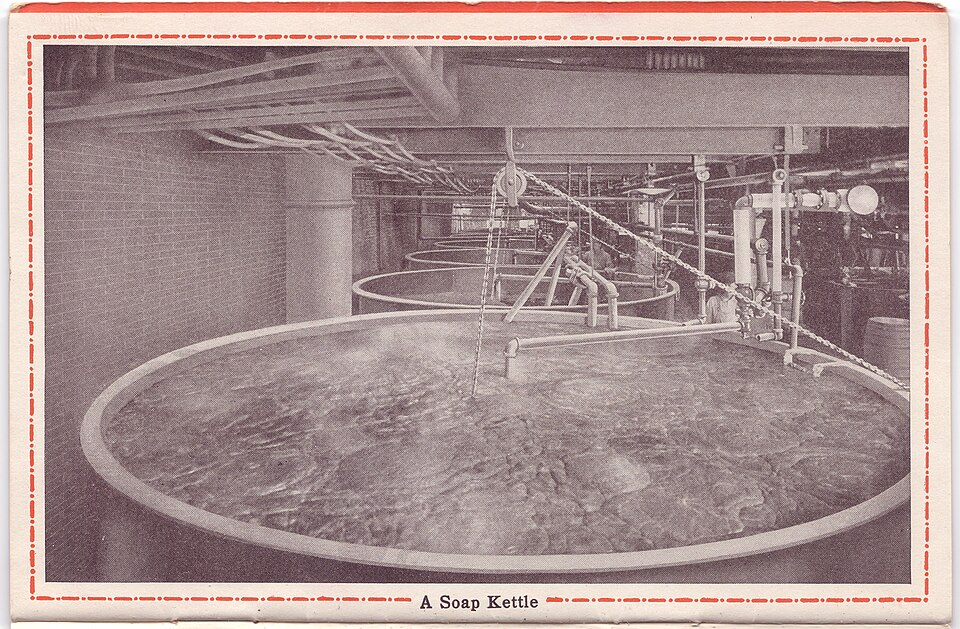
The full boiled process ran in stages in the same pan. First the saponification itself, with alkali added in portions and the mass boiled by steam injected through coils.
Then graining out: salt brine added so that the soap separates from the water layer and rises, because soap is insoluble in strong brine. The lower layer, the spent lye, carried the glycerol and was drawn off to be recovered, because glycerol was valuable in its own right.
Then washing, with the operation repeated to remove the last of the alkali and salt, and finally fitting or pitching, boiling with a carefully judged amount of water so that the mass separates into neat soap floating above a dark layer called nigre, which held the impurities.
The neat soap was then run off into frames, which were large iron boxes holding several tons, and left for days to cool and solidify.
Every one of those separations depended on judgment. There were tests, but the man on the pan decided, and a misjudged fitting meant a batch of soap that was either soft and short-lived or harsh with free alkali.
Frames, slabbing and the smell of the place
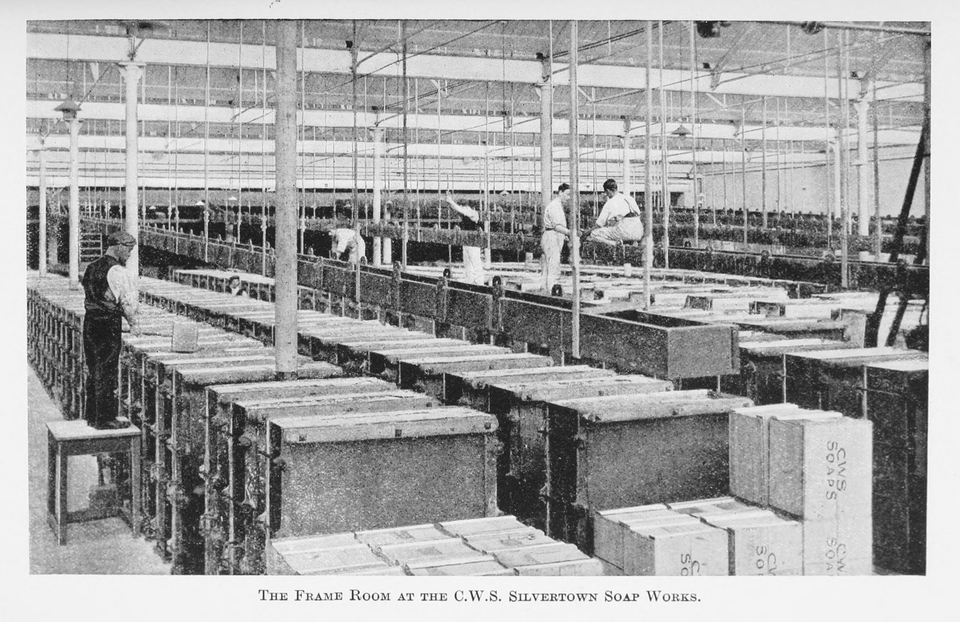
A cooled frame was dismantled to leave a solid block of soap the size of a small room. It was cut into slabs by drawing wires through it, the slabs cut into bars, the bars cut into tablets, and each tablet stamped in a press.
All of that was physical work with wire, trolleys and presses, done at the pace of the cutting line. Soap at that stage is heavy, slightly greasy and unforgiving to drop.
Toilet soap went through a further process. It was dried into chips or ribbons, then milled between rollers with perfume, colour and any additives, which both mixes them in thoroughly and works the soap to a finer structure, then plodded through a screw press into a continuous bar and cut.
That milling step is the difference between a cheap bar that cracks and goes soft and a bar that lasts, and it is still the difference today.
The smell of a soap works was, by every account, overwhelming and not entirely pleasant: hot fat, alkali, and perfume oils in quantity, all at once.
Caustic soda, handled as though it were flour
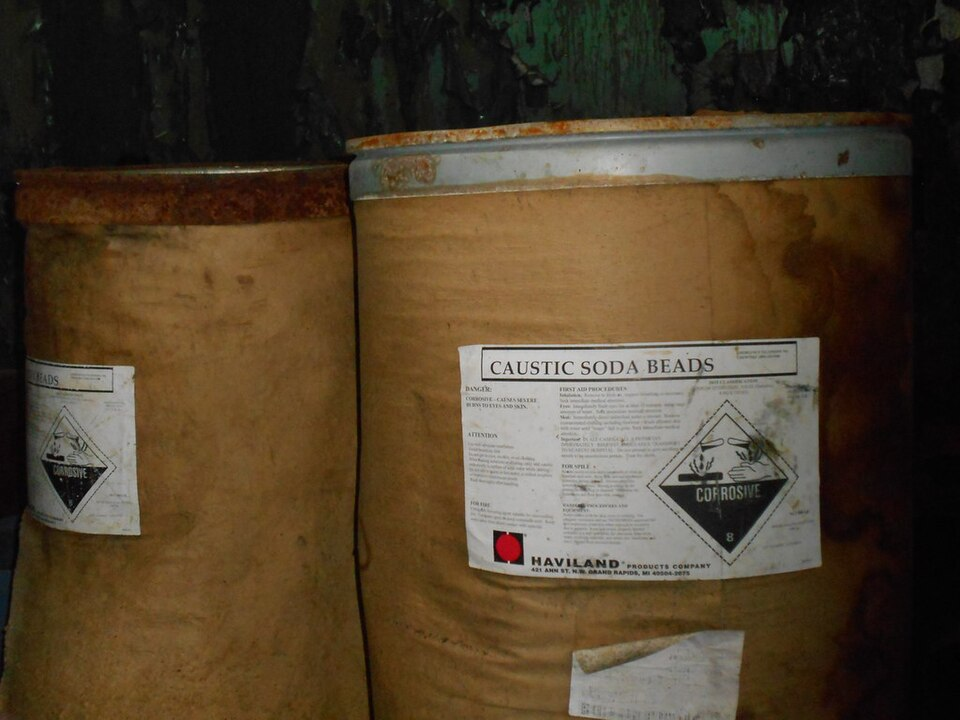
Caustic soda is strongly corrosive. It arrived as solid flake or lump and as strong solution, and in 1960 it was moved, tipped, dissolved and pumped in works where the protective equipment was a rubber apron and, if you were fortunate, goggles.
Dissolving it generates heat, which is the detail that catches people out, and adding water to concentrated caustic rather than the other way about can produce a violent release.
The hazard is to skin and above all to eyes, and the modern controls are the ones that were missing: closed handling and bulk delivery by tanker into fixed tanks, full face protection, chemical-resistant clothing and gloves, immediate access to emergency showers and eyewash, and procedures for every transfer.
Nothing in this file describes an injury or offers first aid. The point is that an industry which produced the most domestic product imaginable ran on one of the more aggressive industrial chemicals, and that the men handling it in 1960 had almost nothing between them and it.
Hot soap was the second hazard and is easy to overlook. A pan at boiling point containing a saponifying mass can foam up, and the material is hot, alkaline and sticky.
The by-product that paid for a lot of it
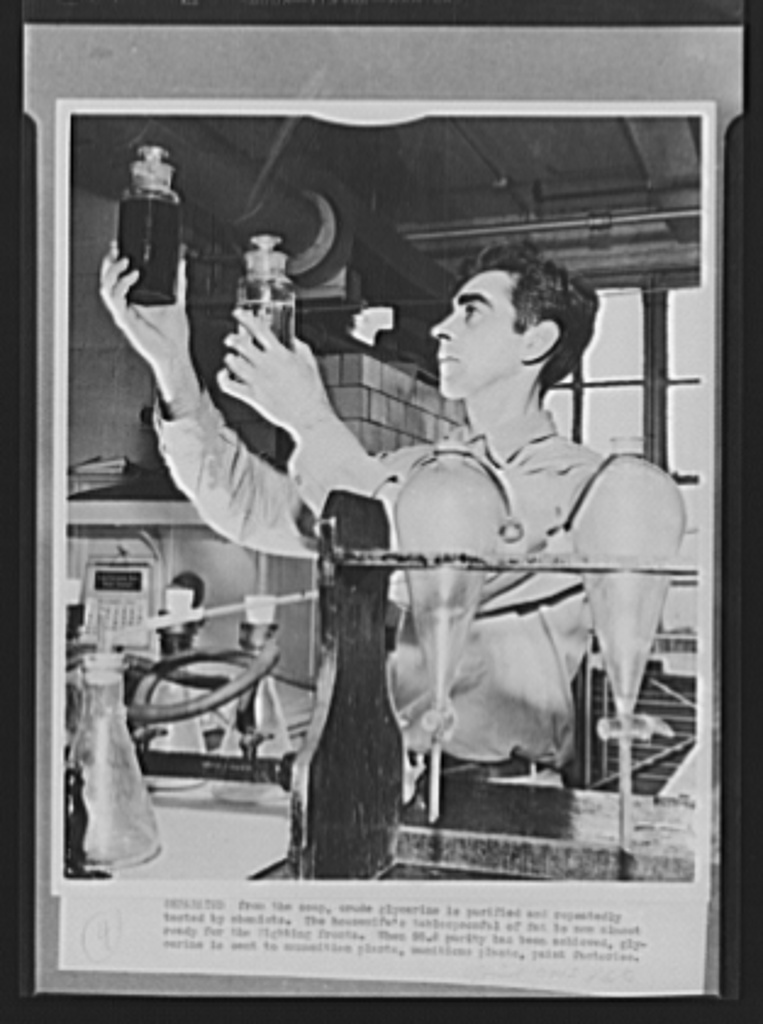
Glycerol, usually called glycerine in the trade, was recovered from the spent lye by evaporation and distillation, and it was worth real money.
Its markets were pharmaceutical and food use, tobacco conditioning, textile and leather processing, antifreeze before better options existed, and, historically and significantly, the manufacture of explosives.
That last connection meant soap works occupied a strange position in wartime economies, since the by-product of making soap was a feedstock for munitions, and the supply of fats was accordingly controlled.
The practical consequence for a 1960 works was that the glycerine recovery plant was often the most technically sophisticated part of the site, with stills and vacuum equipment, while the soap pans themselves had barely changed in seventy years.
This is a good illustration of how industries actually modernise, which is unevenly and wherever the money is.
What killed it was not a better soap
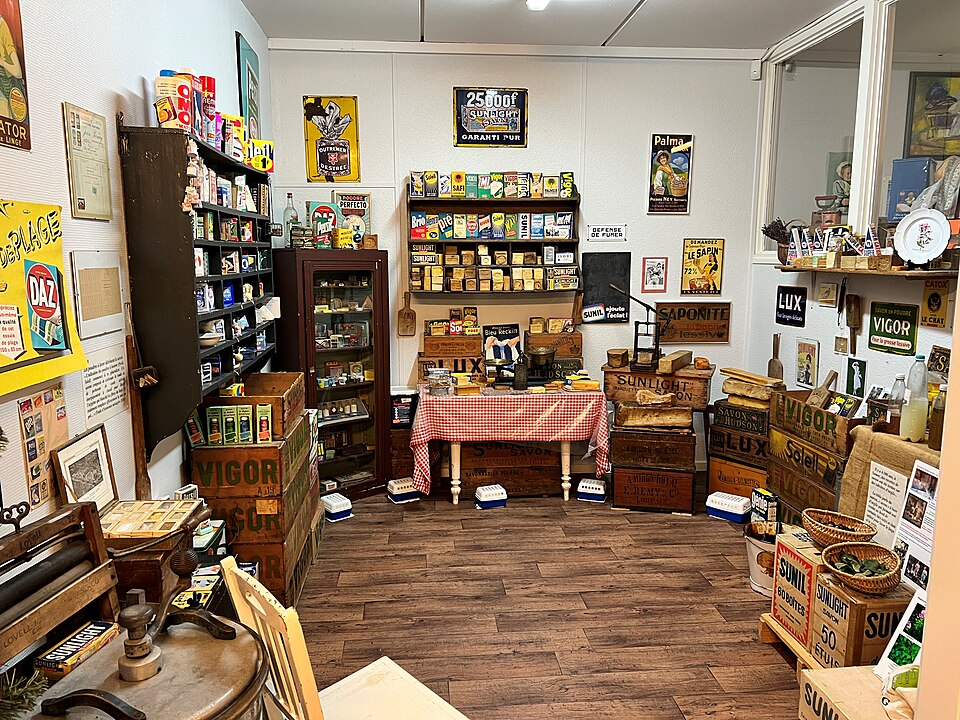
Synthetic detergents. Surfactants made from petrochemical feedstocks rather than from fats arrived in volume after the Second World War and took the laundry market with remarkable speed through the 1950s and into the 1960s.
They had a decisive technical advantage: soap reacts with the calcium and magnesium in hard water to form an insoluble scum, which is why washing with soap in hard water is unsatisfactory and why a soap-washed fabric greys. Synthetic detergents do not do that.
So a 1960 soap works was frequently a works in the middle of being converted, with the soap pans still running for toilet bars while a new plant went up alongside to make detergent powder, and with the washing-powder end of the business transformed within a decade.
The bar soap market survived and still exists, but as a toiletry rather than as the household cleaning product it had been for a century.
The workforce changed with it. Detergent manufacture is a drier, more continuous, more instrumented process requiring fewer and differently skilled people, and the man who could judge a fitting by eye had no equivalent role in the new plant.
How it is made now
Continuously, in closed plant. The dominant modern route splits the fats into fatty acids and glycerol in a high-pressure column first, then neutralises the purified fatty acids with alkali, which gives much better control of quality and recovers the glycerol cleanly.
The soap comes out as a stream rather than as a batch, is dried in a vacuum spray drier into chips, and goes straight into milling and plodding lines. A plant that would have employed hundreds runs with a fraction of that number watching instruments.
The handling of caustic is closed and bulk. The pans are gone, and with them the platform at the rim, the dipper and the judgment.
The honest summary: soap is fat or oil reacted with alkali, yielding soap and glycerol, with tallow and palm, palm kernel and coconut oils as the fats and caustic soda or potash as the alkali; the boiled process ran saponification, graining out with brine, washing and fitting in one open pan, controlled by a man’s judgment of samples, and the neat soap was framed, slabbed by wire, cut, stamped and, for toilet soap, dried, milled with perfume and colour and plodded; caustic soda is strongly corrosive, generates heat on dissolving and is dangerous to add water to when concentrated, and in 1960 was handled with a rubber apron and sometimes goggles; glycerol recovered from the spent lye was a valuable by-product with pharmaceutical, food, industrial and explosives markets, which is why its recovery plant was often the most modern part of the site; and the industry was displaced in its largest market not by a better soap but by synthetic detergents, which do not form scum with the calcium and magnesium in hard water.
Like our content? Follow us for more.