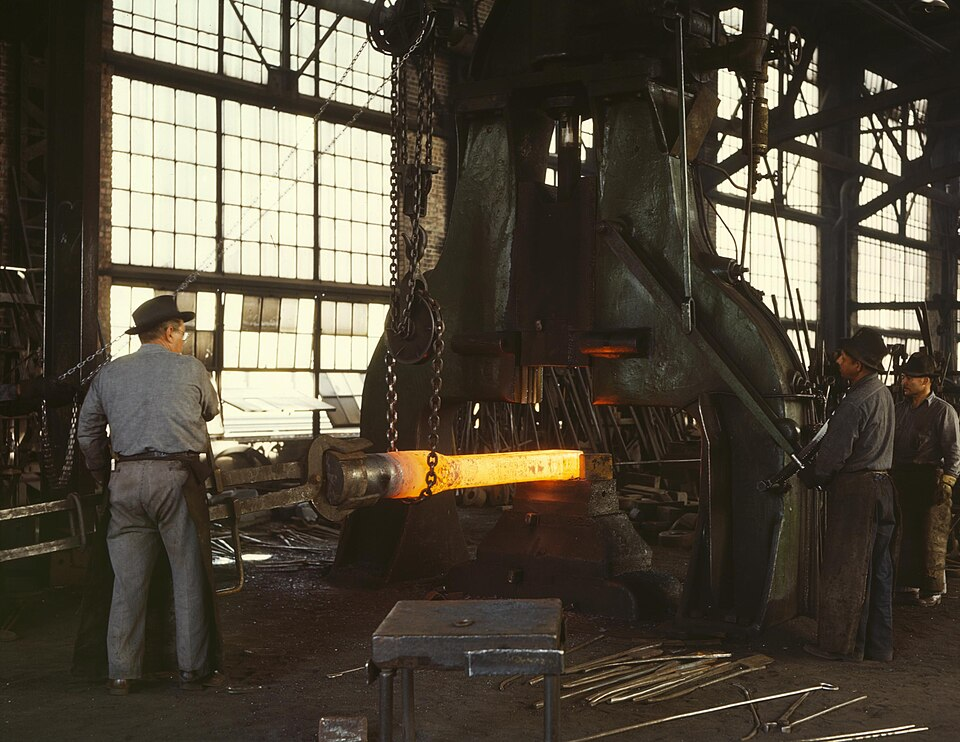
An anchor is one of the largest objects ever made by forging, and until well into the twentieth century it was made the way a horseshoe is made: by heating iron and hitting it, repeatedly, under a hammer, by a team of men working to one man’s instructions.
The difference is scale. A section being forged might weigh more than everybody in the shop put together, it is at a temperature that limits how long anybody can stand near it, and it has to be moved, held and turned under a hammer that does not care what is underneath it.
That turns forging from a solitary craft into a choreographed operation, and the anchor smith’s real skill was running a team on a job where a mistake is measured in weeks. Accounts of the shops describe them as almost silent between heats and deafening during them, with everybody standing in the same place every time because the places had been worked out long before any of them arrived.
The work was built up from pieces, not cut from one
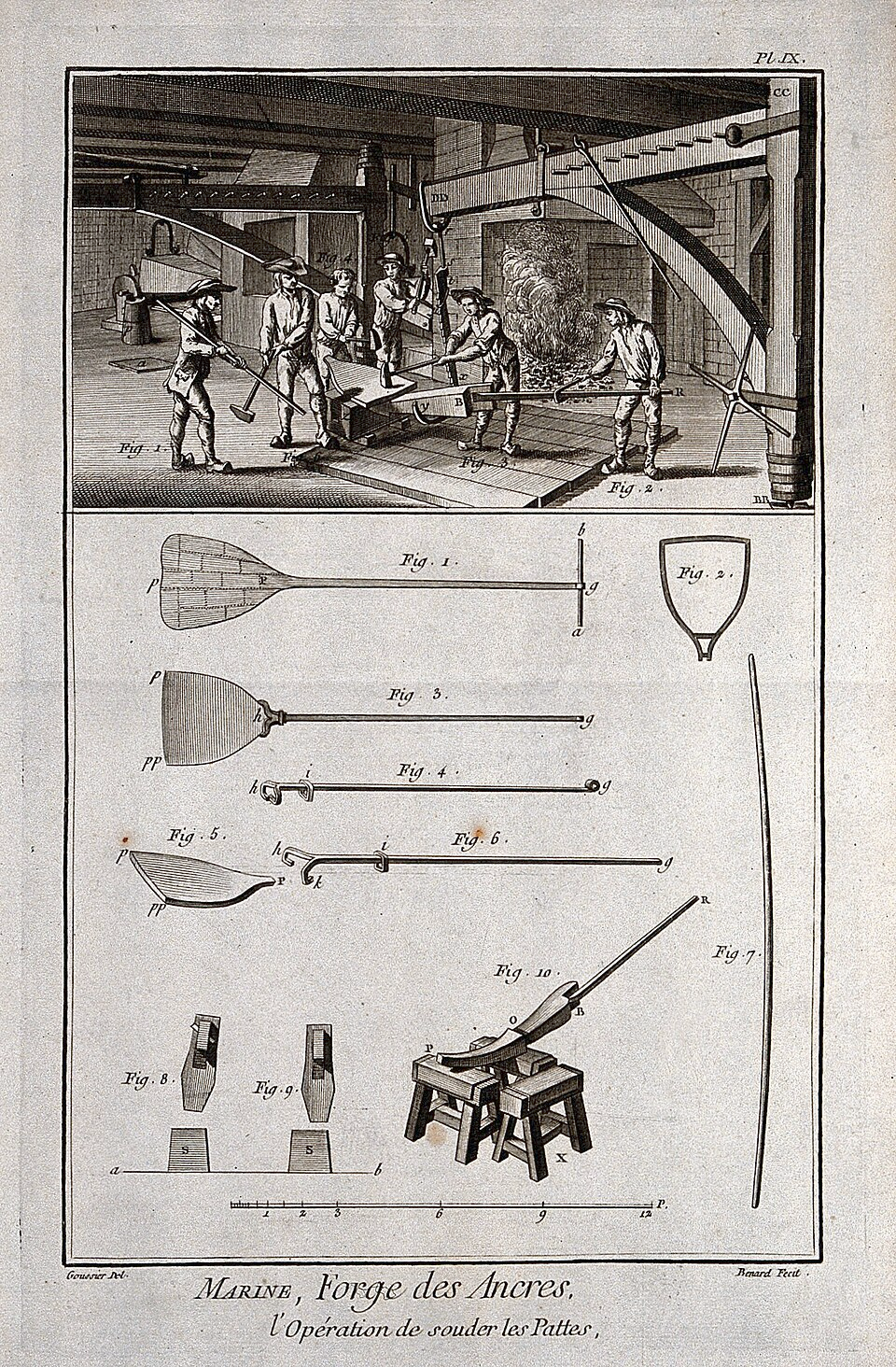
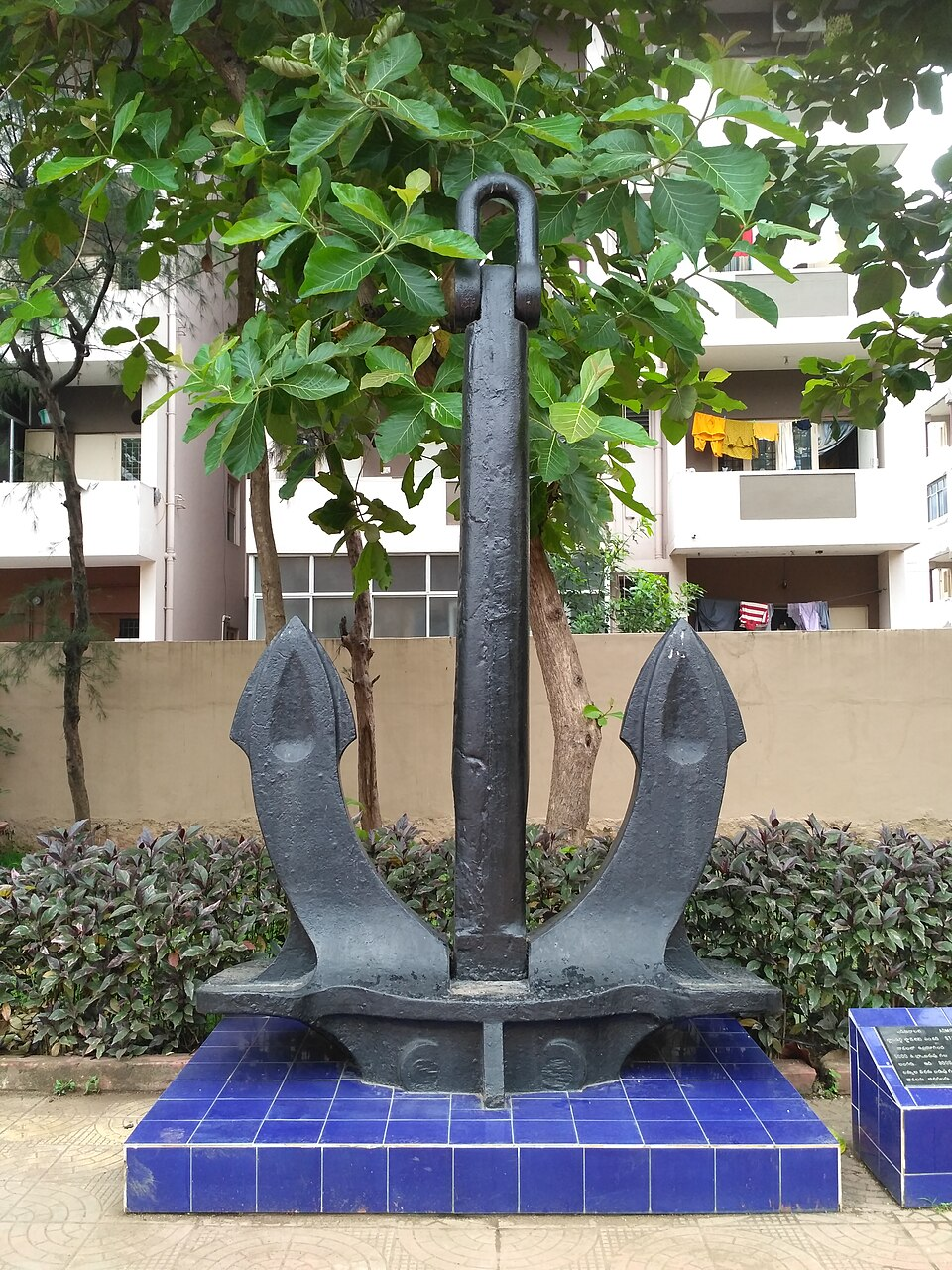
A large forged anchor was not shaped from a single mass. It was assembled from heavy sections — the shank, the arms, the crown — fire-welded together, which means heating two pieces to the point where hammering fuses them.
Fire welding heavy sections is the hardest operation in forging. Both pieces have to reach the right condition at the same moment, the surfaces have to be clean, and the hammer has to come down while the heat is still there.
There is no second attempt in any useful sense. A weld that does not take has to be cut out and the whole area re-made, and a weld that looks sound and is not is considerably worse, because it will be found by a ship.
Cast steel anchors, and later fabricated and welded steel ones, removed fire welding from the process entirely. Modern anchors are cast or fabricated to a specification and tested to it. That change also made anchors cheaper, more consistent and available in a far wider range of sizes, which is the usual shape of the trade-off in this series.
Like our content? Follow us for more.
The hammer was the shop and everything was arranged around it
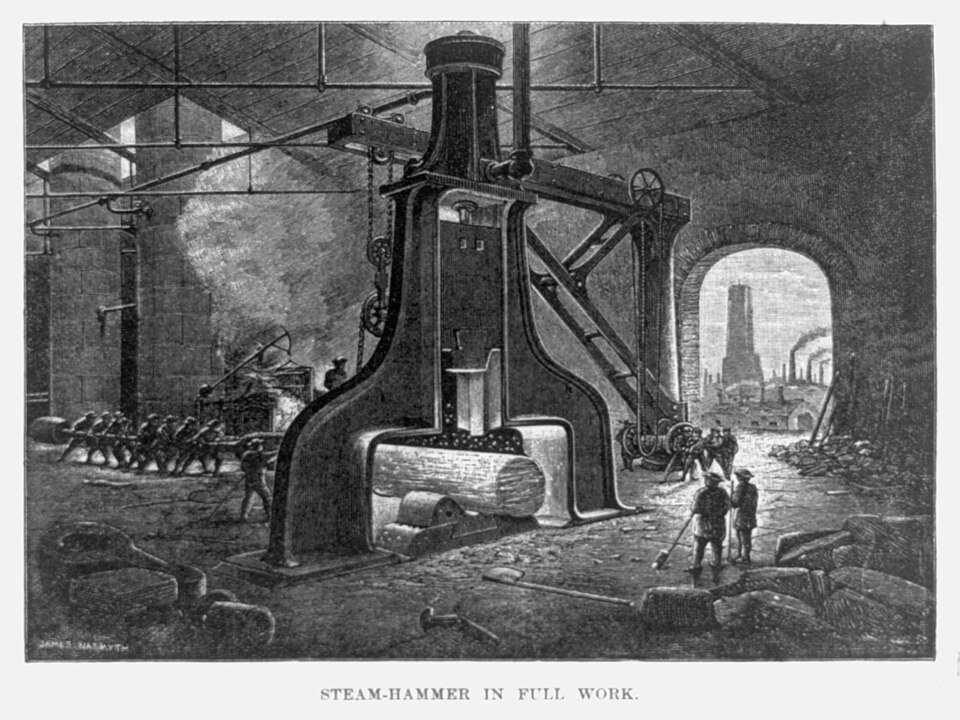
A steam hammer is a large, slow, enormously powerful machine, and in an anchor shop it was fixed and everything else moved to it.
So the sequence of a job was determined by what could be got under the hammer, in what orientation, at what point in the heat, with what lifting. Cranes, slings, porter bars and sheer legs existed to present the work to the hammer rather than the other way round.
The hammer driver was a specialist in his own right. A steam hammer can be made to deliver a blow from a tap to a shattering impact, and an experienced driver could work to the smith’s hand signals continuously without being told anything twice.
Modern forging uses presses and programmed manipulators, which apply controlled force in a controlled sequence and keep people away from the work. The force is the same idea and nobody stands next to it. Hammer drivers are the figures the old shops remembered most fondly, because the whole job’s quality depended on somebody reading a hand signal and producing exactly the blow it asked for.
Heats governed the working day
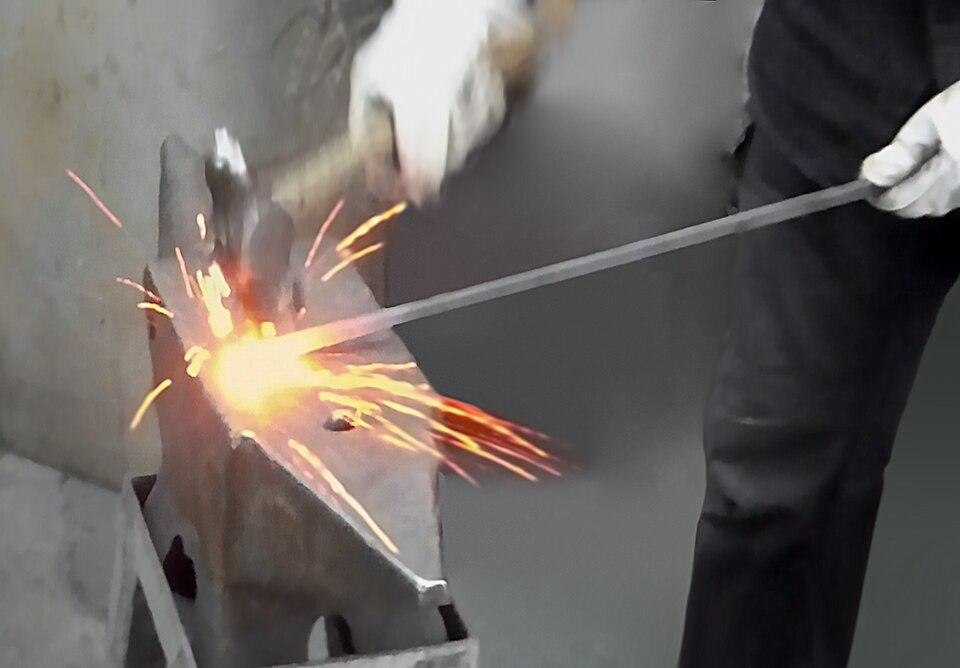
Forged work happens in heats: the piece is brought to temperature, worked until it has cooled past the point of being workable, and returned to the fire.
That creates a rhythm, and on a large anchor each heat might take a long time to get and a short time to use, so the preparation between heats was most of the work and the forging itself was brief and intense.
It also means the number of heats a job takes is the measure of it. Reducing the number of heats was the whole art of planning the work, because every heat costs fuel, time and some loss of metal from the surface.
That calculation still governs modern forging, where heats are minimised by design and by planning, and the furnace cycle is scheduled rather than judged. Surface loss is the part people forget: every time a piece goes into the fire some of it is lost as scale, so a job planned badly ends up smaller as well as later.
Proving was destructive in intent and reassuring in result
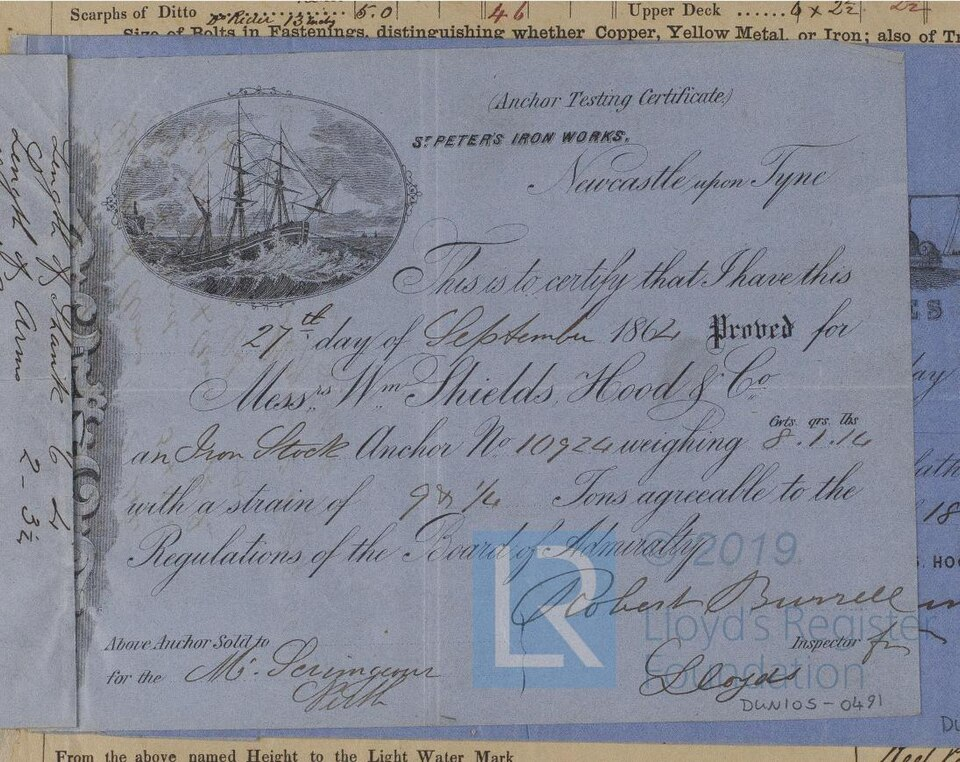
An anchor was proved: loaded to a specified test force to demonstrate it would not fail, and marked with evidence that it had been.
That was a formal arrangement enforced by the authorities that classified and insured ships, and it was one of the earliest examples of mandatory product testing anywhere in manufacturing.
The testing regime also disciplined the trade, because an anchor that failed its proof was scrap and the maker bore the loss, which aligned the smith’s interest with the ship’s rather precisely.
Proof testing continues under modern classification rules, with the test force specified, recorded and certified, alongside material testing and dimensional inspection that did not exist in 1960. It is one of the oldest continuous pieces of safety regulation in any industry and it long predates almost everything else in this series.
The stock was a separate problem and then disappeared
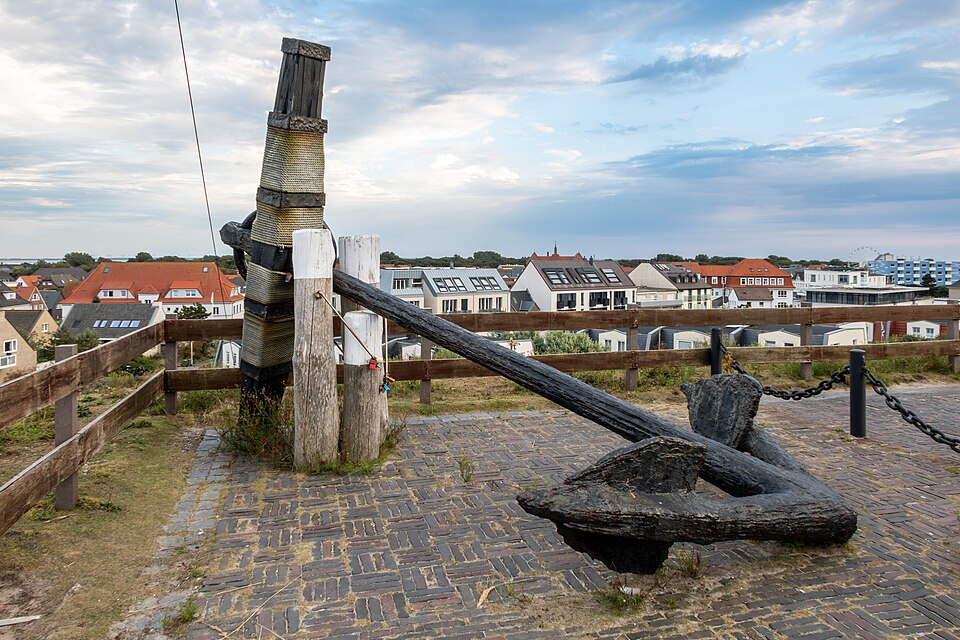
Traditional anchors carried a stock, a bar across the shank that makes the anchor turn so it can take hold, and it had to be fitted, keyed and secured, in wood on older anchors and iron on later ones.
That is a substantial sub-assembly in its own right and a fitting problem rather than a forging one, and the stock was also the part most likely to be lost or damaged in service.
Stockless anchors, which achieve the same turning behaviour by the geometry of pivoting arms, removed the whole component. They stow conveniently in a hawse pipe, which is why almost every large modern ship uses one.
The mechanics of how any anchor comes to hold the seabed are a separate subject with their own explanation and this file does not enter it; what matters here is that the stock was a part the smith had to make and modern designs do not have.
The shop was hot, loud and organised by shouting
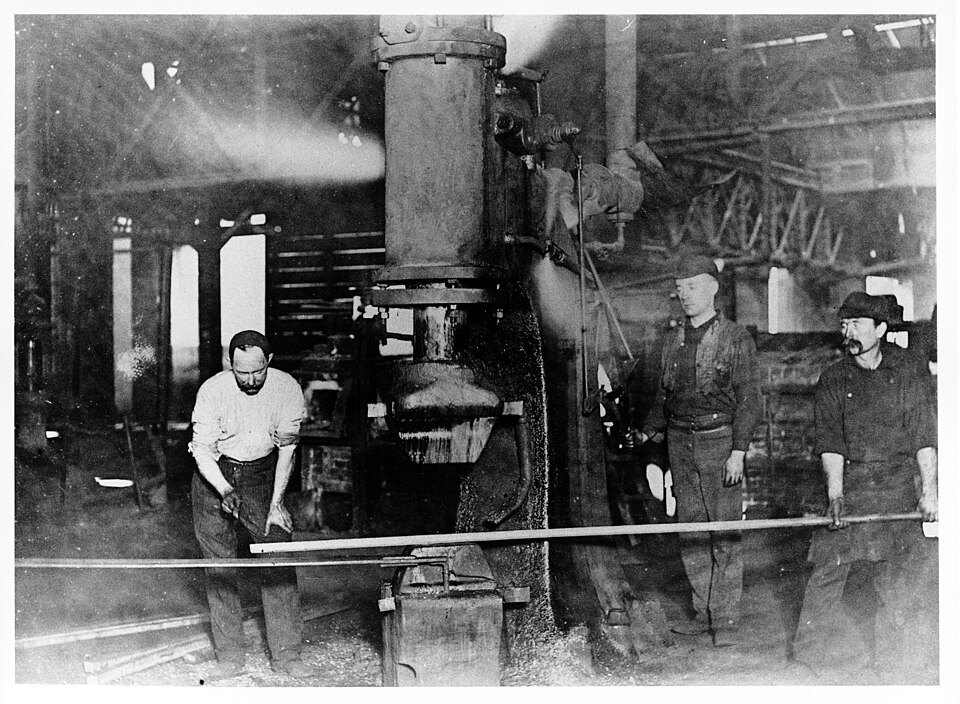
An anchor shop contained an open fire or furnace large enough to heat a very heavy section, a steam hammer, overhead lifting, and a team working close to all three.
Communication was by hand signal and by voice over a noise level that made voice unreliable, which is why the signals mattered. Everybody knew where everybody else was supposed to be, and the discipline about that was the safety system.
In 1960 there was no hearing protection, no measurement of noise, limited eye protection, heavy clothing against radiant heat and lifting arrangements that depended on the competence of the people using them.
All of that is now regulated: noise has assessed limits and mandatory protection with hearing surveillance, lifting operations are planned and equipment examined, heat exposure is managed, and protective equipment is specified and provided. This file gives no procedure, no temperature and no specification of any kind, and nothing in it should be read as describing how to do the work.
Why the trade ended rather than modernised
Forging an anchor by hand is slow, skill-dependent and produces an object whose quality cannot be verified except by testing the finished article.
Cast and fabricated steel anchors are made to a specification, from material whose properties are certified, with the welds inspected and the geometry measured, and they can be made in quantity to a drawing by people who do not need twenty years of experience.
That is not a story about declining craftsmanship. It is a story about a product for which verifiable consistency matters more than anything a craftsman can add, which is exactly the right conclusion for a component holding a ship.
So the trade closed. The large forging shops that could do the work turned to other heavy forgings or shut, and the skills survive in heavy forging generally rather than in anchor making specifically.
What is left
Heavy forging is alive and well and makes shafts, rings, rotors and other large components that cannot be made any other way, using presses, manipulators and process control that would astonish anybody from the old shops.
Hand forging at scale survives in architectural and conservation work, and there are smiths who can fire-weld heavy sections, who are few and are usually working on historic structures.
The anchors themselves outlast everything. Forged anchors sit outside maritime museums, in harbours and on quaysides all over the world, and most of them have no record of who made them.
The honest summary: a large forged anchor was assembled from heavy sections — shank, arms and crown — fire-welded together, which required both pieces to reach the right condition at the same moment and allowed no useful second attempt; the steam hammer was fixed and everything else was presented to it, with cranes, slings, porter bars and sheer legs existing for that purpose; work proceeded in heats, so reducing the number of heats was the art of planning the job because each one costs fuel, time and surface metal; anchors were proved to a specified test force and marked, one of the earliest mandatory product tests in manufacturing; the stock was a separate fitting problem that stockless designs removed entirely; and cast and fabricated steel replaced forging because a component holding a ship needs verifiable consistency more than it needs craftsmanship.