

The Thing Nobody Looks At
Turn a drinks can upside down. The base is not flat. It curves up into the can in a smooth dome, with a narrow ring of metal around the outside for the can to stand on.
That dome is not a styling decision or a side effect of manufacturing. It is the single piece of engineering that allows a container made from metal roughly a tenth of a millimetre thick – thinner than a human hair – to hold a carbonated drink at several atmospheres of pressure, be stacked dozens high on a pallet, be dropped, thrown into a cooler, and sit in a hot car without deforming.
A flat base of that thickness would bulge outwards under internal pressure almost immediately, and once bulged the can would not stand up. The dome solves it by pointing the metal the other way: pressure pushing down on an upward-curving surface is pushing the dome into itself, and a curved surface in compression is enormously stronger than a flat one in bending.
It is the same reason an arch holds up a bridge and the bottom of a champagne bottle is pushed up into the bottle rather than sitting flat.
Like our content? Follow us for more.
Why the Can Is Thinner Than Anybody Believes

The numbers on a modern drinks can are genuinely hard to credit.
The wall is around a tenth of a millimetre – thin enough that an empty can crushes in one hand, thin enough to be translucent if the coating were stripped off, thin enough that there is less metal in the body than in the lid. The base and the lid are considerably thicker than the wall, because they take different loads.
And it is holding pressure. A carbonated drink at room temperature sits at a few atmospheres above ambient, rising substantially if the can gets warm. That pressure is the reason an unopened can is rigid enough to stand on: the contents are inflating it from inside and the metal is in tension rather than being asked to hold itself up.
This is why an unopened can supports a surprising weight and an opened one collapses the moment you lean on it. The can is not strong. The can plus the pressure inside it is strong. Open it and you have removed the structural component.
The Shoulder at the Top Is There to Save Metal
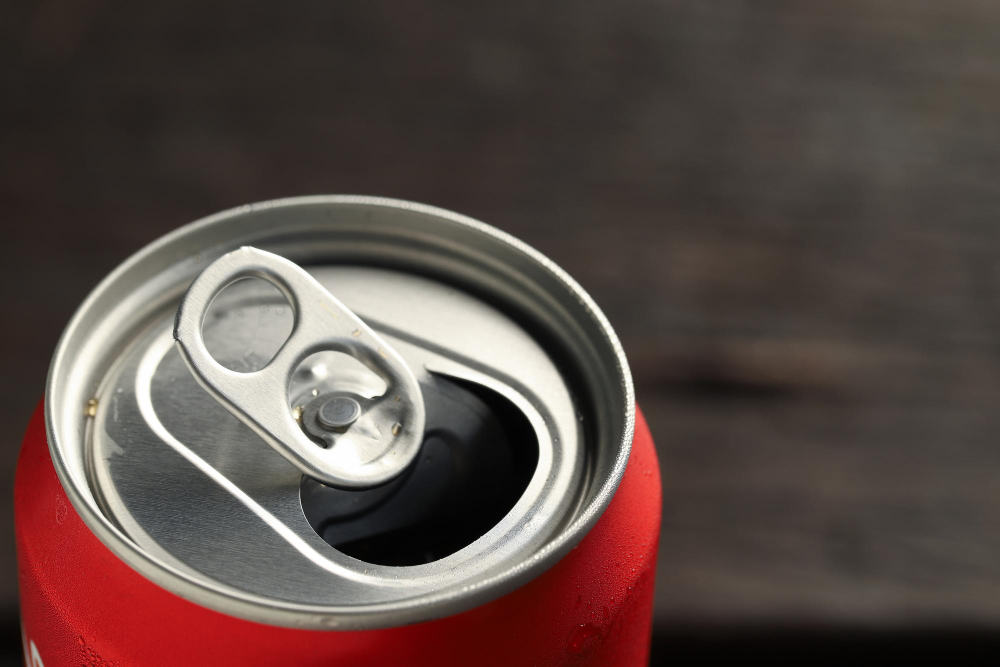
Look at the top of a can and the wall narrows in before it reaches the lid, so the lid is noticeably smaller in diameter than the body.
That taper is called the neck, and it exists for one reason: the lid is the expensive part. A can end has to be thicker than the wall, because it carries the opening mechanism and has to seal, and it is made of a different alloy. So every millimetre of diameter taken off the lid is a direct saving in metal across billions of units.
The reduction has been pursued relentlessly. Can ends have shrunk in diameter several times over the decades, each step requiring a redesign of the necking equipment and the filling lines, each step justified purely by the metal saved per can.
It has a visible consequence that people notice without knowing why: cans have become slightly awkward to drink from, because the opening is narrower relative to the body than it used to be. That is the cost of the saving, and it was judged worth paying.
The Ring It Stands On Is Doing Two Jobs

The narrow ring at the outside of the base – the one the can actually rests on – is not simply the edge of the dome.
Its first job is stability. A can standing on a dome would rock. A defined circular bearing ring gives it a flat, stable footprint even though almost none of the base is flat.
Its second job is stacking, and it is the clever part. The ring is sized and positioned to locate inside the recessed rim of the lid of the can below it. Stack two cans and the base ring of the upper one sits down into the chime of the lower one, so the stack locates itself and resists sliding.
That is why cans stack neatly in a fridge and in a shipping tray, and why a pallet of cans twenty layers high does not shuffle apart in transit. The two features are designed as a pair – change the lid diameter and the base ring has to move to match, which is one of the reasons lid reductions were expensive to implement.
It Is Made by Stretching One Disc of Metal

The body of a can is not rolled from a sheet and seamed. It is formed from a single flat disc, in one continuous mechanical sequence, with no joints anywhere in the wall or base.
The disc is first pressed into a shallow cup. The cup is then pushed through a series of rings, each slightly smaller than the last, which thin the wall and lengthen it – a process called ironing. The metal that started as a thick disc a few centimetres across ends up as a tall thin-walled cylinder, with the base left at its original thickness and the dome pressed into it in the same operation.
The wall ends up thinner than the base because it has been stretched; the base is thicker because it was never ironed. That is why the thickness varies around a single piece of metal with no join.
The whole sequence takes a fraction of a second, and a single line produces cans at rates measured in thousands per minute. The absence of seams is why the can holds pressure at that thickness: a seam would be the weak point, and there isn’t one.
The Inside Is Not Bare Metal

A drinks can is lined. The inside carries a thin polymer coating sprayed on and cured before the can is filled, and the drink never touches aluminium.
The reason is chemical. Carbonated soft drinks are acidic, and an acid in contact with bare aluminium will attack it – at that wall thickness, perforation is a real possibility over a shelf life measured in months. The coating is also what stops the drink picking up a metallic taste.
The lining is why an empty can left in the rain corrodes on the outside first, and why a can with a dent that has cracked the internal coating can develop a pinhole leak while looking undamaged.
The coatings themselves have been the subject of ongoing reformulation and of genuine public debate about which materials should be used in food contact, which has driven changes in the chemistry over the past couple of decades. That debate is about the coating, not the aluminium, and it is one of the few parts of this object still actively changing.
The Lid Is Attached by Folding, Not by Welding
The one joint on a can is where the lid meets the body, and it is made without heat, adhesive or solder.
After filling, the lid is placed on top and a seaming roller folds the edge of the lid and the edge of the body over each other, several layers deep, and then presses the whole fold flat. The result is a double seam: a mechanical interlock of five thicknesses of metal with a bead of sealing compound inside it.
No welding is involved, which matters because the can is already full at that point and because welding thin aluminium reliably at thousands of units a minute would be a considerably harder problem. A fold is fast, it is tolerant of small variations, and it can be inspected by cutting a can open and measuring the layers.
It is also the reason the rim of a can is sharp enough to notice. That raised edge around the top is the seam, and it is the thickest part of the whole container.
Why It Rattles in a Vending Machine and Not in a Fridge

A detail that sounds trivial and is actually a design consequence worth knowing.
Because the base ring locates into the lid of the can below, a vertical stack is stable. Lay cans on their sides, though, and nothing locates anything – a cylinder on a cylinder rolls – which is why cans in a horizontal rack shift, clatter and occasionally jam, and why horizontal storage relies on the rack rather than on the cans.
The same geometry explains a more useful fact. A can lying on its side in a cooler full of ice chills faster than one standing upright, because more of its surface is in contact with the ice and because the contents can convect along the length of the cylinder rather than fighting gravity in a short column. The difference is real and measurable, and it costs nothing to use.
And if a warm can has been shaken, standing it upright for a few minutes genuinely does help, because the dislodged bubbles rise to the single pocket of gas under the lid instead of being distributed through the liquid as foam. That is not folklore; it is just where the gas goes.
Why It Is Shaped Like That and Not Some Other Way
Put the features together and the can is a tightly optimised object in which almost nothing is arbitrary.
It is a cylinder because a cylinder is the most efficient shape for holding internal pressure with the least material, apart from a sphere, and spheres do not stack or fit in a hand.
It has a domed base because a flat base would bulge.
It has a bearing ring because a dome will not stand up, and that ring also locks into the can below it.
It necks in at the top because the lid is the costly component.
It is seamless because a seam would fail at that thickness.
It is lined because the contents would eat it.
And it weighs almost nothing, which is the whole point: the reason this much engineering went into shaving fractions of a millimetre off a drinks container is that the item is made in the hundreds of billions, and a saving of a gram per can is an enormous saving in aggregate.
Which is the thing worth taking away. The dome in the bottom of a can is not there because somebody thought it looked good. It is there because it is the only way to make the walls thin enough to be worth making at all.
Like our content? Follow us for more.
