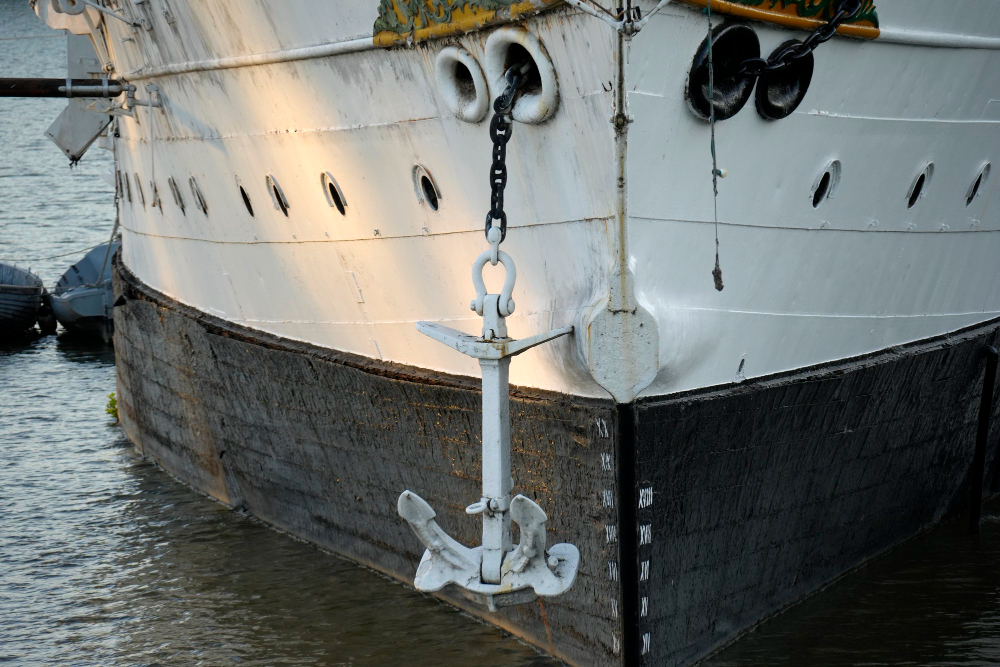
Almost everyone pictures an anchor as a heavy thing dropped on the bottom, holding a boat by sheer mass. If that were how it worked, no ship could carry an anchor big enough to be useful. The real mechanism is entirely different, and it explains a set of things that otherwise look arbitrary: why the chain is so long, why an anchor has that peculiar shape, why ships drag their anchors in some places and not others, and why sailors care so much about what the bottom is made of.
The Weight Argument Does Not Work
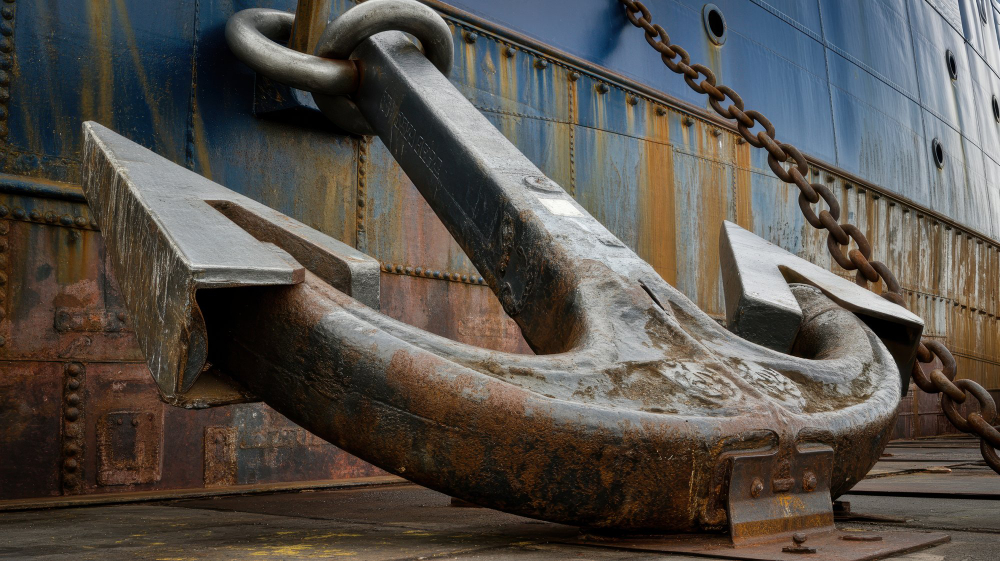
Start with the numbers, roughly, because they settle it immediately.
A large container ship might displace a hundred thousand tonnes. Its anchors weigh in the region of ten to twenty tonnes each. Even a modest wind on the side of a hull that size produces forces of many tonnes, and a current adds more. The ratio is nowhere close.
Friction alone does not rescue the argument either. A steel object resting on a seabed has a limited grip, and pulling it sideways across mud or sand takes far less force than lifting it. If the only mechanism were an anchor sitting on the bottom, ships would slide steadily downwind whenever the weather got up, which is not what happens.
So the anchor cannot be a weight. It has to be a device that engages the seabed, and that is what the shape is for.
Like our content? Follow us for more.
What the Shape Does
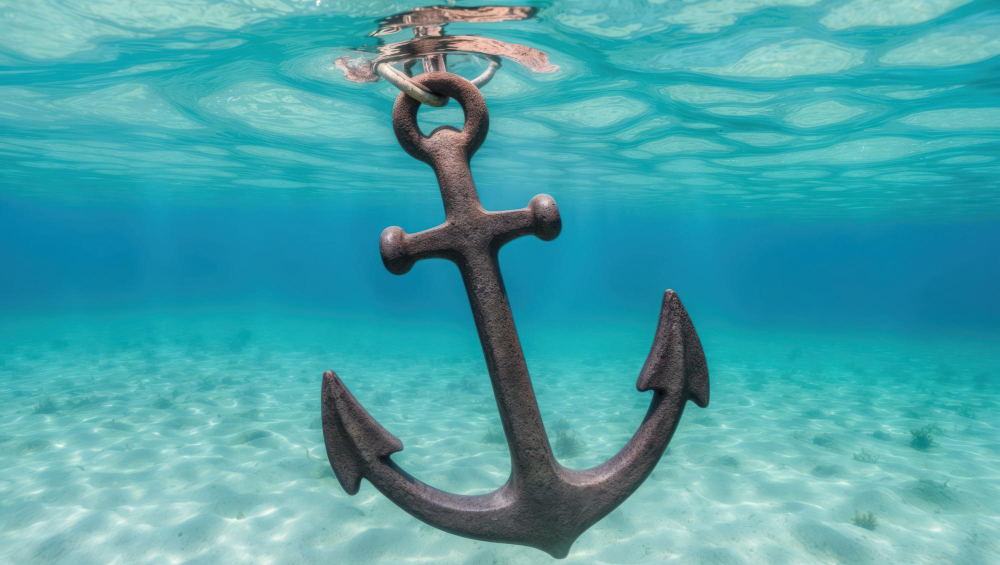
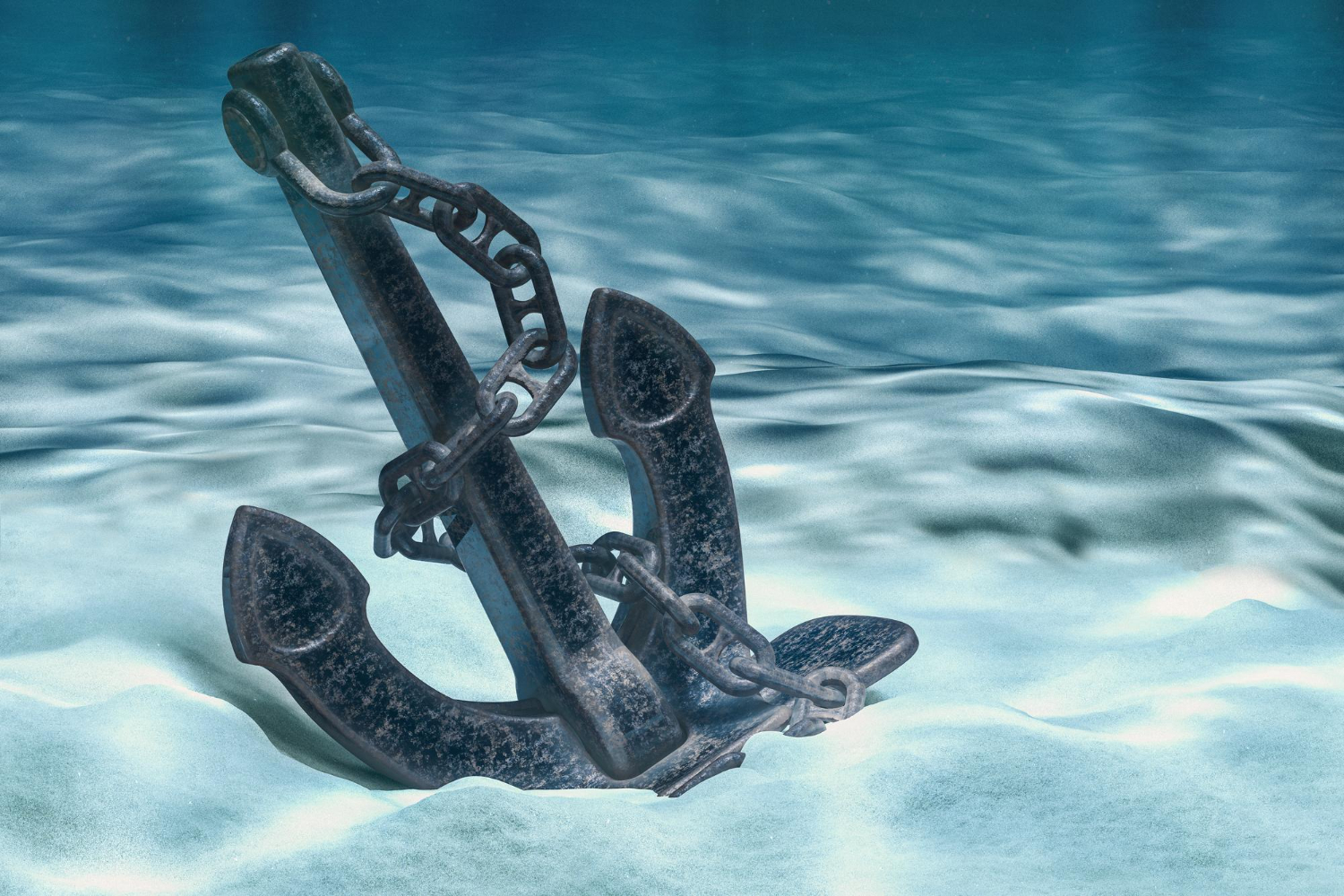
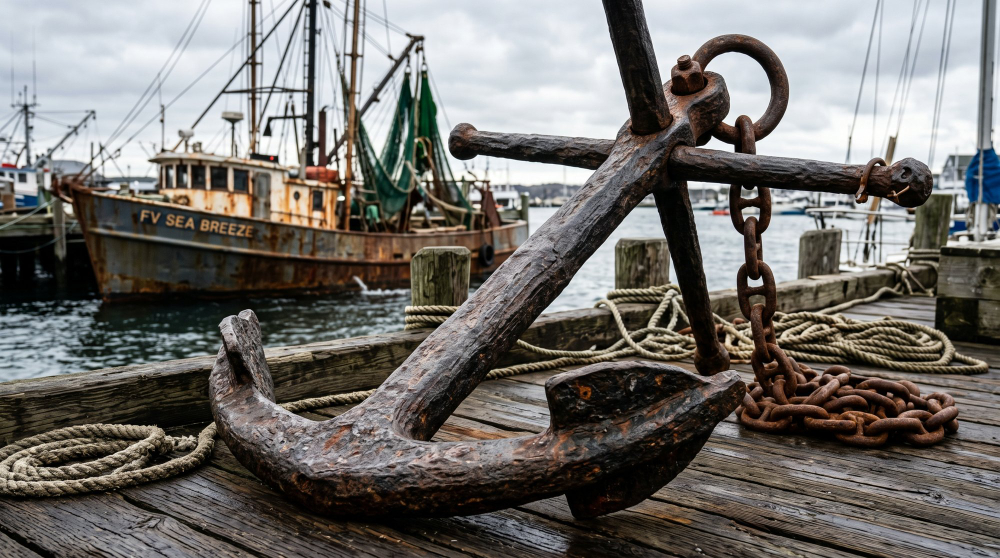
A traditional anchor has a shank, the long central bar, and flukes, the broad angled blades at the bottom end. The design problem is to get the flukes to dig in and then stay in.
When the anchor first lands it is lying on its side, doing nothing. As the ship falls back and the pull begins, the anchor is dragged along the bottom. This is the critical moment, and it is called setting. The geometry is arranged so that dragging it causes a fluke tip to catch and rotate downwards, so the pull that is trying to move the anchor is also the force that drives it into the ground.
Once a fluke is in, the anchor buries itself further as load increases, sometimes disappearing completely. At that point the thing resisting the ship is not the anchor’s weight or friction. It is the shear strength of the seabed material sitting in front of the buried flukes – a wedge of mud or sand that has to be pushed out of the way before the anchor can move.
This is why holding power is so much greater than anchor weight. A well-set anchor in good ground can hold many times its own weight, and the figure varies hugely by design: modern anchor types are compared largely on how many times their own weight they hold and how reliably they set in the first place.
It also explains a common confusion about anchor design. There is no universally best anchor, because the setting behaviour depends on the bottom. A broad fluke that sets beautifully in soft mud may skate across hard sand; a heavy narrow design that penetrates gravel may fail to generate enough area in mud. Ships in known waters carry anchors chosen for those waters.
Which Is Why the Pull Has to Be Horizontal
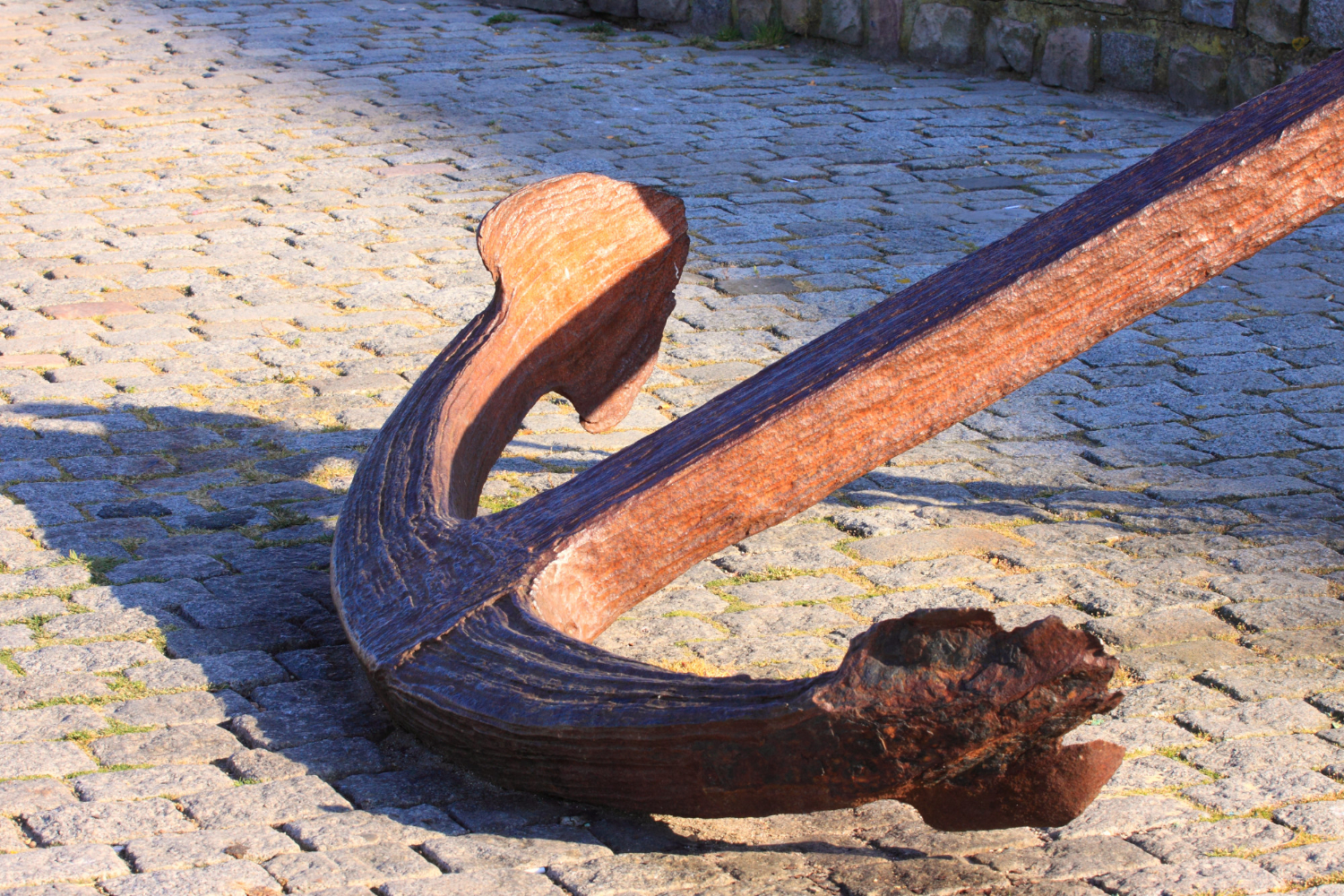
Everything above depends on one condition: the force on the anchor must arrive close to horizontal.
If the pull comes upward at an angle, it works to rotate the anchor out of the ground rather than into it. Enough upward angle and the flukes simply lever themselves free, and the whole assembly starts skating along the bottom.
But a ship floats on the surface and the anchor is on the bottom, so the line between them is necessarily at an angle. Resolving that is the purpose of the chain.
Chain is heavy. Laid along the seabed, it sags into a curve under its own weight, and if there is enough of it, the last section leaving the anchor lies flat on the bottom. The anchor therefore feels a horizontal pull even though the ship above is pulling upward at the other end of the curve.
The length paid out is called scope, and it is usually described as a ratio of chain length to water depth. Modest ratios are common in calm conditions; substantially more is paid out when weather is expected. The reason a ship lets out more chain in bad weather is not to reach further down. It is to keep the pull at the anchor horizontal when the ship is being pushed harder and the curve is being straightened out.
Which is the fact worth keeping. The chain is not a rope that happens to be made of metal. It is a load-managing component, and its weight is a feature.
The Chain Is Also the Shock Absorber
The sagging curve does a second job that matters as much as the first.
A ship at anchor is not still. Waves lift and drop it, and gusts surge it back. If it were attached to the anchor by something inelastic and straight, every one of those movements would arrive at the anchor as a sharp jerk, and jerks are exactly what breaks an anchor out of the ground.
The curve absorbs them. When the ship surges back, it does not immediately pull on the anchor; it lifts more chain off the bottom, straightening the curve. That takes energy, and the energy comes out of the ship’s movement. When the ship comes forward again, the chain settles back down. The curve acts as a spring made of geometry rather than of elastic material.
This is why the dangerous condition is a chain pulled bar-taut. A straight chain has no give left, the pull is no longer horizontal, and the next wave arrives at the anchor as a shock.
On smaller craft using rope rather than chain, the spring comes from the rope stretching instead, which is why a length of chain is commonly used next to the anchor even on a rope rode: the chain keeps the pull horizontal at the anchor end while the rope provides the elasticity.
Why Ships Drag, and Why the Bottom Matters So Much
Anchors fail in a small number of specific ways, and all of them follow from the mechanism.
The anchor may never set at all, skating over a bottom it cannot penetrate. Rock is the obvious case: an anchor cannot bury itself in rock, and what holding there is comes from hooking a crevice, which may hold enormously or let go without warning. Hard-packed sand, gravel and shell can all resist penetration.
Weed is a particular problem, because the flukes collect a mat of vegetation which then prevents any contact with the ground underneath. The anchor comes up clean of mud and covered in weed, which tells the story.
The pull may become too vertical, either because insufficient chain was paid out or because the ship was driven far enough to straighten the curve. The anchor then breaks out.
The wind may shift, pulling the anchor from a new direction. A buried anchor resists best in the direction it was set; pulled sideways it usually breaks out, then has to re-set in the new direction, and during that interval the ship is moving.
And the seabed itself may be too soft to hold, so the anchor simply ploughs a furrow through it indefinitely.
All of this is why charts mark the nature of the bottom, and why a sheltered bay with good holding ground has historically been worth more than a sheltered bay without one. Anchorages were selected for what was under the water, not only for the shape of the coast.
Recovery works by reversing the same logic. The ship motors up over its anchor so that the pull becomes vertical, which is the direction that levers the flukes out. The mechanism that makes an anchor hold is also the mechanism that releases it, approached from a different angle.
It Has Barely Changed and It Has Changed Completely
The basic concept is very old. Early anchors were stones, then stones with wooden stakes driven through them to catch the bottom, then iron hooks. The principle of engaging the ground rather than resting on it was understood early, and the classic two-armed shape with a crossbar is ancient.
What has changed is the efficiency. The old admiralty pattern, the shape still used as a decorative symbol, sets reasonably but has an awkward problem: with one fluke buried, the other sticks up, ready to foul the chain or the hull. Twentieth-century designs solved this with pivoting flukes that both bury, and then with single-blade ploughing and scoop designs that bury deep and re-set themselves when the pull direction changes.
The gains have been large. Modern designs achieve holding powers per unit weight that make older anchors look like what they were: heavy objects that mostly worked. But the underlying physics never moved. It was always about getting a blade under the seabed and keeping the pull flat.
So the next time you see a ship lying at anchor, the useful picture is not a weight on the bottom. Somewhere below, a steel blade is buried in mud with a wedge of seabed jammed in front of it, and a long curve of chain is lying along the bottom doing two things at once: holding the pull flat so the blade stays buried, and absorbing every wave so the blade is never jerked. The anchor gets the credit. The chain does at least half the work.
Like our content? Follow us for more.