

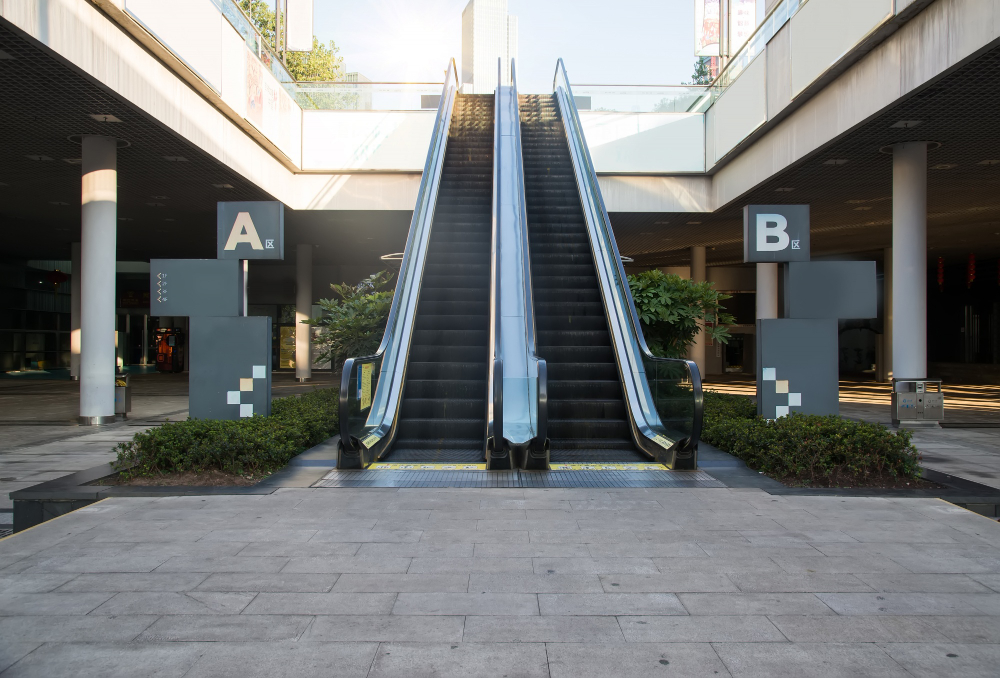
Watch the top of an escalator for a few seconds and something slightly impossible happens. A flat plate slides out from under a comb, then rises into a step, then a whole staircase forms, and at the other end it all flattens back into a moving floor. It looks as though the steps must be changing shape. They are not. Every step on the machine is a single solid casting that never alters, and the transformation is done entirely by geometry.
Two Tracks, Not One
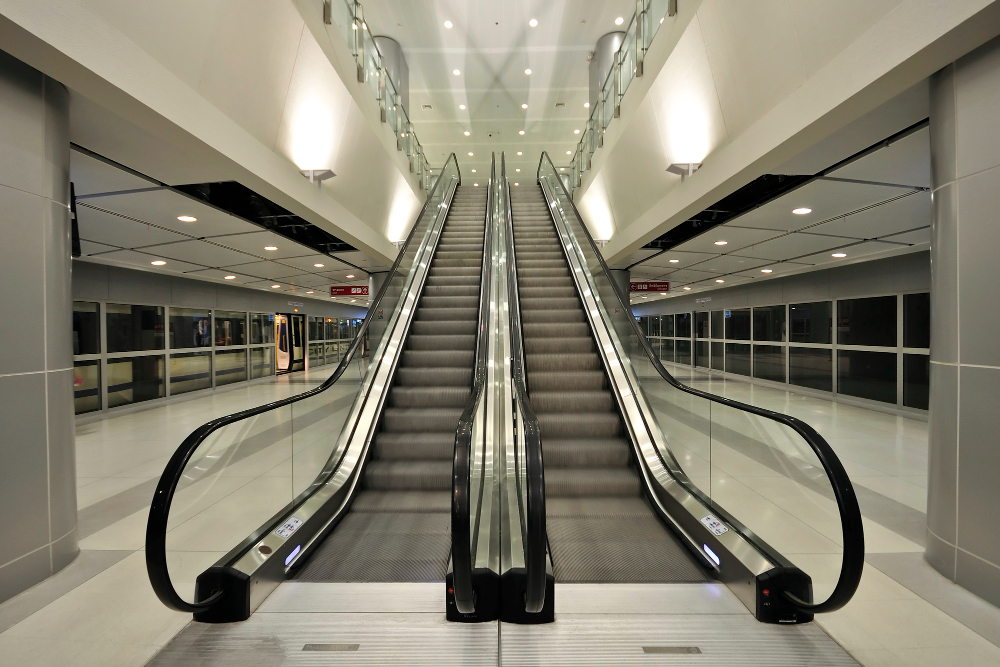
Here is the whole trick, and it is worth going slowly.
Each step is a rigid unit with a horizontal tread and a vertical riser joined at a right angle, which makes the side profile roughly triangular. It has two axles: a main axle near the front, carrying the large wheels, and a second pair of smaller wheels set behind and below.
Inside the truss – the structural box the whole machine sits in – there are two separate tracks running the length of the escalator. One guides the main wheels. The other guides the trailing wheels.
Along the inclined middle section, those two tracks are set apart by a particular distance, and that distance holds each step at the angle that makes its tread horizontal and its riser vertical. A staircase.
As a step approaches either end, the two tracks converge. The trailing wheels are drawn up level with the main wheels, which rotates the whole step about its main axle. The tread stays horizontal – it has to, because it is the surface people stand on – and the riser swings from vertical to horizontal, sliding in underneath the tread of the step ahead.
By the time the step reaches the landing, all the risers have tucked away and the treads have lined up into a flat moving platform. The step did not change. The relationship between its two sets of wheels did.
Like our content? Follow us for more.
Which Is Why the Steps Have Grooves
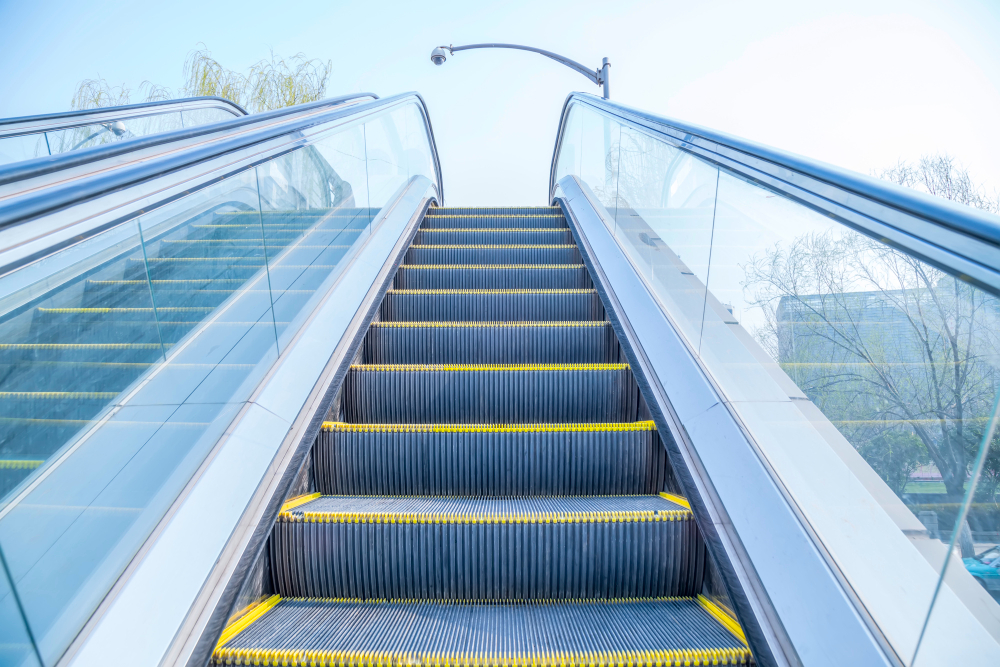
Every escalator tread is ribbed with fine parallel grooves running in the direction of travel, and every riser has matching ones. They are not for grip, though they help.
Their real job is at the transition. As one step rises relative to its neighbour, the ribs on the riser of one step pass between the ribs on the tread of the next, interleaving like the teeth of two combs. That means there is never an open gap between adjacent steps into which something could fall or be drawn.
The same principle appears at both landings, where a fixed comb plate sits at the end of the moving floor with its teeth pointing along the direction of travel, and the step grooves pass between those teeth. The moving surface and the fixed surface mesh rather than meeting edge to edge.
This is also the source of the classic escalator hazard. A groove is a slot, and anything soft and flexible that gets into one can be carried along and pulled into the meshing point. That is why the warnings concern loose clothing, long laces and soft-soled footwear specifically, and why the yellow lines on the step edges exist to keep feet away from the sides.
The bristle strips along the skirt panels at foot level serve the same purpose from the other direction: they keep feet and clothing away from the narrow gap between the moving step and the stationary side panel.
The Handrail Is Trying to Keep Up and Never Quite Manages
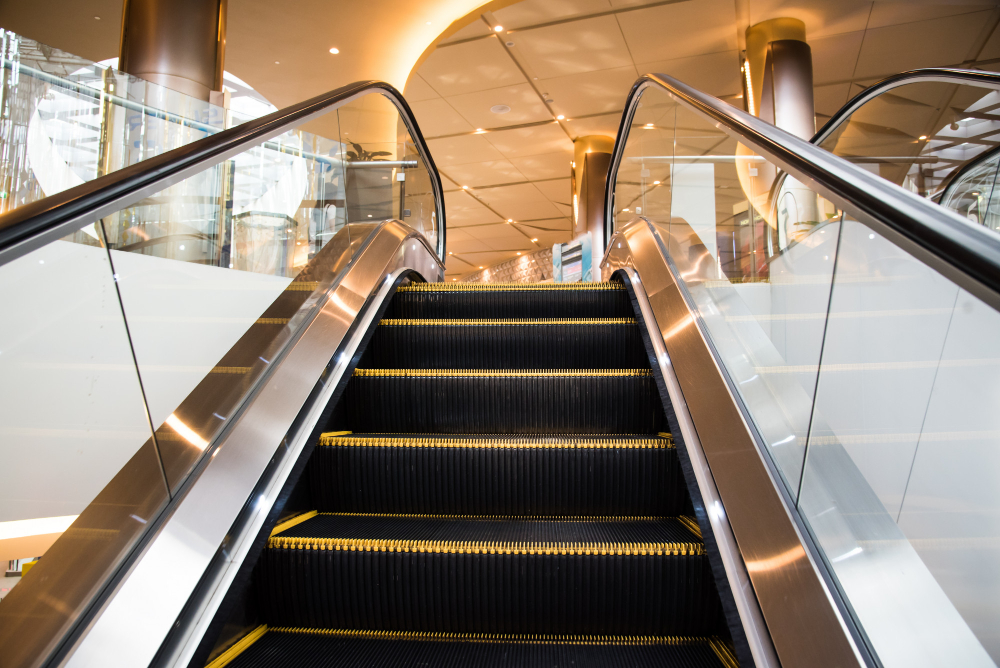
The handrail is driven from the same machinery as the steps, through its own drive wheel, and it is designed to travel at the same speed. In practice it very often does not.
The handrail is a loop of reinforced rubber, and it is driven by friction rather than by a positive connection. It stretches with age, it wears, and the amount of friction available at its drive varies with temperature and cleanliness. The result is that handrails commonly run marginally slow or marginally fast relative to the steps.
The effect is small – a few per cent – but over the length of a long escalator it is enough to notice. If you hold the rail without adjusting, your hand slowly travels forward or backward relative to your feet, which is why people find themselves either reaching or catching up.
It is also the reason the handrail is checked routinely. A substantial mismatch is an actual hazard rather than an annoyance, particularly for anybody relying on the rail for balance.
Why They Are the Speed They Are
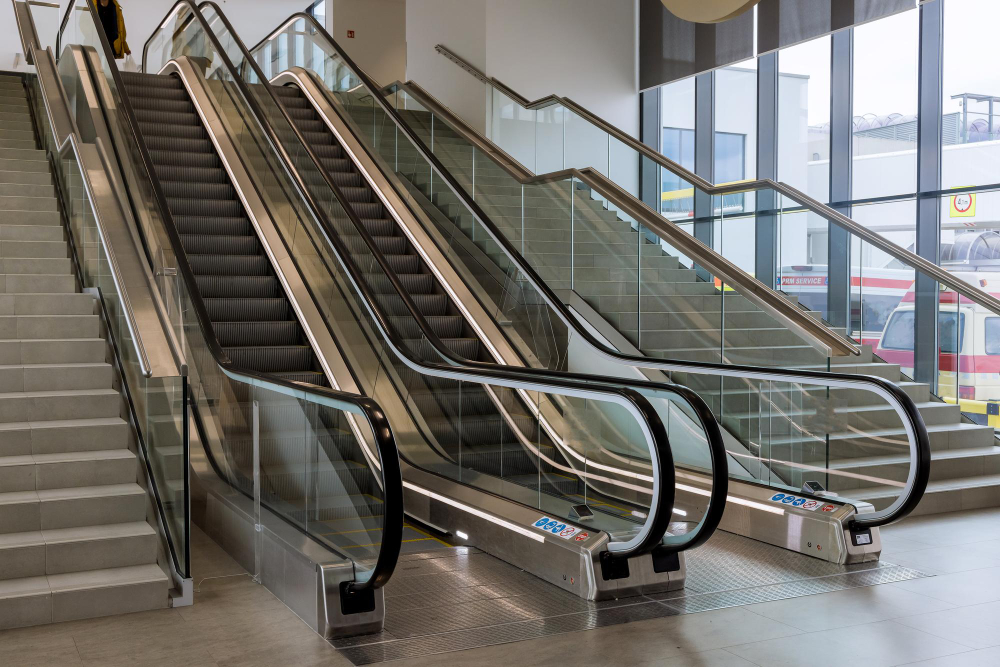
Escalators run at a speed that feels conservative, and the constraint is not the machinery.
The limit is the transition at each end. A passenger has to step onto a surface that is already moving, and off one that is still moving, and the time available to do that is set by the speed. Faster steps mean less time to place a foot and less margin for anybody who is unsteady, carrying something, or not paying attention.
There is a second constraint at the exit. People do not disperse instantly at the top; they take a moment to walk clear. If the escalator delivers people faster than the space at the top can absorb them, the result is a pile-up at precisely the point where a pile-up is most dangerous.
So the speed is set by human reaction and by what happens at the landings, and that is why escalators in different settings run at noticeably different speeds despite identical mechanisms.
Standing, Walking, and the Argument That Will Not Die
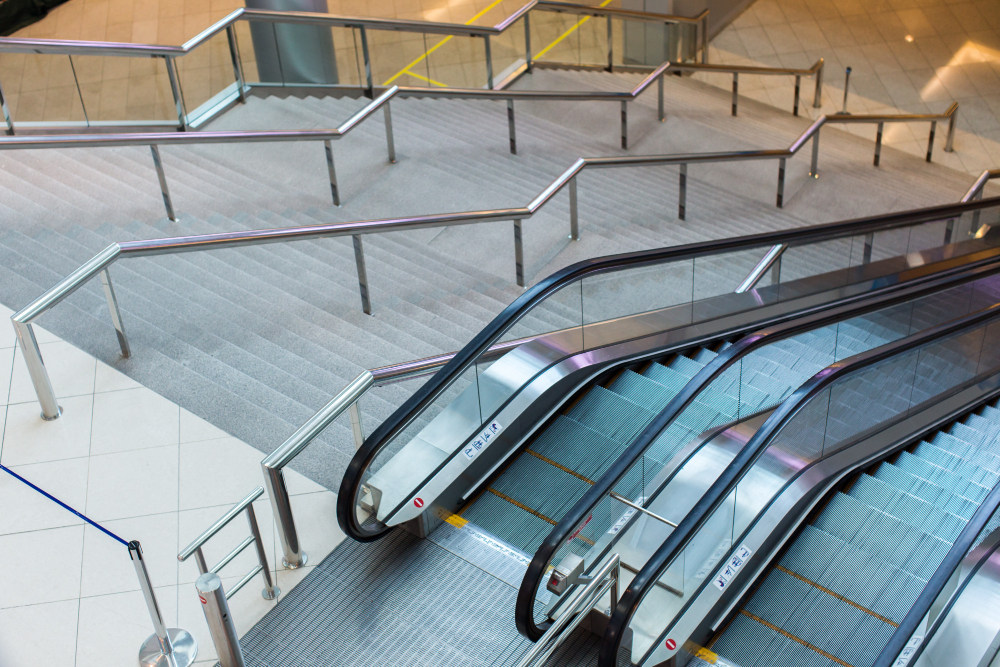
On busy escalators, one side is conventionally for standing and the other for walking. The convention is deeply held and the underlying arithmetic is more interesting than either camp usually admits.
Standing on both sides moves more people per minute. This is not intuitive but it follows from how much space each person occupies. A walker needs a step to themselves plus clearance ahead and behind – in practice several steps – while standers can occupy every other step. When an escalator is at capacity, the walking lane carries far fewer people than the standing lane, so half the machine is being used at a fraction of its throughput.
Trials on very busy escalators have found meaningful increases in capacity when both sides are used for standing, and the effect is larger on longer escalators, because the longer the rise, the smaller the proportion of people willing to walk it.
The complication is that this only holds when the escalator is properly congested. On a quiet one, walking is faster for the walker and costs nobody anything. And the convention is remarkably resistant to change regardless of the arithmetic, because it is a social norm rather than a calculation, and people who are asked to stand still on a side they have always walked up tend not to comply.
So the honest position is that standing on both sides is better under congestion, worse otherwise, and difficult to enforce either way.
The Chain Underneath Is the Expensive Part
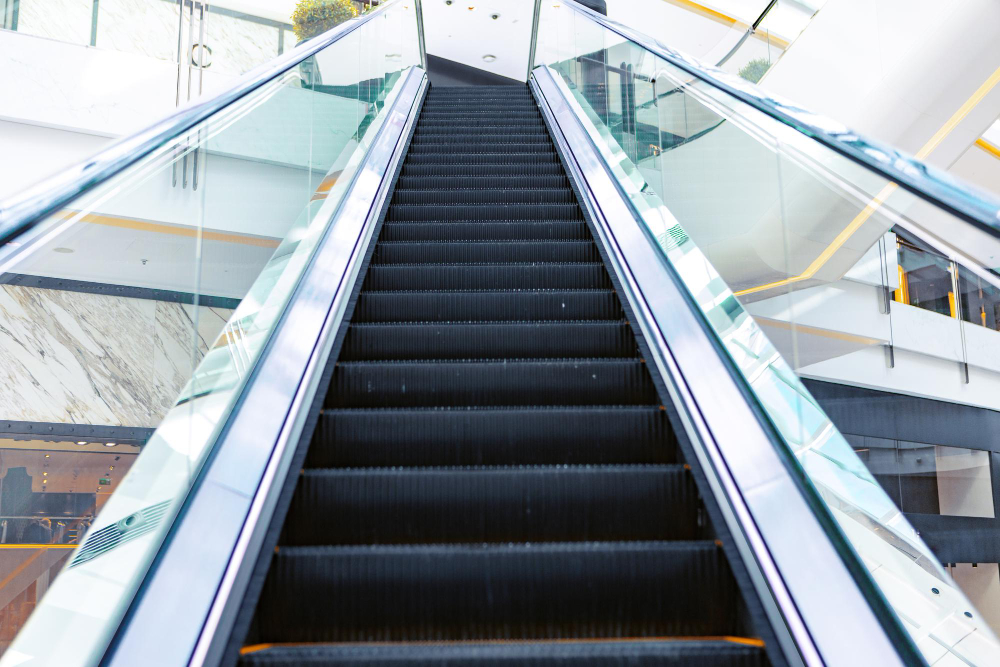
The steps get the attention, but the component that determines what an escalator costs and how long it lasts is the chain dragging them.
Each step is attached to a heavy roller chain running down each side, and that chain is under continuous load from every person on the machine plus the weight of the steps themselves. It runs over a drive sprocket at the top and around a return at the bottom, and it has to be kept at the correct tension: too slack and the steps do not sit correctly at the transitions, too tight and the wear accelerates.
The tension is maintained automatically, usually by a weighted or sprung carriage at the lower end that can move as the chain stretches with age. That carriage is also a safety device. If the chain breaks or stretches beyond its limit, the carriage moves far enough to trip a switch and stop the machine, because a broken step chain on a loaded escalator is the failure that matters most.
This is why escalator refurbishment is a major operation rather than a service visit. Replacing steps is straightforward; replacing the chain means opening the truss along its entire length.
What They Were Invented For
The escalator was not designed to move people between floors. It was designed as an attraction.
The first versions, at the end of the nineteenth century, were built as amusement rides – a moving inclined belt with no steps at all, installed at a seaside pier, ridden for the novelty of it. Several competing designs followed, some with flat belts, some with steps, and the modern arrangement of interleaving triangular steps with comb plates emerged from that competition rather than from a single invention.
The shift from novelty to infrastructure happened in department stores, which had exactly the problem an escalator solves and a lift does not. A lift moves a batch of people intermittently and requires them to wait. An escalator moves a continuous stream, requires no waiting, and, importantly for a shop, carries customers slowly past merchandise rather than sealing them in a box.
That commercial logic is why escalators appeared in shops long before they appeared anywhere else, and it is still visible in how stores are laid out around them.
And the underlying geometry has not changed since. The machine in an airport today is doing the same thing the pier attraction did: rotating a rigid wedge about a fixed axle while two tracks quietly move apart and back together, turning a floor into a staircase and then back into a floor, several thousand times an hour, without anything on it ever changing shape.
Like our content? Follow us for more.
