

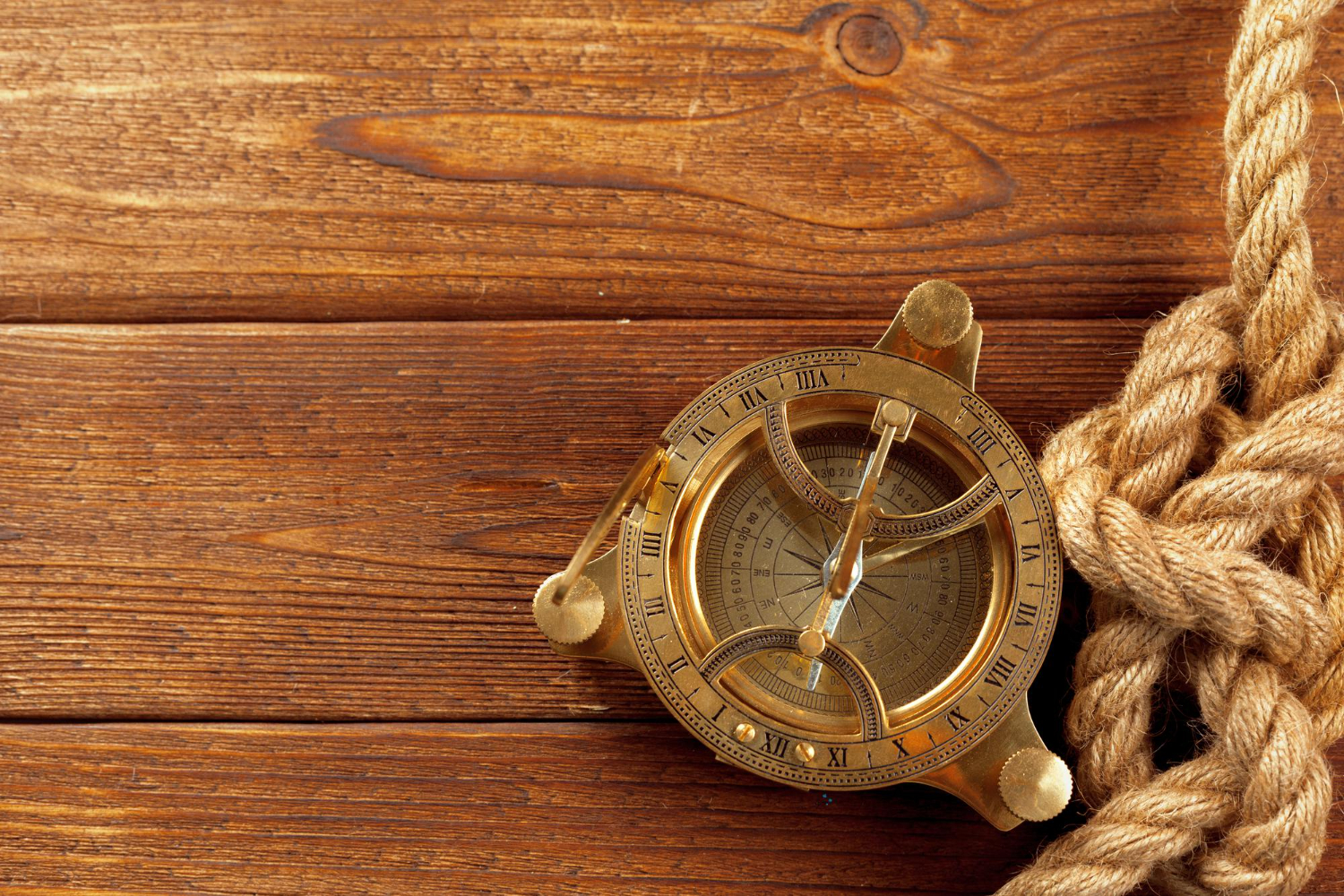
For most of the history of ocean navigation, a ship’s crew could tell you how far north or south they were with reasonable confidence and had very little idea how far east or west.
That asymmetry is not arbitrary. It follows from the geometry, and understanding why explains one of the great engineering problems of the eighteenth century.
The consequences were serious. Ships missed islands, ran onto coasts they believed were elsewhere, and took longer routes than necessary because captains stayed on a known latitude and sailed along it rather than risk a direct crossing.
Solving it required a clock that could keep accurate time on a rolling deck, through temperature swings and salt air, for months. Here is why that was so difficult and how it was done.
Why One Is Easy and One Is Not
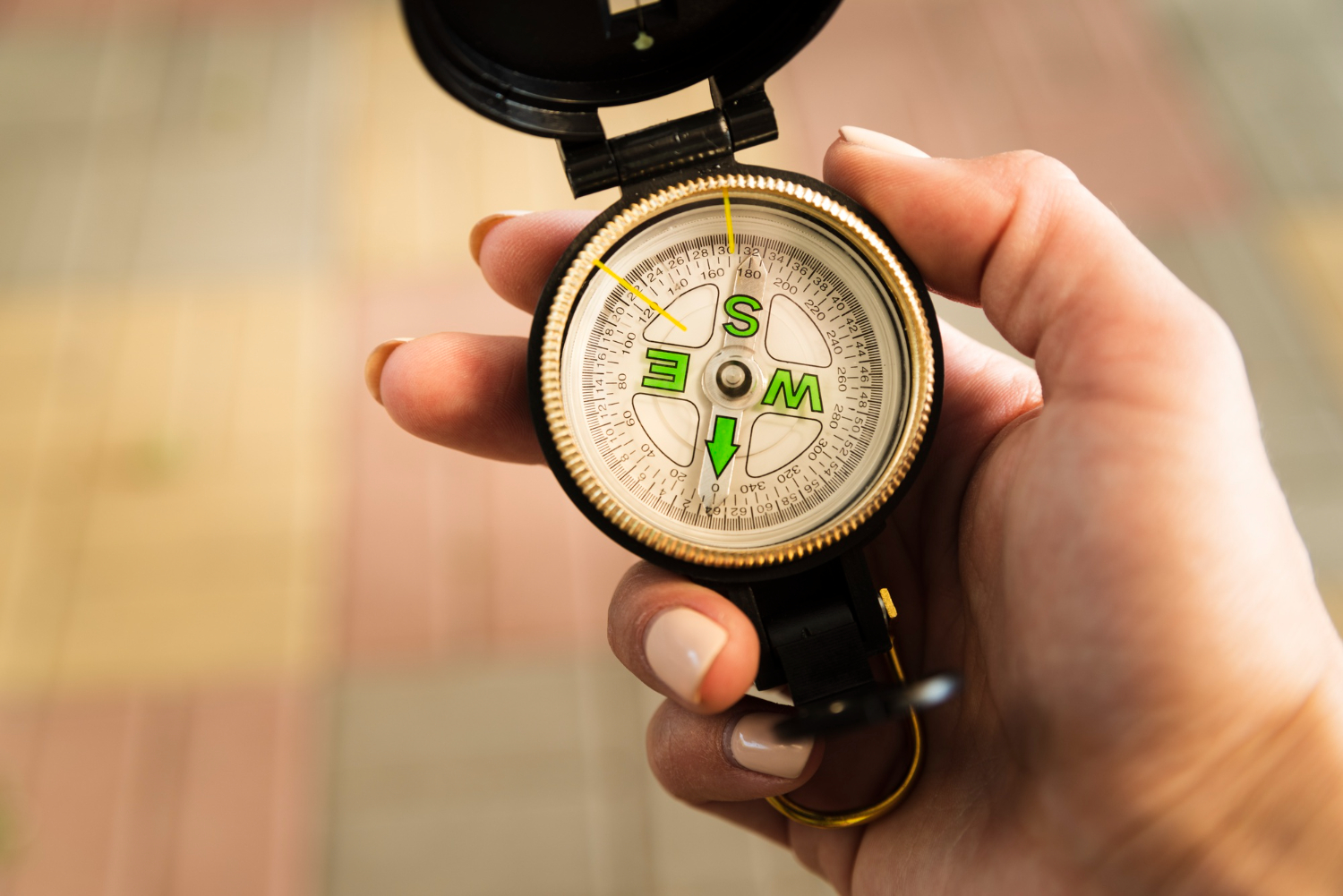
Latitude has a natural reference. The Earth’s axis points at a fixed place in the sky, so measuring the angle of the sun at noon, or of a particular star at night, tells you your distance from the equator directly. The sky provides the scale.
Longitude has no equivalent. The Earth rotates, so every point passes under the same sky in turn, and there is no celestial marker that distinguishes one meridian from another.
What there is, however, is a clean relationship between longitude and time. The planet turns once in twenty-four hours, so fifteen degrees of longitude corresponds to one hour.
That gives a method. Establish local time by observing when the sun reaches its highest point, compare it against the time at a known reference location, and the difference converts directly into a distance east or west.
Which reduces the entire problem to a single requirement: know what time it is somewhere else.
Like our content? Follow us for more.
Why That Was So Hard
Knowing the time elsewhere means carrying a clock set to that place, and clocks of the period were not up to it.
The best timekeeping available depended on a pendulum, and a pendulum measures time by swinging under gravity. Put one on a ship and it is useless — the deck pitches and rolls, which disturbs the swing, and the apparent strength of gravity varies with latitude, which changes the period.
Every other mechanism suffered from problems that were tolerable on land and disqualifying at sea. Metal parts expand and contract with temperature, changing the rate. Lubricating oils thicken in cold and thin in heat. Salt air corrodes. A mainspring delivers more force when fully wound than when nearly run down.
The accuracy required was severe. Being an hour out puts you fifteen degrees of longitude wrong, which near the equator is a very long way indeed. Useful navigation demanded a clock losing or gaining only seconds over a voyage of months — an order of accuracy that the best land clocks could not sustain in a stable room.
So the problem was not simply building a better clock. It was building a clock whose rate did not depend on motion, temperature, humidity or how long ago it was wound.
The Prize and the Competition
The problem was serious enough that the British Parliament established a substantial reward in 1714 for a practical solution, administered by a board of commissioners.
There was a rival approach, and it is essential to the story. The lunar distance method used the Moon as a clock: the Moon moves against the background stars at a predictable rate, so measuring the angle between it and a known star, and comparing that against published tables, yields the reference time.
That method required no special instrument beyond a good angle-measuring device, but it demanded clear skies, a visible moon, considerable skill and roughly four hours of calculation per observation.
The board included astronomers who favoured the lunar method, some of whom were actively developing it. Whether that produced real bias against the mechanical solution has been argued about ever since, and the popular version of the story — a lone genius obstructed by a hostile establishment — is generally regarded by historians as substantially overstated, though the tension was real.
Solving It Mechanically

John Harrison was a carpenter from Lincolnshire with no formal training in horology, who began by building clocks largely out of wood.
His early sea clocks were large, heavy machines. He replaced the pendulum with linked oscillating balances arranged so that the ship’s motion affected both equally and cancelled out. He addressed temperature using strips of two different metals joined together, which bend as they expand at different rates and can be arranged to compensate automatically. He designed escapements requiring little or no lubrication, avoiding the oil problem entirely.
Each machine took years. He kept identifying flaws and starting again, which is why the sequence ran across decades.
The decisive change was conceptual. Having built three large machines, he abandoned the approach entirely and produced something the size of a large pocket watch — a fundamentally different design, running fast with a high-frequency balance, which turned out to be far less vulnerable to disturbance than a slow-moving mechanism.
That watch performed to the required standard on a transatlantic voyage, and was tested again afterwards. The board proved reluctant to accept the result, demanded further trials and additional demonstrations, and payment was eventually settled only after intervention at the highest level.
Why It Took So Long to Matter

A working prototype is not a solution, and this is the part usually omitted.
The watch was a hand-made object of extraordinary complexity, produced by one man over years. Nothing about it could be issued to a fleet.
What converted it into practical navigation was the subsequent work of makers who simplified the design into something that could be produced in quantity by trained workshops at a price a ship could justify. That took decades more.
For a long period both methods ran together. Lunar distances remained in use because chronometers were expensive, and a prudent navigator used one to check the other. Only as production improved and prices fell did the mechanical method become standard.
There is a further reason the reference-time approach won that has nothing to do with accuracy: it required no astronomy, no tables and no four-hour calculation. Any competent officer could read a dial.
The Method Everybody Actually Used

There is a third approach that deserves mentioning, because for most of maritime history it was what ships truly relied on.
Dead reckoning estimates position from what the ship has done: a known starting point, a heading from the compass, a speed estimate, and elapsed time. Multiply speed by time along the heading and you have a new position.
Speed was measured with a device of striking simplicity. A weighted board on a line, with knots tied at intervals, was thrown over the stern and allowed to run out for a period timed by a sandglass. Counting the knots that ran out gave the speed – which is why ships’ speeds are still quoted in knots.
The method is entirely sound and accumulates error relentlessly. Currents move the ship without registering. Wind pushes it sideways. Steering is imprecise. Every small error carries forward into every subsequent calculation, so uncertainty grows with every day out of sight of land.
That is why longitude mattered so much. Latitude could be checked against the sky whenever the weather permitted, which corrected half the drift. Longitude could not be checked at all, so the east-west error simply accumulated for an entire crossing.
A chronometer did not replace dead reckoning. It supplied the correction that dead reckoning had never had.
What the Problem Actually Was
The reason this story is worth understanding is that it is not really about clocks.
The underlying difficulty was that longitude is a relative measurement with no natural zero, so establishing it requires comparing your local circumstances against a distant reference — and the only way to carry a reference across an ocean was to carry a machine that remembered it.
That is a general shape. A great many measurement problems reduce to transporting a standard from where it is defined to where it is needed, and the difficulty is almost always in the transport rather than in the definition.
The eventual solution to knowing the time elsewhere is now a signal from a satellite, which is a substantially easier way to carry a reference than a wooden clock in a padded box.
But the requirement is identical. Satellite positioning works by comparing extremely precise timing signals, and a receiver calculates position from tiny differences in when those signals arrive. It is the same insight — position from time comparison — with the clock moved off the ship and into orbit.
Which means the problem was never solved so much as relocated, and the carpenter from Lincolnshire had identified the right question about three centuries before anyone had the equipment to answer it comfortably.
Like our content? Follow us for more.
