Almost everyone who cooks has stood over a chopping board with streaming eyes, and almost everyone has a theory about how to stop it. Light a match. Hold a spoon in your mouth. Cut under water. Wear goggles. Breathe through your mouth.
Some of these work, some do not, and the reason is that most people are guessing at a mechanism they have never had explained.
What is happening is not vague irritation. It is a specific, two-stage enzymatic reaction that the onion deploys when its tissue is damaged — a chemical defence against being eaten, which happens to be aimed at exactly the wrong target when the thing eating it has a knife.
The chemistry is truly elegant, it was only fully worked out in the twenty-first century, and understanding it tells you precisely which kitchen remedies have a basis and which do not. Here is what actually happens when you cut an onion.
The Two-Step Reaction
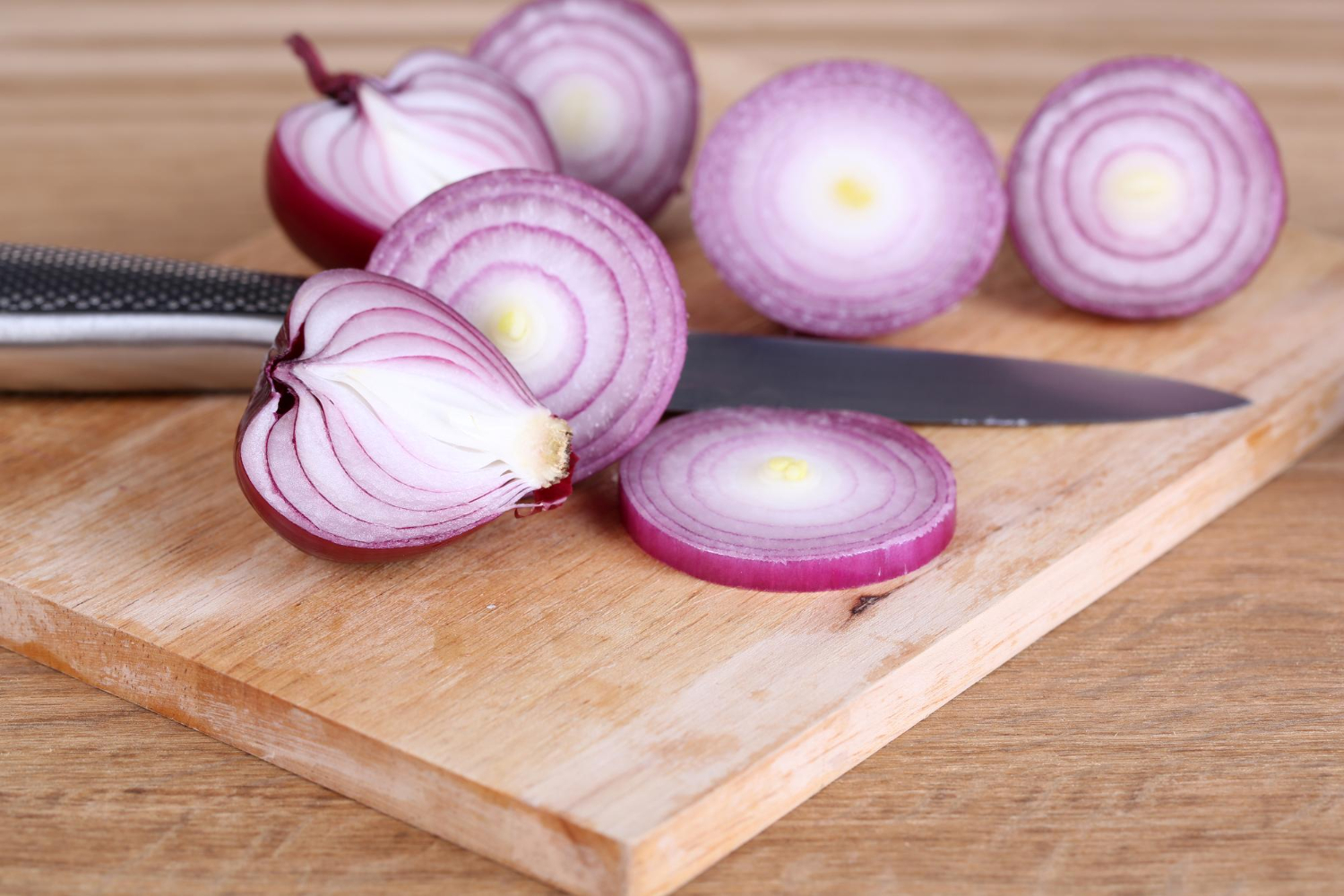
Inside an intact onion, nothing is happening. The relevant components are stored in separate compartments within the cells, kept apart and stable.
Cutting ruptures those compartments and allows the contents to mix, and the sequence runs very fast.
First, an enzyme called alliinase is released. It acts on sulphur-containing amino acid derivatives stored in the cells — specifically compounds known as amino acid sulphoxides — converting them into unstable intermediates called sulphenic acids. One of these, 1-propenyl sulphenic acid, is the one that matters.
Second, a different enzyme called lachrymatory factor synthase, usually abbreviated to LFS, acts on that sulphenic acid almost immediately, rearranging its structure into a new compound: syn-propanethial S-oxide.
That compound is the lachrymatory factor — the thing that makes you cry. It is volatile, meaning it evaporates readily, so it lifts straight off the cutting board and into the air.
The second enzyme is the crucial part, and it is what distinguishes onions from their relatives. Garlic contains alliinase too, and produces plenty of pungent sulphur compounds, but it does not contain LFS and does not make you cry. Lachrymatory factor is specific to onions and some other Allium species.
Like our content? Follow us for more.
The Enzyme Nobody Knew Was There
For a long time the accepted explanation was simpler and wrong in an interesting way.
Scientists had blamed alliinase alone, assuming the sulphenic acid it produced rearranged spontaneously into the tear-inducing compound. That was the textbook account.
In 2002, Japanese researchers published findings in Nature demonstrating that a second, previously undiscovered enzyme was responsible for the final step. The reaction was a two-stage process with a dedicated enzyme performing the conversion, and that enzyme was named lachrymatory factor synthase.
The compound itself had a longer history. Its molecular formula was determined in 1956, and its structure — including the specific syn, or Z, configuration — was pinned down in 1979, with roughly 5 percent of the natural substance occurring in the alternative anti configuration.
As one of the researchers involved in later work on the enzyme noted, it took decades to work the process out. That is a striking amount of scientific effort for something that happens in every kitchen daily.
Why It Makes You Cry Specifically
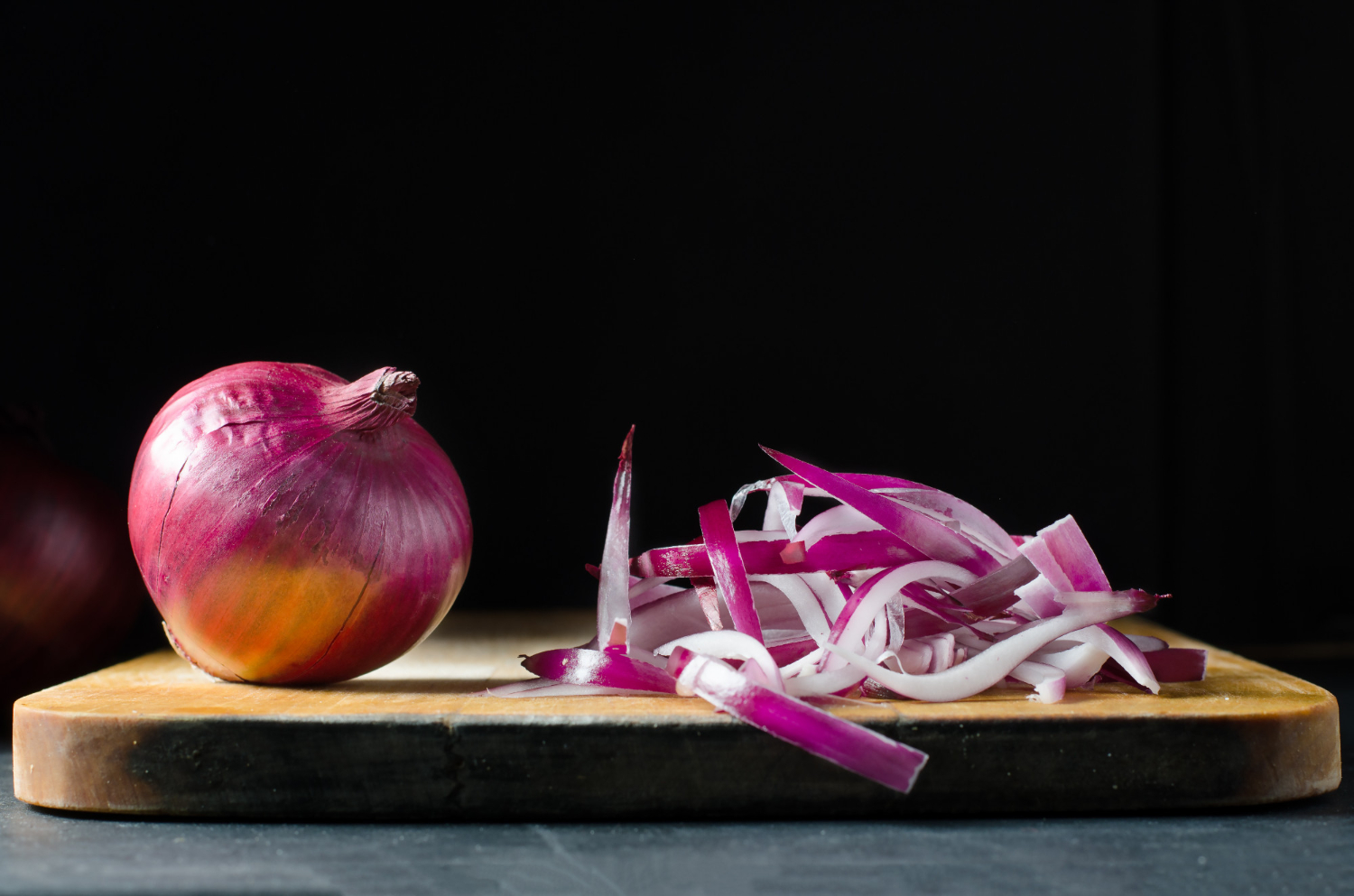
Once the gas is airborne, the rest follows from where it lands.
Syn-propanethial S-oxide rises from the board and reaches the eyes, where it dissolves in the tear film — the thin layer of watery fluid covering the eyeball. Reacting with the water there, it forms what is effectively a dilute acid solution on the surface of the eye.
That mild acidity irritates the cornea. Sensory nerves detect the irritation and signal the brain, which instructs the lacrimal glands to produce tears.
So the crying is not an emotional response or a coincidence. It is a defensive flushing reflex, exactly the same mechanism that clears grit from your eye, doing precisely what it evolved to do. The tears are washing the irritant away.
For most people the reaction is uncomfortable and short-lived rather than harmful.
It is also worth noting that lachrymatory factors are rare in nature. Only three are known, and all are produced by plants — onions, a South and Central American shrub, and a species sometimes called honey garlic.
Why It Burns as Well as Stings
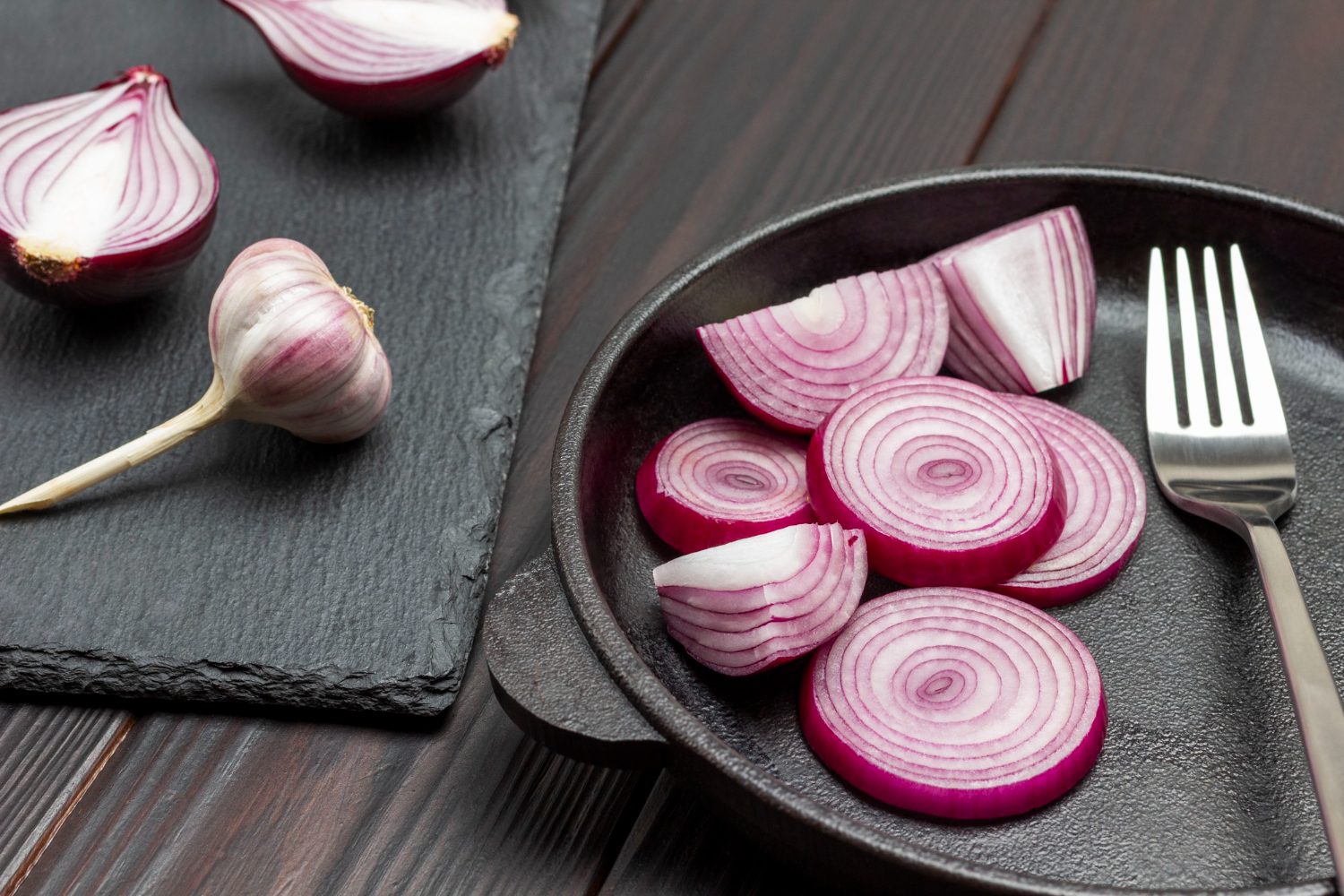
There is a second sensation people report and rarely separate from the tearing: a burning feeling in the eyes and sometimes the nose and throat.
That is the same compound doing the same thing in slightly different places. Syn-propanethial S-oxide is volatile, so it does not travel in a narrow beam toward the eyes; it fills the air above the board and reaches whatever mucous membrane is nearby.
On the eye it dissolves in the tear film and forms the dilute acid that triggers the flushing reflex. In the nose and throat it does something comparable to the moist tissue there, which is why a strong onion can catch at the back of the throat.
The intensity varies with how much gas is produced and how concentrated it becomes, which is why a small onion cut quickly by a sharp knife in a ventilated kitchen is a minor event, and a large one worked slowly with a blunt blade over a still board is not.
It also explains why the effect fades quickly once you step away. The compound is volatile and disperses; nothing is left behind to keep reacting.
Which Kitchen Tricks Actually Work
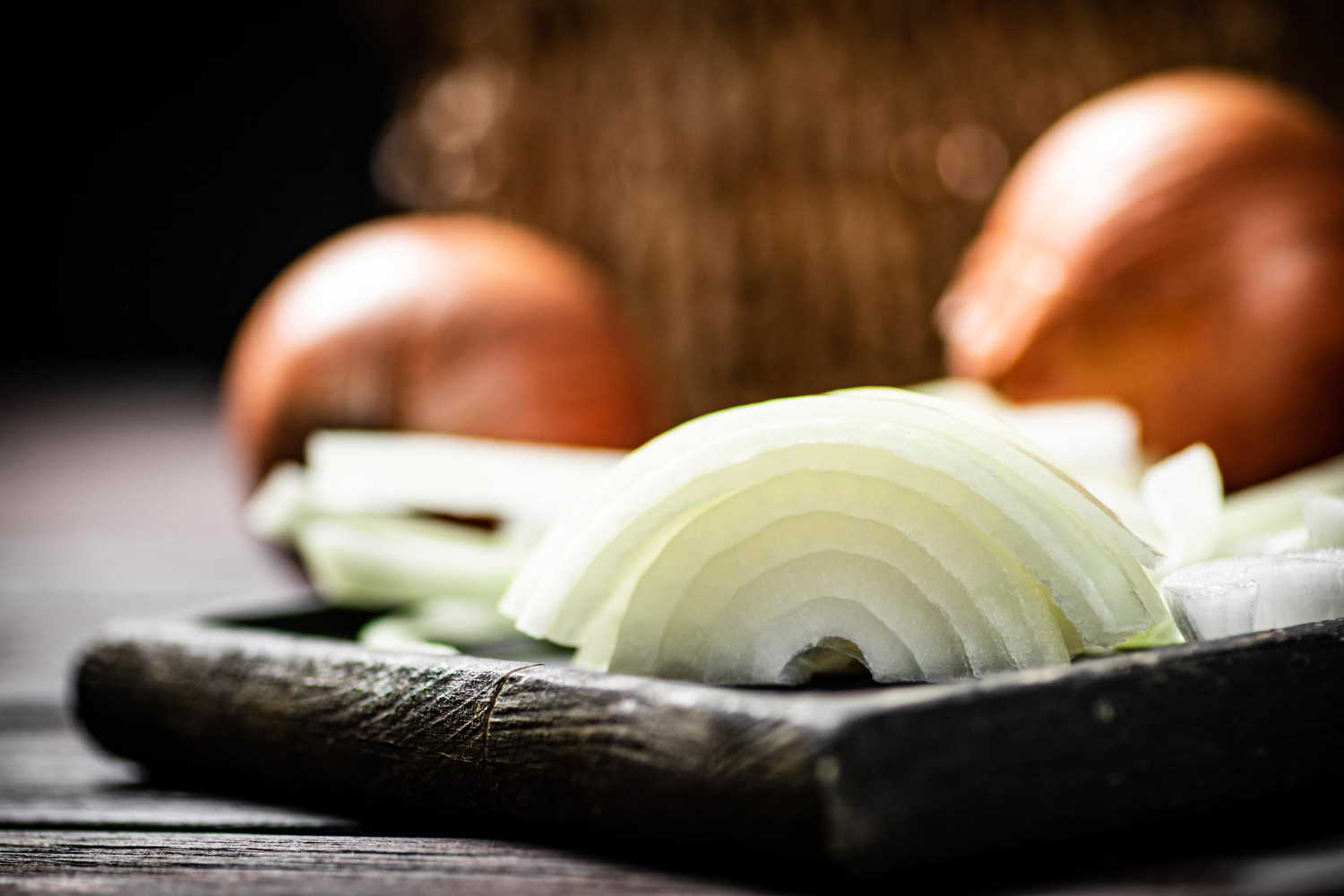
Knowing the mechanism lets you sort the remedies, and the sorting principle is simple: anything that slows the enzymes, reduces cell damage, or moves the gas away from your face has a basis. Anything else does not.
Chill the onion. Enzymes work more slowly at lower temperatures. Ten to fifteen minutes in the refrigerator reduces the activity of both alliinase and LFS, and therefore how much lachrymatory factor is produced. This is one of the better-supported tricks. Freezing goes further but damages texture and does not eliminate the effect.
Use a sharp knife. A dull blade crushes and tears cells, rupturing far more of them and releasing more enzyme. A sharp blade makes clean cuts through fewer cells. Research has specifically suggested that thin, sharp blades minimise tears.
Manage the airflow. Cutting near an open window, under an extractor fan, or beside a small fan physically disperses the gas before it reaches your face. Cutting under or near running water helps for the same reason, since water absorbs some of it.
Protective eyewear. Sealed goggles work by simple physical barrier. Ordinary glasses do not seal and will not help much.
Save the root end for last. The root end has a higher concentration of the relevant compounds, so leaving it intact as long as possible delays the worst of it.
And the ones that do not hold up: breathing through your mouth may slightly alter airflow near your face, but it does not reliably prevent the reaction, because the gas still reaches the eye surface regardless of how you are breathing. Holding a match or a spoon in your mouth has no mechanistic basis.
There is also variation between onions. Red and white onions tend to produce the strongest reaction. Spring onions barely register, because they contain much lower levels of the enzymes involved.
Why the Onion Bothers
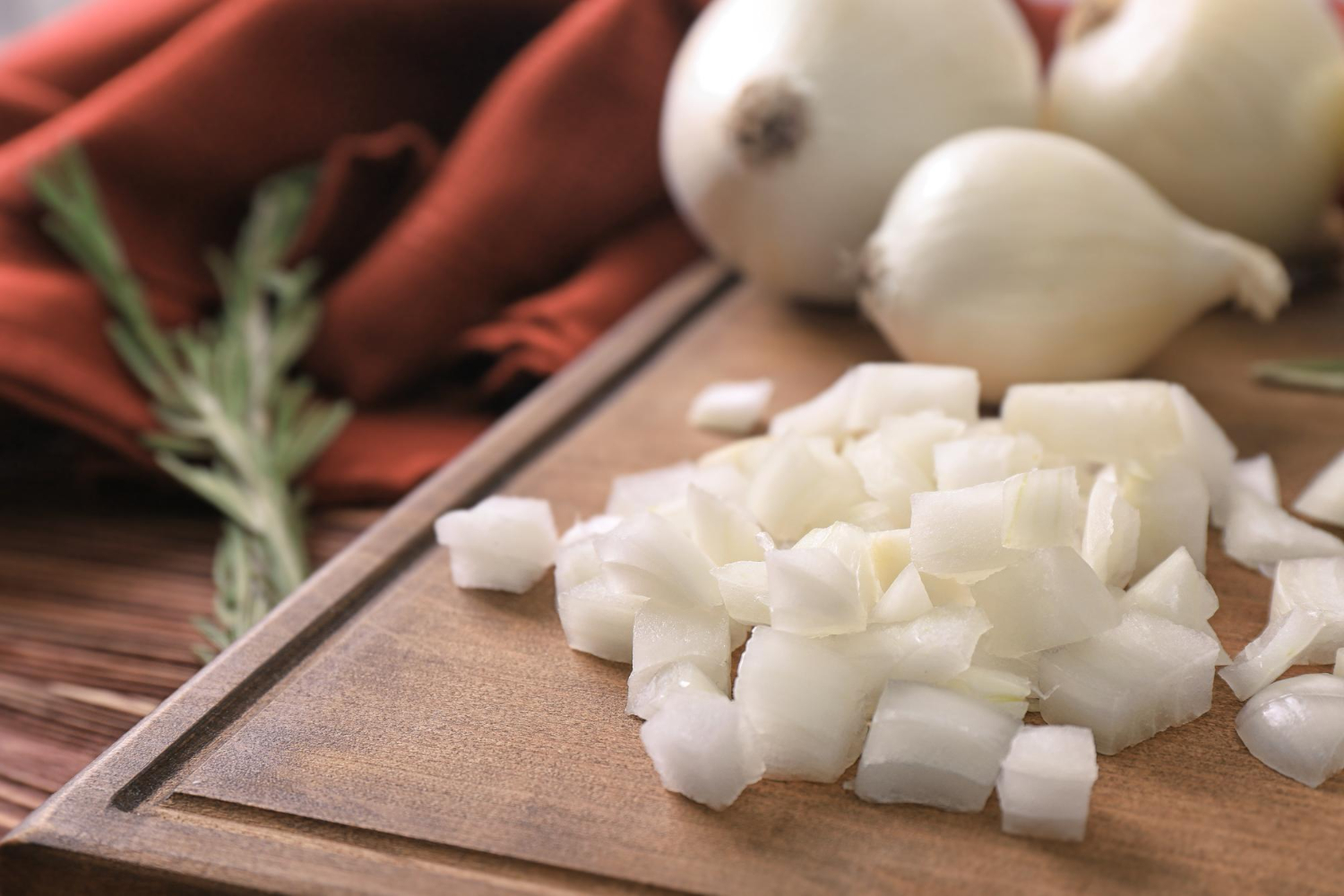
It is worth asking what the plant is doing this for, because the system is metabolically expensive and precisely targeted.
An onion bulb is a storage organ sitting underground, packed with sugars and water, in an environment full of things that would like to eat it. It cannot run and it cannot hide, so the available strategy is chemical.
Keeping the components separated inside intact cells is the clever part. A plant that simply contained an irritant would be irritating all the time, including to itself, and would lose the compound steadily to the environment. Storing an inert precursor and the enzyme that activates it in different compartments means the weapon costs nothing until something bites.
That design — separated precursor and enzyme, combining on damage — recurs across the plant kingdom. Garlic uses a version of it to produce allicin, which is what gives cut garlic its pungency and is absent from an intact clove. Brassicas such as mustard and horseradish do something comparable with different compounds.
So the onion is not being difficult. It is running a targeted defence against being chewed, and the fact that it also defeats a cook with a knife is an accident of the delivery mechanism being airborne.
The Tearless Onion
The final development is that the chemistry has been engineered around.
Because LFS is a single identifiable enzyme performing a single identifiable step, it can be targeted. A New Zealand-based food technology company developed an onion in which the lachrymatory factor synthase gene is switched off, so the plant produces alternative sulphur compounds instead of the tear-inducing one.
Low-lachrymatory and so-called tearless onion varieties have been developed through both genetic modification and conventional breeding, and are available in some markets.
Whether they are worth it is a matter of taste in both senses. The compounds diverted away from lachrymatory factor go somewhere else, and some accounts suggest the resulting flavour profile differs from a standard onion.
What the tearless onion really demonstrates is how completely the problem is understood. A century ago, onions made you cry for reasons nobody could specify. Now the responsible molecule has a name, a structure and a documented configuration, the two enzymes producing it have been identified, the pathway is mapped, and a plant has been made that skips the final step.
All of which is a fairly extraordinary amount of science standing behind the moment you stop chopping, step back from the board, and wipe your eyes on your sleeve.
Like our content? Follow us for more.