

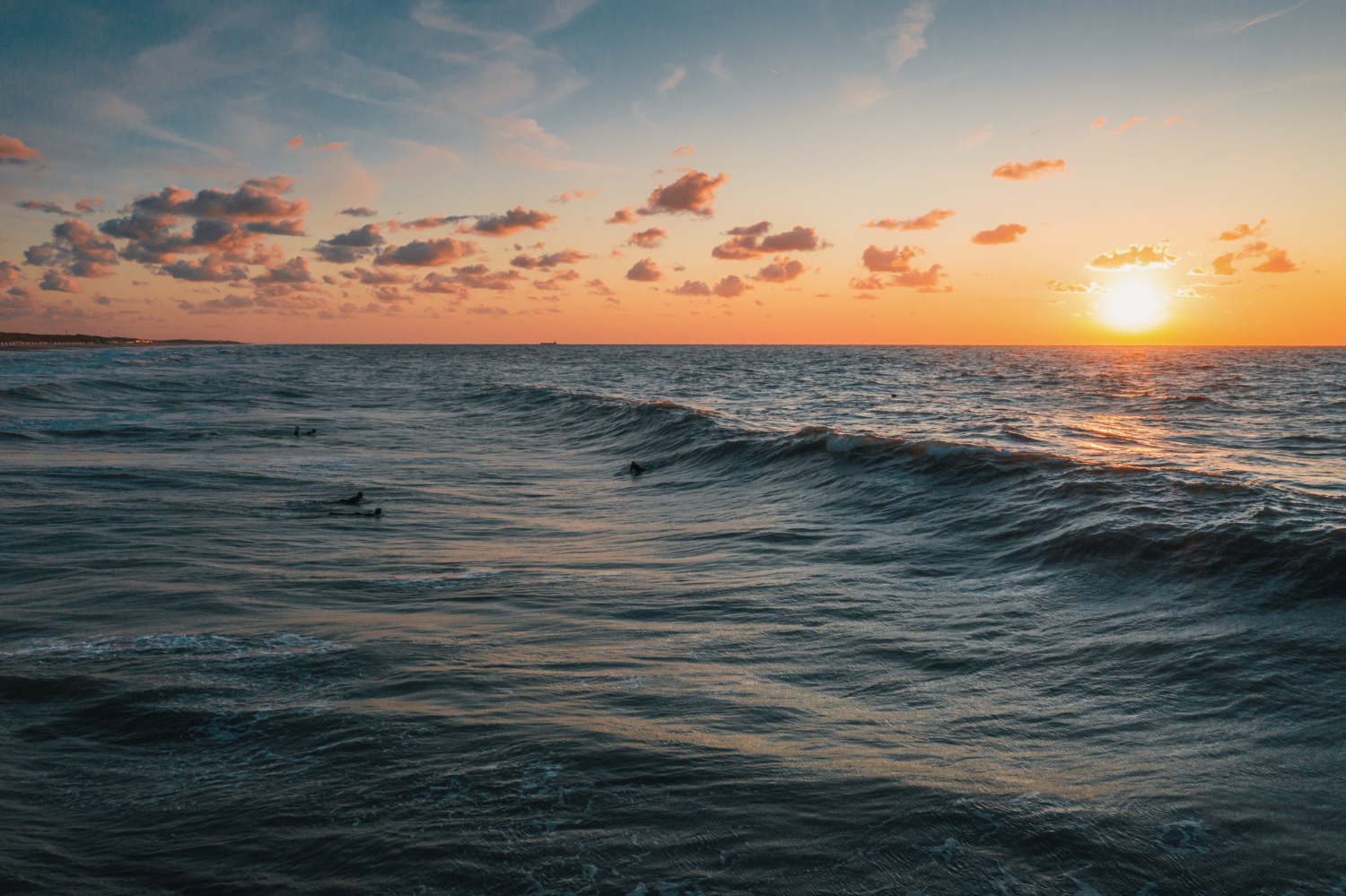
Children ask why the sea is salty, and the standard answer — rivers carry salt into it and evaporation leaves the salt behind — is correct as far as it goes.
What that answer does not address is the far stranger part. If salt has been accumulating in the ocean continuously since there was an ocean, the concentration ought to be climbing without limit. It is not. Ocean salinity has been broadly stable over an extremely long period, and understanding why turns a simple question into a rather good one.
The answer requires knowing where the salt comes from, and then where it goes, and the second half is much less familiar than the first.
Where the Salt Comes From
Two sources supply most of it.
The first is weathering on land. Rain is slightly acidic, because carbon dioxide from the air dissolves into it forming a weak acid. That mildly acidic water falls on rock and dissolves it, extremely slowly, releasing ions — sodium, chloride, calcium, magnesium, potassium, sulphate and others.
Rivers carry those ions to the sea. Individually the quantity in any river is small, which is why fresh water tastes fresh, but the delivery has been continuous for a very long time and the destination has no exit.
The second source is the seafloor itself. Water percolates into the crust at mid-ocean ridges, is heated by the rock beneath, reacts chemically with it, and returns through hydrothermal vents carrying dissolved minerals. Underwater volcanic activity contributes further material directly.
Between them, these two processes have supplied the dissolved content of every ocean.
Like our content? Follow us for more.
Why Evaporation Is the Concentrating Step
The reason the ocean is salty and rivers are not comes down to what leaves.
Water evaporates from the sea surface constantly, and evaporation is highly selective: water molecules enter the atmosphere and dissolved salts do not. The salt stays behind.
That vapour condenses, falls as rain, and returns to the land and the rivers as fresh water, ready to dissolve more rock and carry more ions seaward.
So the water cycles and the salt does not. The ocean functions as the end of the line for anything dissolved, and it has been accumulating for billions of years.
Which is precisely why the stability is surprising. Average ocean salinity is around 3.5 percent — roughly 35 grams of dissolved salts per litre — and it has not been climbing steadily toward saturation.
Where the Salt Goes
The resolution is that the ocean is not a closed container. Salt is removed continuously by several processes, and over geological time removal roughly balances delivery.
The largest mechanism involves the seafloor. Dissolved ions are incorporated into minerals that precipitate out and settle, and they react with hot basaltic rock at mid-ocean ridges, becoming locked into the crust. Sea water circulating through that rock is chemically altered in the process, giving up some of its dissolved load.
Plate tectonics then completes the removal. Ocean crust carrying those minerals is eventually subducted — driven down beneath another plate — taking the salt out of the system entirely.
Biology removes more. Marine organisms build shells and skeletons from calcium carbonate and silica drawn from sea water, and when they die those structures sink and accumulate as sediment on the seafloor.
Evaporite formation removes a great deal in specific circumstances. Where a body of sea water is cut off and evaporates, the dissolved salts crystallise out and are buried as thick mineral deposits. Enormous salt beds around the world are the remains of exactly this process, and much of the salt people eat is mined from them.
Sea spray contributes a little too, carrying salt particles inland where they are deposited on land.
So the ocean is better understood as a system with an input and an output, in approximate long-term balance, rather than a bucket that only fills.
Why Some Seas Are Saltier Than Others
The global average conceals substantial local variation, and the pattern is explained by the same balance.
Salinity rises where evaporation is high and freshwater input is low. Enclosed or semi-enclosed warm seas in dry regions concentrate their contents accordingly.
It falls where fresh water arrives in quantity — near large river mouths, in regions of heavy rainfall, and near melting ice.
The most extreme cases follow the same logic taken further. A lake with no outlet at all in a hot dry climate has only evaporation as an exit, so dissolved material concentrates until the water is many times saltier than the ocean.
Latitude matters too. Sub-tropical regions, where evaporation exceeds precipitation, tend toward higher surface salinity than equatorial regions with heavy rainfall or polar regions with ice melt.
One further piece completes the loop, and it explains why the cycle can run indefinitely.
Evaporation is a phase change: individual water molecules gain enough energy to leave the liquid surface and enter the air as vapour. Dissolved ions cannot do that. They are electrically charged, strongly attracted to the surrounding water molecules, and require far more energy to escape than the process supplies.
So what leaves the sea surface is essentially pure water. The salt stays.
That vapour condenses into cloud droplets and falls as rain, and it arrives on land carrying almost nothing except whatever it picked up from the atmosphere on the way down – dust, dissolved carbon dioxide, and a small amount of sea salt lifted as spray.
Which means the same water that dissolved minerals out of rock, carried them to the sea and left them there is immediately available to do it again, indefinitely, for as long as the sun keeps driving the cycle.
Distillation works on exactly this principle, and desalination plants are essentially industrial versions of what the sun does to the ocean every day at a scale no engineering could match.
What the Salt Is Actually Made Of
Sea water is not simply sodium chloride dissolved in water, though that dominates.
Chloride and sodium together account for the great majority of dissolved solids. Sulphate, magnesium, calcium and potassium make up most of the remainder, with a long tail of other elements present in small quantities.
A striking feature is that the relative proportions of the major ions are remarkably consistent throughout the world ocean, even where total salinity varies. Water can be more or less salty from place to place, but the ratio of the components stays much the same — a consequence of thorough mixing over long timescales.
That consistency is truly useful. It means measuring one property allows the others to be inferred, which underpins a great deal of oceanography, and it is why salinity can be determined by measuring electrical conductivity rather than by chemical analysis of every sample.
How Long the Water Stays
One figure makes the scale of the system easier to grasp, and it concerns time rather than quantity.
Oceanographers describe elements in sea water in terms of residence time — how long, on average, a given atom of something remains dissolved before being removed.
Those times differ enormously by element, and the differences explain a great deal about the composition of sea water.
Sodium and chloride have very long residence times, measured in tens of millions of years. They are chemically unreactive in sea water, few organisms remove them, and they are not readily incorporated into settling minerals, so they accumulate and dominate.
Elements with short residence times behave in the opposite way. Anything readily taken up by organisms or precipitated into sediment is removed quickly, which keeps its concentration low regardless of how much rivers deliver.
That is the actual explanation for why sea water tastes of salt rather than of everything else rivers carry. Rivers deliver a wide range of dissolved material, and most of it is removed rapidly. Sodium and chloride are the components that stay.
So the ocean is not simply concentrating whatever arrives. It is filtering, retaining the persistent elements and shedding the rest, and its taste is a record of what fails to find an exit.
A Question Worth Asking Properly
The reason this is a better question than it first appears is that the naive answer produces a prediction that fails.
Rivers deliver salt, evaporation concentrates it, therefore the ocean gets saltier without limit. That reasoning is sound and the conclusion is wrong, which means something is missing — and the missing piece turns out to be an entire set of removal processes operating on geological timescales, involving mineral precipitation, seafloor chemistry, shell-building organisms, plate tectonics and evaporite burial.
There is a satisfying scale to it. The salt in a mouthful of sea water was dissolved out of rock by slightly acidic rain, carried down a river, and mixed through the ocean over thousands of years. Given long enough it will be incorporated into a mineral or a shell, settle to the seafloor, and eventually be either buried as a salt bed or carried down into the mantle by a subducting plate.
The ocean is not a container that fills. It is a stage in a very slow circulation of material between rock, water and rock again, and the taste of sea water is what that process looks like partway through.
Like our content? Follow us for more.
