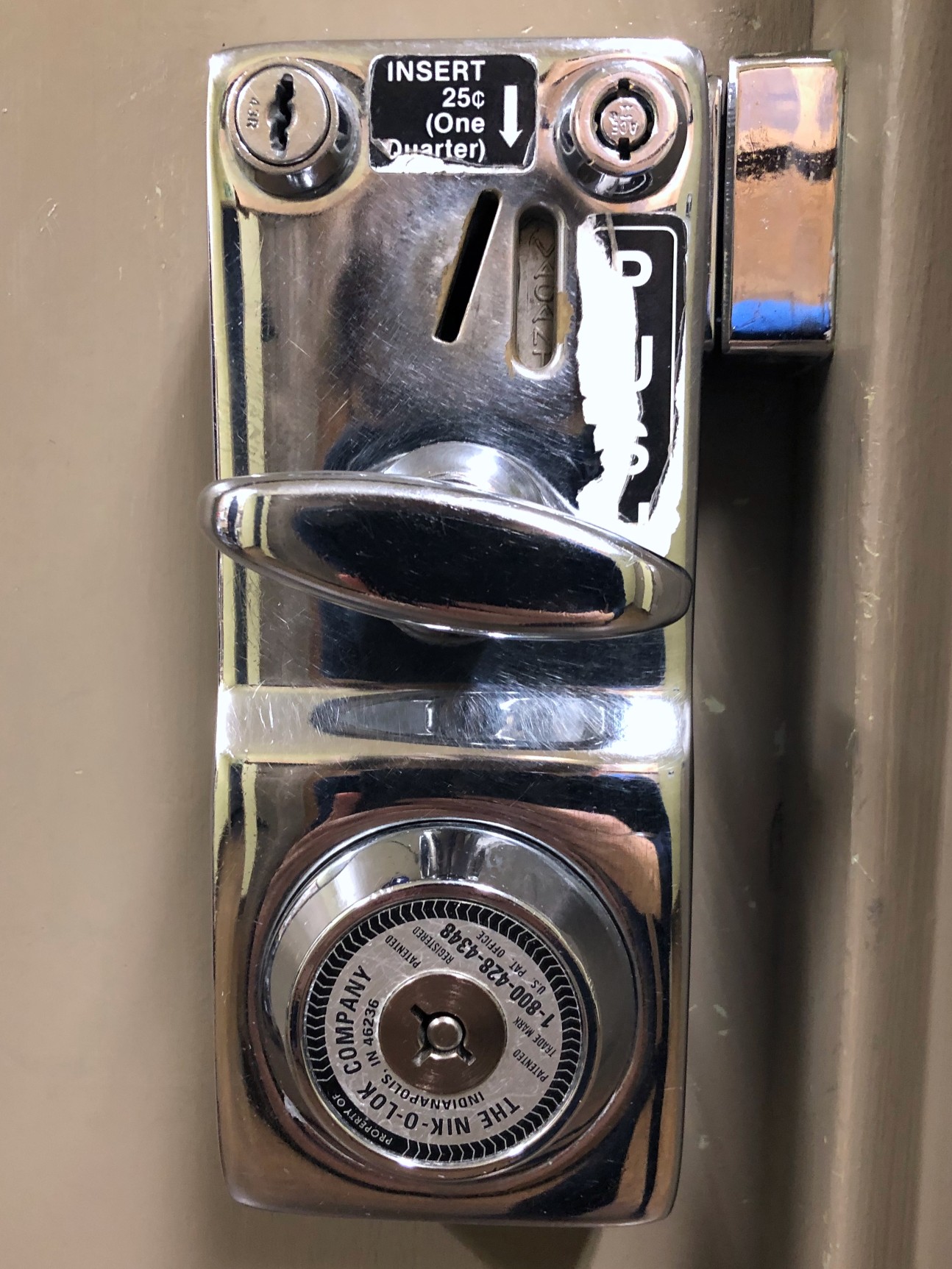
There was a slot on the door of the stall, a chrome plate, and a knob. You put in a dime and turned it, and the latch released and the door opened.
If you had no coin you waited for somebody to come out and caught the door, or you crawled under, or you went without. Everybody who travelled in America before the mid-1970s has a version of this story.
The Mechanism Was Simple and the Door Was the Product
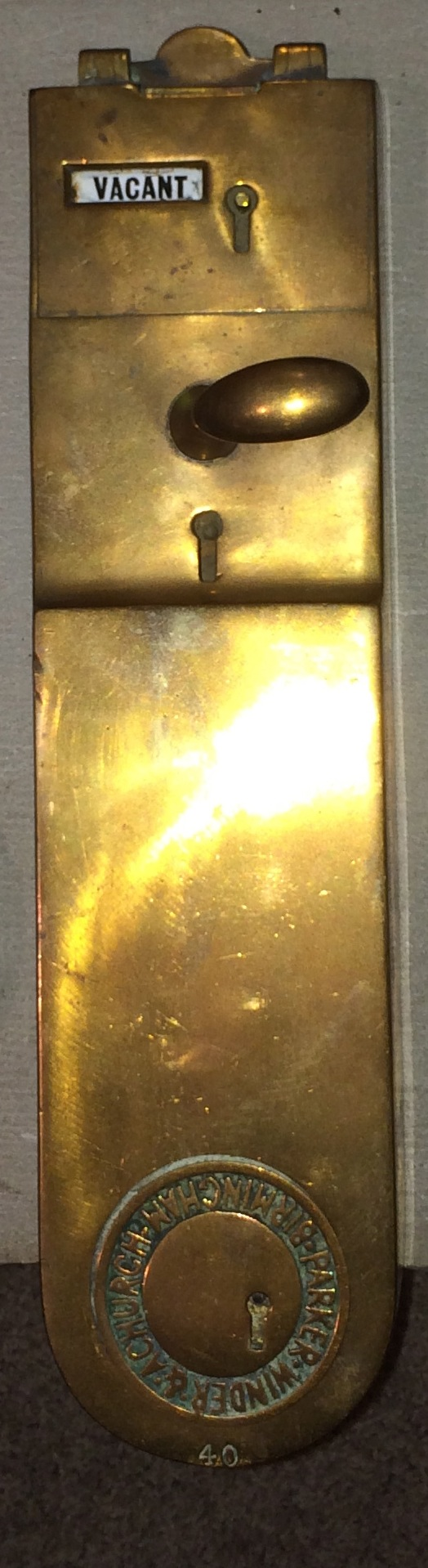
The lock was a self-contained coin mechanism fitted to the stall door, not to the room. Entry to the washroom was free; the sinks were free; the stall was what you paid for.
Inside the chrome plate was a straightforward coin-operated latch: the coin dropped into a chute, allowed a cam to turn, the cam withdrew a bolt, and the door opened. Turning the knob back reset it and the coin fell into a locked box emptied on a collection round, in the same way payphone vaults were emptied.
A washroom typically had a mixture – several paid stalls and one free stall, or in some places no free stall at all. The free one, where it existed, was the one with the queue.
Like our content? Follow us for more.
And That Created the Asymmetry That Ended Them
Here is the fact that the whole history turns on.
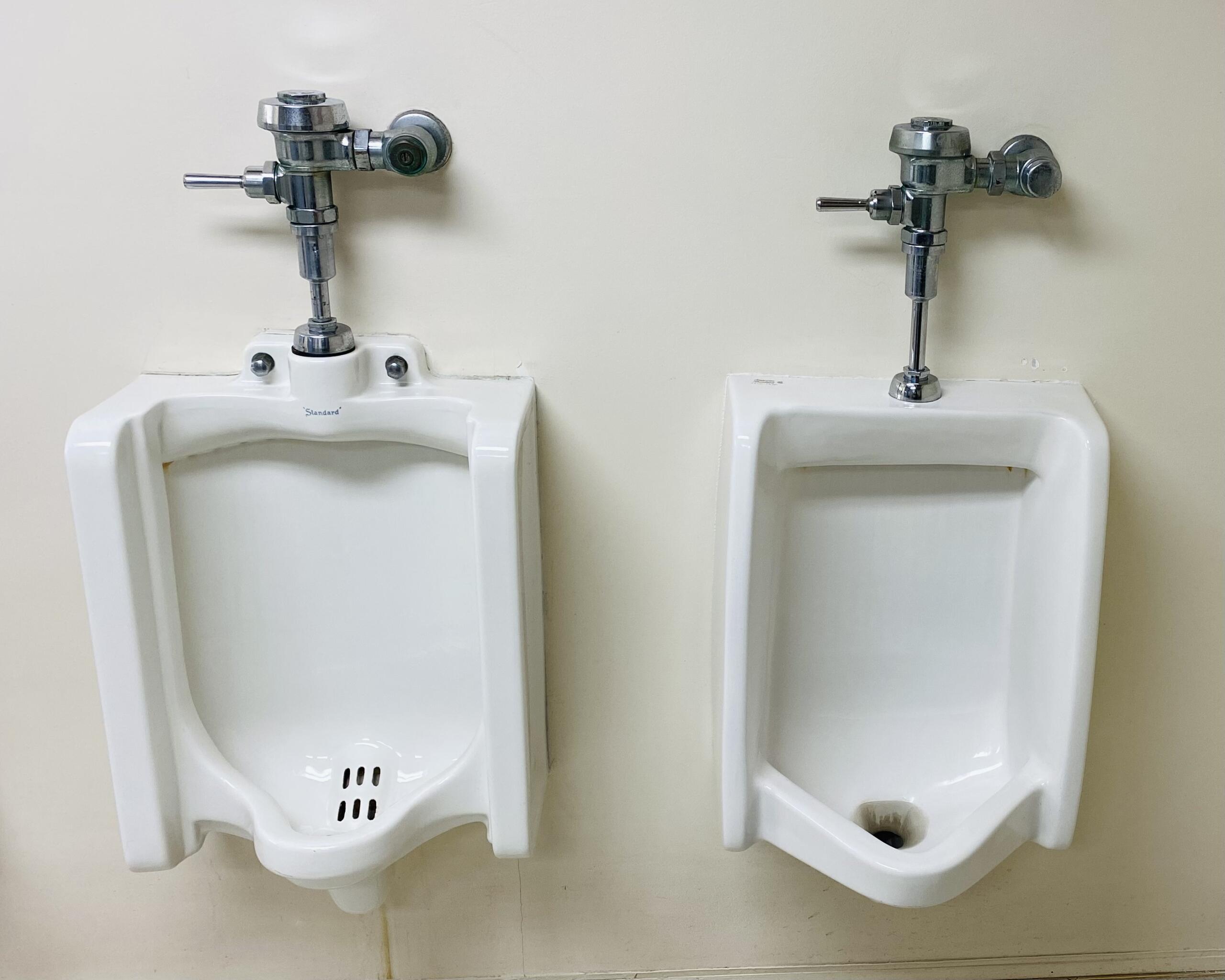
A men’s washroom contains urinals, and urinals were free. There was no mechanism on them and no practical way to fit one. So a man entering a pay-toilet washroom could, in most cases, use it for nothing.
A women’s washroom contains only stalls. Every one of them had a lock on it.
That meant the charge fell almost entirely on women, and it fell on them every single time, for the same bodily necessity that men were meeting free of charge in the same building. It also fell disproportionately on anybody with a medical need, on parents with small children, and on people with no money.
This was not an obscure observation. It was obvious to everybody who used a washroom, it was discussed, and it was the argument that eventually did the job.
The Campaign Was Started by Students
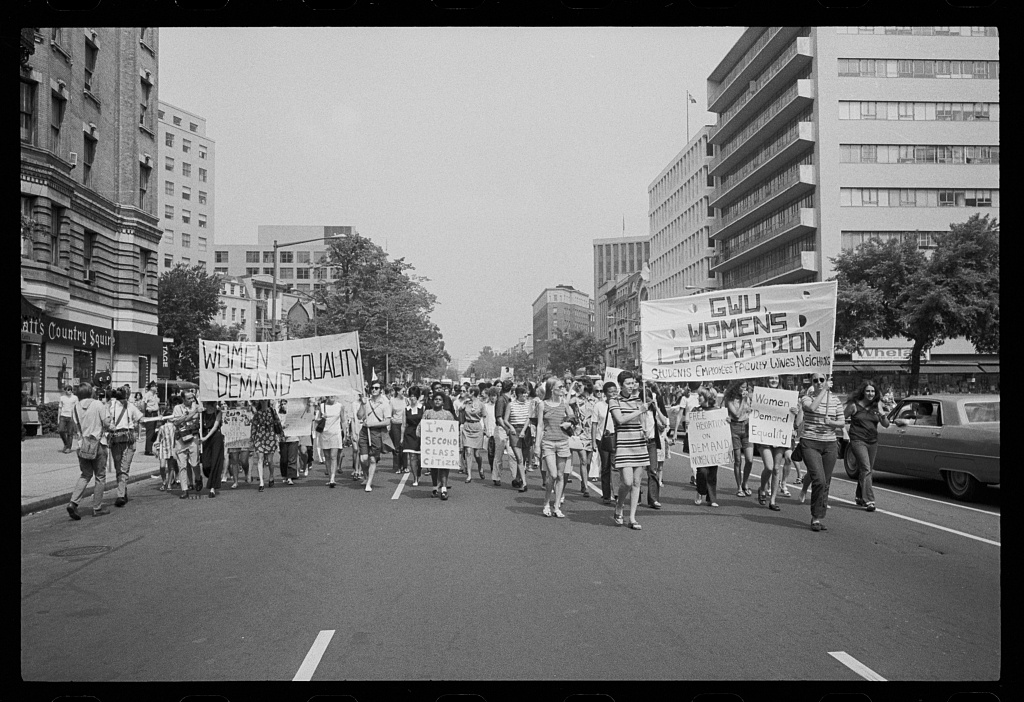
In the early 1970s a small American organisation formed specifically to abolish pay toilets. It was founded by students – a group of siblings and their friends, operating on a tiny budget out of a bedroom – and its entire purpose was to get coin locks removed from stall doors.
They worked it as a straightforward civil equality argument: a public facility charging one sex for something it provides the other sex free is unequal treatment, in a context where the need is universal and not deferrable. They lobbied state legislatures, wrote to newspapers, gave interviews, and produced a newsletter.
It worked, and quickly. Through the mid and later 1970s a succession of American states and cities passed laws prohibiting pay toilets in public accommodations. Once the first few went, the rest followed, and the fixtures came off the doors over about a decade.
It is one of the better documented cases of a tiny, unfunded, single-issue campaign achieving its entire stated objective within a few years and then dissolving because there was nothing left to do.
The Case for Them Was Not Nothing
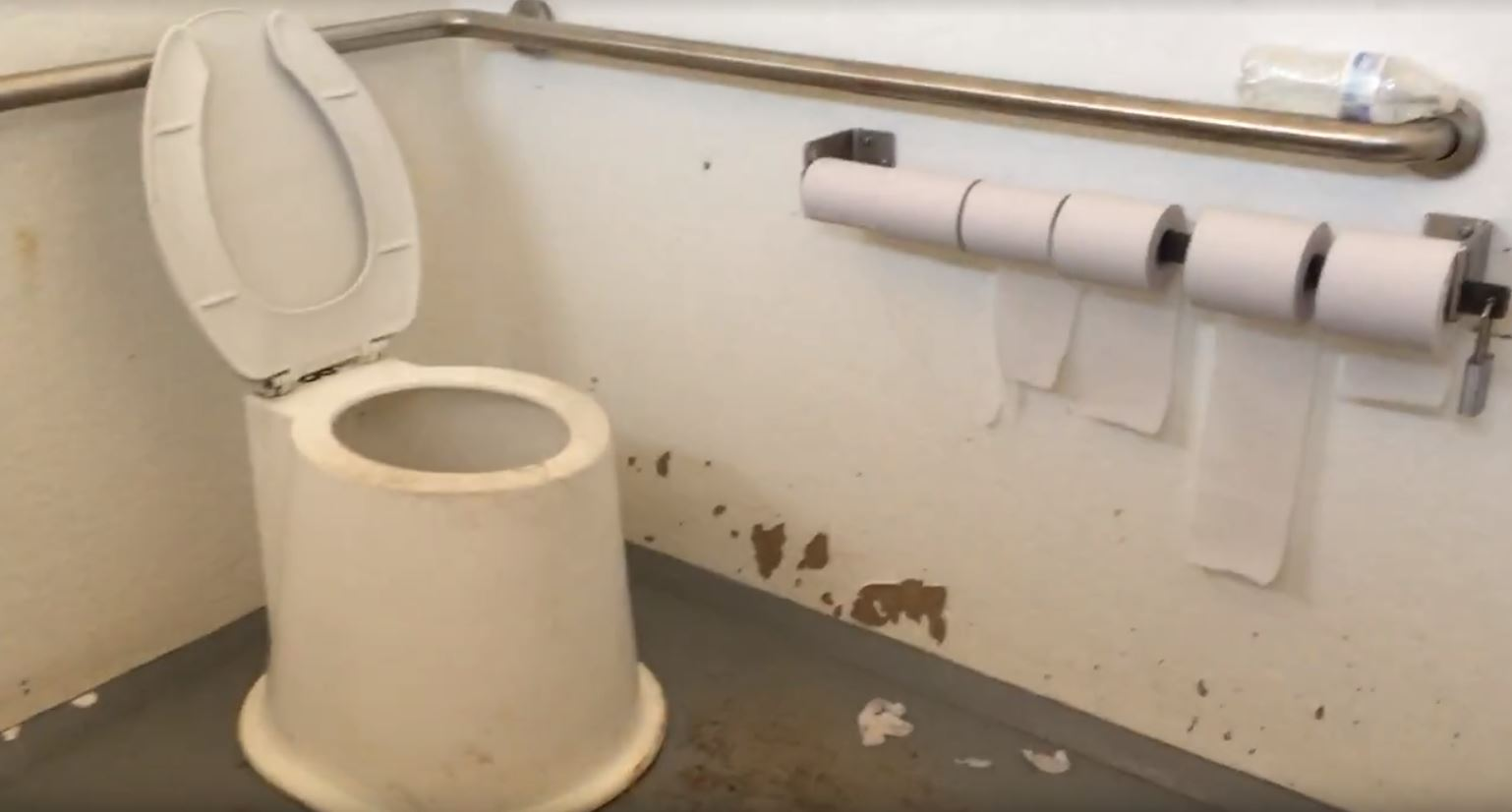
It is worth putting the other side, because the operators had an argument and it was not purely cynical.
A public washroom costs money. It has to be cleaned repeatedly through the day, supplied, repaired and supervised, and it suffers vandalism and misuse. Operators of bus stations, railway stations, airports and department stores argued that the coin served two functions: it contributed to the cost of maintenance, and it discouraged people from using the stalls for things other than their intended purpose.
The second argument carried more weight with the public than the first. A ten cent charge does not meaningfully fund a cleaning programme, but a locked door does change who comes in – and operators were explicit that part of what they were buying was the exclusion of loitering and of people with nowhere else to go.
Which is the honest reading of the pay toilet: a small revenue item attached to a filtering mechanism, justified on maintenance grounds. The campaign’s answer was that whatever the merits, the cost of the filter was being charged to women and to the poor, and that is not a defensible way to allocate it.
What Happened to the Washrooms Afterwards
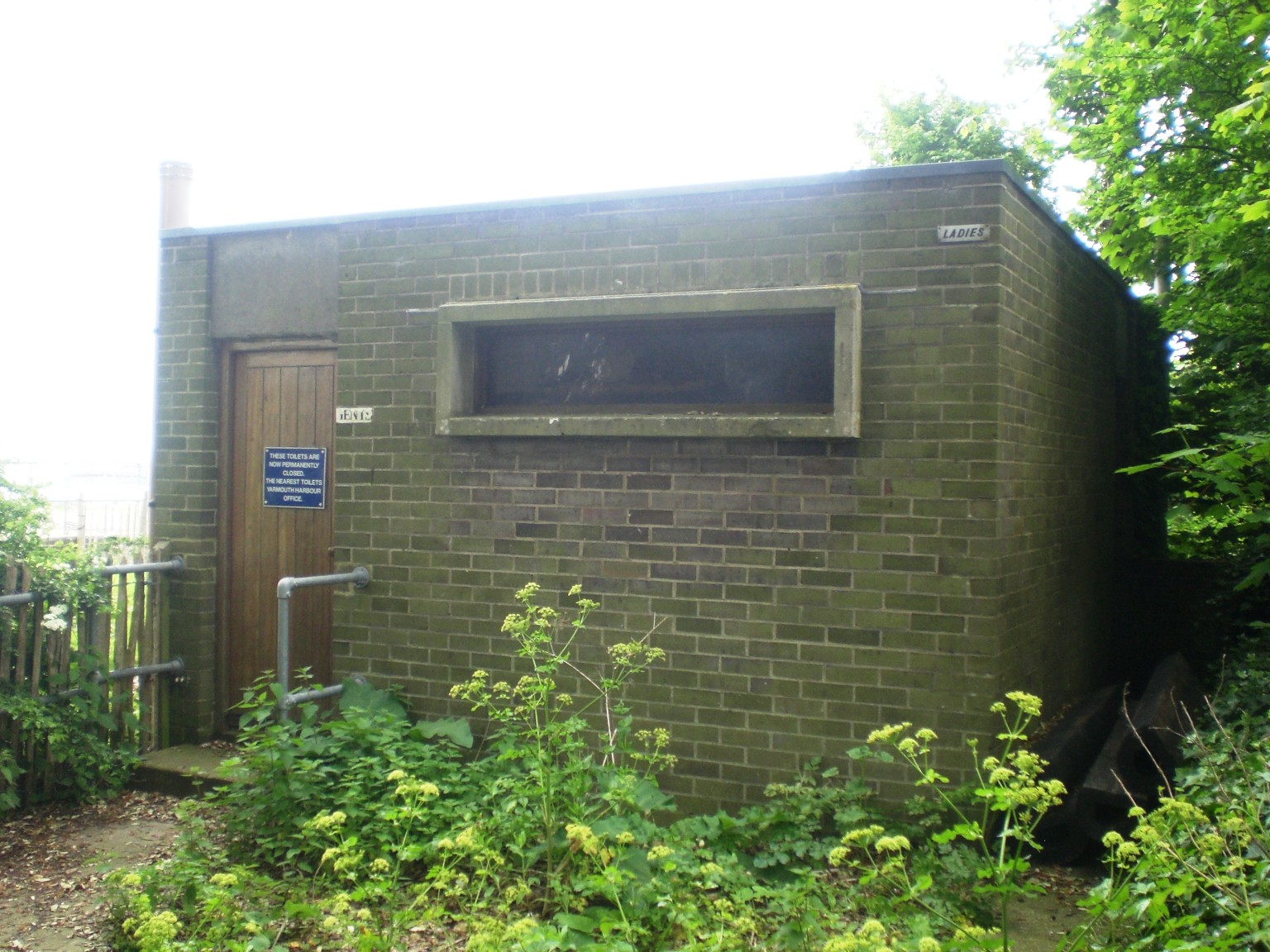
The bans removed the coin and left the underlying problem, which is that somebody still has to pay for the cleaning.
What followed, over the next few decades, is the arrangement Americans now live with. Public washrooms in publicly accessible buildings largely stopped being provided by anybody whose job it was to provide them, and became something attached to a business. The washroom in a fast food restaurant, a coffee shop, a department store or a petrol station is free, and it is free because you are expected to be a customer.
Some of them require a key, a code on a receipt, or a staff member to open a door. That is the pay toilet’s filtering function, re-implemented without the coin – and it is applied by judgement rather than by a flat charge, which has its own problems.
Dedicated public facilities, meanwhile, were closed in large numbers across American towns and cities on cost grounds, and the United States now has notably fewer public toilets per head than most comparable countries.
They Were Everywhere, and the List Is Longer Than People Remember
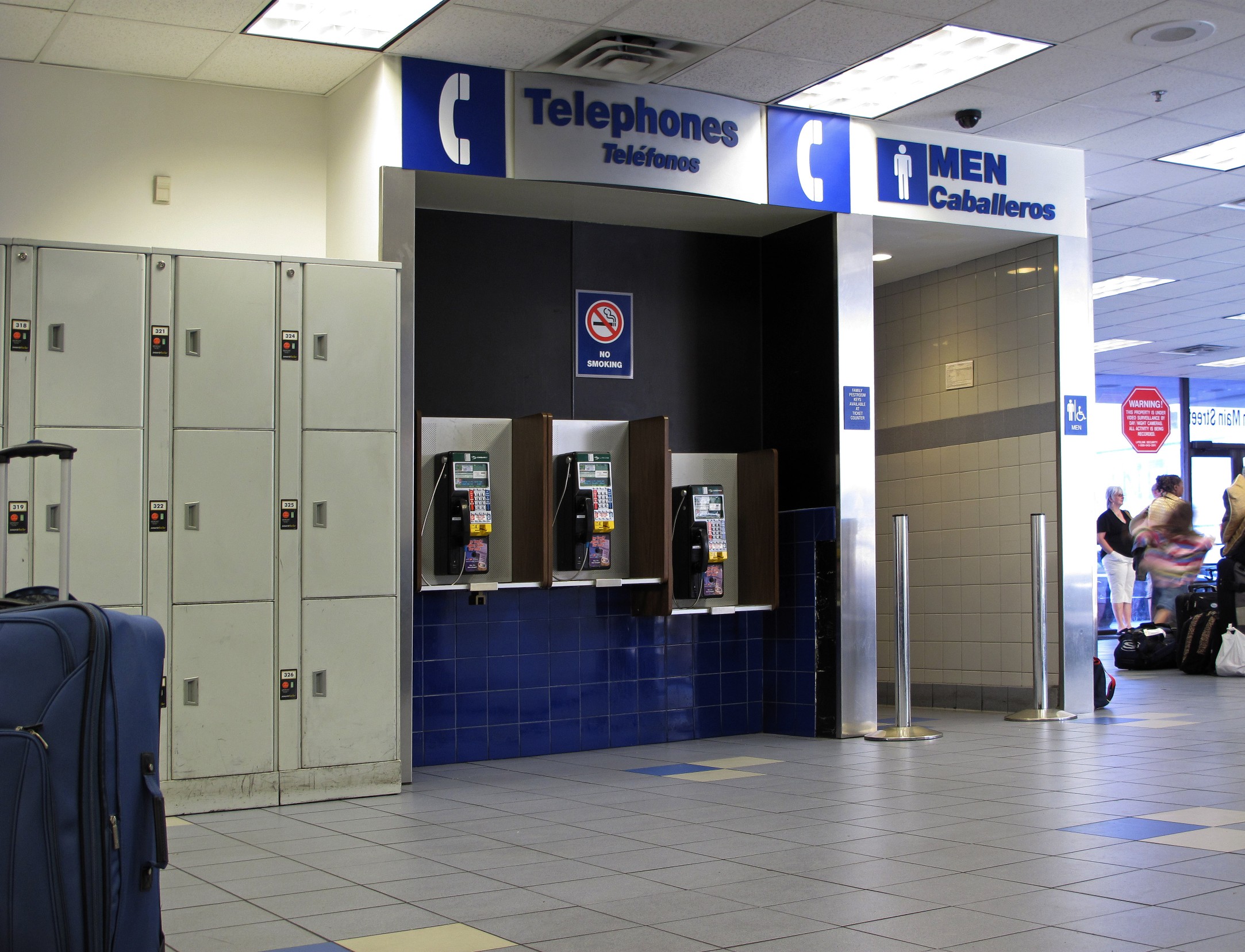
The coin lock was not confined to bus stations, which is how it tends to be remembered.
They were in railway stations and airports, in department stores, in the washrooms of large office buildings, at service plazas on turnpikes, in some parks and municipal buildings, at fairgrounds and amusement parks, and at a great many petrol stations – which in that period frequently had the only washroom for miles on a highway.
The highway case is the one that produced the most complaint, and for an obvious reason. A family on a long drive, with children, stopping at the only facility available, found that the stall required a coin that nobody in the car necessarily had – and there was no change machine, no attendant obliged to help, and no alternative for forty miles.
That is also why the campaign found its argument so easy to make in public. It did not need a theory. It needed people to recall the last time they had stood outside a locked stall door going through a pocket, and almost everybody could.
The Dime Was Not Trivial Either
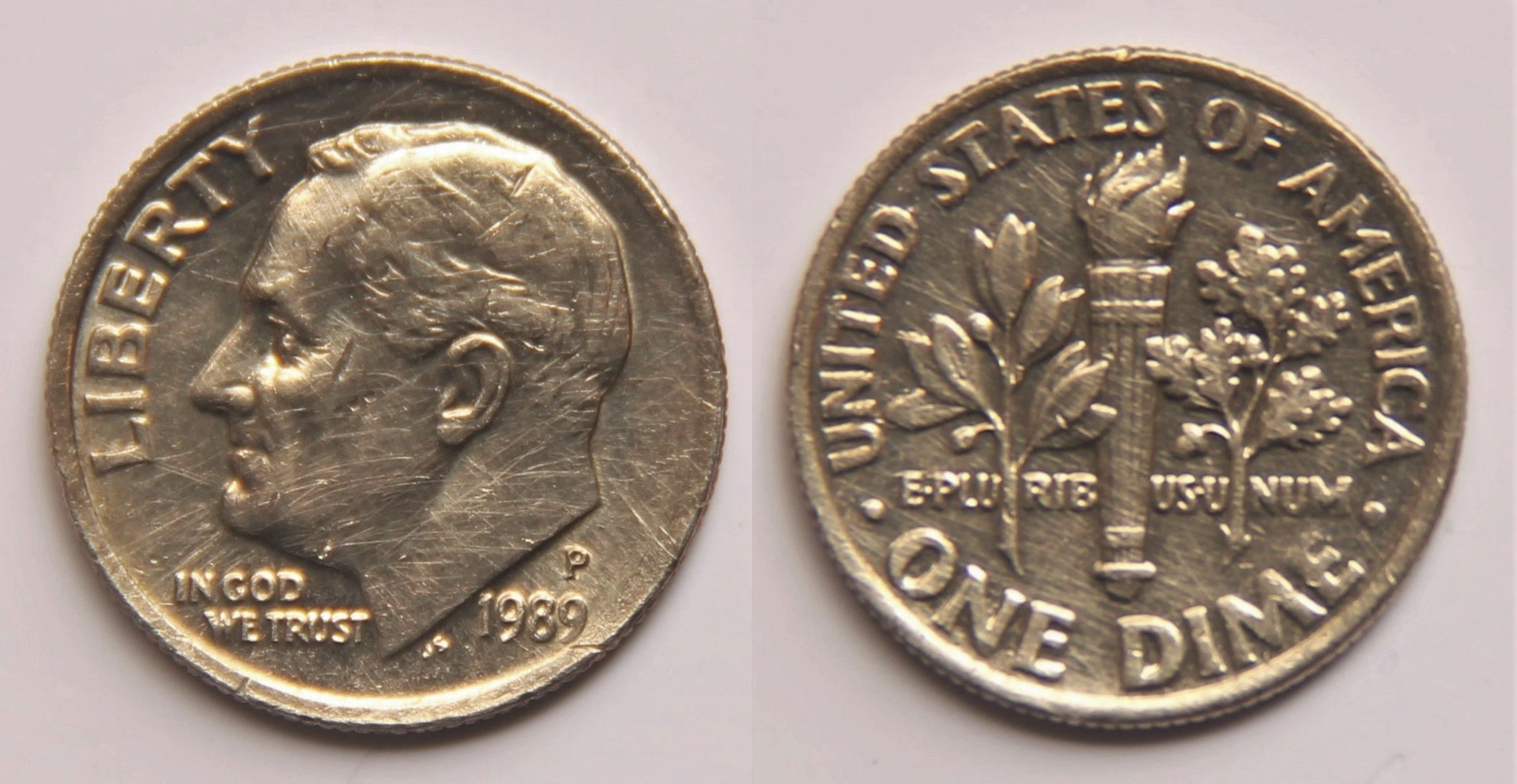
It is tempting to dismiss the charge as small, and the arithmetic deserves a sentence.
The typical charge was a dime, which was also the price of a local telephone call for most of this period. A family of four travelling across the country, stopping several times a day, over several days, with the charge falling on each stall use, was spending a noticeable amount on a necessity – and doing it in coins, which had to be found and kept separate for the purpose in exactly the way toll change was.
For somebody with no money at all, the amount is irrelevant and the door is simply locked. That was the circumstance the campaign kept returning to, and it is the one the operators’ maintenance argument never addressed, because a maintenance contribution levied on people who cannot pay it does not collect anything. It just excludes them.
The Twist: The Charge Came Back Without the Coin
The pay toilet is usually told as a clean victory, and on its own terms it was one. A charge that fell on one sex and on the poor was identified, campaigned against and legislated away by a handful of students in about five years, which is a genuinely good story.
But the thing the coin was doing did not go away, and that is the part worth noticing.
The coin was rationing access, and the operators said so. Remove the coin and the rationing has to happen some other way, and what it moved to was customer status – a code on a receipt, a key behind a counter, a staff member deciding whether you look like somebody who bought a coffee.
A dime was a bad way to allocate access to a toilet, for all the reasons the campaign gave. It also had one property that the replacement does not: it was the same dime for everybody, it did not involve being looked at, and it did not require you to explain yourself or buy anything.
So the comparison is not simple. The coin was unequal by sex and by income, which is why it was abolished and why it should have been. What replaced it is unequal by appearance and by purchasing power, applied case by case, with no published rule and no appeal.
The campaign won the argument it made, completely. The question underneath it – who is responsible for providing a toilet to a person walking through a town – was never answered at all, and the answer that emerged by default is that nobody is.
Like our content? Follow us for more.