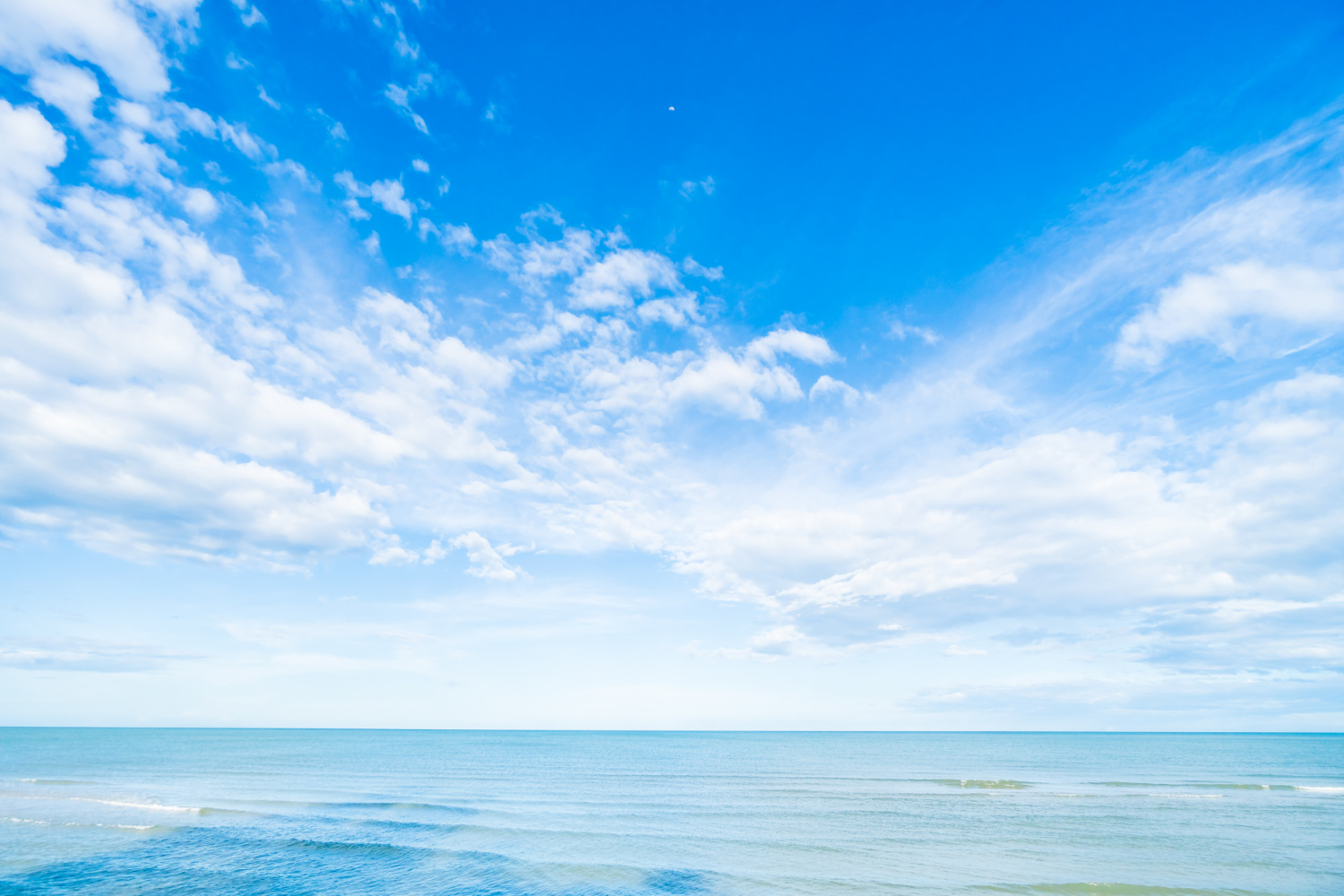
Ask why the sky is blue and you will get one of three answers. That it reflects the sea. That the atmosphere is somehow blue in the way tinted glass is. Or a vague reference to light scattering, offered with the confidence of someone who has heard the phrase and would rather not be asked a follow-up question.
The first two are wrong. The third is right, and the details are more satisfying than the summary, because the same mechanism explains a set of things that look unrelated.
Sunsets. The colour of the sun. Why distant mountains look hazy blue. Why the sky is black in photographs taken from the Moon. All of it follows from one property of how light interacts with very small particles.
Here is the actual explanation.
Sunlight Is Not White

The starting point is that sunlight contains all visible wavelengths, which our eyes combine into what we perceive as white.
Those wavelengths differ in length. Red light has the longest wavelengths in the visible range, around 700 nanometres. Violet and blue sit at the short end, around 400 to 450. The others fall in between.
That difference in wavelength is the entire basis of what follows, because particles interact with light differently depending on how the wavelength compares to the particle’s size.
The atmosphere is mostly nitrogen and oxygen molecules, and these are far smaller than the wavelength of visible light. That size relationship determines which kind of scattering dominates.
Like our content? Follow us for more.
Small Particles Prefer Short Wavelengths

When light encounters particles much smaller than its wavelength, the result is what physicists call Rayleigh scattering, named after the nineteenth-century physicist who worked it out.
The essential feature is how strongly the effect depends on wavelength. Scattering intensity varies with the inverse fourth power of wavelength, which is a steep relationship: halve the wavelength and you scatter sixteen times as much.
In practice, blue light is scattered several times more strongly than red by the same air. Rather than passing straight through, blue light is redirected repeatedly by molecule after molecule, bouncing around the sky in all directions.
So when you look up at a part of the sky away from the sun, you are not looking at sunlight travelling directly toward you. You are seeing scattered light, arriving from every direction, dominated by the wavelengths that scatter most — which is blue.
The sky is blue because blue is the light that has been thrown sideways.
Why Not Violet

There is an obvious objection. Violet has a shorter wavelength than blue and should scatter even more strongly, so why is the sky not violet?
Two reasons combine.
The first is the sun itself, which does not emit equally across all wavelengths. It produces less violet than blue, so there is less violet available to scatter.
The second is our eyes. Human colour vision uses three types of cone cell, and their sensitivity is not evenly distributed. We are substantially less sensitive to violet than to blue, and the combination of cone responses to the scattered mixture is perceived as blue.
So the sky’s colour is partly a fact about physics and partly a fact about the equipment looking at it. A creature with different visual pigments would see a differently coloured sky above the same atmosphere.
Sunsets Are the Same Effect Running Longer

Here is where one mechanism explains something that looks like a separate phenomenon.
When the sun is overhead, its light passes through a relatively short path of atmosphere to reach you. Some blue is scattered out, and the sky glows blue while the sun still looks yellowish-white.
When the sun is near the horizon, its light enters the atmosphere at a shallow angle and travels through a much longer column of air before reaching your eye — many times the vertical distance.
Over that longer path, scattering removes progressively more of the short wavelengths. Blue and green are scattered away almost entirely, leaving the wavelengths that resist scattering: orange and red.
So a red sunset is not a different effect. It is the same scattering, applied for long enough to strip out everything except the long wavelengths.
This also explains why the sun looks yellow rather than white during the day. Some blue has already been removed from the direct beam, shifting the remainder toward yellow. From orbit, above the atmosphere, the sun appears white.
Particles larger than air molecules — dust, smoke, pollution, salt — scatter differently and can intensify or alter sunset colours, which is why some evenings produce far more dramatic skies than others.
A detail most people notice without registering is that the sky is not uniformly blue. It is pale and washed out near the sun and deepest overhead or on the opposite side.
Scattering is not evenly distributed in direction. Rayleigh scattering sends light preferentially forward and backward relative to its original path, with less at right angles.
Look near the sun and you are seeing light scattered only slightly off its original course, which includes a large proportion of all wavelengths, so the sky there appears whitish. Look well away from the sun and you are seeing light that has been turned through a large angle, which is far more strongly weighted toward the short wavelengths, so it appears a deeper blue.
Altitude compounds it. On a mountain there is less atmosphere above you, so less scattered light overall, and the sky appears darker and more saturated. Climb far enough and it approaches black, which is what high-altitude balloon footage shows.
Humidity and particulates work the other way, adding larger scattering particles that whiten the sky, which is why the blue is deepest in cold, dry, clean air.
The Moon Proves It

The cleanest confirmation comes from somewhere with no atmosphere.
Photographs taken on the lunar surface show a black sky, with stars absent from most images only because of camera exposure settings. The sun is shining, the ground is brightly lit, and the sky above is black.
That is exactly what the scattering explanation predicts. Sky colour requires something to scatter light. With no atmosphere, sunlight travels in straight lines from the sun to the surface, and none of it is redirected toward an observer looking away from the sun. Nothing between you and space means nothing to see.
The same logic explains the blue haze over distant mountains. Light reflecting from a distant ridge travels through a long column of air before reaching you, and scattered blue light from that air is added along the way, layering a blue wash over the view. Painters have exploited this for centuries under the name aerial perspective, and it works as a depth cue precisely because the atmosphere is doing the scattering.
Why Clouds Are White

The scattering explanation makes a testable prediction, and clouds are the test.
Cloud droplets are not molecules. They are vastly larger — comparable to or bigger than the wavelength of visible light — and that changes the physics entirely.
When particles are that size, scattering stops depending steeply on wavelength. All colours are scattered roughly equally, in a regime physicists distinguish from the molecular case. Equal scattering of all wavelengths means the light emerging is still a mixture of everything, which we perceive as white.
That is why clouds are white rather than blue, despite being made of water in air.
It also explains why thick clouds look grey. A dense cloud scatters light so many times that much of it is redirected back upward rather than reaching the ground, so the underside receives less and appears darker without any change in colour.
The same principle covers fog, milk and white paint, all of which look white for the same reason: particles large enough to scatter every wavelength without preference.
So the sky and the clouds within it demonstrate two different scattering regimes simultaneously, separated only by the size of the thing doing the scattering.
The Ocean, and Why the Myth Persists
Which returns us to the reflection idea, and it is worth addressing directly because it is so widespread.
Water is not colourless in bulk. Water molecules absorb light at the red end of the spectrum more than at the blue end, so a sufficient depth of water appears blue on its own account. That is a different mechanism — absorption rather than scattering — and it is why a swimming pool with white tiles looks blue.
Surface reflection also matters. A calm sea reflects the sky, which is why the water looks grey under cloud and blue on a clear day. So the causal arrow, to the extent there is one, runs from sky to sea rather than the reverse.
The myth survives for an understandable reason: two blue things are next to each other, and the human instinct is to connect them. It is a reasonable guess that happens to be wrong.
There is something worth appreciating in the actual answer. The colour of the sky is not a property of the air, which is transparent. It is a property of an interaction — of light meeting particles smaller than itself and being redirected according to a fourth-power relationship — combined with the specific sensitivity of the eyes doing the looking.
Every clear day, that relationship is being demonstrated over your head at planetary scale, and every sunset is the same demonstration run through a longer stretch of air.
Like our content? Follow us for more.