The conversion of sound to signal was solved early and has changed comparatively little in principle. Connecting any telephone to any other took a century of engineering. Here are fourteen problems and their answers.
1. Sound Has to Become Electricity and Back

A microphone converts pressure variations in air into a varying electrical signal, and an earpiece converts that signal back into pressure variations.
Both are transducers doing the same job in opposite directions. Conversion at each end is the part that was solved first and stayed solved.
2. Connecting Everybody to Everybody Is Impossible

A network where every telephone has a direct line to every other requires a number of connections that rises with the square of the users, which becomes unmanageable almost immediately.
A few hundred users would need tens of thousands of wires. The connection problem is what the entire system exists to solve.
3. So Everything Connects to One Point Instead

Running a single line from each telephone to a central location, and joining lines there as required, reduces the wiring to one connection per user regardless of how many users there are.
That is an enormous simplification. The central exchange is the idea that made networks possible.
4. Somebody Had to Make the Connection

Early exchanges were operated by people who answered each call, asked which number was wanted and physically joined the two circuits with a cord.
The whole network ran on human beings plugging in cables. Manual switching is how every call was connected for decades.
5. And Knew a Great Deal About Everybody

An operator handling a small community heard every call request, knew who was calling whom and frequently knew where people were – which was accepted at the time as unremarkable.
It was a substantial concentration of local knowledge. The operator role is the position automation removed entirely.
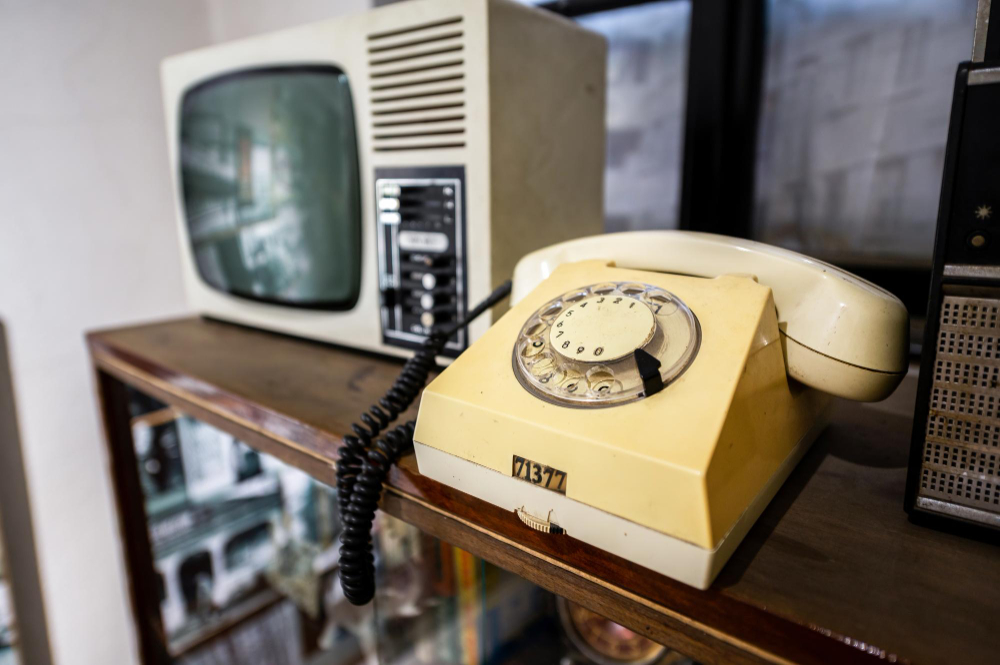
6. The Dial Sends Counted Pulses

Turning a dial and releasing it produces a series of interruptions in the circuit, one per digit value, and mechanical equipment at the exchange counts them and moves a selector accordingly.
The clicking is the number being transmitted. Pulse dialling is counting implemented as interruptions.
7. The Speed Was Set by the Dial, Not the User

The dial returns under spring tension at a fixed rate, which means the pulses are correctly timed regardless of how fast or slowly the user turns it.
That is why it cannot be hurried. Governed return is the detail that made the mechanism reliable.
8. Tones Replaced Counting
Later systems sent a pair of audio frequencies for each digit instead of counting pulses, which is faster, works over the voice channel and allows signalling during a call.
The sound is two notes played together. Tone signalling is what replaced mechanical counting.
9. Numbers Had to Be Structured

A number is not an arbitrary label – it is a hierarchical address, with leading digits identifying a region, then an exchange, then a line, so routing decisions can be made progressively.
Each stage only needs to read the next part. Hierarchical numbering is what makes routing possible without any central directory.
10. Exchanges Had to Connect to Each Other

Once every area had an exchange, those exchanges required connections between them, producing a network of trunk routes carrying many conversations between centres.
The hierarchy repeats at a larger scale. Trunk networks are the exchanges solving their own connection problem.
11. One Call Occupied a Whole Circuit

Under the traditional system, a connection reserved a dedicated path for the entire duration of a call, whether anybody was speaking or not.
Silence used exactly as much capacity as speech. Circuit switching is why capacity was so tightly limited.
12. Sharing the Line Solved That

Dividing signals into pieces and interleaving them allowed many conversations to share one physical connection, using capacity only when there was something to send.
The pieces are reassembled at the far end. Shared capacity is the change that removed the fundamental limit.
13. Distance Weakens the Signal

A signal travelling along a wire loses strength and definition, which required amplification and correction at intervals for any long-distance connection to be intelligible.
Long routes needed equipment along their length. Signal loss is the constraint that made distance expensive.
14. The Old Network Is Still Underneath

The exchanges, the routes between them and a great deal of the physical cable were built for the original system and continue to carry later ones, which is why the geography of the network reflects decisions made long ago.
New systems inherited the old map. Persistent infrastructure is why the network still has the shape it was given.
Not Sound, but Connection

Every telephone connecting to one point, a switch making the join, a number acting as an address and a hierarchy of exchanges routing between regions – all of it solving the impossibility of wiring everybody to everybody.
The second item is the one that reframes the whole subject. A telephone is a straightforward device and a telephone network is an extremely hard problem, because the number of possible connections grows far faster than the number of users – and every exchange, dial, area code and routing rule exists to avoid ever having to build most of them.