
The claim has everything a good piece of trivia needs. It is counterintuitive, it explains an observation you can go and verify, and it makes the physical world feel stranger and more alive than it appears. Solid glass, secretly liquid, creeping down cathedral walls over eight hundred years.
It also has the useful quality of being sayable in a pub with total confidence. Many of us learned it in school, from teachers who believed it, presented as an example of how ordinary matter is weirder than it looks.
The observation underneath it is real: many old window panes really are measurably thicker at the bottom. The explanation is not. Glass does not flow at room temperature in any meaningful sense, the panes are uneven for an entirely different reason, and the actual explanation says something more interesting about how things used to be made. Here is the correction.
What Glass Actually Is

Part of why the myth has proved so durable is that glass really is unusual, and the technical vocabulary describing it has caused real confusion.
Most solids are crystalline. Their atoms sit in a repeating, orderly lattice, which is what makes a grain of salt or a sugar crystal what it is. Glass is not like that. Its atoms are arranged without any long-range repeating pattern, in a disordered structure that resembles the arrangement in a liquid, frozen in place.
This makes glass an amorphous solid, a category that sits somewhere between the tidy definitions of solid and liquid. It is rigid, it holds its shape, it fractures rather than pours, and the material it most closely resembles chemically and physically is quartz, which nobody disputes is a solid.
The trouble arrived with the phrase “supercooled liquid,” which has been used in some explanations to describe glass’s disordered structure. That is a statement about atomic arrangement. But tell people something is a supercooled liquid and they will reasonably picture it behaving like a liquid, which is precisely the leap the myth depends on. The terminology did real damage.
Like our content? Follow us for more.
Running the Numbers
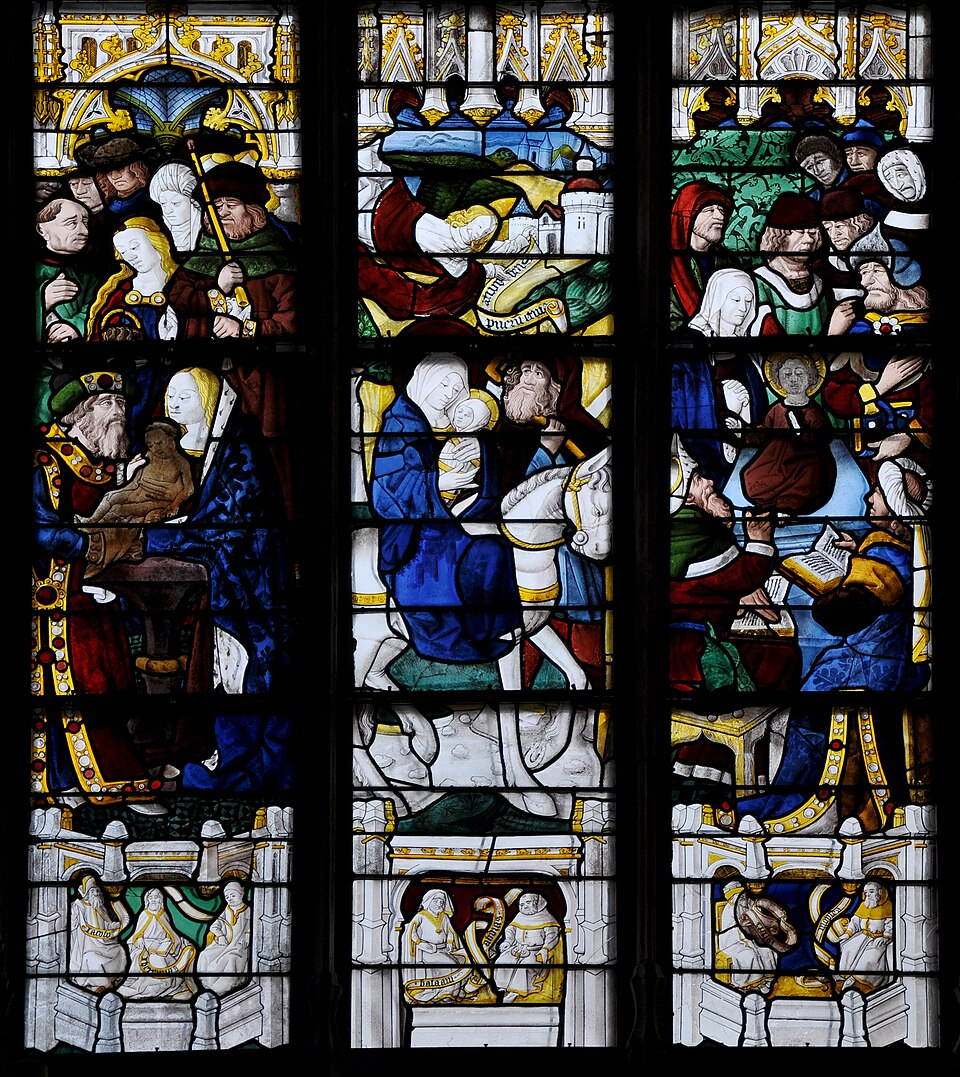
The decisive response to the myth is not rhetorical. It is arithmetic.
The Brazilian materials scientist Edgar Zanotto worked out how long it would take ordinary window glass to flow visibly at room temperature, based on its measured viscosity. The figure comes out on the order of 10 to the power of 23 years.
That number is difficult to feel, so it is worth translating. The universe is roughly 14 billion years old. The time required for a cathedral window to sag perceptibly is somewhere around a trillion times that. The Sun will have exhausted itself and the galaxy will have been rearranged many times over before a window pane at room temperature shows any measurable droop.
The physical reason is that flow depends on temperature. Glass has a glass-transition temperature above which its molecules become mobile enough to move meaningfully, which is why glass can be worked when hot. Cathedral glass sits hundreds of degrees below that threshold. Whatever molecular motion is occurring is so slow that it cannot produce a visible change on any timescale that means anything.
A related claim, that glass slowly turns crystalline as it ages, is also false. Left at room temperature it stays amorphous essentially forever. A window installed this year will have the same structure in a thousand years.
The Evidence Against, From the Windows Themselves
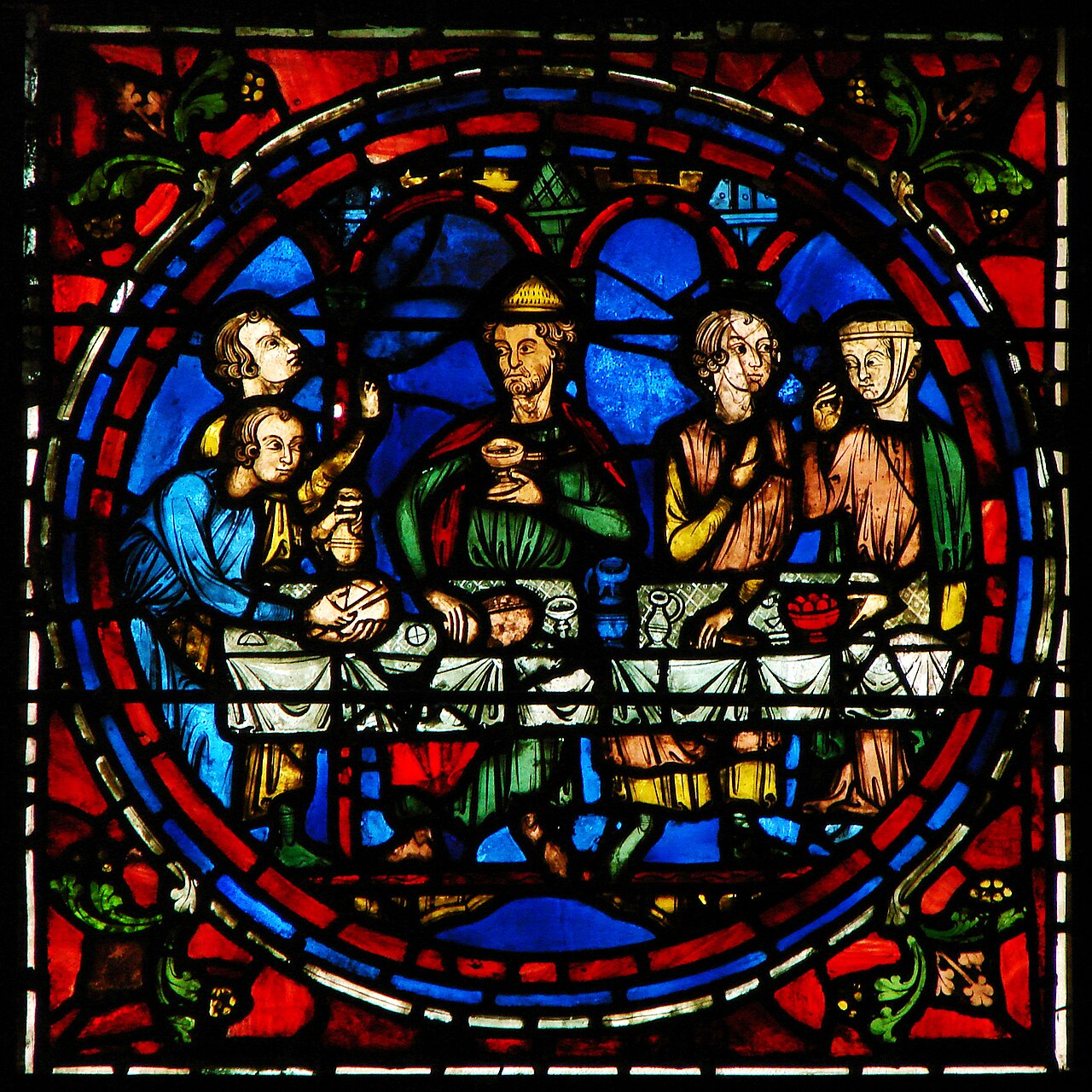
Beyond the calculation, the myth fails several straightforward observational tests, and this is where it really falls apart.
If old panes were sagging under their own weight, the effect should be consistent. Older glass should be more distorted than newer glass, in proportion to age. Instead, thickness variation in old panes is all over the place: some are thicker at the bottom, some at the sides, some at the top.
Flowing glass would also produce other signatures. Material moving downward would deform around the frame and eventually squeeze past it. That is not observed.
The most damaging counterexample is chronological. Ancient Egyptian glass vessels, thousands of years older than any cathedral window, show no sagging whatsoever, as researchers at glass museums have pointed out. If glass flowed at any perceptible rate, objects three thousand years old would be the most distorted things in any museum. They are not.
Why the Panes Are Really Uneven

The actual explanation is a manufacturing story, and it is more interesting than the myth once you picture the process.
Before modern methods, window glass was commonly made by the crown glass technique. A glassblower gathered a blob of molten glass, blew it into a hollow globe, then opened and spun it rapidly on a rod. Centrifugal force flattened the globe into a large circular disc, which was then cut into panes.
A disc made this way is not uniform. It comes out naturally uneven, thinner toward the middle and thicker toward the outer edge, because of how the material distributes as it spins. Every pane cut from it inherits some of that variation, and the panes from nearer the rim are noticeably wedge-shaped.
Then comes the human decision that produced the pattern everyone noticed. When glaziers fitted these uneven panes, they generally installed them with the thicker edge at the bottom. That is simply sensible: the heavier side sits lower, the pane is more stable in the frame, and it is easier to handle and less likely to break during fitting.
Centuries later, people looked at rows of windows that were thicker at the bottom, reasoned backwards, and arrived at flowing glass. The pattern was real. The cause was a workshop convention.
An alternative older technique, cylinder glass, produced its own irregularities. Only the relatively recent float glass process, in which molten glass is floated on molten metal, produces consistently uniform flat sheets. Perfectly even window glass is a modern expectation projected onto pre-modern manufacturing.
Where the Story Probably Started

Tracing a myth to its origin is rarely clean, but the ingredients here are identifiable.
The observation came first and it was accurate. People did notice that old panes were often thicker at the bottom, and noticing something real is a respectable starting point for a wrong explanation.
Then came the vocabulary problem. Glass sits awkwardly in the standard categories of matter, and the descriptions used for it, including “supercooled liquid,” were technically about atomic structure but sounded like claims about behavior. That gave the observation a ready-made mechanism with scientific-sounding backing.
The third ingredient was the appeal of the idea itself. A fact that overturns an everyday assumption feels like insight, and it transmits far better than a manufacturing detail. “Glass is secretly a liquid” is a story. “Crown glass discs came out thicker at the rim” is a footnote.
Finally, it was taught. Once a claim enters classrooms and guidebooks it acquires authority independent of its truth, and each person who repeats it does so on the credit of whoever told them. Chemistry teachers passed it on in good faith. So did tour guides standing in cathedrals, pointing at visibly uneven windows.
Every element of that chain is understandable. The result was still wrong for the better part of a century.
Why This Myth Is Worth Correcting
There is a temptation to treat this as harmless. The window is not melting, but who is hurt by thinking it might be?
The case for caring is that this myth is unusually instructive about how false beliefs survive. It has almost every advantage a piece of misinformation can have: it comes with visible supporting evidence, it is taught by trusted authorities, it is more entertaining than the truth, and it sounds like the kind of counterintuitive fact that a sophisticated person would know. Nobody has an incentive to check it, and everyone who repeats it feels clever.
Understanding what glass actually is also has practical weight. Treating glass as an amorphous solid with predictable mechanical behavior matters for architecture, for precision optics, for screens, and for semiconductor manufacturing. Materials that steadily flowed over time would be unusable in most of those applications.
And the true explanation is more satisfying. The myth says: matter is secretly strange. The truth says: for centuries, people made window glass by blowing a bubble and spinning it into a disc, and it came out uneven, so they put the heavy end down. That is a real window into how things were made, and it is sitting there in every old building, visible to anyone who knows what they are looking at.
The glass is not moving. It never was. It was just made by hand, one spun disc at a time, by people who had no reason to make it perfectly flat.
Like our content? Follow us for more.